
How Bidirectional Charging is Turning 2026's Electric Vehicles Into Rolling Home Batteries
As automakers standardize two-way power flow, electric vehicles are transforming from simple transportation into decentralized energy assets capable of powering homes and stabilizing the grid.
By Factlen Editorial Team
- Energy Infrastructure Planners
- View EVs as critical grid assets that can absorb excess renewable energy and discharge it during peak demand, reducing the need for fossil-fuel peaker plants.
- Automotive Industry
- Focused on standardizing communication protocols and ensuring that bidirectional features serve as a compelling selling point without overly complicating the user experience.
- Battery Technologists
- Emphasize the importance of smart software to manage discharge cycles, ensuring that grid-support activities do not compromise the vehicle's primary battery lifespan.
What's not represented
- · Independent Electricians
- · Home Insurance Providers
Why this matters
If you buy an electric vehicle in the coming years, you aren't just buying a car—you are acquiring a massive home backup battery that could eliminate the need for a generator and even earn you money from your local utility.
Key points
- Bidirectional charging allows EVs to send power back to homes (V2H) or the electrical grid (V2G).
- A standard EV battery holds enough energy to power a typical home for three to four days during an outage.
- The ISO 15118 standard ensures that vehicles and chargers from different brands can communicate seamlessly.
- Utilities are beginning to pay EV owners to draw small amounts of power during peak demand hours.
- Studies indicate that smart discharging for home or grid use causes minimal wear on the vehicle's battery.
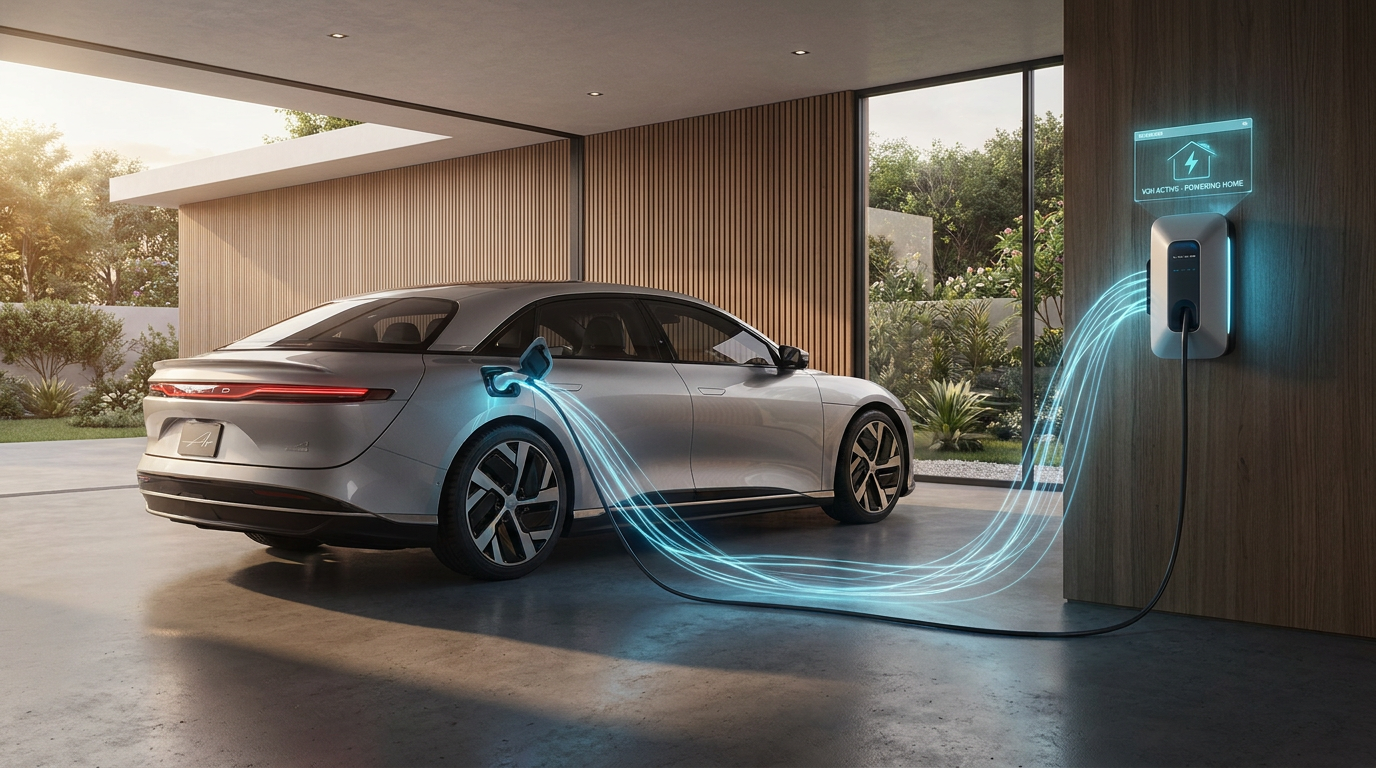
For the first decade of the electric vehicle revolution, the relationship between the car and the electrical grid was strictly a one-way street. Drivers plugged their vehicles into the wall, drew power until the battery was full, and drove away. But as battery capacities have swelled and power electronics have miniaturized, a fundamental shift is occurring in how we conceptualize the automobile. In 2026, the EV is no longer just a consumer of electricity; it is a mobile, high-capacity energy storage node.[1]
This transformation is driven by the rapid standardization of bidirectional charging—a technology that allows power to flow both into the vehicle and back out of it. Often categorized into Vehicle-to-Home (V2H) and Vehicle-to-Grid (V2G) applications, bidirectional capability is transitioning from a niche luxury feature to a baseline expectation for new electric vehicles.[7]
The sheer scale of energy stored in a modern EV makes this capability highly practical. The average American home consumes roughly 28 kilowatt-hours of electricity per day. Meanwhile, the battery packs in 2026 electric trucks and SUVs routinely range from 100 to 130 kilowatt-hours, with standard sedans carrying 60 to 80 kilowatt-hours.[2]
Mathematically, this means a fully charged electric pickup truck parked in a driveway holds enough energy to power a typical household for three to four days during a blackout, without requiring a drop of gasoline or a noisy backup generator.[1]

To understand how this works, one must look at the conversion of electrical currents. The power grid and household appliances operate on alternating current, while batteries store energy as direct current. The bridge between these two systems is the inverter.[3]
When charging a standard EV, an onboard inverter converts the grid's alternating current into direct current to fill the battery. Bidirectional charging requires the system to perform the reverse operation—taking the battery's direct current, converting it back to alternating current, and pushing it out at the correct voltage and frequency to safely operate a refrigerator, HVAC system, or the broader electrical grid.[3]
Historically, this required proprietary, highly expensive wall equipment specific to each automaker. However, the industry has recently coalesced around the ISO 15118 standard, a universal communication protocol that allows any compatible EV to negotiate power flow with any compliant smart charger. This interoperability is the linchpin of the 2026 rollout, ensuring consumers aren't locked into a single brand's hardware ecosystem.[1][3]
For most consumers, the immediate appeal of bidirectional charging is resilience. As extreme weather events increasingly strain aging electrical grids, home backup power has become a premium commodity for homeowners looking to protect their families from extended outages.[2]
For most consumers, the immediate appeal of bidirectional charging is resilience.
Previously, homeowners seeking energy independence had to purchase dedicated stationary wall batteries, which typically store only 10 to 14 kilowatt-hours and cost thousands of dollars. By unlocking the massive battery already sitting in the garage, Vehicle-to-Home technology effectively renders the standalone home battery obsolete for EV owners.[7]

Beyond individual home backup, policymakers and utility companies are eyeing a much larger prize: Vehicle-to-Grid integration. This application allows utilities to tap into the collective storage capacity of thousands of plugged-in EVs during moments of peak demand, effectively using civilian vehicles to balance the grid.[4]
During a late-summer heatwave, when air conditioners threaten to overwhelm the grid, a utility can send a digital signal to participating EVs. The vehicles temporarily stop charging and instead discharge a small percentage of their stored energy back into the network to prevent rolling blackouts.[4]
These aggregated vehicles act as a Virtual Power Plant. In exchange for allowing the utility to borrow a fraction of their battery capacity, EV owners are compensated financially, effectively turning their parked cars into revenue-generating assets that pay for their own charging costs.[6]
The primary consumer hesitation surrounding bidirectional charging is battery degradation. Lithium-ion batteries degrade slightly with every charge and discharge cycle, leading to concerns that powering a home or supporting the grid will prematurely wear out an expensive vehicle battery.[5]
However, recent longitudinal studies suggest these fears are largely overstated when the system is managed correctly. Because home and grid applications typically draw power at a very low, steady rate compared to the massive power spikes required for highway driving, the thermal stress on the battery cells is minimal.[5]

Furthermore, smart software limits the depth of discharge. The system ensures the car never drops below a user-defined threshold—such as 40 percent—so the driver is never left stranded without enough range for their morning commute or an unexpected emergency.[1][5]
Despite the technological readiness, significant friction remains in the deployment phase. The bidirectional chargers required to facilitate this power flow are still expensive, often ranging from $1,500 to $4,000, not including the cost of professional electrical installation and necessary home panel upgrades.[7]
Additionally, connecting a power-generating asset to the grid requires an interconnection agreement with the local utility. In many jurisdictions, this bureaucratic process remains sluggish, with utilities struggling to update their legacy frameworks to accommodate thousands of residential micro-generators.[6]

To force the issue, states like California have begun implementing aggressive policy mandates. Energy commissions have strongly signaled that bidirectional capability will soon be a requirement for all new EVs sold in key markets, pushing automakers to standardize the necessary onboard hardware.[4]
As the hardware costs fall and utility regulations adapt, the electric vehicle is poised to become the most critical component of the 21st-century smart home. By seamlessly bridging the gap between transportation and energy infrastructure, bidirectional charging is quietly rewiring the economics of renewable power.[1][6]
How we got here
2014
Early EVs like the Nissan Leaf introduce limited bidirectional capability using the CHAdeMO standard.
2022
The Ford F-150 Lightning launches with proprietary Intelligent Backup Power, popularizing the concept of the truck as a home battery.
2024
The ISO 15118-20 standard is finalized, creating a universal communication protocol for bidirectional power flow.
2026
Major automakers adopt universal Vehicle-to-Home capabilities as a standard feature on new models, moving away from proprietary hardware.
Viewpoints in depth
Grid Operators & Utilities
Utilities view bidirectional EVs as a massive, untapped resource to stabilize the grid and integrate renewable energy.
For grid operators, the transition to renewable energy presents a massive storage problem: solar and wind power are intermittent, requiring massive batteries to store energy for when the sun sets or the wind dies down. Instead of spending billions to build utility-scale battery farms, operators see the millions of EVs sitting in driveways as a decentralized solution. By networking these vehicles into Virtual Power Plants, utilities can absorb excess solar power during the day and draw it back during the evening peak, fundamentally altering the economics of grid management.
Automakers & Battery Engineers
Manufacturers are balancing the consumer appeal of home backup with the technical realities of battery chemistry and warranty liabilities.
Automakers recognize that bidirectional charging is a powerful selling point, but they approach the technology with caution regarding warranty exposure. Because they guarantee battery performance for up to a decade, engineers must ensure that V2G applications do not accelerate chemical degradation. Consequently, manufacturers are implementing strict software guardrails—limiting the maximum discharge rate and capping how much energy the grid can pull—to ensure the battery's primary function as a transportation power source is never compromised.
Consumer Advocates
Advocates champion the resilience benefits but warn about the high upfront costs and complex installation processes.
While the prospect of energy independence is highly appealing, consumer groups point out that the transition is not yet seamless. The hardware required to safely disconnect a home from the grid and draw power from a car remains expensive, and navigating the permitting process with local utilities can be daunting for the average homeowner. Advocates are pushing for streamlined interconnection rules and state-level rebates to ensure that the benefits of bidirectional charging are accessible to all EV owners, not just early adopters with disposable income.
What we don't know
- How quickly local utility companies will update their legacy interconnection rules to allow widespread residential V2G participation.
- Whether the financial compensation offered by utilities for grid support will be high enough to incentivize mass consumer enrollment in Virtual Power Plants.
Key terms
- V2H (Vehicle-to-Home)
- The process of using an electric vehicle's battery to supply power to a single residence, typically during a blackout.
- V2G (Vehicle-to-Grid)
- The process of discharging electric vehicle battery power back into the broader electrical grid to help balance supply and demand.
- Inverter
- A device that converts direct current (DC) stored in a battery into the alternating current (AC) used by household appliances and the power grid.
- Virtual Power Plant (VPP)
- A cloud-based network of decentralized energy resources, such as plugged-in EVs, that collectively act as a single power plant to support the grid.
- ISO 15118
- The international standard for digital communication between electric vehicles and charging stations, enabling plug-and-charge and bidirectional power flow.
Frequently asked
Will powering my home ruin my car's battery?
Studies show minimal degradation because home power draw is very low compared to driving. Smart software also prevents the battery from draining completely, protecting its long-term health.
Do I need special equipment to use bidirectional charging?
Yes. You need a compatible bidirectional home charger and an interconnection switch to safely disconnect your home from the grid during an outage.
Can any electric vehicle do this?
While older models cannot, most new EVs released in 2026 support standardized bidirectional charging protocols, making it a widespread feature.
Sources
Source coverage
7 outlets
3 viewpoints surfaced







[1]Factlen Editorial TeamBattery Technologists
Synthesis by Factlen editorial team
Read on Factlen Editorial Team →[2]U.S. Department of EnergyEnergy Infrastructure Planners
Bidirectional Charging and Vehicle-to-Grid Integration
Read on U.S. Department of Energy →[3]IEEE SpectrumAutomotive Industry
How ISO 15118 is Unlocking the Vehicle-to-Grid Revolution
Read on IEEE Spectrum →[4]California Energy CommissionEnergy Infrastructure Planners
Vehicle-to-Grid (V2G) Technology and Policy
Read on California Energy Commission →[5]MIT Technology ReviewBattery Technologists
Does Powering Your Home Ruin Your EV Battery? The Data Says No.
Read on MIT Technology Review →[6]Wood MackenzieEnergy Infrastructure Planners
The Rise of EV-Based Virtual Power Plants in 2026
Read on Wood Mackenzie →[7]Kelley Blue BookAutomotive Industry
What Is Bidirectional Charging and Which EVs Have It?
Read on Kelley Blue Book →

Every angle. Every day.
Get technology stories with full source coverage and perspective breakdowns delivered to your inbox.