
The Science of Tangzhong: How a Simple Flour Paste Transforms Home Baking
By pre-cooking a small fraction of flour and water, bakers can permanently lock moisture into their dough, creating incredibly soft bread that resists staling for days.
By Factlen Editorial Team
- Home Baking Advocates
- Prioritizing accessibility, recipe versatility, and sensory results.
- Food Scientists
- Focusing on the chemical mechanisms of starch gelatinization and retrogradation.
- Commercial Bakery Operators
- Valuing shelf-life extension, cost reduction, and production scalability.
What's not represented
- · Gluten-free bakers adapting the gelatinization method for alternative flours.
- · Traditional European artisan bakers who rely strictly on autolyse and fermentation for crumb texture.
Why this matters
Understanding the mechanics of starch gelatinization allows home cooks to achieve bakery-tier softness and extended shelf life without relying on chemical preservatives or excessive amounts of butter.
Key points
- Pre-cooking a small portion of flour and water to 150°F (65°C) forces starch granules to swell and permanently trap moisture.
- This trapped moisture allows dough to hold significantly more water without becoming sticky, resulting in a lighter, fluffier crumb.
- The gelatinized paste delays retrogradation, the chemical process that causes bread to stale, keeping loaves soft for days.
- Tangzhong uses a 1:5 ratio cooked on a stove, while Yudane uses a 1:1 ratio mixed with boiling water.
- The technique is vegan-friendly and can replace the need for heavy fats or commercial dough conditioners in home baking.
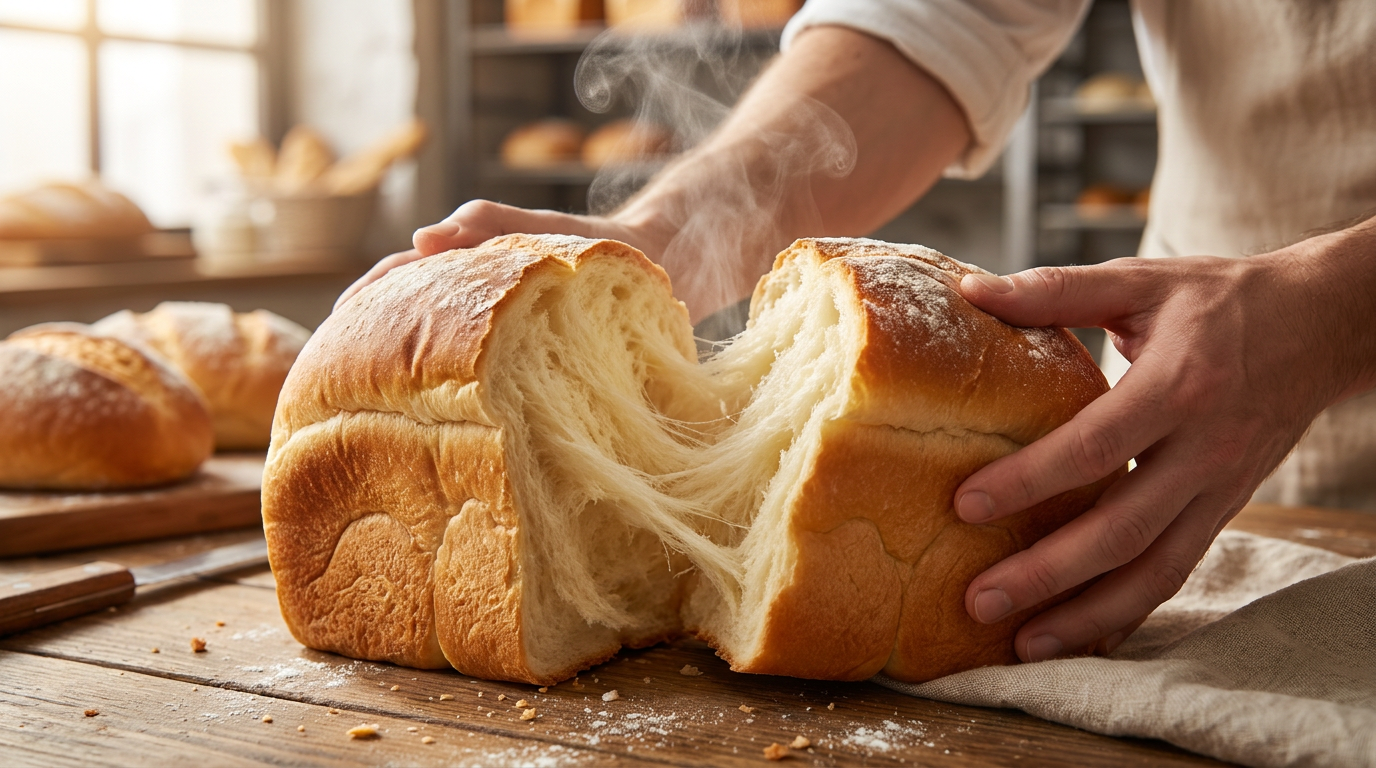
Start with the sensory experience of Hokkaido milk bread—cloud-like, feathery, and miraculously soft days after baking. For years, Western bakers relied on heavy enrichments like butter, oil, and egg yolks to achieve tender crumbs, yet these traditional loaves still staled relatively quickly on the counter. The secret behind the enduring softness of Asian bakery staples is not a chemical preservative or a specialized industrial oven, but a simple mechanical manipulation of flour and water known as the tangzhong or yudane method. By fundamentally altering how the dough absorbs and retains moisture, this accessible technique has revolutionized both commercial production and home baking.[1][4]
At its core, the technique relies on a chemical process called starch gelatinization. When raw wheat flour is mixed with room-temperature water, its proteins bind together to form gluten, but its starches remain relatively inert and crystalline. However, when a portion of that flour is heated with liquid to approximately 150°F (65°C), the starch granules physically swell and burst. In this heated state, the starches can absorb up to twice as much liquid as they normally could, creating a viscous, pudding-like paste that traps moisture permanently within a gel structure.[2][3]
To understand why heat is necessary, it helps to compare this pre-cooking method to another popular baking technique: the autolyse. In a standard autolyse, bakers mix raw flour and warm water, letting it rest to hydrate the proteins and develop gluten passively. During this rest, the starches only absorb water superficially. Scalding the flour, by contrast, forces the hot water directly into the starch molecules, leaving the gluten-forming proteins—gliadin and glutenin—temporarily deprived of the water they need to form strong, rubbery networks. This prevents the dough from becoming overly chewy during the initial mixing phase.[5]

By pre-cooking just 5% to 10% of the total flour in a recipe, bakers fundamentally alter the dough's overall hydration capacity. The gelatinized paste holds onto its trapped water so tightly that the resulting dough feels smooth, cohesive, and highly workable, even though its total water content is significantly higher than a standard loaf. During the baking process, this trapped moisture converts to steam from within the dough structure, creating a dramatic oven spring and yielding a remarkably open, fluffy interior crumb that feels impossibly light.[4][5]
The scientific literature confirms the structural and longevity benefits of this trapped moisture. According to studies published in food science journals like LWT, the addition of pre-gelatinized flour directly impacts dough rheology—the scientific measure of how the dough flows, stretches, and deforms. The swollen starches act similarly to natural gums, increasing dough strength while simultaneously delaying retrogradation. Retrogradation is the inevitable crystallization process that causes bread starches to harden and stale over time; by locking the moisture into a gel, the staling process is dramatically slowed.[3][6]
The scientific literature confirms the structural and longevity benefits of this trapped moisture.
While the underlying chemistry is identical, bakers generally divide the pre-gelatinization technique into two distinct camps: tangzhong and yudane. Tangzhong, a Chinese technique that was widely popularized across Japanese and Taiwanese bakeries, involves whisking flour and liquid—usually milk or water—at a 1-to-5 ratio over a stovetop until it thickens into a glossy paste. Because the mixture is actively cooked, it requires careful temperature control to ensure it reaches 150°F without scorching. This method produces a highly delicate, feathery crumb that is ideal for milk rolls, Swiss rolls, and soft sandwich loaves.[4][7]

Yudane, originating in Japan, takes a slightly different and more passive approach to achieving the same chemical result. Instead of continuous stovetop cooking, boiling water is poured directly over raw flour at a 1-to-1 ratio, mixed rapidly into a stiff, dough-like paste, and left to rest—often overnight in the refrigerator. Because the boiling water rapidly activates naturally occurring amylase enzymes within the flour, the yudane method breaks down some of the complex starches into simple sugars. This yields a crumb that is subtly sweeter and possesses a chewy, mochi-like resilience that tangzhong lacks.[2][7]
For commercial bakery operators, the choice between the two methods often comes down to production logistics and scale. Yudane is frequently favored in mass manufacturing environments because pouring boiling water from an industrial tank directly into a commercial mixer is vastly easier and more consistent than cooking a massive slurry on a stovetop. Furthermore, the extended shelf life provided by either method allows commercial bakers to significantly reduce the fat content in their formulas without sacrificing the bread's signature softness, representing a major cost-saving measure at scale.[2]
Despite the proven benefits, there is some uncertainty regarding the exact hydration math when home bakers adapt standard recipes to use a cooked roux. Because tangzhong requires several minutes of active stovetop cooking, a variable amount of water evaporates during the process, depending on the heat level and the surface area of the pan. Home baking educators note that this unmeasured evaporation can alter the final dough consistency if not carefully compensated for, leading some to prefer the yudane method, which traps all the boiling water under a tight cover with virtually zero evaporation.[4][7]

Ultimately, the pre-gelatinization technique represents a paradigm shift for home bakers looking to improve their daily loaves without relying on complex additives. Because the method relies entirely on the mechanical manipulation of water and flour, it offers a powerful, vegan-friendly dough improver that eliminates the need for commercial dough conditioners or excessive dairy enrichments. By simply borrowing a fraction of a recipe's existing flour and water for a brief pre-cook, bakers can unlock bakery-tier softness and longevity from a standard home kitchen.[1][4]
The versatility of the water-roux method extends far beyond traditional Asian milk bread. Modern bakers are increasingly applying tangzhong and yudane to whole wheat loaves, rustic sourdoughs, and even heavily enriched holiday doughs like brioche and panettone. Because whole grains typically yield denser, drier crumbs that stale rapidly, the moisture-locking properties of the gelatinized paste help counteract the heavy bran. This results in a lighter, more palatable whole-grain loaf that maintains its fresh, tender texture for nearly a week on the counter.[1][6]
How we got here
Post-WWII
Wheat replaces rationed rice in Japan, sparking innovations in bread-making to suit local palates.
2000s
The tangzhong method gains widespread popularity across Asia, becoming the standard for Hokkaido milk bread.
2010s
Western home bakers and culinary blogs adopt the water-roux method to improve the shelf life of sourdough and sandwich loaves.
Viewpoints in depth
Food Scientists' View
Focusing on the chemical mechanisms of starch gelatinization and retrogradation.
For culinary scientists and researchers, the water-roux method is a masterclass in manipulating dough rheology. By forcing starch granules to swell and burst at 150°F, bakers fundamentally alter the water-holding capacity of the flour. This trapped moisture acts as a physical barrier against retrogradation—the crystallization of starches that causes staling. Researchers note that this mechanical intervention achieves what commercial bakeries typically rely on chemical dough conditioners to do, making it a subject of intense study in food technology.
Home Baking Advocates' View
Prioritizing accessibility, recipe versatility, and sensory results.
Baking educators and enthusiasts view tangzhong and yudane as empowering tools that democratize bakery-quality bread. Rather than requiring expensive steam-injected ovens or complex chemical additives, the technique uses ingredients already present in the recipe. Advocates emphasize the sensory payoff: a feathery, cloud-like crumb that remains soft for days. They often debate the practical merits of the two methods, noting that while yudane requires less active stovetop time, tangzhong offers a slightly fluffier texture that is easier to incorporate into a final dough.
Commercial Bakery Operators' View
Valuing shelf-life extension, cost reduction, and production scalability.
At the industrial scale, the pre-gelatinization technique is evaluated through the lens of efficiency and margins. Commercial operators heavily favor the yudane method because pouring boiling water from a tank into an industrial mixer is vastly more scalable than cooking a slurry. Furthermore, because the gelatinized starches keep the bread softer for longer, manufacturers can reduce the amount of expensive fats—like butter and oil—in their formulas, lowering production costs while extending the product's retail shelf life.
What we don't know
- The exact amount of water that evaporates during the stovetop cooking of tangzhong varies by kitchen, making precise hydration math difficult.
- While the technique improves whole-grain and sourdough loaves, the optimal percentage of pre-gelatinized flour for non-wheat flours remains highly variable.
Key terms
- Starch Gelatinization
- The process where starch granules swell and burst when heated in liquid, permanently trapping moisture.
- Retrogradation
- The chemical process where starch molecules crystallize after baking, causing bread to stale and harden.
- Rheology
- The study of how matter flows and deforms; in baking, it refers to the elasticity and extensibility of dough.
- Autolyse
- A resting period for dough where flour and water are mixed before adding yeast or salt, allowing gluten to develop passively.
Frequently asked
Can I use the tangzhong method with any bread recipe?
Yes. You can adapt almost any yeast bread recipe by taking 5% to 10% of the total flour and cooking it with five times its weight in liquid from the recipe.
Does tangzhong make bread taste sweeter?
While it doesn't add sugar, the yudane method in particular activates amylase enzymes that break down starches into simple sugars, subtly enhancing the bread's natural sweetness.
Can I use milk instead of water for the roux?
Absolutely. Milk is commonly used in Hokkaido milk bread to add richness and fat, though water works perfectly for vegan or leaner loaves.
Why did my tangzhong turn into a hard rubbery lump?
Cooking the paste past 150°F (65°C) or using too high of a heat can cause the starches to over-coagulate and dry out. It should be removed from heat as soon as lines form in the paste.
Sources
Source coverage
7 outlets
3 viewpoints surfaced







[1]Factlen Editorial TeamCommercial Bakery Operators
Synthesis by Factlen editorial team
Read on Factlen Editorial Team →[2]Institute of Culinary EducationFood Scientists
Tangzhong Method: A Revolutionary Baking Technique
Read on Institute of Culinary Education →[3]BakerpediaFood Scientists
Tangzhong Method | Baking Processes
Read on Bakerpedia →[4]The Perfect LoafHome Baking Advocates
How to Make Tangzhong (and Yudane)
Read on The Perfect Loaf →[5]American Society of BakingFood Scientists
Tangzhong Method
Read on American Society of Baking →[6]LWT - Food Science and TechnologyFood Scientists
The effect of the addition of gelatinized flour on dough rheology and quality of bread
Read on LWT - Food Science and Technology →[7]ChainBakerHome Baking Advocates
Tangzhong vs Yudane, What is the Difference?
Read on ChainBaker →

Every angle. Every day.
Get food drink stories with full source coverage and perspective breakdowns delivered to your inbox.