
The Science of Starch Gelatinization: How Tangzhong and Yudane Transform Bread
By pre-cooking a small portion of flour and water, bakers can manipulate starch molecules to hold significantly more moisture. This simple chemical shift produces ultra-soft bread that stays fresh for days without artificial additives.
By Factlen Editorial Team
- Culinary Science
- Focuses on the chemical mechanisms of starch gelatinization, dough rheology, and retrogradation.
- Home Baking
- Focuses on the practical application of the methods, recipe adaptation, and achieving bakery-quality texture at home.
- Commercial Baking
- Values the techniques for naturally extending shelf life and improving product volume without the use of artificial dough conditioners.
What's not represented
- · Nutritional scientists studying the digestibility of pre-gelatinized starches.
- · Gluten-free bakers attempting to adapt the moisture-retaining principles without wheat starch.
Why this matters
Understanding the science behind these methods empowers home bakers to achieve bakery-level results without commercial dough conditioners. It transforms a frustrating, error-prone process into a predictable chemical reaction, saving time and reducing food waste by naturally extending the bread's shelf life.
Key points
- The tangzhong and yudane methods involve pre-cooking a portion of a bread recipe's flour and liquid.
- Heating the flour above 65°C triggers starch gelatinization, allowing the granules to absorb massive amounts of water.
- This trapped moisture creates a dramatically softer crumb and increases the dough's overall hydration capacity.
- By slowing down starch retrogradation, these methods naturally extend the bread's shelf life without chemical preservatives.
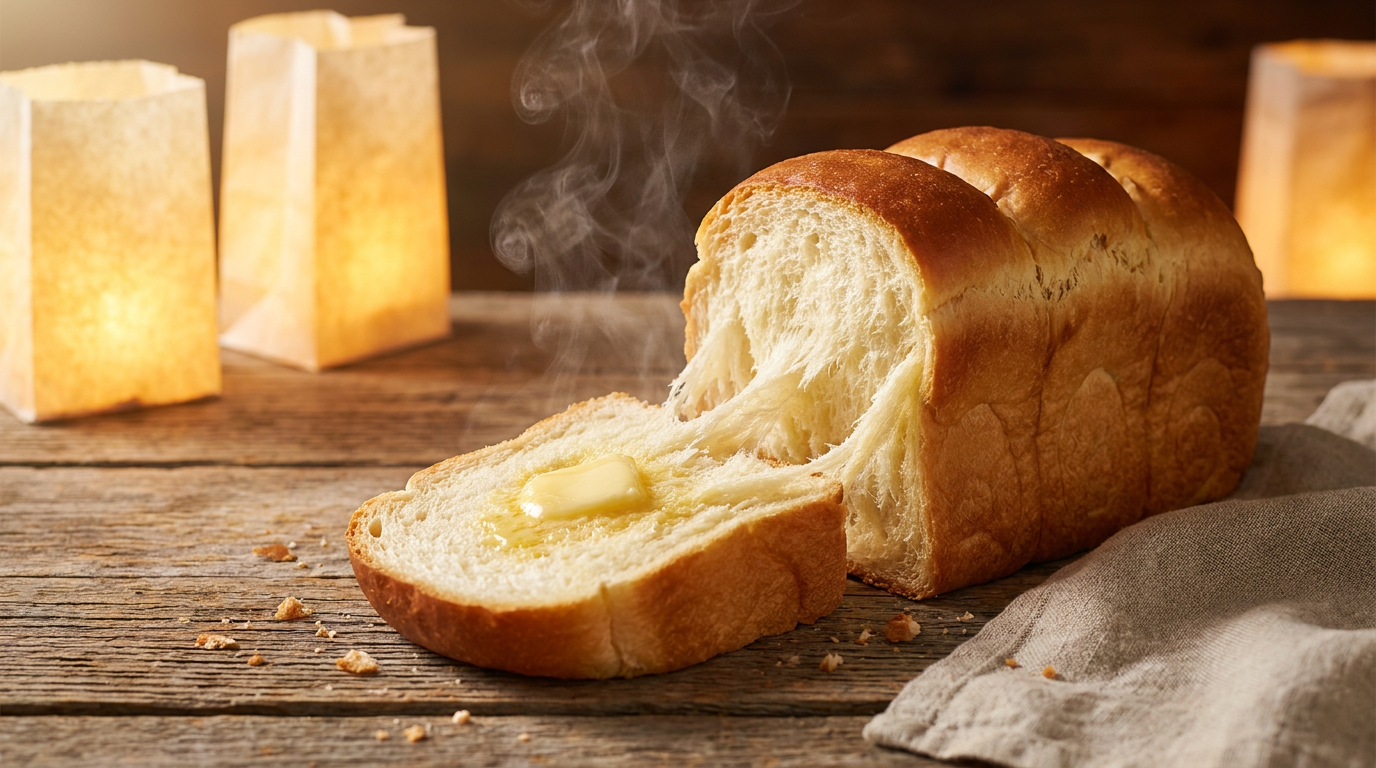
Home baking often hits a wall when trying to replicate the impossibly soft, pillowy texture of Asian bakery staples like Hokkaido milk bread. The secret to this feathery crumb isn't a complex chemical additive or a specialized commercial oven, but a simple, centuries-old manipulation of heat and water.[6]
Enter the tangzhong and yudane methods. These techniques involve pre-cooking a small portion of a recipe's flour and liquid before incorporating it into the main dough. While the extra step takes only minutes, it fundamentally alters the chemistry of the dough, allowing it to hold significantly more moisture than traditional European baking methods.[3][4]
To understand why this works, it is necessary to look at the microscopic structure of wheat flour. After gluten, starch is the second most significant component of wheat flour, making up roughly 70 to 85 percent of its composition. In its raw, native state, this starch is partially crystalline and highly organized.[1][7]
When raw flour is mixed with room-temperature water, its starch granules only absorb about 30 to 40 percent of their dry weight in moisture. The granules swell slightly and settle, but their crystalline structure remains largely intact, limiting how much liquid the dough can handle before becoming an unworkable, sticky mess.[1][5]

However, when heat is introduced—specifically above 65°C (150°F)—a process called starch gelatinization begins. Starch gelatinization is the irreversible loss of the molecular order of the starch granules. As the temperature rises, the granules imbibe massive amounts of water, swell dramatically, and eventually burst, creating a highly viscous, gel-like slurry.[1][3][5]
By pre-gelatinizing a portion of the flour via tangzhong or yudane, bakers can force the dough to hold significantly more water than it normally could. A standard bread dough might max out at 60 percent hydration. With a cooked roux, hydration can easily exceed 70 percent, yet the dough remains smooth, cohesive, and easy to knead because the water is trapped within the swollen starch matrix.[2][4]
While both methods rely on the exact same underlying chemistry, their execution and final textural results differ slightly. The tangzhong method, which gained worldwide popularity in the 1990s, involves cooking flour and liquid—usually at a 1:5 ratio—on a stovetop until it forms a thick, gluey paste.[3][4]
While both methods rely on the exact same underlying chemistry, their execution and final textural results differ slightly.
The yudane method, which originated in Japan, is even simpler and requires no active cooking. It uses a 1:1 ratio of flour to boiling water. The boiling liquid is poured directly over the flour, stirred into a shaggy dough, and left to cool and gelatinize, often resting overnight in the refrigerator.[3][4]

The choice between the two methods dictates the final crumb of the bread. Tangzhong produces a lighter, more delicate, and intensely fluffy bread, often compared to a brioche but without the heavy reliance on butter and eggs. Yudane, on the other hand, yields a crumb that is slightly denser, moister, and more resilient, often described as having a chewy, mochi-like bite.[4]
The benefits of this trapped moisture extend directly into the baking process itself. As the dough hits the hot oven, the trapped water turns to steam, creating a dramatic oven spring that pushes the loaf higher and creates a more open, airy interior.[2][3]
Simultaneously, the pre-gelatinized starch provides crucial structural support. As the oven heat weakens the dough's gluten network, the increasingly viscous starch gel steps in to hold the expanding gas bubbles, preventing the bread from collapsing as it sets.[5]
Beyond texture and volume, the most significant advantage of these methods is their impact on shelf life. Bread goes stale not just because it dries out, but because of starch retrogradation—the chemical process where gelatinized starches cool and slowly recrystallize, turning the crumb hard and crumbly.[6]

Because tangzhong and yudane doughs hold onto water so tenaciously, they drastically slow down this retrogradation process. A standard homemade white loaf might taste stale by day two, but a milk bread baked with a cooked roux can remain soft, springy, and fresh for several days at room temperature.[2][3][4]
While these techniques are synonymous with Asian milk breads and sweet rolls, their utility is not limited to specific recipes. Bakers are increasingly adapting the tangzhong method to whole wheat breads, which are notoriously dry, and even sourdough loaves to tenderize the crumb and extend freshness.[6]
However, the method does require some technical adjustments. Because the roux locks up a portion of the flour's protein, it can slightly dilute the overall gluten strength of the dough. Bakers must compensate by kneading the dough longer to fully develop the remaining gluten, ensuring the bread has enough structure to support its increased moisture content.[2][6]

Ultimately, the tangzhong and yudane methods represent a perfect intersection of culinary tradition and food science. By understanding the thermal properties of starch, bakers can bypass the need for commercial dough conditioners, achieving professional-level softness and longevity with nothing more than flour, water, and heat.[6]
How we got here
1800s
The yudane method begins to take shape in Japan as bakers experiment with scalding flour to create softer breads.
Post-WWII
A cultural exchange between European cooks and Japanese bakers in Hokkaido leads to the refinement of milk bread techniques.
1990s
Taiwanese author Yvonne Chen publishes '65°C Bread Doctor', popularizing the tangzhong method across Asia and eventually globally.
2010s–Present
The techniques gain massive popularity in Western home baking communities as a natural way to achieve ultra-soft crumb structures.
Viewpoints in depth
Culinary Scientists
Food scientists view tangzhong and yudane primarily as mechanisms for altering dough rheology through starch pre-gelatinization.
From a scientific perspective, the focus is on the irreversible loss of crystalline structure in starch granules. Researchers note that by pre-gelatinizing a portion of the flour, the dough's overall water-holding capacity increases exponentially. This not only changes the viscosity of the dough during the baking process but fundamentally alters the rate of starch retrogradation, which is the primary chemical driver of bread staling.
Home Bakers
Home bakers value these methods as accessible techniques to achieve professional-level softness without specialized equipment.
For the home baking community, tangzhong and yudane are practical solutions to the common problem of dense, dry homemade bread. Enthusiasts often debate the minor textural differences between the two—preferring tangzhong for delicate milk breads and yudane for chewier rolls. The appeal lies in the simplicity: using only standard pantry ingredients and a stovetop, home bakers can replicate the feathery crumb of commercial Asian bakeries.
Commercial Bakeries
Commercial producers utilize these techniques to naturally extend shelf life and improve product consistency.
In commercial settings, the primary draw of these methods is their ability to act as natural dough improvers. By trapping more moisture in the crumb, bakeries can significantly extend the shelf life of their products without relying on artificial preservatives or chemical conditioners. While tangzhong requires active cooking that can be difficult to scale, the yudane method—which simply requires pouring boiling water over flour—is frequently adopted in mass production for its operational efficiency.
What we don't know
- Whether the exact ratio of amylose to amylopectin in different wheat varieties significantly alters the optimal tangzhong cooking temperature.
- The precise long-term impact of pre-gelatinized starch on the glycemic index of the baked bread compared to traditional methods.
Key terms
- Starch Gelatinization
- The process where starch granules are heated in water, causing them to swell, lose their crystalline structure, and absorb massive amounts of liquid.
- Tangzhong
- A Chinese technique of cooking a portion of a bread recipe's flour and liquid into a paste to increase moisture retention and softness.
- Yudane
- A Japanese technique of pouring boiling water over a portion of flour to gelatinize the starches, resulting in a chewy, moist bread.
- Retrogradation
- The chemical process where gelatinized starches cool and slowly recrystallize over time, causing bread to become hard and stale.
- Hydration
- The ratio of liquid to flour in a bread dough, expressed as a percentage of the flour's total weight.
Frequently asked
Can I use the tangzhong method with any bread recipe?
Yes, but it requires recalculating the hydration. You typically take 5 to 10 percent of the recipe's total flour and mix it with five times its weight in liquid from the recipe to create the roux.
Does tangzhong make bread taste sweeter?
It can subtly enhance sweetness. The gelatinization process makes the starches more accessible to amylase enzymes, which break them down into simple sugars during fermentation.
Why is my tangzhong dough so sticky?
While tangzhong doughs hold more water, the gelatinized paste should actually make the dough feel smoother. If it is unmanageably sticky, the roux may not have been cooked to the proper temperature (65°C) to fully absorb the liquid.
Can I substitute water for milk in the roux?
Yes. Both water and milk will successfully gelatinize the starch. Milk adds additional fat and sugars, which further tenderize the crumb and enhance browning, but water works perfectly for the chemical process.
Sources
Source coverage
7 outlets
3 viewpoints surfaced







[1]BAKERpediaCulinary Science
Starch Gelatinization | Baking Processes
Read on BAKERpedia →[2]American Society of BakingCulinary Science
Tangzhong Method
Read on American Society of Baking →[3]ChainBakerHome Baking
Tangzhong & Yudane Explained, Bread Improvers
Read on ChainBaker →[4]Severn BitesHome Baking
Japanese Milk Bread. Yudane vs Tangzhong
Read on Severn Bites →[5]KPM AnalyticsCulinary Science
Starch Gelatinization: When Heat and Water Activate Flour
Read on KPM Analytics →[6]Factlen Editorial TeamCommercial Baking
Synthesis by Factlen editorial team
Read on Factlen Editorial Team →[7]Milling Middle East & Africa MagazineCommercial Baking
STARCH: The Architect of Baked Products
Read on Milling Middle East & Africa Magazine →
Every angle. Every day.
Get food drink stories with full source coverage and perspective breakdowns delivered to your inbox.