
The Science of Sleep Trackers: Which Wearables Actually Work in 2026?
Consumer sleep trackers have improved dramatically, but independent validation studies reveal a persistent gap between their marketing claims and clinical reality. While devices like the Oura Ring and Apple Watch excel at measuring total sleep time, their ability to accurately map specific sleep stages remains scientifically contested.
By Factlen Editorial Team
- Clinical Sleep Researchers
- Prioritize polysomnography (PSG) as the only true measure of sleep architecture, warning against the diagnostic use of consumer wearables and the rise of orthosomnia.
- Wearable Manufacturers
- Emphasize the value of continuous, longitudinal data over single-night clinical precision, highlighting advanced multi-sensor algorithms and actionable lifestyle coaching.
- Quantified Self Advocates
- Value the behavioral changes driven by daily tracking, using directional trends in HRV and sleep duration to optimize athletic recovery and daily habits.
What's not represented
- · Individuals with severe clinical insomnia
- · Low-income consumers priced out of premium subscription wearables
Why this matters
Millions of consumers rely on daily sleep scores to dictate their routines, training loads, and health anxiety. Understanding the clinical evidence behind these devices prevents an unhealthy obsession with imperfect data and helps users choose the right tool for their actual needs.
Key points
- Consumer wearables are highly accurate at detecting total sleep time, typically falling within 15 to 30 minutes of clinical polysomnography.
- Most wrist and ring-based trackers struggle with sleep staging, achieving only 60% to 70% accuracy for deep and REM sleep.
- Ring-based trackers generally capture cleaner pulse signals than smartwatches, leading to slightly better non-EEG accuracy.
- The FDA recently cleared flagship smartwatches from Apple and Samsung to screen for moderate-to-severe sleep apnea.
The modern consumer wearable has evolved far beyond a simple pedometer. In 2026, devices like the Oura Ring, Apple Watch, and Whoop band promise to decode the mysteries of our unconscious hours, offering granular breakdowns of light, deep, and REM sleep. Millions of users now wake up and immediately check their "sleep score" before deciding how to approach their day, trusting these algorithms to quantify their recovery.[2][3]
But as the market for sleep tech expands, clinical researchers are increasingly testing these consumer claims against the gold standard of sleep medicine: polysomnography (PSG). PSG requires a patient to sleep in a clinical lab while wired to an electroencephalogram (EEG) that measures brain wave activity, alongside respiratory and cardiac monitors. The fundamental scientific divide is that consumer wearables do not measure brain waves; they infer sleep stages by measuring peripheral signals like heart rate variability (HRV), skin temperature, and movement.[1][4]
When evaluating the evidence, the most robust claim consumer trackers can make is their ability to measure total sleep time. Across multiple independent validation studies, devices from Oura, Whoop, Apple, and Garmin demonstrate high sensitivity in detecting when a user is asleep versus awake. For the basic question of whether you slept for six hours or eight, the current generation of wearables is highly reliable, typically falling within a 15 to 30-minute error margin compared to clinical PSG.[4][6]
The consensus among sleep scientists is that this basic sleep-wake detection is the most clinically valuable metric these devices offer. By providing a frictionless way to track sleep duration over months and years, wearables help users identify chronic sleep deprivation—a major risk factor for cardiovascular disease and metabolic dysfunction. For longitudinal tracking of total rest, the evidence strongly supports the utility of wrist and ring-based trackers.[1][7]

However, the evidence significantly weakens when evaluating the boldest marketing claims: the precise mapping of sleep architecture. Most companion apps present users with a colorful hypnogram, dividing the night into distinct percentages of light, deep, and REM sleep. Independent validation studies consistently show that consumer wearables struggle with this task, achieving only 60% to 70% accuracy in identifying specific sleep stages when compared to EEG data.[4][5]
The difficulty stems from the biological limitations of wrist and finger sensors. While a drop in heart rate and a lack of movement often correlate with deep sleep, the autonomic nervous system's signals are noisy. A user lying perfectly still while awake in the middle of the night is frequently miscategorized as being in REM or light sleep by the device's accelerometer. Because they cannot see the distinct brain wave frequencies that define actual sleep stages, wearables are essentially making highly educated guesses.[1][4]
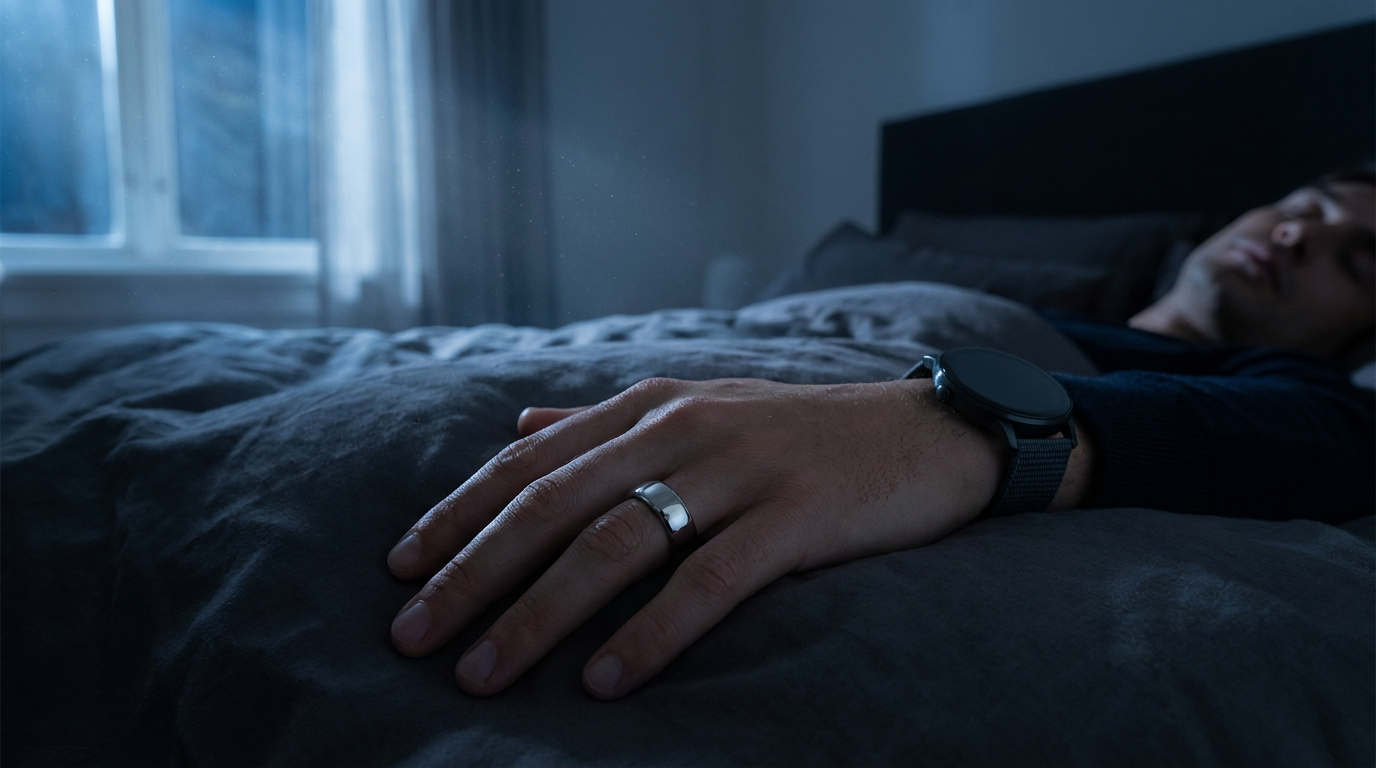
Within the wearable market, form factor plays a measurable role in accuracy. Recent comparative studies, including a 2024 evaluation by the National University of Singapore, found that ring-based trackers—specifically the Oura Ring Generation 4—outperform most wrist-based devices in non-EEG sleep staging. Because a ring sits flush against the finger, closer to the radial artery, it captures a cleaner, more consistent pulse signal than a smartwatch sliding around the wrist.[3][5]
Within the wearable market, form factor plays a measurable role in accuracy.
For users demanding the highest possible consumer-grade accuracy, the evidence points away from the wrist entirely. Devices like the Muse S Athena Headband, which utilize consumer-grade EEG sensors to measure actual brain activity, achieve 75% to 85% accuracy in sleep stage detection. However, these devices highlight the core tradeoff in sleep tech: the more accurate the sensor, the more intrusive it is to wear to bed.[2][7]

Another highly validated approach removes the wearable altogether. Under-mattress trackers, such as the Withings Sleep Analyzer, use pneumatic sensors and microphones to measure ballistocardiography—the mechanical movement of the heart and lungs. While slightly less granular for staging than top-tier rings, these devices excel at long-term compliance because the user does not have to remember to charge or wear a device.[2][3]
The most significant evidence-backed advancement in 2026 is the integration of sleep apnea screening. Both the Apple Watch Series 10 and the Samsung Galaxy Watch 7 recently secured FDA clearance for sleep apnea detection. Rather than diagnosing the condition outright, these devices monitor overnight breathing disturbances and flag moderate-to-severe respiratory patterns over a 30-day period, prompting users to seek a clinical evaluation.[3][7]
This shift from general "wellness tracking" to targeted medical screening represents the most promising public health application of consumer wearables. Sleep apnea affects millions of undiagnosed adults, and wrist-based screening tools with 87% sensitivity offer a massive, population-level triage system that was previously impossible.[1][7]
Despite these technological leaps, the psychological impact of sleep tracking remains a contested issue among medical professionals. Sleep clinics are increasingly treating patients for "orthosomnia"—an unhealthy obsession with achieving perfect sleep data. When a device erroneously reports a lack of deep sleep, the resulting anxiety can ironically cause the user to sleep worse the following night, creating a negative feedback loop driven by flawed data.[1][4]

To mitigate this, researchers advise consumers to fundamentally change how they interact with their wearable data. Instead of treating a single night's REM percentage as a clinical diagnosis, users should focus on multi-week trends. If a tracker consistently shows a baseline of 90 minutes of deep sleep, and that number drops to 45 minutes for a week during a period of high stress or alcohol consumption, the trend is informative even if the absolute numbers are imprecise.[4][6]
The software algorithms powering these devices are also evolving rapidly. Companies like Whoop and Oura continuously update their machine-learning models, training them against massive proprietary datasets of paired wearable and PSG data. As these algorithms become more sophisticated at filtering out motion artifacts and interpreting autonomic signals, the gap between consumer tech and clinical accuracy is slowly narrowing.[2][6]
Ultimately, the evidence suggests that the best sleep tracker is the one a user finds comfortable enough to wear consistently and whose data they can view without anxiety. While they cannot replace a clinical sleep study, modern wearables offer an unprecedented window into our behavioral patterns, proving highly effective at highlighting the undeniable links between daytime habits, alcohol consumption, and overnight recovery.[1][7]
How we got here
2012
Fitbit introduces basic movement-based sleep tracking to its consumer wristbands.
2018
Oura launches its Generation 2 ring, popularizing the use of HRV and temperature sensors for consumer sleep staging.
2021
Major validation studies begin highlighting the discrepancy between wearable sleep stage claims and clinical EEG data.
2024
Apple and Samsung secure FDA clearance for sleep apnea screening features on their flagship smartwatches.
Viewpoints in depth
Clinical Sleep Researchers
Prioritize polysomnography (PSG) as the only true measure of sleep architecture, warning against the diagnostic use of consumer wearables.
Medical professionals emphasize that sleep stages are fundamentally defined by brainwave activity, not heart rate. They argue that consumer wearables, by relying on peripheral autonomic signals, offer an illusion of precision. This camp frequently warns about the rise of 'orthosomnia,' where patients develop severe anxiety over their wearable's sleep scores, paradoxically worsening their actual sleep quality. They advocate for using wearables strictly for basic duration tracking rather than medical self-diagnosis.
Wearable Manufacturers
Emphasize the value of continuous, longitudinal data over single-night clinical precision.
The tech industry argues that while a clinical PSG is highly accurate, it is a highly artificial, one-night snapshot in an uncomfortable lab setting. Manufacturers contend that the true power of consumer wearables lies in continuous tracking over months and years. By utilizing advanced machine learning models trained on massive datasets, they argue their devices excel at identifying personal baselines and highlighting how lifestyle choices—like late meals or alcohol—negatively impact overnight recovery.
Quantified Self Advocates
Value the behavioral changes driven by daily tracking to optimize athletic recovery and daily habits.
This community of athletes and biohackers views sleep trackers as essential behavioral modification tools. They acknowledge the absolute error margins in sleep staging but argue that the directional trends are highly actionable. For this group, a drop in a device's 'recovery score' is a reliable signal to reduce training intensity or prioritize rest, proving the utility of the device regardless of its strict clinical accuracy against an EEG.
What we don't know
- How the proprietary algorithms of major wearable companies weigh specific biometric signals, as their exact machine-learning models remain closed-source.
- Whether long-term reliance on sleep scores definitively improves population-level health outcomes or merely increases health anxiety.
- How accurately next-generation optical sensors will be able to mimic the staging precision of clinical brainwave monitoring.
Key terms
- Polysomnography (PSG)
- A comprehensive clinical sleep study that records brain waves, oxygen levels, heart rate, and breathing to diagnose sleep disorders.
- Electroencephalogram (EEG)
- A test that measures electrical activity in the brain using small electrodes attached to the scalp, essential for accurately identifying sleep stages.
- Heart Rate Variability (HRV)
- The measure of the time variation between consecutive heartbeats, used by wearables to infer autonomic nervous system activity and recovery.
- Orthosomnia
- An unhealthy obsession with achieving perfect sleep metrics, often triggered by hyper-fixation on data from consumer sleep trackers.
- Sleep Architecture
- The cyclical pattern of sleep as it shifts between different stages, including light sleep, deep sleep, and REM sleep, throughout the night.
Frequently asked
Do I need a sleep tracker to improve my sleep?
No. While trackers can help identify behavioral patterns, maintaining a consistent sleep schedule, reducing alcohol intake, and limiting evening screen time are proven methods that do not require a device.
Why does my tracker say I got zero deep sleep?
Wearables infer deep sleep from heart rate and movement. If you have a naturally higher resting heart rate or move frequently, the device's algorithm may misinterpret your sleep stage, even if you are resting deeply.
Can a smartwatch diagnose sleep apnea?
No. Devices like the Apple Watch Series 10 are FDA-cleared to screen for breathing disturbances, but a formal diagnosis still requires a clinical evaluation by a medical professional.
Are smart rings more accurate than watches?
For sleep tracking, rings generally perform slightly better. Because they sit flush against the finger, they capture a cleaner pulse signal than a watch that may slide around the wrist during the night.
Sources
Source coverage
7 outlets
3 viewpoints surfaced







[1]National Institutes of HealthClinical Sleep Researchers
Validation of Consumer Sleep Tracking Devices
Read on National Institutes of Health →[2]Sleep FoundationWearable Manufacturers
Best Sleep Trackers of 2026
Read on Sleep Foundation →[3]Tom's GuideWearable Manufacturers
Best sleep trackers 2026: Tested and rated
Read on Tom's Guide →[4]The Curated WeeklyClinical Sleep Researchers
Consumer sleep trackers: What they get right and wrong against PSG
Read on The Curated Weekly →[5]National University of SingaporeClinical Sleep Researchers
Concurrent evaluation of consumer sleep trackers against EEG
Read on National University of Singapore →[6]JMIR mHealthQuantified Self Advocates
Systematic Review of Wearable Sleep Trackers
Read on JMIR mHealth →[7]Factlen Editorial TeamQuantified Self Advocates
Synthesis by Factlen editorial team
Read on Factlen Editorial Team →

More in shopping
See all 5 stories →

Every angle. Every day.
Get shopping stories with full source coverage and perspective breakdowns delivered to your inbox.