
The Science of Reading: How a Cognitive Revolution is Rewiring K-12 Literacy
After decades of debate, over 40 U.S. states have mandated a shift toward the 'science of reading,' replacing cue-based guessing with evidence-backed phonics and comprehension instruction. This structural overhaul aims to solve a long-standing literacy crisis by teaching children how the brain actually processes written language.
By Factlen Editorial Team
- Cognitive Scientists & Researchers
- Advocate for explicit, systematic instruction based on brain imaging and empirical data.
- Education Policymakers
- Focused on legislative mandates, standardized test scores, and curriculum overhauls.
- Dyslexia Advocates & Parents
- Grassroots drivers demanding instruction that works for neurodivergent and struggling readers.
What's not represented
- · Veteran teachers adjusting to new curriculum mandates
- · Publishers of legacy balanced-literacy materials
Why this matters
Reading proficiency by third grade is the single greatest predictor of high school graduation and lifelong success. This nationwide shift means millions of students will now receive instruction aligned with how the human brain actually learns to decode text, dramatically reducing the number of children who fall behind.
Key points
- Over 40 U.S. states have adopted policies requiring schools to use evidence-based reading instruction.
- The movement replaces 'balanced literacy' and cue-based guessing with explicit phonics and comprehension training.
- Cognitive science shows the human brain is not naturally wired to read; it requires systematic instruction.
- The 'Simple View of Reading' states that reading comprehension requires both decoding skills and language comprehension.
- Early-adopter states have seen significant gains in third-grade literacy rates after implementing these reforms.
For decades, American classrooms have been the battleground for the "reading wars"—a fierce pedagogical debate over how best to teach children to read. But in recent years, a decisive victor has emerged, driven by cognitive science, neuroscience, and grassroots advocacy.[7]
Over 40 U.S. states have now introduced or passed legislation mandating that schools adopt the "science of reading." This sweeping legislative wave represents one of the most significant structural overhauls in modern K-12 education, aiming to reverse a long-standing crisis where only about one-third of American fourth graders read at a proficient level.[2][3]
The stakes for getting this right are existential for students. Research consistently shows that children who cannot read proficiently by the end of third grade are four times more likely to drop out of high school. Furthermore, high school dropouts face vastly higher risks of negative life outcomes, including poverty, poor health, and involvement with the justice system.[3][4]

To understand the shift, it is necessary to understand what the science of reading actually is. It is not a single curriculum or a passing trend; rather, it is a vast, interdisciplinary body of scientifically based research drawn from cognitive psychology, educational psychology, neuroscience, and linguistics.[6][7]
This research has yielded a fundamental insight: unlike spoken language, which humans acquire naturally through exposure, the human brain is not hardwired to read and write. Building a "reading brain" requires explicit, systematic, and cumulative instruction to forge new neural pathways.[6]
For years, many schools relied on an approach known as "balanced literacy," which often utilized the "three-cueing" system. This method encouraged young readers to guess unfamiliar words by looking at pictures, using context clues, or looking at the first letter of the word, rather than sounding it out from left to right.[1][2]
While balanced literacy was intended to foster a love of books by immersing children in rich literature, cognitive scientists and educators found that its reliance on guessing actively hindered the development of decoding skills. When students encountered complex texts without pictures in later grades, their guessing strategies collapsed, leaving them unable to read fluently.[2][7]
When students encountered complex texts without pictures in later grades, their guessing strategies collapsed, leaving them unable to read fluently.
The science of reading replaces guessing with the "Simple View of Reading," a foundational model establishing that reading comprehension is the product of two distinct skills: decoding (sounding out words) and language comprehension (understanding the meaning of spoken words). If either skill is missing, reading comprehension cannot occur.[5][6]

To build these skills, the National Reading Panel identified five essential pillars of effective literacy instruction: phonemic awareness, phonics, fluency, vocabulary, and text comprehension.[5][6]
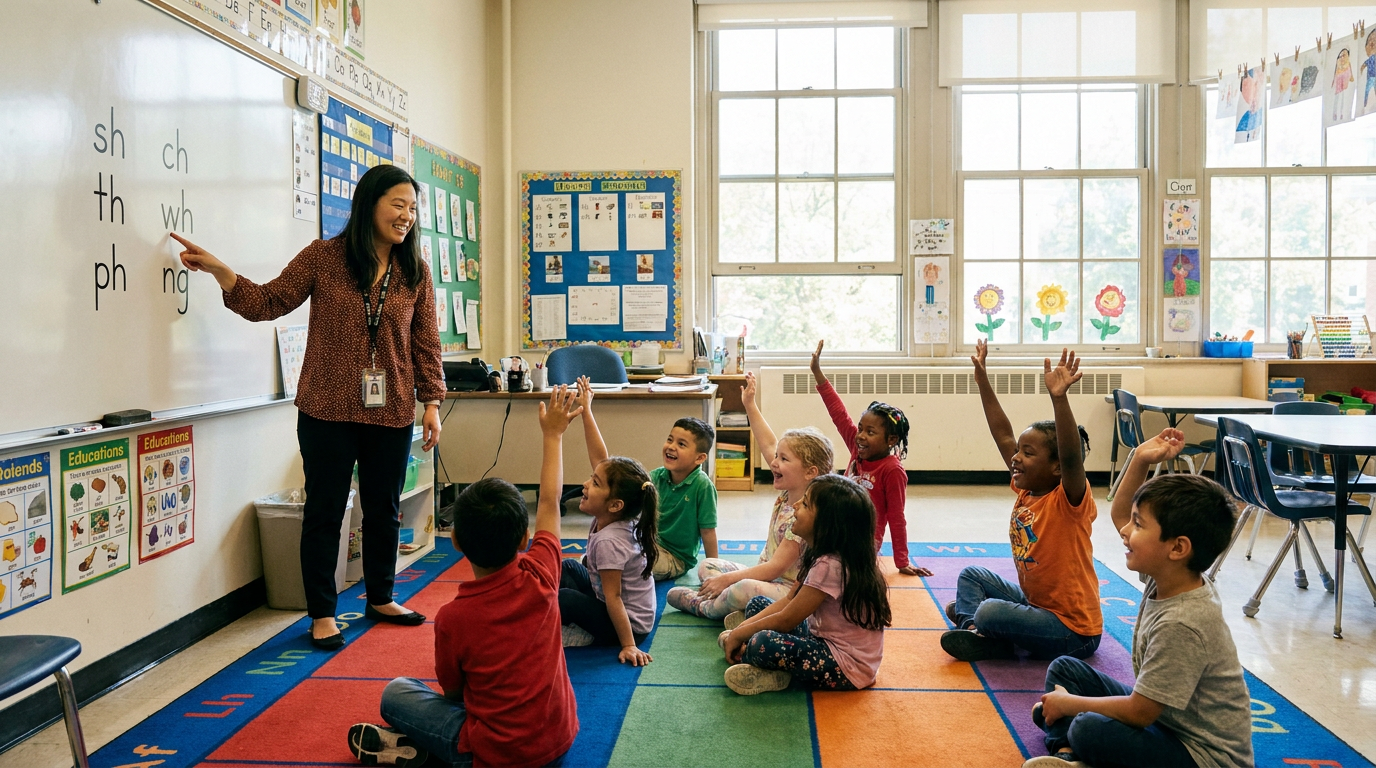
Phonemic awareness involves recognizing and manipulating the individual sounds (phonemes) in spoken words. Phonics then connects those sounds to specific letters and letter patterns. By explicitly teaching these sound-spelling patterns, students learn to decode words accurately.[5]
This systematic phonics instruction allows students to engage in "orthographic mapping," the cognitive process where the brain permanently stores words for immediate, effortless retrieval. Once decoding becomes automatic, the brain's cognitive load is freed up to focus entirely on understanding the text's meaning.[2][7]
The push for this evidence-based approach was heavily championed by a grassroots movement of parents, particularly those of children with dyslexia. These families highlighted that while a small percentage of children might learn to read with minimal instruction, the vast majority—and especially neurodivergent learners—require explicit, structured support to crack the alphabetic code.[2][4]

The transition is already showing promising results in early-adopter states. States like Mississippi and Louisiana, which aggressively implemented science of reading policies, comprehensive teacher training, and aligned curricula, have seen notable gains in their reading scores, defying national downward trends.[1][3]
Conversely, states and districts that have been slower to abandon balanced literacy are facing mounting pressure. In New York, for example, advocacy groups and state leaders have launched campaigns to eliminate debunked reading instruction practices, pointing out that blending old methods with new science often dilutes the effectiveness of the instruction.[1][7]
Implementing this cognitive revolution is not without friction. It requires massive investments in professional development to retrain teachers who were taught balanced literacy in their university preparation programs. It also necessitates auditing and replacing millions of dollars worth of outdated classroom materials.[2][3]
Yet, the momentum is undeniable. By aligning classroom practice with the neurological reality of how the brain learns, the K-12 education system is moving toward a more equitable future. The science of reading promises to demystify literacy, giving every child the foundational tool they need to access the rest of their education.[4][7]
How we got here
Late 1990s
The National Reading Panel is convened by Congress to assess the effectiveness of different approaches used to teach children to read.
2000
The National Reading Panel releases its groundbreaking report identifying the five pillars of effective reading instruction.
2013
Mississippi passes the Literacy-Based Promotion Act, becoming an early pioneer in mandating the science of reading.
2019
Mississippi's fourth-grade reading scores surge on the National Assessment of Educational Progress (NAEP), sparking nationwide interest.
2022-2024
A massive legislative wave occurs, with dozens of states banning 'three-cueing' and mandating structured literacy curricula.
2025-2026
States begin enforcing new curriculum adoptions and rolling out statewide professional development for early elementary educators.
Viewpoints in depth
Cognitive Scientists & Researchers
Advocate for explicit, systematic instruction based on brain imaging and empirical data.
Researchers in neuroscience and cognitive psychology emphasize that reading is not a natural human instinct like speech. Brain imaging shows that learning to read requires physically rewiring the brain to connect the visual processing center with the language comprehension center. This camp argues that explicit, systematic phonics instruction is the only proven way to build these neural pathways for the vast majority of children, and they strongly oppose instructional methods that encourage guessing.
Dyslexia Advocates & Parents
Grassroots drivers demanding instruction that works for neurodivergent and struggling readers.
Parents of children with dyslexia have been the most vocal advocates for legislative change. They argue that 'balanced literacy' and cueing systems disproportionately harm students with learning differences, who cannot rely on context clues to mask decoding difficulties. For this camp, the science of reading is an equity issue: they demand universal screening, specialized interventions, and core classroom instruction that does not leave struggling readers behind.
Education Policymakers
Focused on legislative mandates, standardized test scores, and curriculum overhauls.
State legislators and departments of education view the science of reading as a necessary structural fix to stagnant national test scores. Their approach is top-down: banning debunked teaching methods, mandating new state-approved curricula, and requiring universities to update their teacher preparation programs. Policymakers point to early adopters like Mississippi, which saw dramatic improvements in NAEP scores after implementing strict literacy laws, as proof that policy mandates can drive systemic improvement.
What we don't know
- How quickly universities will update their teacher preparation programs to align with the new state mandates.
- Whether the influx of funding for new curricula and professional development will be sustained long-term.
- How effectively schools will support older students who missed foundational phonics instruction in their early years.
Key terms
- Science of Reading
- A vast, interdisciplinary body of scientifically based research about reading and issues related to reading and writing.
- Phonics
- Instruction that connects spoken sounds with specific letters or groups of letters in an alphabetic writing system.
- Phonemic Awareness
- The ability to recognize, isolate, and manipulate the individual sounds (phonemes) in spoken words.
- Balanced Literacy
- An instructional approach that attempts to combine phonics with exposure to rich literature, but often relies heavily on guessing words from context.
- Three-Cueing System
- A debunked instructional method that encourages students to guess a word by looking at the picture, the context, or the first letter.
- Orthographic Mapping
- The cognitive process where the brain permanently stores words for immediate, effortless retrieval during reading.
Frequently asked
What is the science of reading?
It is a comprehensive body of research from cognitive psychology, neuroscience, and education that explains exactly how the human brain learns to read and write.
Why is balanced literacy being replaced?
Research shows that balanced literacy's reliance on guessing words from pictures or context hinders a child's ability to decode complex texts later on.
Does the science of reading only focus on phonics?
No. While phonics is a critical component for decoding words, the science of reading equally emphasizes vocabulary, fluency, and language comprehension to ensure students understand what they read.
How does this affect students with dyslexia?
The explicit, systematic instruction required by the science of reading is widely considered the most effective way to teach students with dyslexia and other language-based learning disabilities.
Sources
Source coverage
7 outlets
3 viewpoints surfaced







[1]The Hechinger ReportEducation Policymakers
New York’s reading scores are going in the opposite direction of states adopting the science of reading
Read on The Hechinger Report →[2]Stanford UniversityCognitive Scientists & Researchers
Stanford Professor Rebecca Silverman discusses a transformative movement backed by research
Read on Stanford University →[3]ExcelinEdEducation Policymakers
The Case for Early Literacy Policies that Align with the Science of Reading
Read on ExcelinEd →[4]National Center for Learning DisabilitiesDyslexia Advocates & Parents
Policy Position: Literacy and Science of Reading
Read on National Center for Learning Disabilities →[5]NWEACognitive Scientists & Researchers
What is the science of reading?
Read on NWEA →[6]HMHCognitive Scientists & Researchers
The Science of Reading Explained: Answers to the Top 5 Questions
Read on HMH →[7]Factlen Editorial TeamDyslexia Advocates & Parents
Synthesis by Factlen editorial team
Read on Factlen Editorial Team →
Every angle. Every day.
Get education stories with full source coverage and perspective breakdowns delivered to your inbox.