
The Science of Prediction: How Markets and Superforecasters Are Rewiring How We See the Future
Prediction markets and elite human forecasters are transforming how society anticipates global events, turning subjective guesswork into a multi-billion-dollar data-driven science.
By Factlen Editorial Team
- Market Optimists
- Argue that prediction markets are the most accurate truth-seeking engines available because they penalize bias.
- Traditional Regulators
- Warn that event contracts blur the line between finance and gambling, requiring strict oversight.
- Human Forecasters
- Maintain that human judgment is irreplaceable in complex, low-data geopolitical environments.
What's not represented
- · Traditional oddsmakers
- · Gambling addiction advocates
Why this matters
By assigning precise financial probabilities to future events, prediction markets offer a clearer, less biased lens into what is likely to happen next. Understanding how these tools work empowers individuals to cut through media noise and make better decisions based on statistical reality rather than punditry.
Key points
- Prediction markets have surged into a multi-billion-dollar industry, allowing users to trade on the probability of future events.
- Regulated platforms like Kalshi have reached massive valuations by integrating with mainstream retail brokers like Robinhood.
- Superforecasters use structured probabilistic reasoning to consistently outperform traditional subject-matter experts.
- While AI is expected to beat human baselines in data-rich forecasting by 2028, humans retain an edge in sparse-data geopolitical events.
- The industry is facing regulatory friction as states debate whether event contracts constitute financial derivatives or gambling.
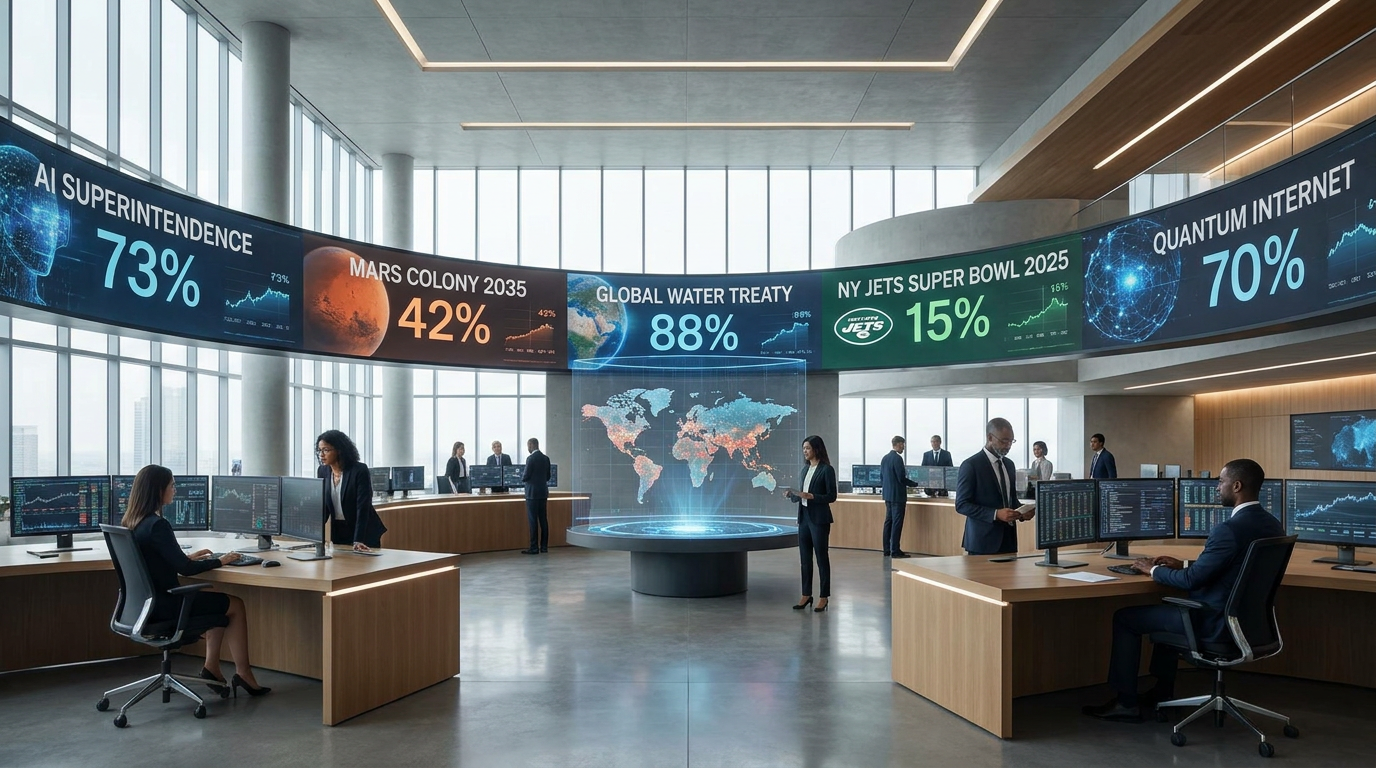
For decades, predicting the future was the domain of pundits, pollsters, and subject-matter experts. But in 2026, the business of forecasting has been fundamentally rewired by the explosion of prediction markets and the formalization of "superforecasting." Platforms that were once niche experiments have morphed into a multi-billion-dollar asset class, aggregating the wisdom of crowds to assign real-time probabilities to everything from geopolitical conflicts to the release date of the next major video game.[4][10]
The scale of this shift became undeniable in May 2026, when the regulated U.S. exchange Kalshi reached a staggering $22 billion valuation following a $1 billion funding round. This surge was fueled in part by integration with mainstream retail platforms like Robinhood, which facilitated billions of event contract trades. Simultaneously, Polymarket, a decentralized competitor, executed its first institutional block trade, signaling that Wall Street hedge funds and asset managers are now utilizing these platforms not just for speculation, but as real-time sentiment indicators.[5][7][10]
At their core, prediction markets operate on a simple mechanism: they price the probability of future events using binary contracts. If a market asks whether the Federal Reserve will cut interest rates by a certain date, participants can buy "YES" or "NO" shares. The price of these shares always adds up to $1. If a "YES" share trades at $0.40, the market implies a 40 percent chance of the event occurring. When the event resolves, the winning share pays out $1, and the losing share goes to zero.[2][10]

This financial mechanism forces participants to put their money where their mouth is, effectively penalizing inaccurate predictions and rewarding correct ones. As new information enters the world—a leaked document, a sudden weather shift, or a geopolitical escalation—traders instantly update their positions, causing prices to shift. Proponents argue that this dynamic creates a highly efficient truth-seeking engine, one that frequently surpasses the accuracy of professional assessments and conventional projections by eliminating individual bias.[4][10]
But the rise of prediction markets is only half of the forecasting revolution; the other half is the human element, specifically the cultivation of "superforecasters." The concept originated from the Good Judgment Project, a research initiative funded by the U.S. intelligence community that discovered certain individuals consistently outperform intelligence analysts with access to classified information. These superforecasters are not necessarily subject-matter experts, but rather individuals who excel at probabilistic reasoning and actively avoid cognitive biases.[1][6]
Superforecasting relies on a specific methodology. Practitioners are trained to distinguish between the "outside view," which looks at historical base rates and statistical precedents, and the "inside view," which focuses on the unique details of the current situation. They constantly update their beliefs as new data emerges, breaking down complex questions into smaller, measurable components. Today, organizations like Good Judgment Inc. deploy networks of these elite forecasters to help corporate and government clients quantify subjective risk.[1][6]
They constantly update their beliefs as new data emerges, breaking down complex questions into smaller, measurable components.
The human dominance in forecasting, however, is facing a new challenger: artificial intelligence. In February 2026, the Forecasting Research Institute published Wave 5 of its Longitudinal Expert AI Panel, tracking how AI systems stack up against human benchmarks. The results sparked intense debate. Superforecasters themselves are remarkably bullish on the technology, with the median superforecaster predicting that AI systems will beat human baselines on the ForecastBench evaluation by 2028.[1]

Yet, the nuance lies in the type of prediction. AI models excel at data-rich, quantitative questions, such as weather patterns, financial data, and sports analytics, where they can process vast historical datasets instantly. However, human forecasters maintain a distinct edge in geopolitical judgment and novel situations where data is sparse, context is highly dependent, and the environment is in flux. In these scenarios, machines are inherently backward-looking, leaving a critical space for human intuition and contextual synthesis.[1]
While politics once dominated the prediction market landscape, 2026 has seen a massive diversification into sports, technology, and pop culture. With the 2026 FIFA World Cup kicking off across North America, sports markets have generated unprecedented volume. On Kalshi, sports event contracts skyrocketed to account for over 85 percent of the platform's trading volume. Participants trade on match outcomes and in-game events in real-time, offering odds that reflect public consensus rather than the profit margins of traditional sportsbooks.[2][5][8]
Beyond sports, long-term science and technology forecasting has attracted both enthusiasts and professionals. Markets tracking whether there will be a breakthrough in fusion energy by the end of the year, or whether Apple will release a specific augmented reality device, draw millions in trading volume. Even cultural milestones, such as the release date of "Grand Theft Auto VI" or the winner of the Eurovision Song Contest, have become highly liquid markets, reflecting the enormous cultural footprint of these events.[2]

This rapid expansion has not been without growing pains and regulatory friction. As prediction markets blur the line between financial derivatives and gambling, state and federal regulators are clashing over jurisdiction. States like New Jersey and Washington argue that sports-indexed contracts are functionally indistinguishable from traditional sports betting and should be regulated as such. Conversely, platforms like Kalshi operate under the oversight of the Commodity Futures Trading Commission (CFTC), arguing that their event contracts are legitimate financial instruments.[9][10]
The platforms are also grappling with the responsibility of policing their own ecosystems. In June 2026, both Kalshi and Polymarket took unprecedented steps to prohibit paid creators and affiliates from spreading election misinformation. Following reports of influencers casting doubt on the integrity of state elections to manipulate market odds, the platforms updated their terms of service, threatening to revoke sponsorships from users who spread false or misleading information.[3]
Despite these regulatory and operational hurdles, the trajectory of prediction markets points toward deeper integration into the global financial system. The recent execution of block trades on Polymarket suggests that these platforms are developing the structural features—such as negotiated pricing and counterparty risk management—necessary to appeal to large-scale institutional participants. If this trend continues, prediction markets could soon become a standard tool for insurance pricing, event-driven investing, and corporate strategy.[7][9]
Ultimately, the convergence of prediction markets, superforecasting methodology, and artificial intelligence is creating a more rigorous framework for navigating uncertainty. By assigning precise probabilities to future scenarios, these tools move society away from vague punditry and toward a more accountable, data-driven understanding of what lies ahead. Whether predicting a technological breakthrough or a World Cup victory, the wisdom of the crowd is proving to be a formidable lens into the future.[2][4][6]
How we got here
2011
The Good Judgment Project launches, proving that trained amateur 'superforecasters' can outperform intelligence analysts.
2021
Kalshi becomes the first CFTC-licensed prediction market in the United States.
2024
Prediction markets gain mainstream attention during the U.S. elections, driving record trading volumes.
Early 2026
Kalshi integrates with Robinhood, bringing event contracts to millions of retail investors.
June 2026
Polymarket executes its first institutional block trade, signaling Wall Street's entry into the space.
Viewpoints in depth
Market Optimists
Argue that prediction markets are the most accurate truth-seeking engines available.
This camp, which includes platform founders and quantitative analysts, believes that aggregating the financial stakes of thousands of participants eliminates individual bias. They point to the high accuracy of these markets in forecasting election outcomes and economic data, arguing that "putting money on the line" forces intellectual honesty in a way that traditional punditry does not.
Traditional Regulators
Warn that event contracts blur the line between finance and gambling.
State regulators and some federal lawmakers argue that many prediction markets, particularly those focused on sports or pop culture, are simply sportsbooks masquerading as financial derivatives. They express concern over market manipulation, insider trading, and the potential for these platforms to incentivize bad actors to influence real-world events just to win a contract payout.
Human Forecasters
Maintain that human judgment is irreplaceable in complex, low-data environments.
Organizations like Good Judgment and veteran superforecasters acknowledge the rapid advancement of AI in processing quantitative data. However, they argue that geopolitical crises and novel global events lack the historical training data AI requires. In these high-stakes, ambiguous scenarios, they believe human intuition, contextual synthesis, and the ability to weigh unquantifiable variables remain superior.
What we don't know
- Whether the U.S. Supreme Court will ultimately classify sports-indexed prediction markets as gambling or legitimate financial derivatives.
- Exactly how quickly AI models will close the gap with human superforecasters on complex, low-data geopolitical questions.
Key terms
- Binary Contract
- A financial instrument that pays out a fixed amount if a specific event occurs, and nothing if it does not.
- Superforecaster
- A person who has demonstrated a consistently superior ability to predict future events, often utilizing structured analytical techniques.
- Wisdom of the Crowd
- The theory that the collective opinion of a diverse group of individuals is more accurate than that of a single expert.
- Base Rate
- The historical frequency or probability of an event occurring, used as a starting point for making a forecast.
- Block Trade
- A large, privately negotiated securities transaction that bypasses the public open market to minimize impact on the asset's price.
Frequently asked
What is a prediction market?
A prediction market is an exchange where people trade contracts based on the outcome of future events. The price of the contract reflects the crowd's estimated probability of that event occurring.
What makes someone a superforecaster?
Superforecasters are individuals who consistently make highly accurate predictions by using probabilistic reasoning, actively avoiding cognitive biases, and constantly updating their beliefs as new information emerges.
Are prediction markets legal in the US?
The legality depends on the platform and the type of contract. Platforms like Kalshi operate under the regulation of the Commodity Futures Trading Commission (CFTC), while others face legal challenges from state regulators who view certain contracts as unregulated gambling.
Can AI predict the future better than humans?
AI currently excels at forecasting data-rich events like weather or sports. However, human superforecasters still outperform AI in complex geopolitical situations where historical data is sparse and context is highly nuanced.
Sources
Source coverage
10 outlets
3 viewpoints surfaced










[1]Good Judgment NewsHuman Forecasters
What Superforecasters Actually Said About ForecastBench
Read on Good Judgment News →[2]MetaMaskMarket Optimists
Top prediction market categories to watch in 2026
Read on MetaMask →[3]The GuardianTraditional Regulators
Kalshi and Polymarket prohibit affiliates from spreading election misinformation
Read on The Guardian →[4]Tecpinion
Best Prediction Market Platforms in 2026 | Compare & Choose Wisely
Read on Tecpinion →[5]BlockBeatsMarket Optimists
After Polymarket and Kalshi, will there be any dark horses in the prediction market?
Read on BlockBeats →[6]WP IntelligenceHuman Forecasters
Forecasting in the age of AI and prediction markets
Read on WP Intelligence →[7]Vnsgu Net
Polymarket Completes First Block Trade as Prediction Markets Pursue Wall Street Adoption
Read on Vnsgu Net →[8]Mile High Sports
Best Prediction Markets for World Cup 2026
Read on Mile High Sports →[9]Stanford Law SchoolTraditional Regulators
Prediction Markets are Surging – Here's What You Need to Know
Read on Stanford Law School →[10]Arkham ResearchMarket Optimists
A Guide To How Prediction Markets Work (2026)
Read on Arkham Research →


Every angle. Every day.
Get meta stories with full source coverage and perspective breakdowns delivered to your inbox.