
The Science of Induction Cooking: How Magnets Are Replacing Gas Stoves
Induction cooktops use electromagnetic fields to heat pans directly, offering an 84-90% efficiency rate that boils water faster while eliminating indoor air pollution.
By Factlen Editorial Team
- Energy & Health Advocates
- Focuses on the thermodynamic efficiency of induction and the elimination of harmful indoor combustion pollutants.
- Culinary Professionals
- Values the technology primarily for its rapid heating speeds, precise temperature control, and easy cleanup.
- Consumer Accessibility Advocates
- Highlights the practical barriers to entry, such as upfront costs, electrical panel upgrades, and the need for renter-friendly solutions.
- Scientific Consensus
- Focuses on the underlying physics, electromagnetism, and thermodynamic principles that make the technology function.
What's not represented
- · Cookware Manufacturers
- · Natural Gas Utilities
Why this matters
Switching to induction cooking can save households hundreds of dollars in energy costs, cut cooking times in half, and eliminate harmful indoor pollutants like nitrogen dioxide that increase childhood asthma risks.
Key points
- Induction cooktops use electromagnetic fields to heat the cookware directly, rather than generating heat that transfers to the pan.
- This direct-heating method achieves up to 90% energy efficiency, compared to just 32-40% for traditional gas stoves.
- Because there is no combustion, induction cooking completely eliminates indoor emissions of nitrogen dioxide and benzene.
- Cookware must contain ferromagnetic metal, such as cast iron or magnetic stainless steel, to function on an induction burner.
- New innovations, like 120-volt portable hobs and battery-backed stoves, are making the technology accessible to renters without requiring electrical upgrades.
The American kitchen is undergoing a quiet but profound thermodynamic shift. For decades, the blue flame of a gas stove was the undisputed symbol of serious home cooking, marketed as the only way to achieve professional-grade temperature control. But in 2026, that conventional wisdom is being rapidly upended. A technology that once seemed like a futuristic luxury—induction cooking—is now moving into the mainstream, driven by a convergence of falling prices, climate policy, and startling new health data.[2][5][8]
To understand why induction is replacing both traditional electric coils and gas burners, you have to look under the glass. Traditional cooking methods rely on thermal conduction: a flame or a glowing red electric coil generates heat, which then transfers to the bottom of a pot, which then heats the food inside. This multi-step process is inherently wasteful, as a significant portion of the thermal energy simply escapes into the surrounding air, heating the kitchen rather than the meal.[1][4]
Induction cooking bypasses this thermal middleman entirely. Instead of generating heat, an induction cooktop uses the principles of electromagnetism to turn the cookware itself into the heat source. Beneath the sleek, featureless glass-ceramic surface lies a tightly wound coil of copper wire. When the stove is turned on, a high-frequency alternating current—typically oscillating between 25 and 50 kilohertz—flows through this coil.[1][3]
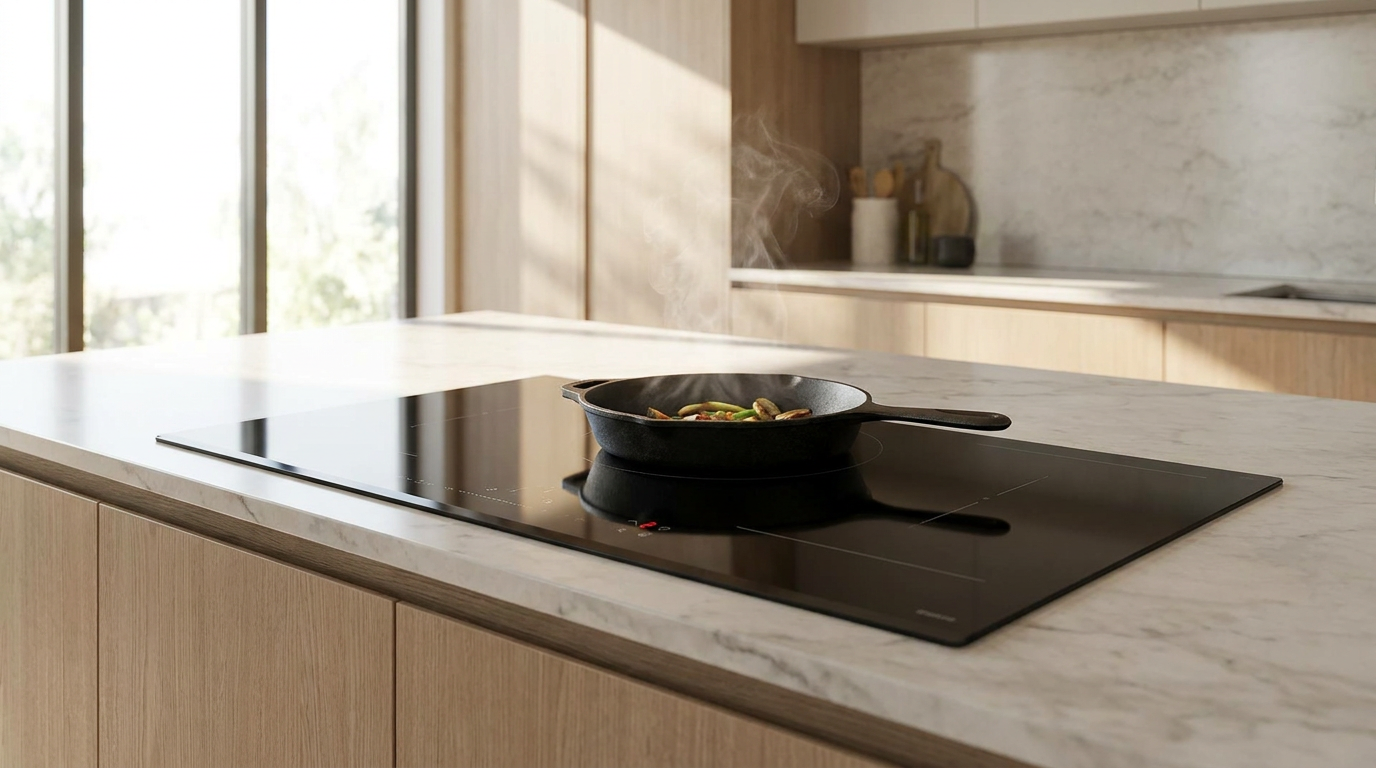
This alternating current generates a dynamic, rapidly fluctuating magnetic field that projects just a few inches above the surface of the cooktop. If you place your hand over an active induction burner, you will feel absolutely nothing, because human tissue is not magnetic. The magic only happens when a piece of ferromagnetic metal—like a cast-iron skillet or a magnetic stainless-steel pot—enters that invisible field.[1][3][4]
When the magnetic field penetrates the base of the compatible cookware, it induces a swirling flow of electrons within the metal. These localized electrical loops are known in physics as "eddy currents." Because the metal of the pan has electrical resistance, it fights against the flow of these eddy currents.[3][4][8]
This resistance results in a phenomenon called Joule heating. As the electrons are forced through the resistive metal by the magnetic field, their kinetic energy is converted directly into intense, instantaneous heat. The pan gets hot, the food cooks, but the glass surface of the stove only warms up secondarily, absorbing residual heat from the hot pan resting upon it.[1][3][4]

The thermodynamic efficiency of this direct-heating method is staggering. Because the heat is generated inside the cookware rather than beneath it, an induction stove operates at roughly 84% to 90% energy efficiency. By contrast, traditional electric resistance stoves hover around 65% to 75% efficiency.[2]
Gas stoves fare even worse in the efficiency department. When cooking over an open flame, only 32% to 40% of the energy consumed actually makes it into the food. The remaining 60% or more is lost to the ambient air, which is why professional kitchens with gas ranges are notoriously sweltering environments.[2][8]
When cooking over an open flame, only 32% to 40% of the energy consumed actually makes it into the food.
This efficiency translates directly into speed, which is one of the primary reasons culinary professionals are making the switch. Because there is no waiting for a heavy iron grate or a ceramic element to heat up, the energy delivery is instantaneous. An induction cooktop can bring a pot of water to a rolling boil up to 50% faster than a comparable gas or electric burner, saving home cooks significant time over the course of a year.[1][2][5]

Beyond speed, induction offers a level of precision that rivals, and often exceeds, the responsiveness of gas. When a cook turns down the dial on an induction stove, the magnetic field weakens instantly, immediately halting the generation of heat within the pan. This allows for delicate tasks, like melting chocolate or holding a gentle simmer, without the risk of scorching that comes with residual heat from electric coils.[3][5][8]
But the current surge in induction adoption is not just about culinary performance; it is heavily driven by a growing awareness of indoor air quality. Recent peer-reviewed meta-analyses have quantified the health impacts of gas combustion in the home, revealing that gas stoves emit significant levels of nitrogen dioxide (NO2) and benzene, even when turned off.[2][6]
The health implications are particularly stark for children. Studies have shown that living in a home with a gas stove increases a child's risk of developing asthma by 42%, prompting public health officials to compare the respiratory impact of an unventilated gas stove to living with a cigarette smoker. Because induction cooking relies entirely on electromagnetism, it produces zero point-source emissions, completely eliminating these indoor pollutants.[2][6]
This environmental and health calculus has caught the attention of policymakers. Across the United States, more than 100 jurisdictions, including major cities like New York and Seattle, have updated building codes to restrict or prohibit gas hookups in new residential construction. As the electrical grid becomes increasingly decarbonized, the overall carbon footprint of an induction stove is now significantly lower than that of a gas appliance in the vast majority of states.[2]

Despite the clear advantages, the transition to induction is not without friction. The most immediate hurdle for many consumers is cookware compatibility. Because the technology relies on magnetic fields, pots and pans made of pure aluminum, copper, or glass will not work on an induction stove unless they have been manufactured with a specialized magnetic base plate.[1][3]
The simple test for compatibility is the "magnet test": if a standard refrigerator magnet sticks firmly to the bottom of a pan, it will work on an induction cooktop. Fortunately, most modern cookware manufacturers have adapted to the trend, ensuring that their stainless steel and non-stick offerings are induction-ready, while classic cast iron and enameled Dutch ovens have always been perfectly suited for the technology.[4]

Cost remains another significant barrier. While prices have plummeted by roughly 40% since 2020, a full-size induction range still commands a premium over entry-level gas or electric models, often starting around $1,000. Furthermore, retrofitting an older home to replace a gas stove with a full induction range often requires an expensive electrical panel upgrade to support a dedicated 240-volt circuit.[2][5][7]
However, the market is rapidly innovating to solve these accessibility issues, particularly for renters and those in older buildings. Portable, single-burner induction hobs that plug into standard 120-volt wall outlets have become wildly popular, allowing renters to experience the technology without modifying their apartments. Additionally, new battery-integrated induction stoves are hitting the market, which can plug into a standard outlet and draw trickle power, using the battery to supply the high-voltage bursts needed for cooking.[7]
As the technology matures and economies of scale continue to drive down manufacturing costs, the kitchen of the future is coming into sharp focus. By marrying the precision of a professional gas range with the clean, hyper-efficient physics of electromagnetism, induction cooking is poised to become the definitive standard for the 21st-century home.[5][8]
How we got here
Early 1900s
The first patents for induction cooking technology are filed in the United Kingdom and Germany, though the concept remains theoretical for decades.
Mid-1950s
General Motors' Frigidaire division showcases early demonstration induction stoves on a touring showcase, introducing the concept to the American public.
2020s
Induction technology drops significantly in price and gains mainstream popularity as professional chefs adopt it and health concerns over gas stoves rise.
2026
Induction cooktops become a dominant kitchen trend as over 100 US jurisdictions implement building codes restricting new residential gas lines.
Viewpoints in depth
Energy & Health Advocates
Focuses on the thermodynamic efficiency of induction and the elimination of harmful indoor combustion pollutants.
For climate and public health researchers, the transition away from gas stoves is an urgent infrastructure priority. They point to data showing that gas stoves emit nitrogen dioxide and benzene—known carcinogens and respiratory irritants—directly into living spaces, increasing childhood asthma risks by 42%. By achieving up to 90% thermal efficiency and eliminating point-source emissions entirely, this camp views induction technology as a critical tool for both decarbonizing the residential grid and immediately improving indoor air quality.
Culinary Professionals
Values the technology primarily for its rapid heating speeds, precise temperature control, and easy cleanup.
While health metrics dominate the policy debate, chefs and food writers champion induction for its sheer performance. Because the magnetic field induces heat directly in the pan, an induction burner can boil water up to 50% faster than a high-BTU gas flame. Furthermore, the instant responsiveness of the magnetic field allows for exact temperature adjustments without the residual heat lag of electric coils. The added benefit of a glass surface that doesn't bake on spills makes it highly attractive for high-volume commercial kitchens and busy home cooks alike.
Consumer Accessibility Advocates
Highlights the practical barriers to entry, such as upfront costs, electrical panel upgrades, and the need for renter-friendly solutions.
Despite the clear benefits, housing advocates and consumer groups caution that the induction transition risks leaving low-income households and renters behind. A full induction range often requires a dedicated 240-volt circuit, meaning older homes may need electrical panel upgrades costing thousands of dollars. This camp emphasizes the importance of accessible alternatives, such as 120-volt portable induction hobs and new battery-integrated stoves that can plug into standard wall outlets, ensuring that the health and efficiency benefits of induction aren't restricted to wealthy homeowners.
What we don't know
- How quickly the secondary market for used induction appliances will develop to make the technology accessible to lower-income households.
- Whether natural gas utilities will successfully lobby to reverse municipal bans on new gas hookups in key housing markets.
- How the widespread adoption of battery-integrated 120-volt induction stoves will impact the overall demand on residential electrical grids during peak cooking hours.
Key terms
- Electromagnetic Induction
- The process of generating an electrical current by placing a conductive material within a changing magnetic field.
- Eddy Current
- Swirling loops of electrical current induced within the metal of a pan by the stove's magnetic field, which create heat through resistance.
- Joule Heating
- The physical process by which the passage of an electric current through a conductor (like an iron skillet) produces heat.
- Ferromagnetic
- Materials, such as iron or certain types of steel, that are highly susceptible to magnetization and are required for induction cooking.
Frequently asked
Do I need to buy all new pots and pans for an induction stove?
Not necessarily. If a magnet sticks firmly to the bottom of your current cookware, it will work. Cast iron, enameled Dutch ovens, and most magnetic stainless steel pans are fully compatible.
Is an induction cooktop the same as a glass-top electric stove?
No. Traditional glass-top electric stoves use radiant heat from glowing metal coils beneath the surface to warm the glass, which then warms the pan. Induction uses magnets to heat the pan directly, leaving the glass much cooler.
Are induction stoves safe for people with pacemakers?
Because induction cooktops generate electromagnetic fields, they can theoretically interfere with some medical devices. Individuals with pacemakers should consult their cardiologist before using one, though the risk is generally considered low if a safe distance is maintained.
Sources
Source coverage
8 outlets
4 viewpoints surfaced








[1]Massachusetts Clean Energy CenterEnergy & Health Advocates
How Induction Cooking Works
Read on Massachusetts Clean Energy Center →[2]Energy SolutionsEnergy & Health Advocates
Induction vs Gas Cooktops: The Definitive Health, Efficiency & Economic Analysis (2026)
Read on Energy Solutions →[3]WikipediaScientific Consensus
Induction cooking
Read on Wikipedia →[4]Rewiring AmericaEnergy & Health Advocates
How induction stoves work
Read on Rewiring America →[5]Tasting TableCulinary Professionals
Why Induction Stoves Are Set To Dominate 2026 Kitchen Trends
Read on Tasting Table →[6]House DigestCulinary Professionals
The Cooktop Trend That's Making Kitchens Safer & More Efficient In 2026
Read on House Digest →[7]KQEDConsumer Accessibility Advocates
Hot Rugs, Heat Pumps and Induction Cooktops: How Renters Can Go Electric
Read on KQED →[8]Factlen Editorial TeamScientific Consensus
Synthesis by Factlen editorial team
Read on Factlen Editorial Team →
Every angle. Every day.
Get home stories with full source coverage and perspective breakdowns delivered to your inbox.