
The Science of Emulsions: How Chemistry Creates Perfect Sauces
Understanding the molecular mechanics of emulsification can help home cooks transform immiscible liquids into stable, restaurant-quality sauces.
By Factlen Editorial Team
- Culinary Traditionalists
- Focus on technique, patience, and the mastery of classic mother sauces through precise physical agitation and temperature control.
- Food Scientists
- Focus on the physical chemistry, thermodynamics, and molecular interactions that govern phase stability and droplet size.
- Home Cooking Innovators
- Focus on practical applications, demystifying the science to make restaurant-quality techniques accessible using everyday pantry ingredients.
What's not represented
- · Industrial Food Manufacturers
Why this matters
Mastering emulsions eliminates the frustration of broken sauces and separated dressings, empowering home cooks to elevate their meals with reliable, science-backed techniques.
Key points
- Emulsions are forced mixtures of two immiscible liquids, like oil and water.
- They require mechanical force, such as whisking, to break one liquid into microscopic droplets.
- Emulsifiers, like lecithin in egg yolks, act as molecular bridges to prevent the liquids from separating.
- Adding oil too quickly or exposing the mixture to extreme heat will cause the emulsion to break.
- Pantry staples like mustard, garlic paste, and tomato paste act as natural, plant-based emulsifiers.
The difference between a watery, uninspired salad dressing and a velvety, restaurant-quality vinaigrette rarely comes down to the quality of the ingredients alone. More often, it is a matter of molecular architecture. Behind the glossy sheen of a perfect hollandaise or the thick, spreadable texture of mayonnaise lies a complex dance of physical chemistry that transforms everyday liquids into culinary magic.[7]
The fundamental conflict in the kitchen is that oil and water are inherently hostile to one another. They are what chemists call "immiscible" liquids. Water molecules are polar, meaning they carry a slight electrical charge that makes them highly attracted to each other. Oil molecules are non-polar and hydrophobic. When poured into the same bowl, they naturally repel each other, separating into distinct layers to minimize their surface contact.[1][6]
Enter the emulsion. An emulsion is the forced, harmonious mixture of two liquids that normally refuse to blend. By applying physical force and the right chemical mediators, cooks can trick these opposing substances into coexisting in a stable, unified state.[1][5]
In this microscopic environment, one liquid is violently broken down into tiny droplets and suspended throughout the other. The liquid that gets shattered into droplets is known as the "dispersed phase," while the liquid that surrounds and suspends those droplets is called the "continuous phase."[1][3]
There are two primary types of culinary emulsions that dictate the texture of our food. "Oil-in-water" (O/W) emulsions feature microscopic oil droplets suspended in a water-based continuous phase. This category includes mayonnaise, milk, cream, and classic vinaigrettes.[3][6]

Conversely, "water-in-oil" (W/O) emulsions suspend water droplets within a continuous fat phase. Butter and margarine are the most common examples of this structure, which is why they feel distinctly richer and greasier on the palate than heavy cream, despite containing similar ingredients.[3][6]
Creating any emulsion requires significant mechanical energy. Whisking, blending, or shaking provides the sheer force necessary to shatter the dispersed liquid into microscopic droplets. The smaller the droplets, the thicker and more stable the resulting sauce will be.[2][5]
However, physics dictates that this forced mixture is inherently unstable. Without intervention, the laws of thermodynamics will eventually win. The suspended droplets will bump into each other, fuse together in a process called coalescence, and separate back into two distinct, unappetizing layers.[3][6]

This is where emulsifiers save the day. Emulsifiers are amphiphilic molecules, meaning they possess a split personality: one end of the molecule is hydrophilic (water-loving) and the other is hydrophobic (oil-loving).[1][3]
When added to the mixing bowl, these molecules act as microscopic diplomats. They coat the newly formed oil droplets, burying their hydrophobic tails in the fat while their hydrophilic heads face outward into the water. This creates a protective barrier that prevents the droplets from fusing back together.[3][6]

When added to the mixing bowl, these molecules act as microscopic diplomats.
The most famous culinary emulsifier is lecithin, a powerful phospholipid found abundantly in egg yolks and soybeans. A single egg yolk contains enough lecithin to stabilize up to a full cup of oil, which is the chemical secret behind thick, towering peaks of homemade mayonnaise.[1][5]
But eggs are not the only option in the pantry. Mustard contains natural mucilage that acts as a highly effective stabilizer. Garlic paste and tomato paste also offer their own emulsifying properties, making them invaluable for crafting robust vegan sauces or allergy-friendly dressings.[4][6]
Even dairy proteins, such as the casein found in milk and butter, act as natural emulsifiers. This is why whisking a splash of heavy cream or a pat of cold butter into a thin pan sauce at the last minute can suddenly bind the liquid and fat into a cohesive, glossy glaze.[4]
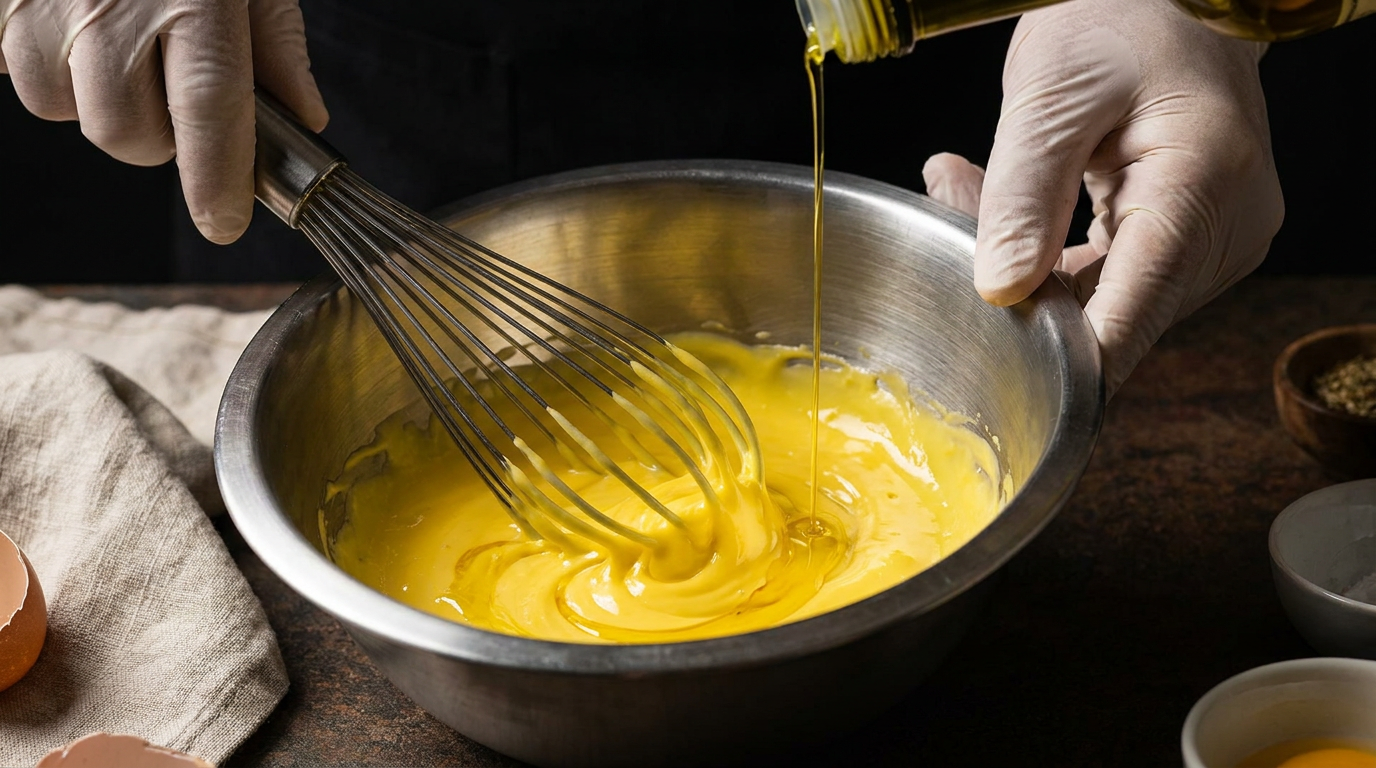
Yet, technique matters just as much as chemistry. When building a mayonnaise or vinaigrette, the dispersed phase (usually the oil) must be added in a slow, thin stream while the cook whisks vigorously. This allows the mechanical force to break the oil down just as the emulsifiers rush in to coat the droplets.[4][5]
Dumping the oil in all at once overwhelms the continuous phase. The emulsifiers simply cannot coat the massive volume of fat fast enough, causing the droplets to instantly coalesce and the sauce to "break" into a greasy, separated mess.[5]
Temperature also plays a critical role in maintaining this delicate balance. Heat can cause the egg proteins in a hollandaise to coagulate too quickly, or melt the butterfat in a beurre blanc, destroying the emulsion network and ruining the sauce.[4]

Interestingly, the physical structure of an emulsion dictates exactly how we taste it. Because the continuous phase is what physically touches the tongue first, a well-made mayonnaise tastes tangy and creamy rather than like a mouthful of pure oil, despite being composed of nearly 80 percent fat.[7]
In the modern food industry, scientists are pushing these boundaries even further with nanoemulsions and microfluidization. By creating ultra-small droplets, manufacturers can produce highly stable products that encapsulate sensitive vitamins or deliver highly specific flavor profiles over a long shelf life.[2][3]
Viewpoints in depth
Culinary Traditionalists
Focus on technique, patience, and the mastery of classic mother sauces through precise physical agitation and temperature control.
For classically trained chefs, the creation of an emulsion is a test of physical skill and patience. This perspective emphasizes that while the chemistry is important, the human element—knowing exactly how fast to whisk, recognizing the visual cues of a stabilizing sauce, and controlling the temperature of the bowl—is what separates a good cook from a master. They view the slow, methodical incorporation of oil into a yolk as an artisanal craft that cannot be rushed.
Food Scientists
Focus on the physical chemistry, thermodynamics, and molecular interactions that govern phase stability and droplet size.
Food scientists view emulsions through the lens of thermodynamics and molecular architecture. To them, a sauce is a temporary defiance of entropy, achieved by manipulating hydrophilic-lipophilic balances and sheer forces. This camp is less concerned with culinary tradition and more focused on how variables like pH, droplet size distribution, and the specific molecular weight of synthetic or natural surfactants can be optimized to create hyper-stable products with extended shelf lives.
Home Cooking Innovators
Focus on practical applications, demystifying the science to make restaurant-quality techniques accessible using everyday pantry ingredients.
This perspective bridges the gap between the laboratory and the home kitchen. By translating complex physical chemistry into practical advice, innovators empower everyday cooks to use food processors, immersion blenders, and accessible pantry staples like mustard and garlic paste to achieve perfect emulsions. They argue that understanding the "why" behind a recipe frees the cook from rigid traditionalism, allowing for creative, foolproof variations on classic sauces.
What we don't know
- How to perfectly replicate the complex mouthfeel of animal-fat emulsions using entirely plant-based synthetic emulsifiers without altering the flavor profile.
- The exact long-term health impacts of consuming highly processed, industrially stabilized nanoemulsions compared to traditional macroemulsions.
Key terms
- Emulsion
- A mixture of two or more liquids that are normally unmixable, forced together through agitation and stabilized by a binding agent.
- Immiscible
- Liquids that do not dissolve into one another and naturally separate, such as oil and water.
- Amphiphilic
- A molecule possessing both water-loving (hydrophilic) and fat-loving (lipophilic) properties, allowing it to bind opposing liquids.
- Continuous Phase
- The base liquid in an emulsion that surrounds and suspends the microscopic droplets of the other liquid.
- Dispersed Phase
- The liquid that is broken down into microscopic droplets and suspended throughout the continuous phase.
- Coalescence
- The process where small droplets in an emulsion fuse together to form larger drops, eventually causing the sauce to separate.
Frequently asked
Why did my mayonnaise or hollandaise separate?
Sauces "break" when the dispersed phase (oil or butter) is added too quickly, overwhelming the emulsifier, or when extreme temperatures cause the stabilizing proteins to coagulate or melt.
Can a broken sauce be fixed?
Yes. You can often rescue a broken emulsion by starting with a fresh egg yolk or a splash of warm water in a clean bowl, then slowly whisking the broken sauce into the new base drop by drop.
Is butter considered an emulsion?
Yes, butter is a "water-in-oil" emulsion, where microscopic droplets of water and milk proteins are suspended within a continuous phase of solid butterfat.
What are the best vegan emulsifiers for home cooking?
Mustard, garlic paste, tomato paste, and soy lecithin are excellent plant-based emulsifiers that can stabilize vinaigrettes and vegan mayonnaises without using egg yolks.
Sources
Source coverage
7 outlets
3 viewpoints surfaced





[1]WikipediaFood Scientists
Emulsion
Read on Wikipedia →[2]Turkish Journal of Agriculture - Food Science and TechnologyFood Scientists
An Overview of Food Emulsions: Description, Classification and Recent Potential Applications
Read on Turkish Journal of Agriculture - Food Science and Technology →[3]African Journal of Food Science and TechnologyFood Scientists
The science of food emulsions and their types
Read on African Journal of Food Science and Technology →[4]Michelin GuideCulinary Traditionalists
Technique Thursdays: Emulsions
Read on Michelin Guide →[5]Chef iQCulinary Traditionalists
The Art of Creating Perfect Emulsions
Read on Chef iQ →[6]Sacco SystemHome Cooking Innovators
The Science of Emulsions in Cooking
Read on Sacco System →[7]Factlen Editorial TeamHome Cooking Innovators
Synthesis by Factlen editorial team
Read on Factlen Editorial Team →

Every angle. Every day.
Get food drink stories with full source coverage and perspective breakdowns delivered to your inbox.