
The Science of Building Umami in Plant-Based Cooking
Food scientists and chefs are utilizing the molecular chemistry of umami synergy to give plant-based dishes the deep, savory satisfaction traditionally associated with meat.
By Factlen Editorial Team
- Food Scientists
- Focuses on the molecular interactions of amino acids and taste receptors to explain why we crave savory flavors.
- Plant-Based Chefs
- Emphasizes practical culinary techniques, like layering fermented ingredients and dried fungi, to build depth without meat.
- Public Health Advocates
- Values umami as a strategic tool for reducing dietary sodium while maintaining the palatability of sustainable diets.
What's not represented
- · Traditional Meat Producers
- · Highly Processed Vegan Meat Manufacturers
Why this matters
Understanding the chemistry of flavor empowers home cooks to create deeply satisfying, sustainable meals without relying on highly processed meat substitutes. It also offers a scientifically proven method for reducing dietary sodium without sacrificing taste.
Key points
- Humans are biologically wired to crave umami, which signals the presence of protein, rather than craving meat itself.
- Umami is triggered by the amino acid glutamate binding to specific T1R1 and T1R3 receptors on the tongue.
- "Umami synergy" occurs when glutamates are combined with nucleotides, multiplying the savory flavor by up to eight times.
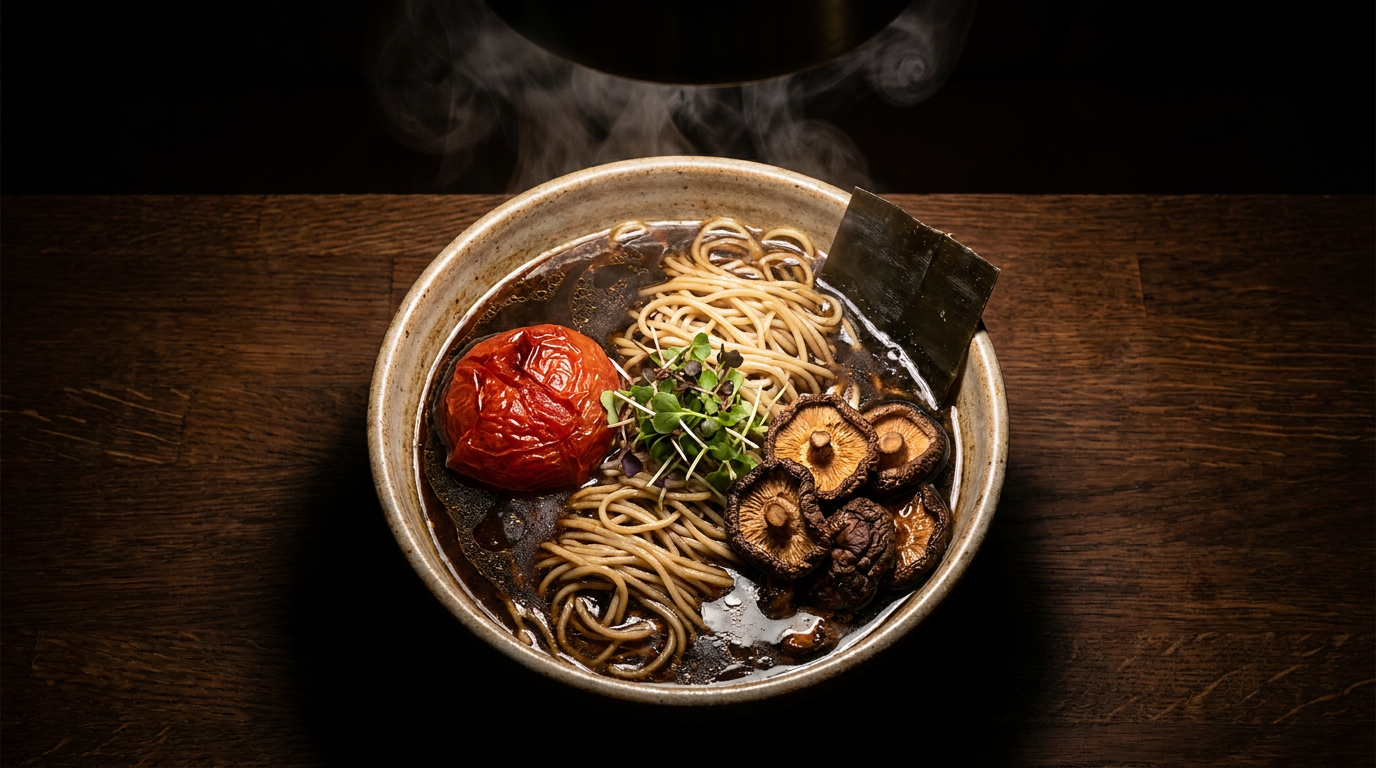
- Plant-based cooks can harness this synergy by pairing glutamate-rich foods (tomatoes, miso) with nucleotide-rich foods (dried shiitake mushrooms).
- Utilizing umami-rich ingredients allows for up to a 30 percent reduction in added sodium without sacrificing flavor.
The shift toward plant-based eating often encounters a stubborn culinary hurdle: the perceived "flatness" of vegetable-centric dishes. Home cooks and transitioning vegetarians frequently report that their meals, while healthy, lack a certain satisfying depth. For decades, this dissatisfaction was chalked up to a biological craving for meat. However, modern food science has revealed that humans are not necessarily craving animal protein itself. Instead, they are searching for a specific chemical signal that tells the brain a food is rich, savory, and nutritionally dense. That signal is umami, the elusive fifth basic taste, and mastering its chemistry is the key to unlocking restaurant-quality plant-based cooking.[1][8]
First identified in 1908 by Japanese chemist Kikunae Ikeda, umami translates roughly to "pleasant savory taste." Ikeda noticed that the dashi broth made from kombu (kelp) possessed a distinct flavor profile that was neither sweet, salty, sour, nor bitter. He isolated the source of this flavor to a single amino acid: L-glutamate. Glutamate is one of the most abundant amino acids in nature, serving as a fundamental building block of protein. When proteins are broken down—through cooking, aging, or fermentation—these glutamates are "freed," allowing them to interact directly with our taste buds.[3][6]
The biological mechanism behind this sensation is highly specific. The human tongue is equipped with specialized G-protein-coupled receptors, known as T1R1 and T1R3, which are perfectly shaped to detect free glutamates. When a glutamate molecule binds to these receptors, it sends a powerful signal to the brain indicating the presence of essential proteins. This triggers a cascade of physiological responses, including the secretion of saliva and digestive juices, which creates a lingering, mouth-watering sensation. Because meat and dairy are naturally dense in protein, they readily produce these free glutamates when cooked or aged, making them effortless sources of umami.[2][3]
This biological hardwiring presents a unique challenge for plant-based cooking. While vegetables contain glutamates, they typically lack the dense concentrations found in a dry-aged steak or a wheel of Parmesan cheese. According to researchers at the University of Copenhagen, this evolutionary quirk is a primary barrier to the widespread adoption of sustainable, plant-based diets. We are genetically primed to crave the savory satisfaction of umami, and when a meal fails to deliver it, we feel deprived. The solution, however, does not require returning to meat; it simply requires a strategic application of food chemistry.[1][8]
The secret to bridging this flavor gap lies in a phenomenon known as "umami synergy." While glutamates provide the baseline savory taste, their effect can be exponentially amplified by the presence of another class of compounds: free nucleotides. Specifically, the nucleotides inosinate and guanylate act as chemical catalysts on the tongue. When these nucleotides are introduced alongside glutamates, they physically alter the shape of the T1R1/T1R3 taste receptors. This structural shift traps the glutamate molecule in the receptor for a longer period, intensifying and prolonging the savory signal sent to the brain.[1][2]

The mathematics of umami synergy are staggering. Food scientists have demonstrated that combining one part glutamate with one part nucleotide does not simply double the savory flavor. Instead, it multiplies the perceived umami intensity by up to eight times. This synergistic multiplier effect is the invisible architecture behind some of the world’s most iconic food pairings. It is the reason why tomatoes (high in glutamate) are classically paired with Parmesan cheese (high in nucleotides), and why a splash of soy sauce can instantly elevate a simple mushroom stir-fry.[1][4]
Food scientists have demonstrated that combining one part glutamate with one part nucleotide does not simply double the savory flavor.
To harness this synergy in a plant-based kitchen, cooks must first identify rich sources of free glutamates. Fortunately, the plant kingdom offers several heavy hitters. Ripe tomatoes, particularly when roasted or concentrated into a paste, are bursting with glutamates. Kombu, the thick kelp used in Japanese cuisine, boasts one of the highest glutamate concentrations of any natural food. Fermented soy products, such as miso paste, tamari, and traditional soy sauce, are also exceptional sources, as the fermentation process actively breaks down soybean proteins into highly accessible free amino acids.[3][7]
Sourcing the second half of the equation—the nucleotides—requires a bit more precision in a vegan diet. While inosinate is predominantly found in animal tissues like fish and cured meats, guanylate is abundant in the fungi kingdom. Mushrooms are the undisputed champions of plant-based nucleotides, but their umami potential is highly dependent on how they are processed. Fresh mushrooms contain modest amounts of guanylate, but the real magic happens during dehydration.[3][6]

When mushrooms, particularly shiitakes, are dried, their cellular structure undergoes a profound transformation. The drying process breaks down the mushroom's RNA, converting it into massive quantities of free guanylate. Consequently, dried shiitake mushrooms possess three to five times the umami potential of their fresh counterparts. By rehydrating these dried mushrooms in hot water, cooks can extract a dark, intensely savory "liquid gold" that serves as a potent nucleotide base for soups, stews, and sauces.[4][7]
Understanding this chemical interplay allows for the creation of intensely satisfying plant-based recipes. Consider the architecture of a rich vegetarian gravy. A standard recipe might rely on vegetable broth and flour, resulting in a flat, one-dimensional sauce. However, by applying umami synergy, the flavor profile is transformed. Simmering dried shiitake mushrooms (guanylate) in the broth, and finishing the gravy with a splash of soy sauce (glutamate) and a dab of Marmite or nutritional yeast (additional glutamates), creates a complex, deeply savory sauce that rivals any meat-based drippings.[4][5]
Fermentation is another critical tool in the plant-based umami arsenal. The action of bacteria and yeast over time acts as a slow-motion cooking process, dismantling complex proteins into free amino acids. This is why ingredients like kimchi, sauerkraut, and fermented bean pastes deliver such a profound depth of flavor. Adding a spoonful of these fermented ingredients to a simmering pot of beans or a braise introduces a layer of savory complexity that raw or simply cooked vegetables cannot achieve on their own.[4][7]

Beyond culinary satisfaction, mastering umami synergy offers significant public health benefits. Because umami compounds trigger a robust sensory response, they naturally enhance the perception of saltiness in a dish. Studies indicate that by strategically incorporating umami-rich ingredients, cooks can reduce the total sodium content of a recipe by up to 30 percent without any noticeable loss in flavor or palatability. This makes umami an invaluable tool for creating meals that are both heart-healthy and deeply satisfying.[1][3]
Ultimately, the science of umami proves that deliciousness is not inherently tied to animal products; it is a matter of molecular composition. By moving away from the idea of "meat substitutes" and instead focusing on the fundamental chemistry of flavor, plant-based cooking transforms from an exercise in restriction to an exploration of synergy. Armed with a pantry of dried mushrooms, fermented pastes, and concentrated tomatoes, any home cook can engineer meals that fully satisfy the human brain's evolutionary craving for savory depth.[1][8]
How we got here
1908
Japanese chemist Kikunae Ikeda identifies glutamate as the source of the savory taste in kombu broth and names it "umami."
1913
Shintaro Kodama discovers that the nucleotide inosinate in dried bonito flakes also contributes to umami.
1957
Akira Kuninaka identifies the nucleotide guanylate in shiitake mushrooms and discovers the principle of "umami synergy."
2002
Scientists definitively identify the specific T1R1 and T1R3 taste receptors on the human tongue dedicated to sensing umami.
Viewpoints in depth
Food Scientists
Focuses on the molecular interactions of amino acids and taste receptors.
For food chemists and researchers, the challenge of plant-based eating is fundamentally a biological one. Humans evolved to seek out protein-dense foods, using the T1R1/T1R3 taste receptors to detect free glutamates. Scientists emphasize that by understanding 'umami synergy'—the exponential reaction between glutamates and nucleotides—we can effectively hack these receptors. This perspective views cooking as applied chemistry, where the goal is to trigger the brain's satiety signals using sustainable, plant-based inputs rather than animal agriculture.
Plant-Based Chefs
Focuses on practical culinary techniques to build depth without meat.
Culinary professionals approach umami not as a chemical equation, but as an architectural challenge. Chefs emphasize the importance of layering ingredients to avoid the 'flatness' that plagues amateur vegan cooking. Rather than relying on highly processed meat analogs, this camp advocates for traditional techniques like fermentation, roasting, and dehydration. By utilizing ingredients like aged miso, dried shiitake mushrooms, and concentrated tomato pastes, they build complex flavor profiles that satisfy the palate through natural, whole-food synergy.
Public Health Advocates
Values umami as a strategic tool for reducing dietary sodium.
Nutritionists and public health officials look at umami through the lens of cardiovascular health and dietary compliance. A major hurdle in transitioning populations to healthier, plant-centric diets is the over-reliance on salt to make vegetables palatable. Because umami compounds naturally enhance the perception of saltiness, this camp promotes umami synergy as a vital public health tool. By maximizing glutamates and nucleotides, cooks can reduce added sodium by up to 30 percent while actually increasing the overall enjoyment of the meal.
What we don't know
- While the T1R1/T1R3 receptors are well understood, researchers are still mapping exactly how individual microbiome variations affect umami perception.
- The full extent of undiscovered plant-based nucleotide sources remains an active area of food science research.
Key terms
- Umami
- The fifth basic taste, translating to "pleasant savory taste" in Japanese, which signals the presence of protein.
- Glutamate
- An amino acid that naturally occurs in proteins and directly triggers the umami taste receptors on the tongue.
- Nucleotides
- Organic molecules, such as inosinate and guanylate, that synergize with glutamates to multiply savory flavors.
- T1R1/T1R3
- The specific G-protein-coupled receptors on the human tongue responsible for detecting umami compounds.
- Umami Synergy
- The exponential amplification of savory taste that occurs when free glutamates and free nucleotides are combined.
Frequently asked
What exactly is umami?
Umami is the fifth basic taste, triggered by amino acids like glutamate, which signals the presence of protein to the brain.
Is MSG vegan?
Yes, monosodium glutamate is typically derived from the natural fermentation of plant starches like corn, cassava, or sugar cane.
Why do dried mushrooms have more umami than fresh?
The drying process breaks down the mushroom's RNA into guanylate, a potent nucleotide that multiplies savory flavors.
How does umami help reduce dietary salt?
Umami compounds naturally enhance the overall flavor profile and the perception of saltiness, allowing cooks to use up to 30% less sodium without the food tasting bland.
Sources
Source coverage
8 outlets
3 viewpoints surfaced








[1]University of CopenhagenFood Scientists
Food scientist: This is how you get plant-based food to taste like more
Read on University of Copenhagen →[2]National Institutes of HealthFood Scientists
Umami synergy as the scientific principle behind taste-pairing
Read on National Institutes of Health →[3]Umami Information CenterPublic Health Advocates
What is Umami?
Read on Umami Information Center →[4]Vegan Asian KitchenPlant-Based Chefs
Vegan Umami: The Science of Layering Flavor
Read on Vegan Asian Kitchen →[5]Umami GirlPlant-Based Chefs
The Best Vegetarian Gravy (Vegan)
Read on Umami Girl →[6]Seisma Magazine
The Science of Umami
Read on Seisma Magazine →[7]The Monday CampaignsPublic Health Advocates
The Secret to Savory: 5 Plant-Based Sources of Umami
Read on The Monday Campaigns →[8]Factlen Editorial Team
Synthesis by Factlen editorial team
Read on Factlen Editorial Team →

Every angle. Every day.
Get food drink stories with full source coverage and perspective breakdowns delivered to your inbox.