
The Science of Aquafaba: How Leftover Bean Water Revolutionized Plant-Based Baking
Once poured down the drain, the viscous liquid from canned chickpeas is now a prized culinary ingredient. Food scientists and home bakers alike are harnessing its unique proteins and saponins to replace eggs in everything from meringues to mayonnaise.
By Factlen Editorial Team
- Food Scientists & Researchers
- Focusing on the biochemical mechanisms that make aquafaba work and how to standardize it for industrial use.
- Plant-Based Recipe Developers
- Valuing aquafaba as an accessible, allergy-friendly culinary miracle that revolutionized vegan baking.
- Culinary Synthesizers
- Highlighting the open-source, community-driven nature of aquafaba's discovery and refinement.
What's not represented
- · Commercial Egg Producers
- · Pulse Farmers
Why this matters
For decades, replacing the complex chemistry of eggs in baking was a frustrating challenge for vegans and those with allergies. Understanding how the proteins and saponins in leftover chickpea water mimic egg whites empowers home cooks to bake more inclusively, reduce food waste, and master the science of plant-based cooking.
Key points
- Aquafaba is the viscous liquid left over after boiling legumes, most commonly chickpeas.
- It can replace egg whites in baking because it shares similar foaming and emulsifying properties.
- The foam is created by a combination of low-molecular-weight proteins and soap-like plant compounds called saponins.
- Polysaccharides in the liquid thicken the water phase, preventing the bubbles from collapsing.
- Three tablespoons of aquafaba can replace one whole egg in standard baking recipes.
- Food scientists are currently working to standardize aquafaba extraction for commercial food manufacturing.
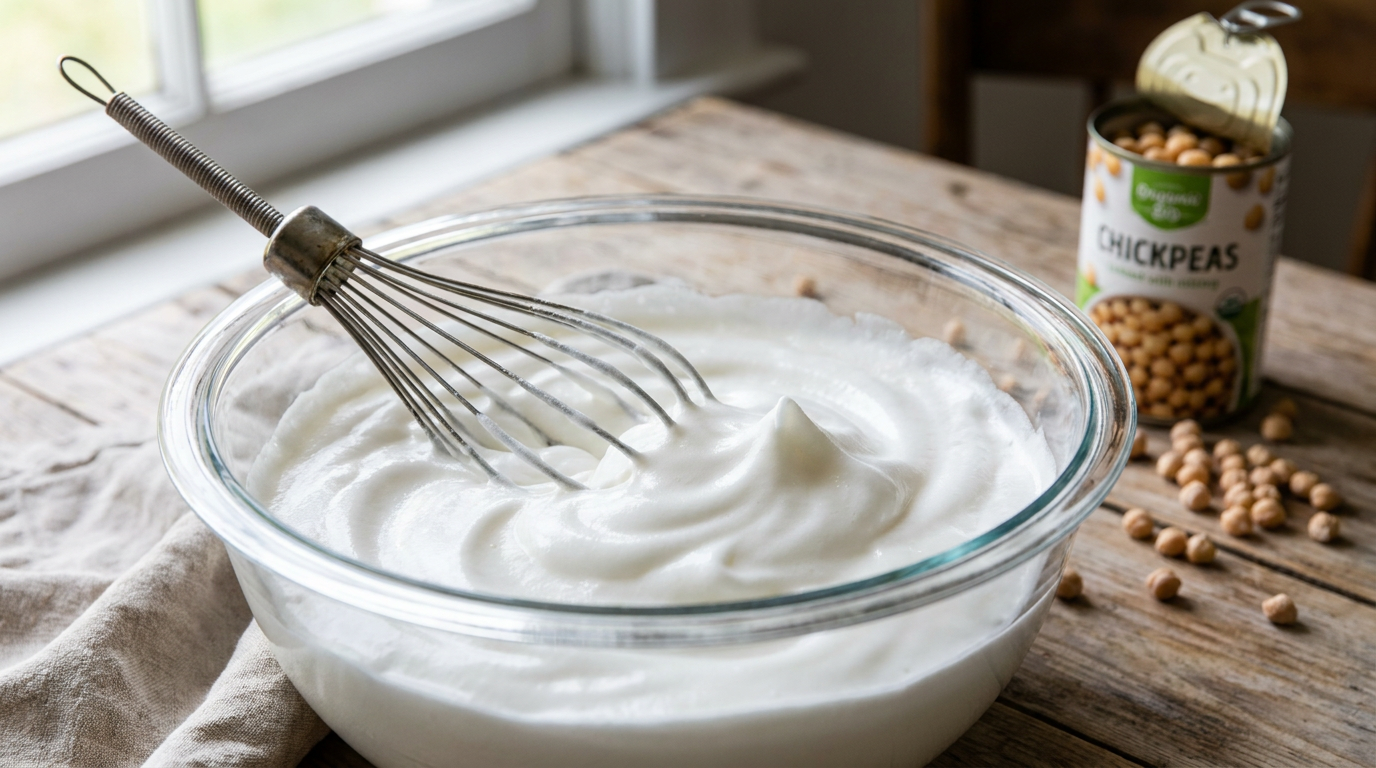
For generations, home cooks have opened cans of chickpeas, drained the murky liquid into the sink, and rinsed the beans without a second thought. That discarded liquid, however, is a culinary goldmine. Known today as aquafaba, this viscous bean water has revolutionized plant-based cooking by solving one of the most persistent challenges in the kitchen: replacing the egg.[5][6]
The term "aquafaba" is a simple amalgamation of the Latin words for water and bean. While it sounds like a highly processed commercial additive, it is literally just the liquid left over after boiling legumes. Though chickpeas are the most popular source due to their mild flavor and light color, the liquid from white beans, navy beans, and even black beans can also be utilized.[1][2][5][6]
To understand why aquafaba is so revolutionary, one must understand the culinary role of the egg. Eggs are polyfunctional ingredients; they do not serve just one purpose. Depending on how they are used, eggs can act as binders, emulsifiers, coagulants, or foaming agents. While ingredients like flaxseed, chia, or applesauce can mimic the binding properties of eggs in dense cakes, they fail completely when a recipe requires the light, airy structure of a meringue or a macaron.[1][3][6]
The discovery of aquafaba's unique properties is a triumph of open-source internet collaboration rather than corporate food science. In December 2014, French musician and vegan food enthusiast Joël Roessel noticed that the water from canned beans could form a foam similar to flax mucilage and protein isolates. He published his findings on a blog, demonstrating its potential in chocolate mousse.[2][6]

A few months later, in March 2015, American software engineer Goose Wohlt took the experiment further. He discovered that chickpea liquid could replace egg whites entirely without the need for additional chemical stabilizers, successfully baking a classic meringue using only bean water and sugar. Wohlt coined the term "aquafaba," and a dedicated Facebook group quickly formed, turning thousands of home cooks into amateur food scientists who crowdsourced recipes for marshmallows, mayonnaise, and cocktails.[2]
But what exactly is happening on a molecular level when bean water is whipped into stiff, glossy peaks? As the culinary trend exploded, actual food scientists began analyzing the liquid to understand its mechanics. They found that during the boiling process, water-soluble proteins and sugars migrate from the inside of the chickpea into the surrounding water.[1][4][7]
Under normal cooking conditions, approximately 5% of the initial dry weight of the bean dissolves into the cooking liquid. The resulting aquafaba is a complex biochemical mixture consisting primarily of polysaccharides, proteins, and plant compounds called saponins.[2][3][4]
Under normal cooking conditions, approximately 5% of the initial dry weight of the bean dissolves into the cooking liquid.
The foaming magic relies heavily on the proteins and saponins. Aquafaba contains roughly 1% protein, specifically low-molecular-weight albumins. When the liquid is whipped, these proteins unfold and coat the air bubbles being beaten into the mixture. This adsorption at the gas-liquid interface reduces interfacial tension, allowing the bubbles to form and persist.[4]
Working alongside the proteins are saponins. Saponins are naturally occurring, soap-like plant compounds characterized by their amphiphilic structure—meaning they have both water-soluble and lipid-soluble components. They act as non-ionic surfactants, creating a rapid, soap-like foam when agitated. Together, the proteins and saponins create the initial airy structure of the whipped aquafaba.[1][4]
However, a foam is useless if it collapses after a few minutes. This is where the polysaccharides come in. The dissolved starches and complex sugars in the aquafaba increase the viscosity of the liquid surrounding the bubbles. By thickening the water phase, polysaccharides prevent the bubbles from merging and collapsing—a process known as creaming—giving the foam its long-lasting stability.[4][7]

Beyond foaming, aquafaba is an exceptional emulsifier. An emulsion is a stable mixture of two liquids that normally repel each other, such as oil and water. The same amphiphilic compounds that trap air bubbles can also coat oil droplets, preventing them from separating. This makes aquafaba the perfect base for creamy, stable vegan mayonnaise or rich salad dressings.[3][4][6]
For home cooks, achieving the perfect texture often requires a simple preparatory step: reduction. The liquid drained straight from a can of chickpeas can sometimes be too dilute, depending on the brand. Boiling the aquafaba on the stove to reduce its volume by about 33% concentrates the proteins and saponins. Once cooled, this thicker, more viscous liquid whips up much faster and holds stiffer peaks.[5][7]
The culinary math for replacing eggs with aquafaba is remarkably straightforward. Generally, three tablespoons of unwhipped aquafaba is equivalent to one whole egg, while two tablespoons will replace a single egg white. A pinch of cream of tartar is often added during whipping to further stabilize the foam, just as it is used with traditional egg whites.[2][5]

While home cooks have fully embraced the ingredient, the commercial food industry is now catching up. Researchers at institutions like the Quadram Institute are actively studying aquafaba to map its biophysical properties and improve extraction methods. Because aquafaba is a natural byproduct of industrial pulse processing, scaling its use could significantly reduce commercial food waste.[3]
The goal of this research is standardization. Homemade aquafaba varies wildly in concentration depending on how long the beans were soaked and boiled. By understanding the exact extraction parameters—temperature, pressure, and pulse genotype—scientists aim to produce a consistent, standardized aquafaba for large-scale bakeries and food manufacturers.[3][4]

Despite its miraculous properties, aquafaba does have limitations. Because its protein content is vastly lower than that of an actual egg white, it cannot provide the same rigid, coagulated structure when baked. This makes it unsuitable for recipes that rely heavily on denatured egg proteins for their physical architecture, such as angel food cake or a classic omelet.[2][3]
Nevertheless, aquafaba remains one of the most significant culinary discoveries of the modern era. By transforming a discarded waste product into a versatile, allergen-friendly staple, it has democratized complex baking for vegans and allergy sufferers alike, proving that sometimes the most magical ingredients are already hiding in the pantry.[6][7]
How we got here
Dec 2014
French musician Joël Roessel discovers that canned bean water can form foams similar to protein isolates.
Mar 2015
Software engineer Goose Wohlt successfully makes vegan meringue using only chickpea liquid and sugar, coining the term 'aquafaba'.
Spring 2015
A dedicated Facebook group launches, crowdsourcing recipes and techniques for using aquafaba in macarons, marshmallows, and mayonnaise.
2018–Present
Food science journals begin publishing peer-reviewed studies on the chemical composition of aquafaba, identifying the roles of saponins and proteins.
2024–2026
Commercial production scales up, with research institutes like Quadram working to standardize aquafaba for the global food industry.
Viewpoints in depth
Food Scientists & Researchers
Focusing on the biochemical mechanisms that make aquafaba work and how to standardize it for industrial use.
For food scientists, aquafaba is a fascinating complex mixture of low-molecular-weight proteins, polysaccharides, and saponins. Researchers at institutions like the Quadram Institute are actively mapping its biophysical properties. Their goal is to understand exactly how pulse genotype, cooking time, and pressure affect the liquid's functional properties. By standardizing the extraction process, they hope to turn a massive byproduct of the pulse-processing industry into a reliable, sustainable ingredient for commercial food manufacturing.
Plant-Based Recipe Developers
Valuing aquafaba as an accessible, allergy-friendly culinary miracle that revolutionized vegan baking.
To vegan bakers and those managing egg allergies, aquafaba is nothing short of alchemy. Before its discovery, replacing the foaming and emulsifying properties of eggs required expensive commercial replacers or complex mixtures of flax and tofu that rarely yielded perfect macarons or meringues. Recipe developers celebrate aquafaba because it is cheap, universally accessible, and utilizes a product that most home cooks were previously pouring down the drain.
Culinary Synthesizers
Highlighting the open-source, community-driven nature of aquafaba's discovery and refinement.
Food historians and synthesizers point to aquafaba as a prime example of internet-era culinary innovation. Unlike traditional food science breakthroughs developed in corporate labs, aquafaba was discovered by a French musician, refined by an American software engineer, and perfected by a global Facebook group of enthusiastic home cooks. This open-source collaboration allowed the ingredient's applications to expand rapidly from simple meringues to complex cocktails and mayonnaise in just a few months.
What we don't know
- Whether aquafaba from other legumes, like lentils or peas, can be standardized to perform as consistently as chickpea liquid.
- How the commercial scale-up of aquafaba extraction will impact the broader economics of the global pulse-farming industry.
Key terms
- Aquafaba
- The viscous cooking liquid of legumes, most commonly chickpeas, used as a plant-based egg substitute.
- Saponins
- Naturally occurring plant compounds that have soap-like, foaming properties when agitated.
- Emulsifier
- An ingredient that helps combine two liquids that normally do not mix, such as oil and water.
- Polysaccharides
- Complex carbohydrates, like starches, that help thicken liquids and stabilize foams.
- Surfactant
- A substance that reduces the surface tension of a liquid, allowing bubbles to form and stabilize.
Frequently asked
Does aquafaba taste like chickpeas?
While raw aquafaba has a mild bean odor, the flavor disappears entirely when baked or mixed with sugar and vanilla in desserts.
Can I use the liquid from other beans?
Yes, white beans, navy beans, and even black beans work. However, chickpeas and white beans are preferred because their liquid is lighter in color and flavor.
Can aquafaba replace eggs in a scramble or omelet?
No. Aquafaba lacks the high protein content needed to coagulate and form a solid structure like a scrambled egg. It is best for foaming, binding, and emulsifying.
How long does aquafaba last in the fridge?
It typically lasts 3 to 5 days in an airtight container in the refrigerator, and it can also be frozen in ice cube trays for months.
Sources
Source coverage
7 outlets
3 viewpoints surfaced






[1]McGill University Office for Science and SocietyFood Scientists & Researchers
Aquafaba: The Vegan Egg Replacer
Read on McGill University Office for Science and Society →[2]WikipediaCulinary Synthesizers
Aquafaba
Read on Wikipedia →[3]Quadram InstituteFood Scientists & Researchers
The science of aquafaba
Read on Quadram Institute →[4]National Center for Biotechnology InformationFood Scientists & Researchers
Processes for obtaining aquafaba, chemical composition, foam stability, and technological properties
Read on National Center for Biotechnology Information →[5]The Hidden VeggiesPlant-Based Recipe Developers
What is Aquafaba? (How to make it & use it)
Read on The Hidden Veggies →[6]PB with JPlant-Based Recipe Developers
What is Aquafaba? The Science Behind the Magic Bean Water
Read on PB with J →[7]Factlen Editorial TeamCulinary Synthesizers
Synthesis by Factlen editorial team
Read on Factlen Editorial Team →
Every angle. Every day.
Get food drink stories with full source coverage and perspective breakdowns delivered to your inbox.