
The Science of Aquafaba: How Chickpea Water Revolutionized Plant-Based Baking
Once discarded as industrial waste, the viscous liquid from cooked chickpeas has transformed vegan pastry. Food scientists are now decoding the complex protein mechanics that allow aquafaba to perfectly mimic egg whites.
By Factlen Editorial Team
- Food Scientists & Rheologists
- Focuses on the molecular mechanisms, protein unfolding, and colloidal stability of the liquid.
- Plant-Based Culinary Innovators
- Focuses on practical applications, recipe development, and replacing animal products in traditional pastry.
- Sustainability & Upcycling Advocates
- Focuses on reducing food waste and valorizing industrial byproducts.
What's not represented
- · Commercial chickpea canneries managing wastewater streams
- · Traditional pastry chefs skeptical of plant-based egg alternatives
Why this matters
Understanding the science of aquafaba demystifies one of the most significant culinary breakthroughs of the decade. By upcycling a common waste product, food science has unlocked sustainable, allergen-friendly alternatives for everything from home baking to commercial mayonnaise production.
Key points
- Aquafaba, the cooking liquid from chickpeas, perfectly mimics the foaming and emulsifying properties of egg whites.
- Its functionality relies on heat-stable globulin proteins (vicilin and legumin) that unfold during cooking to trap air.
- Natural plant surfactants called saponins and gelatinized starches help stabilize the delicate bubble walls.
- Aquafaba foams possess a higher liquid-holding capacity than traditional egg white foams.
- Because chickpea proteins do not polymerize like egg albumin, aquafaba meringues require lower, slower baking temperatures.
- The discovery has turned millions of gallons of industrial legume wastewater into a premium, sustainable food ingredient.
For decades, the culinary holy grail of plant-based baking was the egg white. A natural biological marvel composed of roughly 90 percent water and 10 percent protein, the egg white possesses an extraordinary ability to unfold when whipped, trapping air to create towering, stable foams.[4]
Replacing this delicate architecture without resorting to a chemistry set of industrial powders, modified starches, or synthetic gums proved nearly impossible. As a result, classic pastries relying on aeration—from crisp meringues and airy macarons to delicate angel food cakes—remained largely out of reach for vegan chefs and those with egg allergies.[4]
That changed in 2014 when a French musician named Joël Roessel and an American software engineer named Goose Wohlt independently discovered that the viscous, yellowish liquid discarded from cans of chickpeas possessed remarkable functional properties. Wohlt coined the term "aquafaba"—a portmanteau of the Latin words for water and bean—and sparked an open-source culinary revolution as thousands of home cooks began experimenting with the liquid.[4][8]
But while the internet marveled at the "magic bean water," food scientists recognized a complex colloidal system at work. Aquafaba is not merely starch-thickened water; its ability to mimic egg albumin is rooted in a highly specific combination of seed storage proteins, complex carbohydrates, and natural surfactants.[1][6]

The primary drivers of aquafaba's foaming capacity are two heat-stable globulin proteins found in chickpeas: vicilin, which has a molecular weight of around 70 kilodaltons (kDa), and legumin, at approximately 300 kDa. In their raw state, these proteins are tightly folded.[1][6]
However, during the prolonged high-heat process of boiling or commercial canning, these proteins undergo thermal denaturation. The heat causes the globulins to partially unfold, exposing hydrophobic (water-repelling) regions that are normally buried deep within their molecular structure.[1][5]
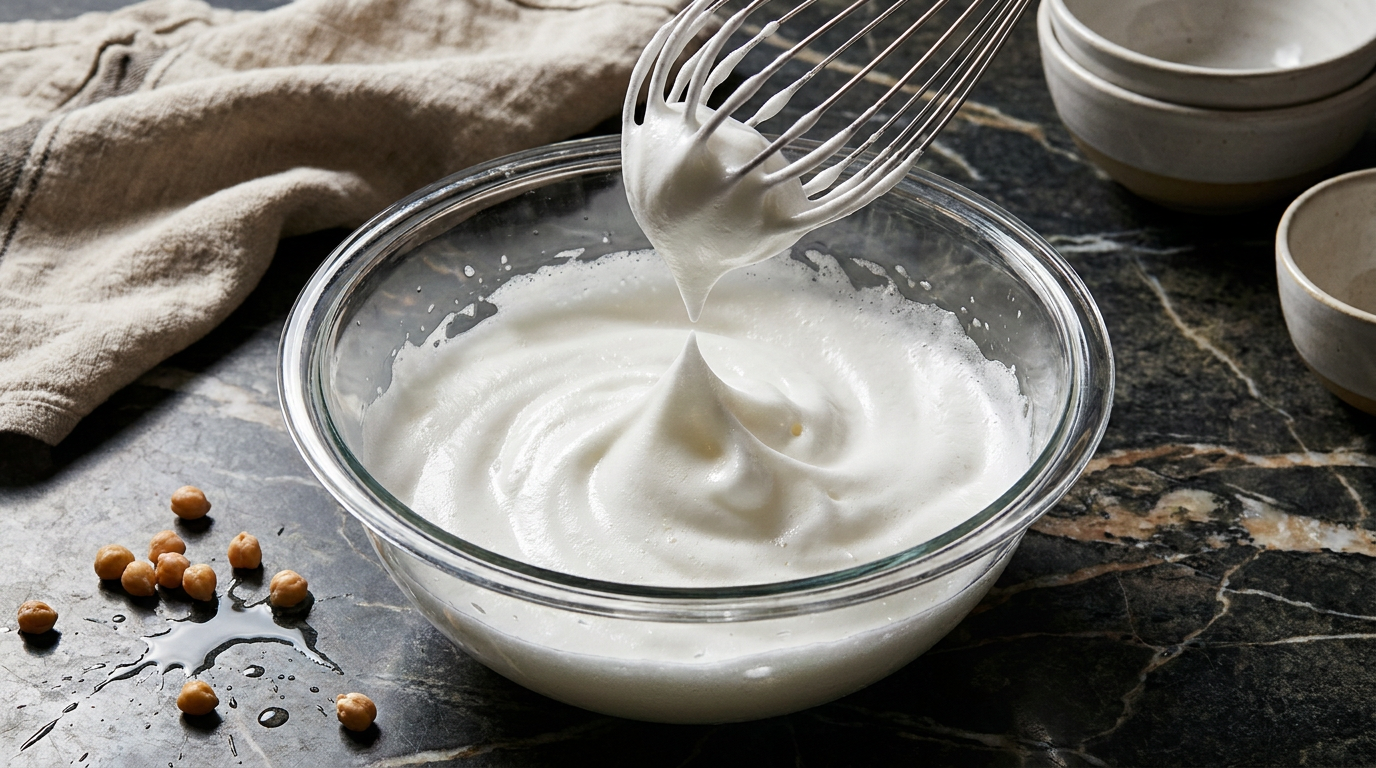
When a whisk introduces mechanical energy and air into the liquid, these unfolded proteins rapidly migrate to the air-water interface. The hydrophobic regions align themselves facing the trapped air, while the hydrophilic (water-attracting) regions remain anchored in the liquid, effectively reducing surface tension and creating a stable bubble wall.[1][6]
Yet, aquafaba's protein content is relatively low—typically hovering between 1.5 and 2 percent, compared to the 10 percent found in egg whites. To achieve structural integrity with such low protein levels, aquafaba relies on a synergistic relationship with other compounds leached from the chickpeas.[1][3]

Yet, aquafaba's protein content is relatively low—typically hovering between 1.5 and 2 percent, compared to the 10 percent found in egg whites.
Saponins, naturally occurring plant compounds whose name derives from the Latin word for soap, act as powerful surfactants that further stabilize the bubble walls. Simultaneously, gelatinized starches and pectins increase the viscosity of the surrounding water, providing a thick, supportive matrix that prevents the trapped air bubbles from draining or popping.[1][4][5]
In some metrics, this plant-based matrix actually outperforms its animal counterpart. Researchers at Aarhus University found that aquafaba foams possess a significantly higher liquid-holding capacity than egg white foams, meaning they bind more water relative to their volume.[2]
Furthermore, aquafaba demonstrates exceptional emulsifying stability. The proteins are highly effective at binding water and oil together, making the liquid an ideal base for egg-free mayonnaise and creamy dressings, remaining stable even under varying salt concentrations.[2][5]

Despite these advantages, aquafaba behaves differently than egg whites under thermal stress. Because chickpea proteins are highly heat-stable, they do not polymerize and set as rigidly as egg albumin does when baked.[5]
This explains why aquafaba meringues are prone to collapsing in the oven if baked too quickly. They require lower temperatures and longer baking times to slowly dehydrate the three-dimensional foam structure without causing the delicate protein network to rupture.[5][6]
The chemical environment also dictates success. Adding an acid, such as cream of tartar, lowers the pH of the aquafaba. This slight acidification helps further denature the proteins and neutralizes their electrical charge, allowing them to pack more tightly around the air bubbles for a stiffer, more resilient foam.[6]

Consistency remains the primary challenge for commercial applications. The functional properties of canned aquafaba vary wildly depending on the chickpea cultivar, the ratio of water to beans, and the specific hydrothermal canning conditions.[3][7]
Food technologists have found that reducing the liquid to achieve a solid concentration of roughly 4 percent yields the most reliable foaming density. Clarification processes and precise temperature controls during extraction can increase foam stability by up to 69 percent compared to standard canning liquid.[3][6]
How we got here
Dec 2014
French musician Joël Roessel discovers that canned bean liquid can form foams and publishes early recipes.
Mar 2015
Software engineer Goose Wohlt perfects a two-ingredient vegan meringue, coins the term 'aquafaba', and shares it online.
May 2016
Commercial food companies begin launching the first vegan mayonnaises utilizing aquafaba instead of synthetic gums.
Sep 2020
Aarhus University publishes research detailing aquafaba's superior liquid-holding capacity compared to egg whites.
Viewpoints in depth
Food Scientists & Rheologists
Focuses on the molecular mechanisms, protein unfolding, and colloidal stability of the liquid.
For food chemists, aquafaba is a fascinating study in colloidal physics. They emphasize that the liquid's functionality is not a culinary accident, but the result of specific seed storage globulins—vicilin and legumin—undergoing thermal denaturation. By measuring surface tension and molecular weights, researchers in this camp seek to isolate exactly how these proteins interact with saponins and starches to form viscoelastic networks, aiming to replicate or enhance these properties for industrial food applications.
Plant-Based Culinary Innovators
Focuses on practical applications, recipe development, and replacing animal products in traditional pastry.
Chefs and vegan bakers view aquafaba as the key that unlocked the final frontier of plant-based pastry. Before its discovery, achieving aeration without eggs required complex, often inaccessible industrial ingredients. This camp prioritizes practical kitchen techniques—such as reducing the liquid to a 4 percent solid concentration, utilizing cream of tartar for pH balance, and adjusting baking temperatures—to reliably produce macarons, meringues, and mousses that rival traditional French patisserie.
Sustainability & Upcycling Advocates
Focuses on reducing food waste and valorizing industrial byproducts.
Environmental scientists and sustainability advocates highlight aquafaba's potential to transform industrial waste streams. Legume processing generates millions of gallons of cooking water that is typically treated as wastewater, incurring environmental and economic costs. This perspective champions the upcycling of this byproduct into a high-value functional ingredient, arguing that aquafaba represents a scalable model for creating sustainable, circular food systems.
What we don't know
- How to perfectly standardize the protein and starch concentrations in commercially canned aquafaba across different chickpea cultivars.
- The exact long-term stability limits of aquafaba emulsions when subjected to extreme industrial freezing and thawing cycles.
- Whether the specific functional proteins in aquafaba can be efficiently extracted and dried into a shelf-stable powder at a mass commercial scale.
Key terms
- Aquafaba
- The viscous cooking liquid of legumes, most commonly chickpeas, used as a functional plant-based egg replacement.
- Globulins
- A family of seed storage proteins, such as vicilin and legumin, that unfold during cooking to provide foaming properties.
- Thermal Denaturation
- The process where heat alters the natural three-dimensional structure of a protein, exposing its internal components.
- Saponins
- Naturally occurring plant compounds that act as surfactants, helping to stabilize bubbles and emulsions.
- Colloidal System
- A mixture where microscopic particles of one substance are suspended evenly throughout another, such as air bubbles trapped in a liquid foam.
Frequently asked
Can I use the liquid from other canned beans?
Yes, the liquid from white beans or cannellini beans works similarly, but chickpea water is preferred because it has the most neutral flavor and an optimal protein-to-starch ratio.
Why do my aquafaba meringues collapse in the oven?
Aquafaba proteins do not polymerize as rigidly as egg whites when heated. They require a lower baking temperature and a longer baking time to slowly dehydrate the foam structure.
Does aquafaba taste like chickpeas?
While the raw liquid and unbaked foam have a mild legume scent, the flavor dissipates entirely once baked or mixed with sugar and extracts like vanilla.
How much aquafaba replaces one egg white?
As a general rule, two tablespoons (about 30 milliliters) of aquafaba can replace one medium egg white in most baking recipes.
Sources
Source coverage
8 outlets
3 viewpoints surfaced








[1]MDPIFood Scientists & Rheologists
Molecular Weight-Dependent Foaming Properties of Reheated Aquafaba
Read on MDPI →[2]Aarhus UniversityFood Scientists & Rheologists
Are the food ingredients of the future plant-based? The functional properties of aquafaba
Read on Aarhus University →[3]Food HydrocolloidsSustainability & Upcycling Advocates
Physico-chemical and foaming properties of chickpeas cooking water (aquafaba)
Read on Food Hydrocolloids →[4]Houston ChroniclePlant-Based Culinary Innovators
Vegans whip up a secret weapon: Aquafaba
Read on Houston Chronicle →[5]National Institutes of HealthFood Scientists & Rheologists
Aquafaba from Chickpeas: Composition and Functional Properties
Read on National Institutes of Health →[6]Factlen Editorial TeamPlant-Based Culinary Innovators
Synthesis by Factlen editorial team
Read on Factlen Editorial Team →[7]Technical University of DenmarkFood Scientists & Rheologists
Effect of extraction conditions on the yield, composition, and foaming properties of aquafaba
Read on Technical University of Denmark →[8]WikipediaPlant-Based Culinary Innovators
Aquafaba
Read on Wikipedia →
Every angle. Every day.
Get food drink stories with full source coverage and perspective breakdowns delivered to your inbox.