
The Science Behind Bioluminescent Beaches and Where to Find Them
Microscopic organisms called dinoflagellates use a complex chemical reaction to illuminate coastal waters, creating a glowing phenomenon that is driving a boom in eco-tourism.
By Factlen Editorial Team
- Marine Biologists
- Scientists focused on the evolutionary mechanisms and ecological role of bioluminescence.
- Eco-Tourism Operators
- Travel providers who balance the demand for nocturnal sightseeing with the preservation of the bays.
- Conservationists
- Advocates focused on protecting fragile bio bays from pollution, over-tourism, and climate change.
What's not represented
- · Local residents living near major bio bays
- · Commercial fishermen operating in bioluminescent waters
Why this matters
Understanding the delicate biology behind glowing beaches helps travelers make responsible eco-tourism choices, ensuring these rare and magical ecosystems survive for future generations.
Key points
- Bioluminescent beaches are primarily illuminated by dinoflagellates, single-celled marine plankton that emit light when mechanically disturbed.
- The glow is produced by a highly efficient chemical reaction between luciferin and oxygen, creating 'cold light' that generates almost no heat.
- Marine biologists believe the light serves as a 'burglar alarm' defense mechanism, attracting larger predators to eat the organisms grazing on the plankton.
- Mosquito Bay in Puerto Rico holds the Guinness World Record for the brightest bioluminescent bay, though the phenomenon can be seen globally.
- Bio bays are fragile ecosystems highly susceptible to light pollution, climate events, and chemicals from sunscreens and boat fuel.
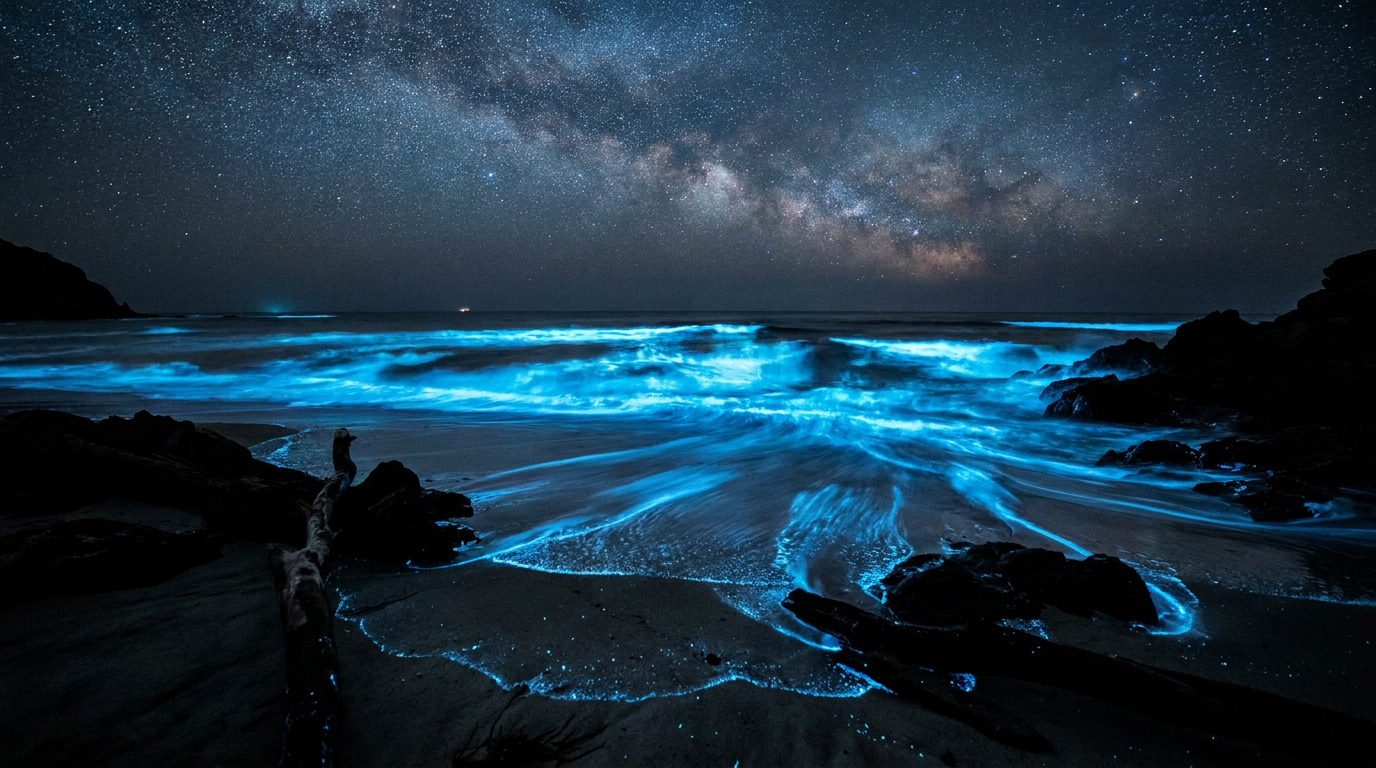
Imagine walking along a dark shoreline where every crashing wave glows with an electric, neon-blue light. Footprints left in the wet sand shimmer like scattered stars, and the wake of a kayak leaves a glowing trail through the water. This is the magic of a bioluminescent beach, a natural phenomenon that transforms ordinary coastlines into surreal, glowing landscapes. Often referred to as the "Sea of Stars," these glowing waters have captivated travelers and scientists alike. In recent years, the pursuit of this phenomenon has fueled a massive rise in "noctourism"—traveling specifically for nocturnal sightseeing. From the remote atolls of the Maldives to the sheltered bays of Puerto Rico, bioluminescence offers one of the natural world's most spectacular light shows, drawing thousands of visitors who want to witness the ocean glowing in the dark.[3][4][5]
But the glowing water is not a trick of the light or a reflection of the night sky. It is the result of millions of microscopic living organisms illuminating the ocean in unison. Understanding how and why these tiny creatures produce such a dazzling display reveals a complex and highly evolved underwater ecosystem. The primary architects of these glowing beaches are dinoflagellates, a type of single-celled marine plankton. While there are many bioluminescent organisms in the ocean—including certain jellyfish, squid, and deep-sea fish—dinoflagellates are the most common cause of glowing coastal waters. Species such as Noctiluca scintillans float near the ocean's surface, gathering in massive numbers when conditions are right. When these plankton form dense blooms, the sheer volume of organisms turns the water into a reactive, light-producing canvas.[1][3]
The glow itself is the product of a highly efficient biochemical reaction that takes place entirely within the single-celled organism. Inside the dinoflagellate, a light-emitting molecule called luciferin reacts with oxygen. This reaction is catalyzed by an enzyme known as luciferase, which speeds up the chemical process. When these elements combine, they produce a compound called oxyluciferin and release energy in the form of visible light. Unlike the light produced by a traditional incandescent bulb, which wastes most of its energy as heat, the glow of a dinoflagellate is known as "cold light." Less than 20 percent of the energy generated in this chemical reaction produces thermal radiation. This incredible efficiency allows the delicate organisms to shine brightly without burning themselves up or altering the temperature of the surrounding water.[1][6][8]

This chemical reaction is not continuous; it is specifically triggered by mechanical stress. When the water surrounding the dinoflagellates is disturbed—whether by a breaking wave, the hull of a boat, or a predator swimming through the bloom—a rapid influx of protons drops the pH within the cell. This internal shift activates the luciferase enzyme, resulting in a flash of light that lasts just a fraction of a second, typically around 100 milliseconds. Because millions of these organisms are flashing simultaneously in response to the same wave or paddle stroke, the water appears to glow continuously to the human eye. The speed of this reaction, taking less than 20 milliseconds from the initial stimulus to the emission of light, makes it one of the most rapid cellular processes known to science.[1][2][6]
This chemical reaction is not continuous; it is specifically triggered by mechanical stress.
But why would a microscopic organism expend precious cellular energy to light up the ocean? Marine biologists believe the primary function of this bioluminescence is defense. The most prominent theory explaining this behavior is known as the "burglar alarm" hypothesis. When a primary predator, such as a small crustacean, begins grazing on the dinoflagellates, the resulting mechanical disturbance triggers the plankton to flash. This sudden burst of light acts as a literal alarm, illuminating the primary predator and attracting the attention of larger, secondary predators. By drawing in a bigger threat to eat their attackers, the dinoflagellates increase their own chances of survival. The flashes can also serve to directly startle or disorient predators, disrupting their feeding behavior and reducing the number of dinoflagellates consumed.[2][6]
Witnessing this evolutionary defense mechanism in person requires specific conditions, which is why permanent bioluminescent bays, or "bio bays," are incredibly rare. They require a delicate balance of warm water, shallow depth, and a narrow opening to the sea, which traps the dinoflagellates and allows their populations to concentrate. The undisputed capital of bioluminescence is Mosquito Bay on the island of Vieques in Puerto Rico. Recognized by the Guinness Book of World Records as the brightest bioluminescent bay on Earth, its waters contain exceptionally high concentrations of dinoflagellates. Visitors who take guided kayak tours through the bay on a dark night describe the experience as paddling through liquid starlight, with every stroke of the paddle igniting a neon-blue fire in the water.[4][5][7][8]

Beyond Puerto Rico, other famous locations include the Luminous Lagoon in Jamaica, where the mixture of fresh water from the Martha Brae River and salt water from the Caribbean Sea creates an ideal environment for the plankton to thrive. In the Maldives, Vaadhoo Island is renowned for its "Sea of Stars," where glowing phytoplankton wash ashore, illuminating the wet sand. Timing is crucial for noctourism at any of these sites. The glow is entirely invisible during the day, as the dinoflagellates operate on a strict circadian rhythm. They use sunlight to photosynthesize and recharge their luciferin reserves, only activating their bioluminescent capabilities at night. To see the phenomenon at its absolute best, travelers must seek out dark, moonless nights, far from the light pollution of major cities.[3][4][5][6]
The intensity of the glow is also deeply tied to environmental factors. Nutrient-rich waters, often bolstered by recent rainfall that washes organic matter into the bays, can trigger massive algae blooms. However, the ecosystems that support these blooms are incredibly fragile and highly sensitive to both natural and human interference. In September 2017, Hurricane Maria devastated Puerto Rico and severely disrupted the delicate balance of Mosquito Bay. The intense winds and massive storm surge flushed the dinoflagellates out to the open sea, and the world's brightest bay went completely dark for months. Fortunately, the ecosystem proved resilient, and the glowing waters eventually returned to their former glory, but the event underscored the extreme vulnerability of these unique coastal habitats.[3][7][8]

Human activity poses an even more persistent threat to these glowing waters. Chemicals from sunscreens, insect repellents, and boat fuel can easily poison the dinoflagellates and decimate the local population. As a result, strict conservation measures have been implemented in the most famous bio bays. In Mosquito Bay, swimming is strictly prohibited, and only licensed, non-motorized tours—typically using clear-bottom kayaks—are allowed to enter the water. In other locations, such as La Parguera in Puerto Rico or the Luminous Lagoon in Jamaica, swimming is still permitted, but conservationists urge travelers to avoid wearing chemical lotions. As the popularity of bioluminescent tourism grows, the challenge lies in balancing the awe-inspiring experience with the need to protect the organisms that create it, ensuring these magical coastlines continue to light up the dark for generations to come.[5][7][8]
How we got here
540 Million Years Ago
Bioluminescence first emerges in marine organisms, evolving independently dozens of times across different species.
1950s
Scientists develop the ability to culture dinoflagellates in the laboratory, allowing for detailed study of their luminescent chemistry.
2008
Mosquito Bay in Puerto Rico is officially recognized by the Guinness Book of World Records as the brightest bioluminescent bay in the world.
September 2017
Hurricane Maria devastates Puerto Rico, flushing the dinoflagellates out of Mosquito Bay and causing the waters to go dark.
Mid-2018
Mosquito Bay miraculously recovers, with dinoflagellate populations returning to pre-hurricane levels and restoring the bay's famous glow.
Viewpoints in depth
Marine Biologists
Scientists focused on the evolutionary mechanisms and ecological role of bioluminescence.
For marine biologists, the glowing ocean is less about aesthetics and more about survival. Researchers view dinoflagellate bioluminescence primarily through the lens of the 'burglar alarm' hypothesis—a highly evolved defense mechanism where microscopic plankton use light to expose their predators to even larger threats. Biologists also study the complex circadian rhythms that govern these organisms, noting that their ability to recharge luciferin during the day and flash at night represents a highly efficient use of cellular energy in nutrient-competitive marine environments.
Eco-Tourism Operators
Travel providers who balance the demand for nocturnal sightseeing with the preservation of the bays.
The travel industry has embraced 'noctourism,' turning bioluminescent bays into highly sought-after destinations. For tour operators, these glowing waters are vital economic engines that draw visitors to remote islands and coastal towns. Operators emphasize the experiential magic of the phenomenon—often utilizing clear-bottom kayaks to enhance the visual impact—while increasingly adopting sustainable practices. Many now act as frontline educators, teaching tourists about the delicate nature of the dinoflagellates and enforcing rules against chemical sunscreens and flash photography.
Conservationists
Advocates focused on protecting fragile bio bays from pollution, over-tourism, and climate change.
Conservationists warn that bioluminescent bays are among the most fragile ecosystems on the planet. They point to the temporary darkening of Puerto Rico's Mosquito Bay following Hurricane Maria as proof of how easily environmental shocks can disrupt the dinoflagellate populations. These advocates push for strict regulations, such as banning motorized boats and prohibiting swimming in the brightest bays, arguing that the introduction of foreign chemicals—from insect repellent to hair products—can quickly decimate the microscopic organisms that make the glow possible.
What we don't know
- Exactly how long-term climate change and rising ocean temperatures will impact the global distribution and frequency of dinoflagellate blooms.
- Whether bioluminescence plays a secondary role in mate attraction for certain species, beyond its primary defensive function.
- The precise threshold of chemical pollution that causes a bioluminescent bay to permanently lose its ability to glow.
Key terms
- Dinoflagellate
- A type of single-celled marine plankton responsible for the majority of bioluminescence in coastal waters.
- Luciferin
- The light-emitting chemical compound found within bioluminescent organisms.
- Luciferase
- The enzyme that catalyzes the reaction between luciferin and oxygen, resulting in the production of light.
- Noctourism
- A growing travel trend where tourists visit destinations specifically for night-time natural phenomena, such as glowing beaches.
- Burglar Alarm Hypothesis
- The scientific theory that plankton emit light when attacked to attract a larger predator that will eat their attacker.
Frequently asked
Is it safe to swim in bioluminescent water?
Generally, yes. The glowing dinoflagellates are harmless to humans. However, some bio bays prohibit swimming to protect the fragile organisms from the chemicals in sunscreens and lotions.
Why does the water only glow at night?
Dinoflagellates operate on a circadian rhythm. They use sunlight during the day to photosynthesize and recharge their light-producing chemicals, saving their bioluminescent flashes for the dark.
Can you take glowing water home in a jar?
No. The dinoflagellates require a specific balance of nutrients, oxygen, and water flow to survive. If trapped in a jar, they will quickly exhaust their energy and die.
Does the glowing water produce heat?
No. Bioluminescence is a form of 'cold light.' The chemical reaction is incredibly efficient, with less than 20 percent of the energy released as heat.
Sources
Source coverage
8 outlets
3 viewpoints surfaced






[1]American Chemical SocietyMarine Biologists
Bioluminescent algae light up the ocean near a beach
Read on American Chemical Society →[2]UC San DiegoMarine Biologists
Dinoflagellate Bioluminescence
Read on UC San Diego →[3]Marine Biological LaboratoryConservationists
America's 5 Best Bioluminescent Beaches
Read on Marine Biological Laboratory →[4]Lonely PlanetEco-Tourism Operators
9 of the best places in the world to see bioluminescence
Read on Lonely Planet →[5]Outside MagazineEco-Tourism Operators
The 9 Best Bioluminescent Bays in the World
Read on Outside Magazine →[6]StudySmarterMarine Biologists
Dinoflagellates: Bioluminescence, Blooms & Ecology
Read on StudySmarter →[7]Factlen Editorial TeamConservationists
Synthesis by Factlen editorial team
Read on Factlen Editorial Team →[8]SolgaardConservationists
Where is the best place to see a bioluminescence beach?
Read on Solgaard →
Every angle. Every day.
Get travel stories with full source coverage and perspective breakdowns delivered to your inbox.