
The Science and Magic of Bioluminescent Beaches: How to Find and Understand Nature's Glowing Coastlines
Microscopic marine plankton use a rapid chemical reaction to produce dazzling blue light, creating one of nature's most spectacular phenomena. Understanding the science behind bioluminescent bays reveals a complex evolutionary defense mechanism and highlights the urgent need for coastal conservation.
By Factlen Editorial Team
- Marine Biologists
- Focus on the evolutionary purpose, cellular mechanics, and ecological health of the dinoflagellates.
- Eco-Tourism Operators
- Focus on sustainable travel, protecting mangrove habitats, and providing low-impact visitor experiences.
- Night Photographers
- Focus on the technical equipment and environmental conditions required to capture the phenomenon visually.
What's not represented
- · Local coastal residents affected by tourism traffic
- · Indigenous communities with historical ties to glowing bays
Why this matters
Experiencing a bioluminescent bay is a bucket-list travel moment, but understanding the fragile science behind the glow is crucial for protecting it. As coastal development and light pollution threaten these rare ecosystems, responsible eco-tourism and environmental awareness are the only ways to ensure they survive for future generations.
Key points
- Bioluminescent beaches glow due to dinoflagellates, microscopic plankton that emit blue light when physically disturbed.
- The glow is a defense mechanism known as the 'Burglar Alarm,' designed to attract large predators to eat the plankton's attackers.
- The light is produced by a rapid chemical reaction between the molecule luciferin and the enzyme luciferase inside the cell.
- Mosquito Bay in Puerto Rico and the Luminous Lagoon in Jamaica are among the few places with the perfect conditions for year-round bioluminescence.
- Capturing the phenomenon on camera requires a tripod, long exposure times, and high ISO settings.
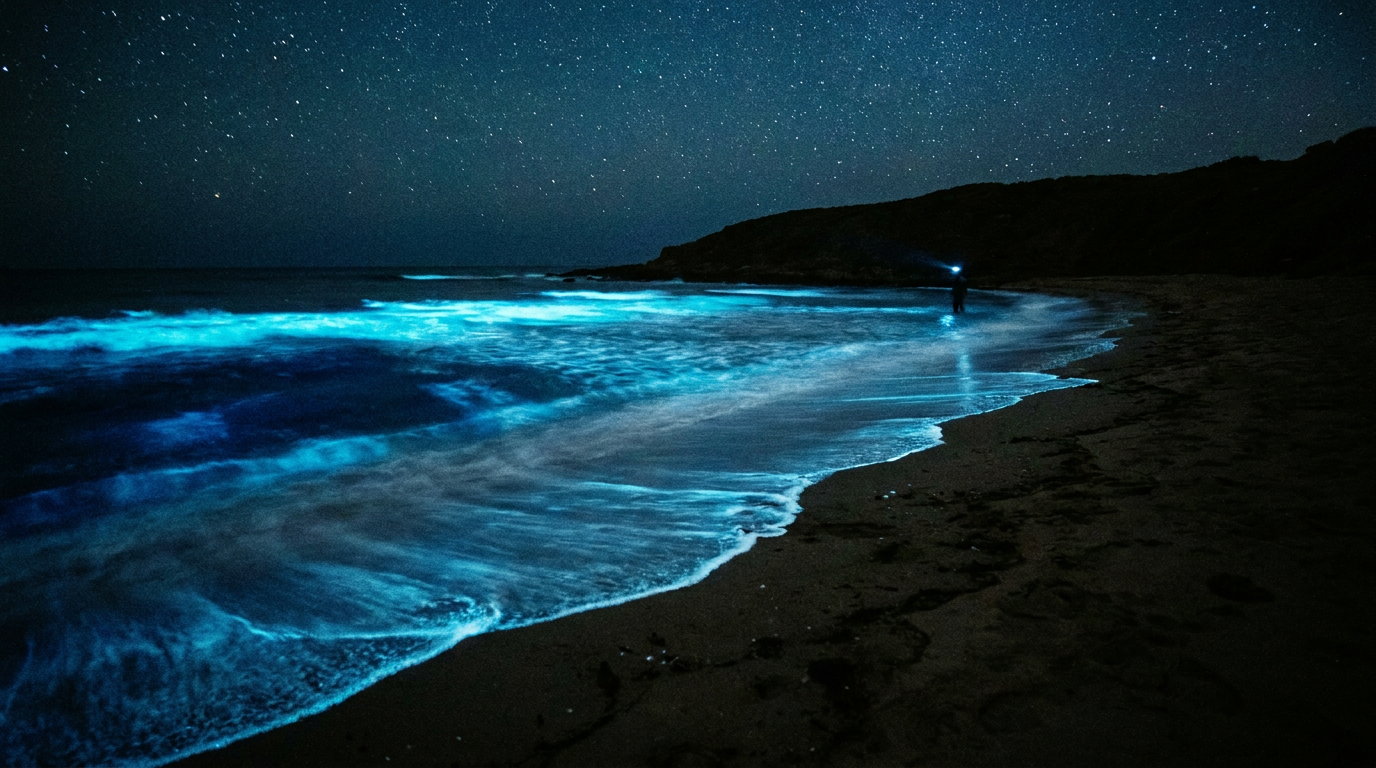
Walking along a dark shoreline and watching the waves crash in a brilliant, neon-blue glow feels like stepping onto another planet. For centuries, sailors, explorers, and coastal dwellers have marveled at the "Sea of Stars," a phenomenon where the ocean surface sparkles with ethereal light at night. While it looks like pure magic, this glowing water is actually one of the most sophisticated biological defense mechanisms on Earth. Bioluminescence—the production and emission of light by a living organism—occurs across various branches of the tree of life, but the spectacular blue waves that draw travelers to tropical bays and remote beaches are primarily the work of microscopic marine plankton known as dinoflagellates. These single-celled organisms transform the mechanical energy of moving water into a dazzling visual display.[1][8]
The sheer speed and efficiency of this natural light show are staggering to scientists who study marine biology. When a dinoflagellate is disturbed by physical movement—whether from a breaking wave, a kayak paddle slicing through the water, or a swimmer's hand—it emits a flash of light in less than 20 milliseconds. This rapid response takes place inside specialized cellular organelles called scintillons, which are clustered near the periphery of the organism's cell membrane. When mechanical pressure distorts the cell, it triggers a cascade of electrical signals, opening gated channels that allow positively charged calcium ions to flood into the scintillon from the surrounding cellular environment.[2][6]
This sudden influx of calcium ions rapidly alters the internal environment of the scintillon, dropping its pH and creating a highly acidic condition. This chemical shift acts as a molecular switch, forcing an enzyme called luciferase to oxidize a light-emitting molecule known as luciferin. The resulting chemical reaction releases energy in the form of photons, producing a brilliant "cold light" that generates almost no heat, ensuring the microscopic organism isn't burned by its own defense mechanism. Because blue light travels furthest through the dense medium of seawater, the resulting flash is a vibrant, electric cyan that perfectly illuminates the surrounding ocean.[2][3]

But why would a microscopic organism expend so much precious metabolic energy to light up the ocean? Evolutionary biologists point to the "Burglar Alarm" hypothesis to explain this behavior. Dinoflagellates are constantly hunted by primary consumers, such as tiny marine crustaceans called copepods. When a copepod disturbs the water to feed, the dinoflagellate flashes its bright blue light. This sudden illumination acts as a biological siren, spotlighting the grazing copepod in the dark water and attracting the attention of higher-level predators, like fish, which swoop in to eat the crustacean. By lighting up its attacker, the dinoflagellate effectively summons a larger bodyguard to eliminate the threat.[2]
While dinoflagellates are ubiquitous in the world's oceans, they rarely concentrate in numbers high enough to create a highly visible glow. To witness a truly spectacular display, travelers must seek out specific geographical anomalies known as bioluminescent bays. Mosquito Bay, located on the island of Vieques in Puerto Rico, currently holds the Guinness World Record for the brightest bioluminescent bay on Earth. Its unique geography features a narrow, shallow inlet that traps the plankton inside the bay, preventing them from washing out to the open sea while allowing them to multiply in a protected, calm environment.[4][7]
While dinoflagellates are ubiquitous in the world's oceans, they rarely concentrate in numbers high enough to create a highly visible glow.
Crucially, Mosquito Bay is surrounded by dense, thriving forests of red mangroves. As the mangrove leaves fall into the water and slowly decompose, they release high concentrations of Vitamin B-12 and other essential nutrients that dinoflagellates require to thrive and multiply. Similar ideal conditions exist at the Luminous Lagoon in Jamaica, where the mixing of warm, fresh river water with the salty Caribbean Sea creates a nutrient-rich estuarine environment. This perfect balance of salinity and nutrients sustains a massive, year-round population of glowing microorganisms, making it one of the most reliable places on the planet to witness the phenomenon.[4][7]

The phenomenon is not entirely restricted to tropical climates. In the Pacific Northwest, the nutrient-dense waters of the San Juan Islands in Washington State host seasonal blooms of bioluminescent plankton, offering kayakers a stunning cold-water version of the light show during the summer months. Meanwhile, in places like Toyama Bay, Japan, the ocean glows for a completely different biological reason: millions of bioluminescent firefly squid rise from the deep ocean to spawn in the shallows, illuminating the water with a dazzling, pulsating blue light that rivals the Caribbean's dinoflagellate bays in both brightness and beauty.[4][7]
Capturing this ethereal glow on camera is notoriously difficult, as the human eye is far more sensitive to the faint light than a standard smartphone sensor. To photograph bioluminescence successfully, photographers must rely on manual camera settings, a sturdy tripod, and a fast lens with a wide aperture—ideally f/2.8 or lower—to let in as much light as possible. Because the light is fleeting and relatively dim, the camera's sensor needs time to absorb the scene, requiring long exposure times ranging anywhere from 5 to 60 seconds depending on the intensity of the bloom.[5]
During these long exposures, any movement of the camera will result in a blurry, unusable image, making a heavy tripod and a remote shutter release absolutely essential. Photographers must also push their camera's ISO settings high—often between 3200 and 6400—to increase the sensor's sensitivity to the dim blue flashes. The ultimate challenge lies in balancing the high ISO, which can introduce distracting digital noise or grain into the image, with a shutter speed that is slow enough to capture the ambient glow but fast enough to retain the crisp shape of the crashing waves or the silhouette of a kayak.[5]
Despite their global popularity as travel destinations, bioluminescent bays are incredibly fragile ecosystems that face mounting environmental threats. The dinoflagellates are highly sensitive to microscopic changes in water chemistry, salinity, and temperature. Agricultural runoff, industrial effluents, and even the chemical compounds from commercial sunscreens and bug sprays worn by swimmers can disrupt the delicate balance of the bays, leading to a rapid decline in plankton populations. Furthermore, increasing light pollution from nearby coastal developments and resorts makes the natural glow much harder for human eyes to perceive, diminishing the magic of the experience.[7][8]

In response to these existential threats, robust conservation efforts have been implemented in the world's most famous glowing bays. In Puerto Rico's Mosquito Bay and Grand Cayman's Bio Bay, authorities and eco-tour operators have strictly banned motorized boats, as the fuel exhaust, oil leaks, and propeller turbulence severely damage the microorganisms and their habitat. Swimming is also heavily restricted or entirely prohibited in many of these protected zones to prevent chemical contamination from human skin products, ensuring that the water remains pristine enough for the dinoflagellates to survive and reproduce.[4][7]
Protecting these glowing coastlines ultimately requires safeguarding the surrounding terrestrial ecosystems, particularly the vital mangrove forests that feed the bays with essential nutrients. For travelers, experiencing a bioluminescent bay from the quiet seat of a transparent kayak offers more than just a stunning vacation photo opportunity. It is a profound, immersive encounter with the hidden complexities of the ocean—a powerful reminder that some of nature's most spectacular magic is born from microscopic chemistry, evolutionary ingenuity, and the delicate, interconnected balance of a healthy marine ecosystem.[1][8]
How we got here
1943
Biologist Martin Burkenroad first proposes the 'Burglar Alarm' hypothesis to explain why marine plankton emit light.
1995
Researchers Fleisher and Case publish experimental evidence supporting the Burglar Alarm theory, showing higher predation on grazers in glowing water.
2008
Mosquito Bay in Puerto Rico is officially recognized by Guinness World Records as the brightest bioluminescent bay in the world.
2017
Advanced computational studies provide deeper insights into the exact quantum mechanics of the luciferin-luciferase reaction in dinoflagellates.
Viewpoints in depth
Marine Biologists
Focus on the evolutionary purpose and delicate chemistry of the phenomenon.
Marine biologists view bioluminescence primarily through the lens of evolutionary advantage and cellular mechanics. They emphasize the "Burglar Alarm" hypothesis, noting that the energy required to produce light is significant for a single-celled organism, meaning it must offer a profound survival benefit. Researchers are particularly focused on how environmental stressors—such as ocean acidification, rising sea temperatures, and agricultural runoff—affect the delicate luciferin-luciferase reaction and the overall health of dinoflagellate populations.
Eco-Tourism Operators
Focus on balancing visitor access with strict environmental preservation.
For local guides and eco-tourism operators, bioluminescent bays represent both a vital economic engine and a sacred natural resource that must be protected. They advocate for low-impact viewing methods, such as transparent kayaks and electric-powered pontoon boats, while strictly enforcing bans on swimming and chemical sunscreens. This camp argues that guided tourism actually aids conservation by funding mangrove protection and educating the public on the fragility of coastal ecosystems.
Night Photographers
Focus on the technical challenges of capturing the fleeting light.
Professional and amateur astrophotographers approach bioluminescent bays as one of the ultimate technical challenges in low-light photography. They are primarily concerned with the physical limitations of camera sensors, advocating for the use of heavy tripods, wide-aperture lenses, and high-ISO settings to capture the phenomenon. This community often shares hyper-specific knowledge about lunar cycles, noting that the absolute best time to shoot is during a new moon when natural light pollution is at its absolute lowest.
What we don't know
- The exact evolutionary origin of the luciferin molecule across so many different, unrelated branches of the tree of life.
- How long-term ocean acidification will alter the delicate pH balance required inside the scintillons for the chemical reaction to occur.
- Whether artificial light pollution permanently disrupts the circadian rhythms that regulate when dinoflagellates produce their light-emitting enzymes.
Key terms
- Dinoflagellates
- Microscopic, single-celled marine plankton responsible for the majority of bioluminescent displays in coastal waters.
- Luciferin
- A light-emitting molecule found within bioluminescent organisms that produces light when oxidized.
- Luciferase
- The enzyme that catalyzes the oxidation of luciferin, triggering the chemical reaction that produces bioluminescence.
- Scintillons
- Specialized cellular organelles within dinoflagellates where the bioluminescent chemical reaction takes place.
- Burglar Alarm Hypothesis
- The evolutionary theory that dinoflagellates glow to attract large predators that will eat the smaller crustaceans trying to graze on the plankton.
- Copepod
- A group of small marine crustaceans that feed on dinoflagellates and inadvertently trigger their glowing defense mechanism.
Frequently asked
Can you swim in bioluminescent bays?
In most protected bays, such as Mosquito Bay in Puerto Rico, swimming is strictly prohibited to protect the microorganisms from chemicals in sunscreen and bug spray. However, a few locations do still allow swimming.
What is the best time of month to see bioluminescence?
The glow is best viewed during a new moon. When the sky is completely dark and devoid of moonlight, the blue flashes from the water appear significantly brighter to the human eye.
Why does the water glow blue?
The organisms emit blue light because blue wavelengths travel the furthest through seawater, making it the most effective color for illuminating the surrounding ocean and attracting secondary predators.
Can I capture the glow with my smartphone?
It is very difficult to capture bioluminescence with a standard smartphone. You typically need a camera with manual settings, a wide aperture, and the ability to take long exposures on a tripod.
Sources
Source coverage
8 outlets
3 viewpoints surfaced







[1]Factlen Editorial TeamEco-Tourism Operators
Synthesis by Factlen editorial team
Read on Factlen Editorial Team →[2]Carolina Biological SupplyMarine Biologists
Bioluminescence: The Light of Life
Read on Carolina Biological Supply →[3]American Chemical SocietyMarine Biologists
Computational Investigation of the Bioluminescence Mechanism of Dinoflagellate Luciferin
Read on American Chemical Society →[4]Lonely PlanetEco-Tourism Operators
9 of the best places in the world to see bioluminescence
Read on Lonely Planet →[5]Nature TTLNight Photographers
How to Photograph Ocean Bioluminescence
Read on Nature TTL →[6]Encyclopedia MDPIMarine Biologists
Bioluminescent System in Dinoflagellates
Read on Encyclopedia MDPI →[7]Marriott Bonvoy TravelerEco-Tourism Operators
Where to Find the Caribbean's Bioluminescent Bays
Read on Marriott Bonvoy Traveler →[8]StudyIQMarine Biologists
Bioluminescent Beaches - Kavaru
Read on StudyIQ →
Every angle. Every day.
Get travel stories with full source coverage and perspective breakdowns delivered to your inbox.