
The Science and Architecture of Artemis III: Evidence for Humanity's Return to the Moon
NASA's Artemis III mission relies on a complex new orbital architecture and commercial landers to gather critical evidence of water ice at the lunar South Pole.
By Logan Price

Half a century after Apollo 17, humanity is preparing to return to the lunar surface. But the Artemis III mission, officially targeted for the late 2020s, is not a simple repetition of past glories. Instead, it represents a fundamentally new architecture designed to establish a sustained human presence on the Moon, driven by a specific scientific target: the lunar South Pole.[1][2]
The primary evidentiary claim driving the Artemis program is the existence of accessible water ice in the Moon's polar regions. Unlike the equatorial landing sites of the Apollo era, the South Pole features rugged terrain heavily cratered by ancient impacts. Because the Moon's axis is barely tilted relative to the Sun, the bottoms of these deep craters have not seen sunlight in billions of years.[3]
These areas, known as Permanently Shadowed Regions (PSRs), act as deep-freeze cold traps. Orbital data from previous robotic missions strongly suggests that volatiles—substances that easily vaporize, like water, carbon dioxide, and sulfur dioxide—have accumulated in these frozen depressions over eons. Artemis III aims to put human geologists directly into this extreme environment to verify these claims and sample the ice directly.[3][4]
The scientific stakes are outlined in NASA's Artemis III Science Definition Team Report, which establishes seven overarching objectives for the surface expedition. Chief among them is understanding the character and origin of these lunar polar volatiles. By analyzing the isotopic composition of the ice, scientists hope to determine whether the water was delivered by ancient comets, solar wind interactions, or volcanic outgassing from the Moon's interior.[4]
However, gathering this evidence presents immense logistical challenges. The evidence is fragile; water ice will immediately sublimate into gas if exposed to the vacuum of space at higher temperatures. Consequently, the scientific community has strongly recommended the development of "cryogenic sample return" hardware—specialized, hermetically sealed vacuum containers designed to keep the ice frozen solid during the entire journey back to Earth-based laboratories.[4]
Beyond pure planetary science, the evidence gathered by Artemis III will dictate the feasibility of In Situ Resource Utilization (ISRU). ISRU is the concept of "living off the land" to sustain deep space exploration. If the water ice in the PSRs is abundant and accessible, it can be harvested and electrolyzed into hydrogen and oxygen.
This process would provide breathable air for astronauts and, crucially, liquid propellant for rockets. Proving this capability is the foundation of NASA's long-term strategy, as manufacturing fuel on the Moon would drastically reduce the mass and cost of launching missions to Mars and beyond. The physical evidence gathered by Artemis III will confirm whether this economic model is viable.[2]
Reaching these shadowed craters requires a mission architecture far more complex than the direct-descent profiles of the 1960s. The journey begins with NASA's Space Launch System (SLS) rocket, which will propel four astronauts aboard the Orion spacecraft toward the Moon. However, unlike the Apollo command modules, Orion is not designed to carry a lander with it from Earth.[2]
Instead, Orion will enter a Near-Rectilinear Halo Orbit (NRHO). Selected from hundreds of potential orbital paths, NRHO is a highly elliptical orbit that balances the gravitational pull of the Earth and the Moon. This specific orbit maximizes fuel efficiency, provides near-constant communication with Earth, and offers access to landing sites across the entire lunar surface.[2]
Waiting in this halo orbit will be the Human Landing System (HLS). NASA has contracted SpaceX to provide the lander for Artemis III, utilizing a lunar-optimized variant of its massive Starship vehicle. The scale of Starship HLS is unprecedented; it is designed to deliver approximately 100 metric tons of payload to the surface, dwarfing the Apollo Lunar Module.
Once Orion docks with Starship HLS in NRHO, two astronauts will transfer into the SpaceX vehicle. They will then descend to the lunar South Pole for a surface expedition lasting approximately six and a half days. During this time, the remaining two crew members will stay aboard Orion in orbit, monitoring systems and conducting secondary research.[2]
Selecting the exact landing site remains an active area of research. Topographical studies have evaluated over 1,200 potential locations within 13 candidate regions near the South Pole. Mission planners must balance competing requirements: proximity to the scientifically valuable PSRs, sufficient sunlight for power generation, direct line-of-sight communication with Earth, and terrain flat enough for Starship to land safely.[3]
While the scientific goals are clear, the engineering timeline carries significant, transparent uncertainty. NASA recently provided a rosy update on the mission's progress, but aerospace experts caution that the schedule remains highly ambitious. The primary source of this uncertainty lies in the novel architecture required to get Starship to the Moon in the first place.[1]
Because of its massive size, Starship HLS cannot launch directly to the Moon with a full tank of fuel. It requires cryogenic propellant transfer in Low Earth Orbit. SpaceX must launch a propellant depot, followed by multiple "tanker" Starships—potentially ten or more in rapid succession—to fill the depot. The HLS will then dock with the depot, refuel, and depart for the lunar NRHO.
This orbital refueling maneuver involves transferring super-chilled liquid oxygen and liquid methane in microgravity. While SpaceX has begun initial testing, transferring thousands of tons of cryogenic fluid in space has never been demonstrated at this scale. The success of Artemis III is entirely dependent on mastering this unproven capability.[1]
Furthermore, the development of the next-generation spacesuits required for the extreme cold of the PSRs, and the readiness of the Starship vehicle itself, remain critical path items. While NASA officially targets a launch before the end of the decade, the agency and its commercial partners must clear a daunting series of uncrewed flight tests first.[1][2]
Despite the engineering hurdles, the evidentiary promise of Artemis III is profound. By combining the heavy-lift capability of SLS, the deep-space endurance of Orion, and the massive payload capacity of Starship, humanity is building an infrastructure designed not just to visit the Moon, but to stay. The ice hidden in the lunar shadows holds the key to the solar system, and Artemis III is the mission built to unlock it.[2][4]
Key points
- Artemis III aims to land astronauts at the lunar South Pole to search for water ice trapped in permanently shadowed craters.
- The mission utilizes a complex architecture, staging the Orion capsule and SpaceX's Starship lander in a Near-Rectilinear Halo Orbit.
- Harvesting lunar ice could provide drinking water, oxygen, and rocket propellant for future deep-space missions.
- Scientists are urging the development of cryogenic sample return containers to keep the ice frozen during the trip back to Earth.
What we don’t know
- Exactly how many tanker launches will be required to fully refuel the Starship HLS in Low Earth Orbit.
- The precise physical state and accessibility of the water ice within the Permanently Shadowed Regions.
- Whether the ambitious late-2020s timeline will hold, given the unprecedented engineering milestones still required.
How we got here
April 2021
NASA selects SpaceX to develop the Starship Human Landing System for the Artemis III mission.
November 2022
The uncrewed Artemis I mission successfully tests the Space Launch System (SLS) and Orion spacecraft.
January 2024
NASA formally delays the Artemis III targeted launch date to allow more time for lander and spacesuit development.
June 2026
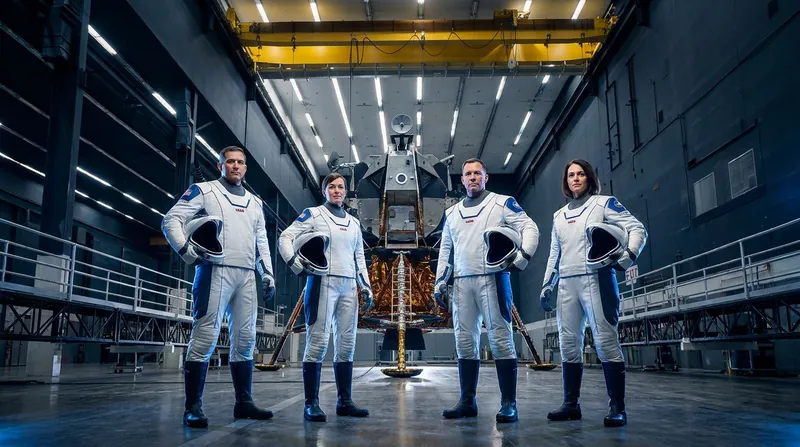
NASA announces the four-person crew for the Artemis III mission.
- Lunar Geologists & Scientists
- Prioritize the evidentiary value of cryogenic sample return and understanding the origins of polar volatiles.
- Aerospace Engineers & Mission Planners
- Focus on the technical execution, specifically the unprecedented challenges of NRHO docking and cryogenic orbital refueling.
- Commercial Space Advocates
- Emphasize the economic shift driven by public-private partnerships and the long-term potential of In Situ Resource Utilization (ISRU).
Perspectives this story doesn't cover
- International space agencies partnering on the Gateway station
- Environmental ethicists debating the commercial exploitation of lunar resources
Sources
Source coverage
4 outlets
3 viewpoints surfaced




- [1]The New York TimesAerospace Engineers & Mission Planners
What NASA Needs to Stay on Track for the Moon
Read on The New York Times → - [2]NASACommercial Space Advocates
Artemis III Mission Overview
Read on NASA → - [3]arXivLunar Geologists & Scientists
Optimal Landing Site Selection for Artemis III Near the Lunar South Pole
Read on arXiv → - [4]SpaceQLunar Geologists & Scientists
NASA Releases Artemis III Science Definition Team Report
Read on SpaceQ →

More in Science
See all →Lunar Exploration
NASA Names Artemis III Crew as Commercial Rocket Setbacks Cloud Lunar Timeline
5 sources
Cosmic Evolution
James Webb Space Telescope Solves Cosmology's 'Chicken or Egg' Problem
4 sources

Habitable Worlds
JWST Data Points to LHS 1140 b as the Strongest Candidate for an Alien Water World
6 sources

Vera Rubin Observatory
Vera C. Rubin Observatory Nears Launch of 10-Year Cosmic Survey Following Massive Early Discoveries
6 sources
Comments
Every angle. Every day.
Get Science stories with full source coverage and perspective breakdowns, free every day.