
The Rise of the 'Trackless Tram': Can Virtual Rails Solve the Urban Transit Crisis?
A new hybrid technology known as Autonomous Rapid Transit (ART) promises the capacity and smooth ride of light rail at a fraction of the cost, but infrastructure skeptics warn of hidden road-maintenance hurdles.
By Factlen Editorial Team
- Transit Innovators & Planners
- View trackless trams as a revolutionary leapfrog technology that can deliver rail-quality transit at a fraction of the cost.
- Infrastructure Skeptics
- Argue the technology is a proprietary 'gadgetbahn' that risks severe road damage and offers little benefit over a well-designed bus network.
- Factlen Editorial
- Synthesizes the promise of the technology with the practical realities of urban infrastructure deployment.
What's not represented
- · Local business owners along proposed transit corridors
- · Disability advocates assessing level-boarding claims in practice
Why this matters
As cities struggle with crippling traffic and the astronomical costs of building new subways or light rail, trackless trams offer a potential 'leapfrog' technology. If successful, they could allow mid-sized cities and sprawling suburbs to deploy high-capacity, zero-emission public transit in months rather than decades.
Key points
- Trackless trams use optical sensors and Lidar to follow painted lines on the road, eliminating the need for steel tracks.
- The vehicles are fully electric, utilizing fast-charging batteries at stations instead of overhead wires.
- Proponents argue they offer the capacity and ride quality of light rail at a fraction of the construction cost.
- Critics warn the 51-tonne vehicles could cause severe pavement damage, requiring expensive road reinforcements.
- The technology is currently operational in several Chinese cities and is being trialed internationally.
Across the globe, urban planners are wrestling with a seemingly intractable math problem. Cities are choking on private vehicle traffic, but traditional solutions are increasingly out of reach. Subways take decades to dig, and surface-level light rail transit (LRT) requires tearing up streets to lay steel tracks and install overhead wires—a disruptive process that routinely costs hundreds of millions of dollars per mile.[1][6]
This leaves a gaping hole in what planners call 'mid-tier transit.' Standard buses are relatively cheap to deploy, but they often get stuck in mixed traffic, suffer from a bumpy ride quality, and carry a stigma that fails to attract choice riders. Cities need a solution that bridges the gap: the capacity and sleek appeal of a train, combined with the flexibility and lower capital cost of a bus.[1][2]
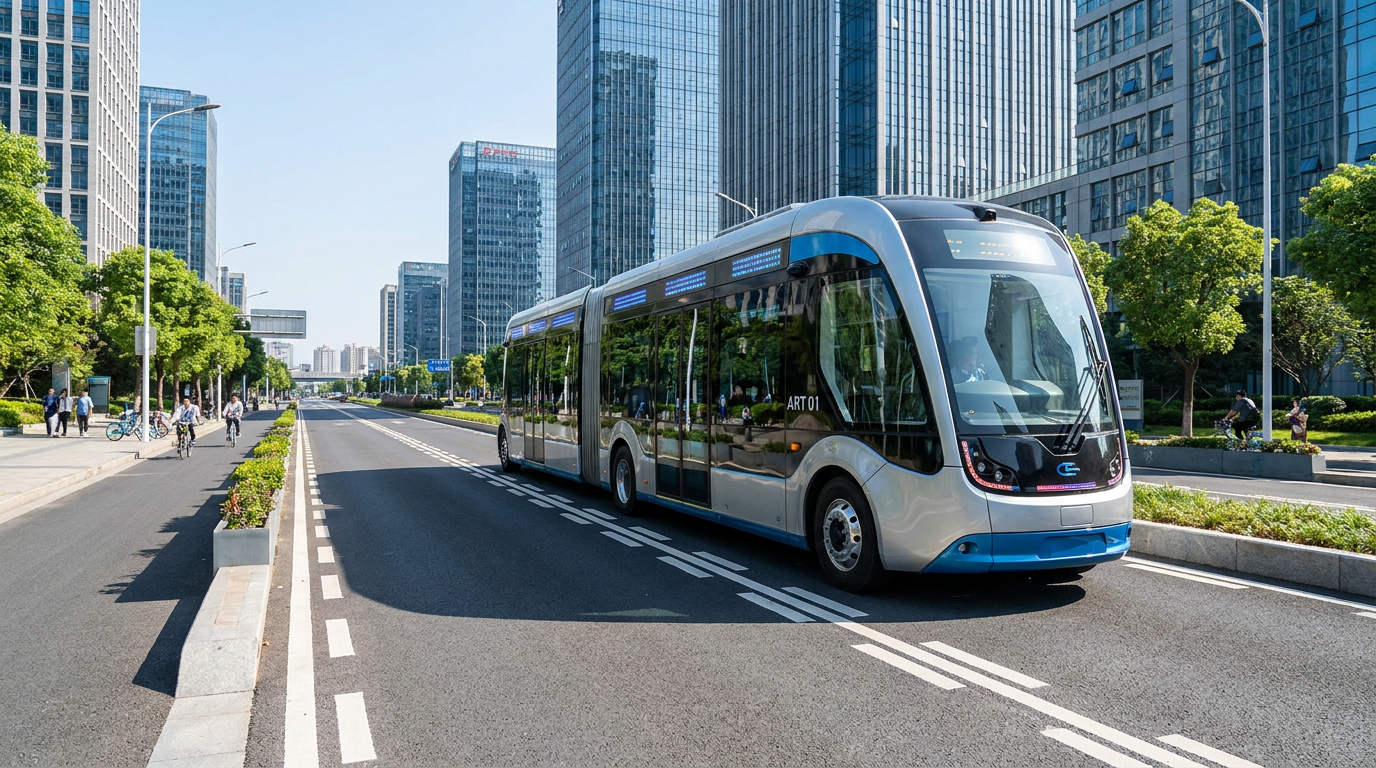
Enter the 'Trackless Tram,' formally known in the industry as Autonomous Rapid Transit (ART). Originally unveiled by the Chinese rail manufacturer CRRC in 2017, the technology has steadily moved from a conceptual prototype to a fully operational transit mode. To a pedestrian on the sidewalk, an ART vehicle looks exactly like a modern, multi-carriage light rail train. But look closer at the ground, and a crucial difference emerges: it runs on rubber tires instead of steel wheels.[1][6]
The magic of the trackless tram lies in its guidance system. Instead of relying on physical rails to steer, the vehicle uses a sophisticated array of optical sensors, Lidar, radar, and GPS to read the road. It autonomously follows double-dashed white lines painted on the asphalt, creating a 'virtual rail' that keeps the multi-articulated carriages perfectly aligned, even through tight urban corners.[1][3]

This optical guidance allows for precision docking at station platforms. Just like a subway, the trackless tram can pull up flush with the platform edge, enabling seamless, level boarding for wheelchairs, strollers, and bicycles. It eliminates the lateral sway that makes standard articulated buses feel unstable, utilizing hydraulic stabilization technology borrowed directly from high-speed rail engineering.[2][6]
Power delivery is equally innovative. The vehicles are fully electric and carbon-neutral, but they do not require the ugly and expensive overhead catenary wires that traditional trams rely on. Instead, they utilize advanced lithium-titanate batteries. When the tram stops at a station to let passengers on and off, an overhead pantograph briefly connects to a charging pylon, delivering a massive burst of power in just 30 to 60 seconds—enough to reach the next station.[1][2]
The capacity numbers rival traditional rail. A standard three-carriage ART vehicle stretches roughly 30 meters (98 feet) and can carry up to 300 passengers. A five-carriage variant can transport 500 people at a time, traveling at top speeds of 70 kilometers per hour (43 mph). Because the carriages are bi-directional, featuring a driver's cabin at both ends, the tram never needs to perform a U-turn; the driver simply walks to the other end to reverse direction.[1][6]
A standard three-carriage ART vehicle stretches roughly 30 meters (98 feet) and can carry up to 300 passengers.
For municipal governments, the primary allure is the balance sheet. Because there is no need to excavate roads, relocate underground utilities, or lay steel tracks, proponents estimate that a trackless tram system can be deployed for a fraction of the cost of light rail. Furthermore, once the dedicated lanes are painted and the stations are built, the system can theoretically be launched in a matter of months, avoiding years of crippling construction that often bankrupts local businesses along the route.[1][3]

Adoption is already underway. The technology has been running in regular passenger service in the Chinese cities of Zhuzhou, Yibin, and Harbin since 2018. The success of these initial lines has sparked a wave of international interest, with feasibility studies and proposals popping up in Malaysia, the United Arab Emirates, and Israel.[1][6]
In Australia, the City of Stirling recently completed a high-profile, Australian-first trial of a trackless tram. Backed by federal funding, the city views the technology as the perfect catalyst to revitalize its Scarborough Beach Road corridor. Local officials argue that the sleek, rail-like permanence of the ART system will spur the same kind of high-density real estate development and urban regeneration typically associated with expensive light rail projects.[3]
However, the technology is not without its fierce critics. Transit engineers and urbanist commentators warn that cities should look past the glossy marketing before committing public funds. A primary concern is the sheer weight of the vehicles. A fully loaded three-module trackless tram can weigh up to 51 tonnes—significantly heavier than standard articulated buses.[4][5]
According to research from the Australasian Transport Research Forum, this immense weight, concentrated on rubber tires that follow the exact same painted path every single trip, creates a massive risk of pavement rutting and structural damage. If cities are forced to dig up their roads to pour heavily reinforced concrete foundations just to support the tram, the promised cost savings and rapid deployment timelines could quickly evaporate.[4][6]

Critics also point to the risk of vendor lock-in. Because ART is a proprietary technology currently dominated by a single manufacturer (CRRC), cities that adopt it are tethered to that company for parts, maintenance, and future expansions. If a city builds a standard Bus Rapid Transit (BRT) system, it can buy buses from any manufacturer in the world. With a trackless tram, the city is locked into a closed ecosystem.[5][6]
Furthermore, transit purists argue that the 'Autonomous' label is currently more marketing than reality. While the optical guidance handles the steering, the vehicles still require a human driver to monitor the road, control the speed, and brake for unpredictable obstacles in mixed urban environments. Until true level-5 autonomy is achieved, the labor costs of operating the system remain identical to driving a bus.[5]
Some skeptics dismiss the trackless tram as a 'gadgetbahn'—a flashy, over-engineered solution to a problem that has already been solved. They argue that if a city is willing to dedicate a permanent, protected lane and give the vehicle priority at traffic lights, a standard electric Bus Rapid Transit system will achieve the exact same travel times and capacity, without the proprietary risks.[5][6]

Despite these debates, the trackless tram represents a fascinating convergence of automotive and rail engineering. It challenges the rigid boundaries of how we define public transit, offering a hybrid that borrows the best elements of both worlds. As battery technology improves and optical guidance systems become more robust, the line between a bus and a train will only continue to blur.[2][6]
For cities paralyzed by the cost of light rail but desperate for something better than a standard bus, the trackless tram offers a tantalizing middle path. Whether it becomes the global backbone of 21st-century mid-tier transit, or remains a niche technology, will depend entirely on how well the first wave of international adopters navigate the hidden infrastructure hurdles.[1][6]
How we got here
2017
Chinese manufacturer CRRC unveils the first Autonomous Rapid Transit (ART) prototype.
2018
The first commercial trackless tram line opens to the public in Zhuzhou, China.
2021
The Australian government allocates funding to study the feasibility of trackless trams in Perth.
Late 2023
The City of Stirling in Western Australia conducts an Australian-first physical trial of an ART vehicle.
Viewpoints in depth
Transit Innovators & Planners
View trackless trams as a revolutionary leapfrog technology that can deliver rail-quality transit at a fraction of the cost.
For urban planners and municipal budget directors, the trackless tram represents a holy grail. By removing the need to excavate roads and lay steel tracks, cities can theoretically deploy high-capacity, zero-emission transit in a matter of months rather than decades. Proponents argue that the sleek, train-like aesthetic of the vehicles is crucial for 'city-shaping'—attracting the kind of high-density real estate investment and choice ridership that standard buses historically fail to generate.
Infrastructure Skeptics
Argue the technology is a proprietary 'gadgetbahn' that risks severe road damage and offers little benefit over a well-designed bus network.
Transit engineers and critics caution that the 'no infrastructure' claim is a mirage. Because a fully loaded trackless tram weighs over 50 tonnes and its optical guidance ensures the tires hit the exact same millimeter of asphalt on every trip, standard roads are likely to suffer rapid pavement rutting. Skeptics argue that once a city pays to heavily reinforce the concrete beneath the route, the cost savings vanish. Furthermore, they warn against vendor lock-in, noting that a city buying a proprietary trackless tram is entirely at the mercy of a single manufacturer for future parts and expansions, unlike an open-market Bus Rapid Transit system.
What we don't know
- How standard municipal road pavements will hold up to the concentrated weight of the vehicles over a 10-to-20-year lifespan.
- Whether the proprietary nature of the technology will lead to long-term maintenance monopolies and price gouging.
- When, or if, the systems will achieve true level-5 autonomy, allowing them to operate safely in mixed traffic without a human driver.
Key terms
- Autonomous Rapid Transit (ART)
- The industry term for trackless trams, referring to multi-articulated, rubber-tired vehicles guided by optical sensors.
- Mid-tier transit
- Public transportation options that sit between standard local buses and heavy rail subways in terms of capacity, speed, and cost.
- Gadgetbahn
- A critical term used by urban planners to describe a public transit concept that relies on flashy, proprietary technology rather than proven, standardized solutions.
- Virtual rail
- The painted lines on the road surface that the trackless tram's optical sensors follow to maintain its designated path.
- Pantograph
- An apparatus mounted on the roof of an electric train or tram to collect power through contact with an overhead line or charging station.
Frequently asked
What is a trackless tram?
A trackless tram, or Autonomous Rapid Transit (ART), is a multi-carriage electric transit vehicle that looks like a light rail train but runs on rubber tires and is guided by optical sensors rather than steel tracks.
How does it steer without rails?
It uses a combination of Lidar, radar, GPS, and optical cameras to read double-dashed white lines painted on the road, autonomously following this 'virtual rail'.
Is it cheaper than light rail?
Yes, because it does not require digging up streets to lay steel tracks or install overhead wires, the capital construction costs are estimated to be significantly lower.
Does it still need a driver?
Currently, yes. While the vehicle can steer itself along the painted lines, a human driver is still required to monitor for obstacles, control speed, and handle emergency braking in mixed traffic.
Sources
Source coverage
6 outlets
3 viewpoints surfaced






[1]World Economic ForumTransit Innovators & Planners
What are trackless trams and how can they revitalize suburbs?
Read on World Economic Forum →[2]ResearchGateTransit Innovators & Planners
Urban Planning and Productivity: An Australian 'Abundance' Approach to Net Zero Cities
Read on ResearchGate →[3]City of StirlingTransit Innovators & Planners
Trackless Tram Business Case and Australian-First Trial
Read on City of Stirling →[4]Australasian Transport Research ForumInfrastructure Skeptics
The road pavement impacts of new Trackless Tram bus technologies
Read on Australasian Transport Research Forum →[5]RMTransitInfrastructure Skeptics
Trackless Trams: Yet Another Gadgetbahn?
Read on RMTransit →[6]Factlen Editorial TeamFactlen Editorial
Synthesis by Factlen editorial team
Read on Factlen Editorial Team →
Every angle. Every day.
Get automotive stories with full source coverage and perspective breakdowns delivered to your inbox.