
The Rise of the 'Plyscraper': How Mass Timber is Rewriting the Rules of High-Rise Construction
Engineered wood products like cross-laminated timber are replacing concrete and steel in urban skylines. By storing carbon rather than emitting it, mass timber offers a powerful climate solution—if sustainable forestry can keep pace.
By Factlen Editorial Team
- Sustainable Architecture Advocates
- View mass timber as a critical tool for decarbonizing the construction industry and creating healthier indoor environments.
- Structural Engineers & Builders
- Focus on the material's strength-to-weight ratio, prefabrication speed, and the necessity of hybrid concrete-timber designs for extreme heights.
- Fire Safety Regulators
- Prioritize strict code compliance, rigorous testing of the charring effect, and encapsulation requirements to ensure life safety.
- Forestry & Conservation Experts
- Emphasize that the climate benefits of mass timber only exist if the wood is sourced from certified, sustainably managed forests.
What's not represented
- · Traditional steel and concrete manufacturers facing market disruption
- · Local communities situated near expanding commercial timber forests
Why this matters
The built environment is responsible for nearly 40% of global carbon emissions, largely due to the manufacturing of concrete and steel. Transitioning to mass timber could transform our cities from massive carbon emitters into long-term carbon sinks, fundamentally altering the climate trajectory of global urbanization.
Key points
- Mass timber uses engineered wood panels that rival the strength of concrete and steel.
- Replacing traditional materials with mass timber can cut a building's embodied carbon footprint by up to 75%.
- Mass timber resists fire through a 'charring effect' that insulates the structural core.
- Recent building code updates allow timber structures to reach 18 stories, with hybrid designs going even higher.
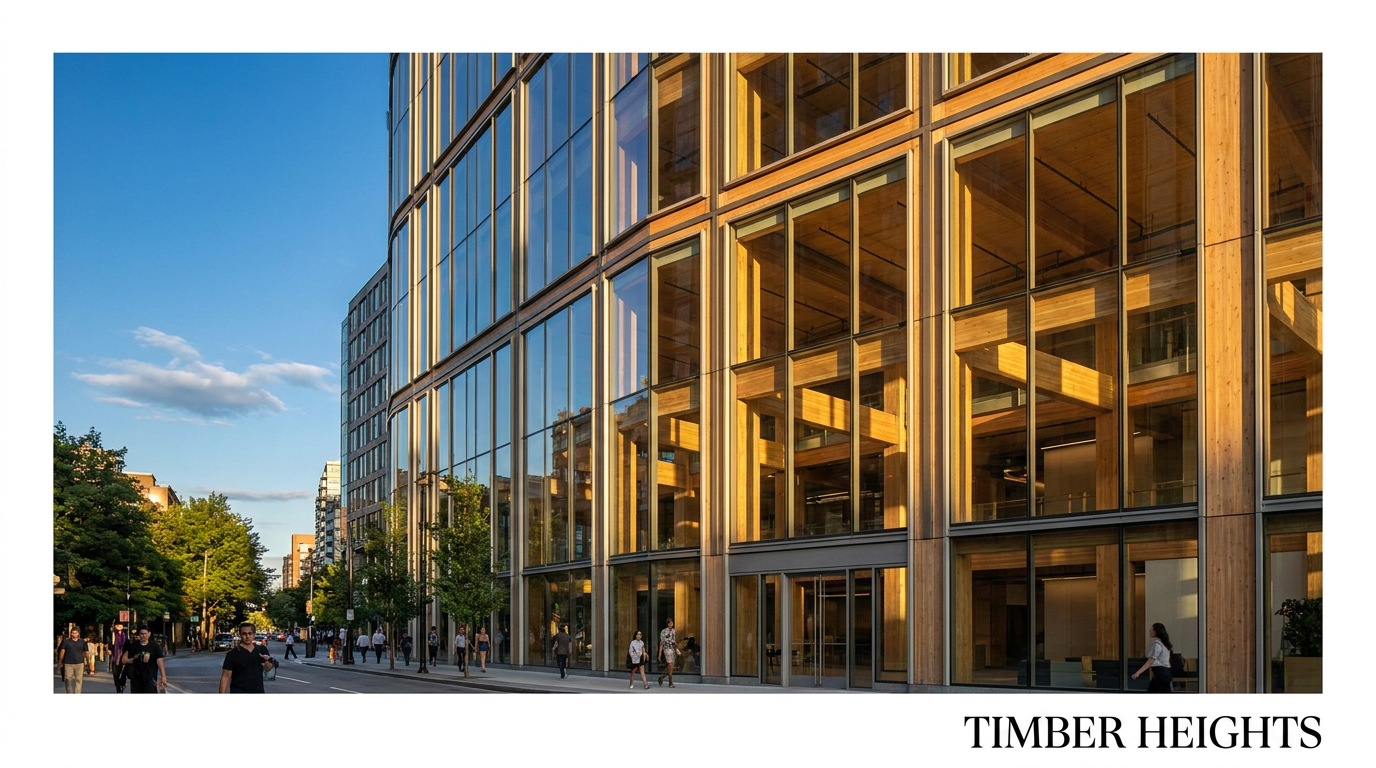
For over a century, the recipe for a skyscraper has been predictable: pour a massive concrete foundation, erect a skeleton of steel, and wrap it in glass. But a quiet revolution is taking root in the world's urban centers. In Sydney, Australia, the Atlassian Central tower is nearing its full height of 183 meters (600 feet), officially becoming the world's tallest hybrid timber structure. It dwarfs the previous record-holder, Milwaukee's 25-story Ascent building, signaling that engineered wood is no longer a boutique architectural trend—it is a viable structural evolution.[2][6]
The shift is driven by a stark climate reality. The traditional materials of high-rise construction are notoriously carbon-intensive. Cement production alone accounts for roughly 8% of global greenhouse gas emissions, while the steel industry contributes another 10%. As cities race to decarbonize, architects are looking back to humanity's oldest building material, reinvented for the 21st century through advanced engineering.[1][2]
This new class of materials is collectively known as "mass timber." Unlike the two-by-fours used in suburban homebuilding, mass timber consists of large, solid wood panels and beams engineered for immense load-bearing capacity. The most prominent product is Cross-Laminated Timber (CLT), created by stacking layers of dimensioned lumber at perpendicular angles and bonding them under high pressure. This cross-lamination gives the panels exceptional dimensional stability and two-way spanning capabilities, allowing them to act much like precast concrete slabs but at a fraction of the weight.[1][2]
For structural columns and long-span beams, engineers rely on Glued-Laminated Timber, or Glulam, where the wood grain runs parallel. Together, these materials offer a strength-to-weight ratio that rivals, and sometimes exceeds, that of reinforced concrete. Because mass timber is significantly lighter, buildings require smaller foundations, which is particularly advantageous when building on soils with lower bearing capacity or over existing infrastructure.[2][6]
The primary allure of mass timber, however, is its carbon math. Trees naturally sequester carbon dioxide from the atmosphere during photosynthesis. When those trees are harvested and turned into mass timber, that carbon remains locked inside the building for decades. A single cubic meter of mass timber can store approximately 0.9 tonnes of CO2.[1][4]

This creates a dual climate benefit. Not only does the building act as a long-term carbon sink, but it also avoids the "embodied carbon"—the emissions generated from manufacturing and transporting materials—associated with steel and concrete. Life-cycle assessments indicate that replacing conventional materials with mass timber can reduce a building's embodied carbon footprint by up to 75%.[4]
Yet, the immediate question most people ask when looking at a wooden skyscraper is: won't it burn? For decades, wood was relegated to low-rise projects due to strict fire codes. However, mass timber behaves fundamentally differently in a fire than light-frame lumber. It relies on a well-documented phenomenon known as the "charring effect."[5]
Yet, the immediate question most people ask when looking at a wooden skyscraper is: won't it burn?
When exposed to intense heat, the outer surface of a mass timber beam burns and turns to charcoal. This charred layer acts as a natural insulator, protecting the unburnt wood core and preventing it from reaching ignition temperature. As a result, the structural capacity of the timber is maintained for a predictable period, allowing occupants to evacuate safely.[5]

Regulatory bodies have recognized this inherent fire resistance. The International Building Code (IBC) introduced major updates in 2021 and 2024, creating new construction types that explicitly permit mass timber buildings up to 18 stories. In many cases, the code requires the timber to be partially or fully encapsulated in fire-resistant materials like gypsum board, though recent updates have increased the allowable percentage of exposed wood to give architects more design flexibility.[5]
Beyond the finished product, mass timber radically alters the construction process itself. Because CLT and Glulam components are precision-milled in a factory using computer-aided design, they arrive at the construction site like a giant flat-pack furniture kit. This prefabrication drastically reduces on-site waste, noise, and the number of personnel required.[1]
It also accelerates the timeline. Mass timber structures can be erected 20% to 50% faster than their concrete counterparts. A single truck can deliver a sequence of panels that are immediately hoisted into place, saving thousands of concrete-mixer truck trips through dense urban neighborhoods.[1]
Despite these advantages, the industry is not abandoning concrete and steel entirely. The tallest timber buildings, including Atlassian Central, are "hybrid" structures. They utilize concrete cores for lateral stability against wind and seismic forces, or steel exoskeletons to support the timber floor plates. This pragmatic approach uses each material for what it does best, pushing the boundaries of verticality while still slashing overall carbon emissions.[6]

The widespread adoption of mass timber does raise valid concerns about global forest health. If every new skyscraper is built from wood, can the planet's forests sustain the demand? A comprehensive 2025 study from the Yale School of the Environment suggests that, counterintuitively, increased demand could actually benefit forests.[3]
The researchers found that a surge in mass timber use would incentivize the market to protect more forestland from being converted to agriculture or urban sprawl. By shifting to intensively managed, sustainable forestry—where trees are replanted and harvested in a continuous cycle—the global productive forest area could expand by an area the size of Germany by 2100. However, this climate benefit is entirely dependent on strict adherence to sustainable certification standards to prevent illegal logging and deforestation.[3][4]
There are still hurdles to overcome. The mass timber supply chain is still maturing, particularly in North America, meaning materials often have to be shipped from Europe, which adds transportation emissions and cost premiums. Additionally, the insurance industry is still adapting its risk models to underwrite tall timber structures, sometimes leading to higher premiums for developers.[4][5]

Ultimately, the rise of the plyscraper represents a profound shift in how we conceive of the built environment. Beyond the carbon math and construction efficiencies, architects point to the psychological benefits of "biophilic design"—the innate human connection to natural materials. By bringing the forest into the city, mass timber is not just changing the skyline; it is fundamentally redefining what it feels like to live and work inside a high-rise.[2][7]
How we got here
2009
The first modern 9-story mass timber building is completed, proving the viability of the material for mid-rise construction.
2021
The International Building Code (IBC) is updated to explicitly allow mass timber buildings up to 18 stories.
2022
Ascent Milwaukee opens at 25 stories, setting a new global height record for a timber structure.
2025
A Yale study confirms that widespread mass timber use could significantly expand global forest carbon sinks if managed sustainably.
2026
Atlassian Central in Sydney tops out at 183 meters, more than doubling the previous height record using a hybrid timber-concrete design.
Viewpoints in depth
The Climate Architects
Advocates who view mass timber as a necessary tool for decarbonization.
For climate-focused architects, the built environment is currently a massive liability, responsible for nearly 40% of global emissions. They argue that transitioning to mass timber is one of the few viable ways to turn buildings from carbon emitters into carbon sinks. Beyond the environmental math, this camp heavily promotes the psychological benefits of biophilic design, arguing that exposed wood interiors reduce stress and improve occupant well-being in urban environments.
The Structural Pragmatists
Engineers focused on the physical limitations and logistical benefits of the material.
Structural engineers appreciate mass timber for its high strength-to-weight ratio and the speed of prefabricated construction, which saves time and labor costs. However, they caution against viewing wood as a universal replacement for concrete and steel. For ultra-tall skyscrapers, this camp advocates for hybrid designs—using concrete cores to resist wind and seismic forces while utilizing timber for the floor plates—arguing that materials should be used where their specific physical properties are most effective.
The Forestry Conservationists
Environmental scientists monitoring the impact of increased timber demand on global forests.
Conservationists acknowledge the carbon-storing potential of mass timber but warn that a sudden spike in demand could lead to deforestation if not strictly regulated. They argue that the climate benefits are entirely contingent on sourcing wood from certified, sustainably managed forests (such as FSC or PEFC). When managed correctly, they note that the economic incentive of mass timber can actually protect forestland from being cleared for agriculture, turning commercial forestry into a tool for ecological preservation.
What we don't know
- Whether the global supply chain for certified sustainable timber can scale fast enough to meet surging urban demand without causing price spikes.
- How the insurance industry will adjust long-term premiums for mass timber high-rises as they age and face water or fire incidents.
- The exact lifespan of modern engineered timber adhesives over a century of structural load and environmental fluctuation.
Key terms
- Cross-Laminated Timber (CLT)
- Engineered wood panels made by gluing layers of lumber at right angles, providing immense strength in two directions.
- Glued-Laminated Timber (Glulam)
- Structural beams and columns made by bonding layers of wood with the grain running parallel.
- Embodied Carbon
- The total greenhouse gas emissions generated from extracting, manufacturing, and transporting building materials before they are even installed.
- Charring Effect
- The predictable way thick timber burns, creating an outer layer of charcoal that insulates and protects the structural core from fire.
- Biophilic Design
- An architectural approach that connects building occupants more closely to nature, often using exposed natural materials like wood.
Frequently asked
Is mass timber safe in a fire?
Yes. Unlike light-frame wood, mass timber relies on a "charring effect" where the outer layer burns and insulates the core, maintaining structural integrity for hours.
Doesn't building with wood cause deforestation?
When sourced from certified sustainable forests, increased demand for timber actually incentivizes the expansion and active management of forestland, increasing overall carbon storage.
Is mass timber as strong as concrete and steel?
Yes. Engineered products like CLT and Glulam offer a strength-to-weight ratio that rivals traditional materials, though ultra-tall buildings often use a hybrid approach with concrete cores for wind stability.
Sources
Source coverage
7 outlets
4 viewpoints surfaced







[1]Environmental and Energy Study InstituteForestry & Conservation Experts
Fact Sheet | Building Sustainably: Mass Timber
Read on Environmental and Energy Study Institute →[2]Parametric ArchitectureSustainable Architecture Advocates
The Rise of Engineered Mass Timber in Global Construction
Read on Parametric Architecture →[3]Yale School of the EnvironmentForestry & Conservation Experts
Mass Timber Could Drive Forest Expansion and Cut Emissions
Read on Yale School of the Environment →[4]EcochainForestry & Conservation Experts
Construction Timber Carbon Footprint Explained Simply
Read on Ecochain →[5]J.S. HeldFire Safety Regulators
Mass Timber Fire Resistance: Sustainability, Code Compliance, and Fire Safety in Tall Buildings
Read on J.S. Held →[6]EBSAStructural Engineers & Builders
Atlassian Central Surpasses Milwaukee's Ascent To Become The World's Tallest Hybrid Timber Tower
Read on EBSA →[7]Factlen Editorial TeamSustainable Architecture Advocates
Synthesis by Factlen editorial team
Read on Factlen Editorial Team →

More in culture
See all 28 stories →Digital Trust
How Content Credentials Are Saving Photography in the AI Era
6 sources

Bibliotherapy
The Science of Bibliotherapy: How Reading Fiction Rewires the Brain for Empathy and Resilience
7 sources

Everyday Awe
The Science of Everyday Awe: How Moments of Wonder Rewire the Brain and Improve Health
6 sources

Optimistic Fiction
Why 'Solarpunk' and 'Hopepunk' Are Dominating 2026 Reading Lists
8 sources
Every angle. Every day.
Get culture stories with full source coverage and perspective breakdowns delivered to your inbox.