
The Rise of Solarpunk: How Science Fiction is Rewriting the Future of Climate Change
As climate anxiety grows, a literary movement known as 'solarpunk' is rejecting dystopian doom in favor of radically optimistic, sustainable futures. By imagining societies that successfully harmonize technology and nature, authors are providing a vital blueprint for real-world environmental action.
By Factlen Editorial Team
- Literary Optimists
- Authors and critics who view solarpunk as a necessary antidote to climate anxiety and a blueprint for a better future.
- Pragmatic Transitioners
- Designers and sociologists who see solarpunk not just as fiction, but as a practical framework for urban planning and renewable energy adoption.
- Genre Historians
- Academics tracing the evolution of sci-fi from cyberpunk's dystopian warnings to solarpunk's protopian solutions.
What's not represented
- · Traditional dystopian sci-fi authors
- · Fossil fuel industry advocates
Why this matters
The stories we consume shape our belief in what is possible. By shifting the cultural narrative from inevitable apocalypse to actionable sustainability, solarpunk provides the psychological resilience and imaginative framework necessary to tackle the real-world climate crisis.
Key points
- Solarpunk is a literary and artistic movement that rejects dystopian pessimism in favor of optimistic, sustainable futures.
- The genre contrasts sharply with cyberpunk, focusing on green technology, decentralization, and community cooperation rather than corporate dystopia.
- Authors like Becky Chambers and Kim Stanley Robinson are popularizing the genre, using it to explore post-capitalist societies.
- Beyond fiction, solarpunk principles are increasingly influencing real-world urban planning, architecture, and climate activism.
For the better part of two decades, the cultural imagination has been held hostage by the apocalypse. From flooded coastal cities to scorched-earth wastelands, mainstream science fiction has largely served as a warning system for a society hurtling toward ecological collapse. While these cautionary tales were designed to spark urgency, their sheer volume has often resulted in the opposite effect: a pervasive sense of climate anxiety and a paralyzing belief that the end of the world is a foregone conclusion.[6]
But a growing literary and artistic movement is pushing back against this relentless dystopian tide. Known as "solarpunk," this genre rejects the paralyzing grip of climate doomerism, offering instead a radically optimistic vision of the future. It asks a simple but profound question: what does a sustainable civilization actually look like, and how do we get there?[2][3]
The term itself is a deliberate counter-narrative. The "solar" represents renewable energy and a bright, sunlit aesthetic, while the "punk" signifies a rebellion against extractive capitalism, consumerism, and the apathy of the status quo. In the solarpunk ethos, choosing optimism and community building in the face of global crisis is the ultimate punk-rock act.[1][6]
Solarpunk stands in stark contrast to its older, more cynical sibling, cyberpunk. Where cyberpunk envisions a "high tech, low life" future dominated by neon-lit rain, monolithic corporations, and societal decay, solarpunk imagines decentralized communities, open-source technology, and a deep, restorative harmony with the natural world. It is a rebellion against a rebellion, born out of profound dystopia fatigue.[2][3]

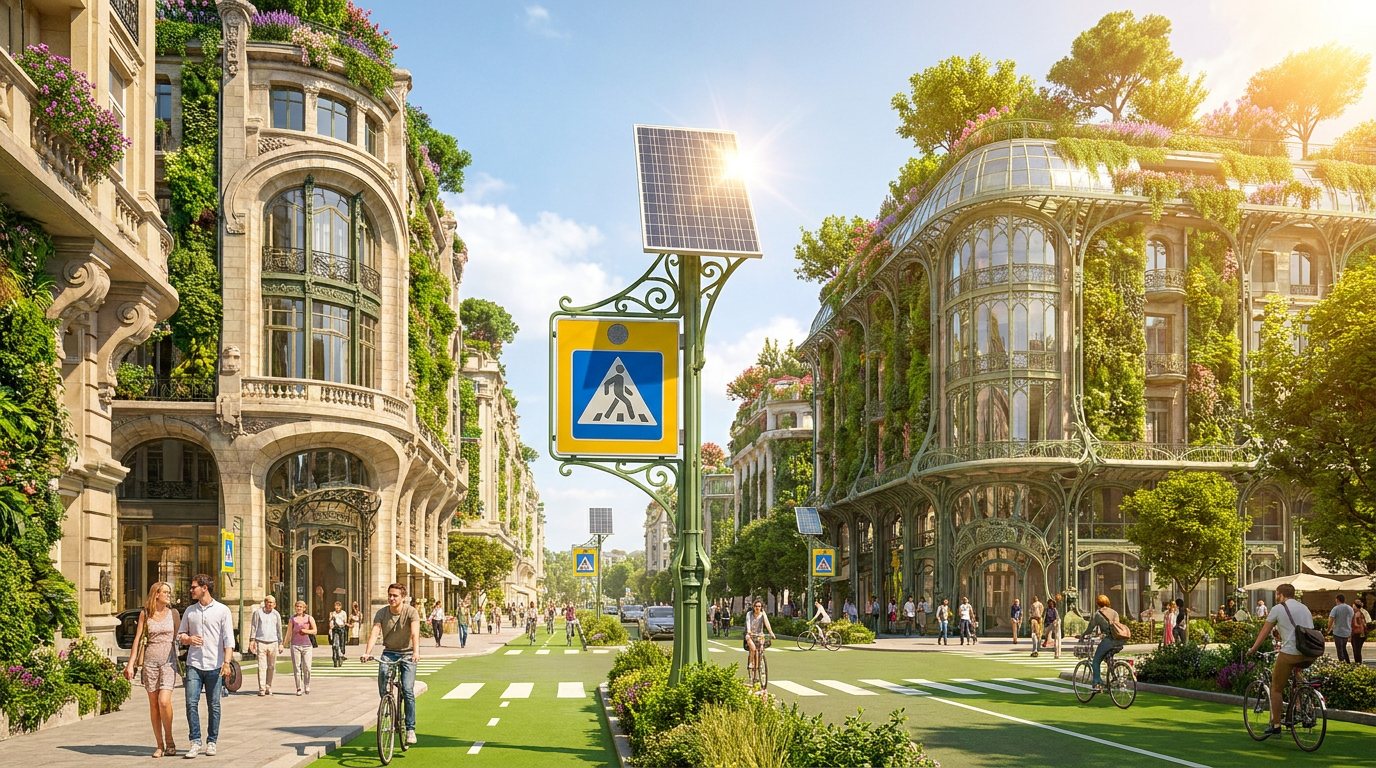
The movement's origins are surprisingly humble. The term was first coined in a 2008 blog post celebrating the maiden voyage of a hybrid cargo ship that used a massive kite to reduce fuel consumption. By 2012, it had crossed into literature with the publication of a short story anthology in Brazil, before exploding across the internet as a vibrant visual aesthetic featuring art-nouveau architecture draped in vertical forests.[1][3]
Today, solarpunk has matured from a niche internet aesthetic into a robust literary genre. Authors within the space are moving beyond merely painting pretty pictures of green cities; they are doing the hard narrative work of exploring how these post-capitalist, ecologically centered societies function on a daily basis. They are mapping the logistics of a world that prioritizes people and the planet over endless profit.[4]
A defining characteristic of solarpunk literature is its focus on community over the individual. Gone is the lone, brooding anti-hero saving the world with a gun. Instead, conflicts are often resolved through cooperation, radical compassion, and collective problem-solving. The narratives emphasize that survival is a group effort, and that diverse, inclusive communities are inherently more resilient.[4]
This shift in narrative structure is perhaps best exemplified by Hugo Award-winning author Becky Chambers. Her "Monk and Robot" series—beginning with "A Psalm for the Wild-Built"—is frequently cited as a quintessential solarpunk text. The books offer a cozy, character-driven journey through a world where humanity has voluntarily stepped back from industrial expansion to let nature heal, focusing instead on philosophy, tea, and mutual understanding.[4][6]

This shift in narrative structure is perhaps best exemplified by Hugo Award-winning author Becky Chambers.
Solarpunk is also closely related to "hopepunk," a term used to describe storytelling that wields kindness and communalism as weapons against a grim reality. Both genres share a fundamental belief that a better world is not guaranteed, but it is entirely worth fighting for. They disrupt extractive worldviews by building civilization rather than destroying it.[4][6]
Crucially, solarpunk is not a naive utopia. Authors in the space frequently describe their worlds as "protopian"—societies that are actively working to be incrementally better today than they were yesterday. These worlds still contain conflict, grief, and the lingering scars of past environmental mistakes, but the characters are equipped with the social and technological tools to address them constructively.[3][5]
The genre frequently draws inspiration from real-world sustainable practices. Solarpunk narratives often feature "jugaad"—a concept of frugal, flexible innovation where existing infrastructure is repurposed rather than discarded. This manifests in stories as communities repairing old technology, utilizing permaculture, and building Earthship-style homes out of salvaged materials, proving that high-tech solutions are not always the answer.[1][3]
The movement also has deep roots in the works of foundational speculative fiction authors. Ursula K. Le Guin’s "The Dispossessed" and Octavia Butler’s "Parable of the Sower" are often viewed as proto-solarpunk texts. They are praised for their radical reimagining of social structures, communal living, and resilience in the face of ecological collapse, laying the groundwork for today's optimistic writers.[4]
In the realm of hard science fiction, Kim Stanley Robinson’s "The Ministry for the Future" serves as a bridge between current climate anxieties and solarpunk ideals. While harrowing in its depiction of climate disasters, the novel meticulously maps a plausible, policy-driven path to a decarbonized global economy, proving that systemic solutions are within our grasp if we have the political will to enact them.[4]

The psychological impact of this literature cannot be overstated. As climate anxiety and eco-grief become increasingly prevalent, particularly among younger generations, solarpunk serves as a form of literary bibliotherapy. It provides an antidote to the paralysis of doomscrolling, offering readers a tangible sense of agency and a reminder that the future is not yet written.[2][6]
Beyond the page, solarpunk is beginning to influence real-world design and urban planning. Designers and researchers are utilizing solarpunk concepts to model desirable futures, translating the genre's optimistic hybridization of technology and nature into actionable principles for sustainable architecture and community organization. It is moving from speculative fiction into speculative design.[5]
The genre is not without its critics. Some argue that the aesthetic risks being co-opted by corporate "greenwashing," where slapping a few plants on a luxury skyscraper is passed off as ecological progress. Others worry that focusing too heavily on the destination obscures the messy, politically fraught transition required to get there, bypassing the necessary friction of dismantling fossil-fuel infrastructure.[3][6]

Yet, defenders of the movement argue that this is precisely why solarpunk literature is necessary. By fleshing out the social dynamics, governance models, and daily lives of a sustainable future, authors prevent the aesthetic from being hollowed out by corporate interests. They provide the ideological scaffolding required to build a genuinely equitable world, ensuring the "punk" element remains intact.[5][6]
Ultimately, solarpunk operates on a simple premise: we cannot build a future we have not first imagined. In an era defined by ecological dread, the decision to imagine a world where humanity gets it right is not just comforting—it is a vital prerequisite for survival. By charting a course toward a better tomorrow, solarpunk gives us the courage to take the first step.[6]
How we got here
2008
The term 'solarpunk' is coined in a blog post celebrating the fuel efficiency of a hybrid cargo ship.
2012
The first solarpunk short story anthology is published in Brazil, moving the concept into literature.
2014
The Project Hieroglyph manifesto is published, outlining the core tenets of the solarpunk aesthetic and philosophy.
2021
Becky Chambers publishes 'A Psalm for the Wild-Built,' bringing cozy, solarpunk narratives to mainstream sci-fi audiences.
Viewpoints in depth
Literary Optimists
Authors and critics who view solarpunk as a necessary antidote to climate anxiety and a blueprint for a better future.
For authors within the solarpunk and hopepunk movements, optimism is not a form of denial, but a deliberate and radical choice. They argue that decades of dystopian media have paralyzed the public imagination, leading to widespread eco-grief and a sense of inevitability regarding climate collapse. By writing stories where humanity successfully navigates the climate crisis through cooperation and renewable technology, these optimists believe they are providing readers with the psychological resilience needed to demand and build a better real-world future.
Pragmatic Transitioners
Designers and sociologists who see solarpunk not just as fiction, but as a practical framework for urban planning and renewable energy adoption.
Beyond the realm of fiction, a growing cohort of urban planners, architects, and designers view solarpunk as a viable blueprint for the physical world. This perspective focuses on the genre's emphasis on 'jugaad'—frugal innovation—and decentralized infrastructure. They argue that the aesthetic of vertical forests and solar-integrated architecture can drive public policy and consumer demand. For these pragmatists, solarpunk is less about escapism and more about prototyping the socio-technical systems required for a post-carbon economy.
Genre Skeptics
Critics who worry the movement risks prioritizing aesthetics over the messy political realities of climate action.
While generally supportive of the genre's goals, some literary critics and environmentalists caution against the 'greenwashing' of solarpunk. They point out that a purely aesthetic appreciation of the genre—such as rendering luxury skyscrapers with a few plants on the balcony—strips the movement of its anti-capitalist, 'punk' roots. Furthermore, skeptics argue that some solarpunk narratives gloss over the immense political friction, class struggles, and resource allocation conflicts that will inevitably accompany any global transition away from fossil fuels.
What we don't know
- Whether solarpunk will fully cross over from a niche subgenre into mainstream blockbuster media.
- How effectively the fictional socio-economic models proposed in solarpunk literature can be translated into real-world political policy.
Key terms
- Solarpunk
- A literary and artistic movement envisioning a sustainable future interconnected with nature and community, rejecting climate doomerism.
- Cyberpunk
- A science fiction subgenre characterized by high-tech advancements juxtaposed with societal collapse and corporate dystopia.
- Protopia
- A state of becoming, where society is incrementally better today than it was yesterday, contrasting with static, perfect utopias.
- Hopepunk
- A narrative concept where optimism, radical compassion, and cooperation are used as weapons of resistance against a grim world.
- Jugaad
- A concept of frugal, flexible innovation where existing infrastructure and materials are creatively repurposed rather than discarded.
Frequently asked
What is the difference between solarpunk and cyberpunk?
While cyberpunk envisions a dystopian future dominated by corporate greed and societal decay, solarpunk imagines an optimistic world focused on renewable energy, community cooperation, and harmony with nature.
Is solarpunk literature purely utopian?
No. Most solarpunk authors describe their worlds as 'protopian'—societies that are actively working to improve, but still face conflicts, grief, and the lingering effects of past environmental damage.
Who are some foundational authors in the solarpunk genre?
Becky Chambers and Kim Stanley Robinson are prominent contemporary voices, while the works of Ursula K. Le Guin and Octavia Butler are widely considered foundational proto-solarpunk texts.
Does solarpunk exist outside of literature?
Yes. Solarpunk began as an aesthetic art movement and has since influenced real-world sustainable architecture, urban planning, and grassroots environmental activism.
Sources
Source coverage
6 outlets
3 viewpoints surfaced






[1]The Indian ExpressPragmatic Transitioners
What is Solarpunk? The artistic movement offering a way forward
Read on The Indian Express →[2]Earth.orgLiterary Optimists
Solarpunk: The Optimistic Climate Movement
Read on Earth.org →[3]WikipediaGenre Historians
Solarpunk
Read on Wikipedia →[4]Susan Kaye QuinnLiterary Optimists
Why I write hopepunk and solarpunk
Read on Susan Kaye Quinn →[5]UX CollectivePragmatic Transitioners
Introduction to Solarpunk and its design principles
Read on UX Collective →[6]Factlen Editorial TeamGenre Historians
Synthesis by Factlen editorial team
Read on Factlen Editorial Team →



Every angle. Every day.
Get culture stories with full source coverage and perspective breakdowns delivered to your inbox.