
The Rise of 'Chronoworking': How Aligning Schedules with Circadian Rhythms is Reshaping the Workday
A growing workplace trend called chronoworking allows employees to set their hours based on their natural biological energy peaks. Research shows that abandoning the rigid 9-to-5 schedule in favor of chronotype alignment significantly reduces burnout and boosts creative output.
By Factlen Editorial Team
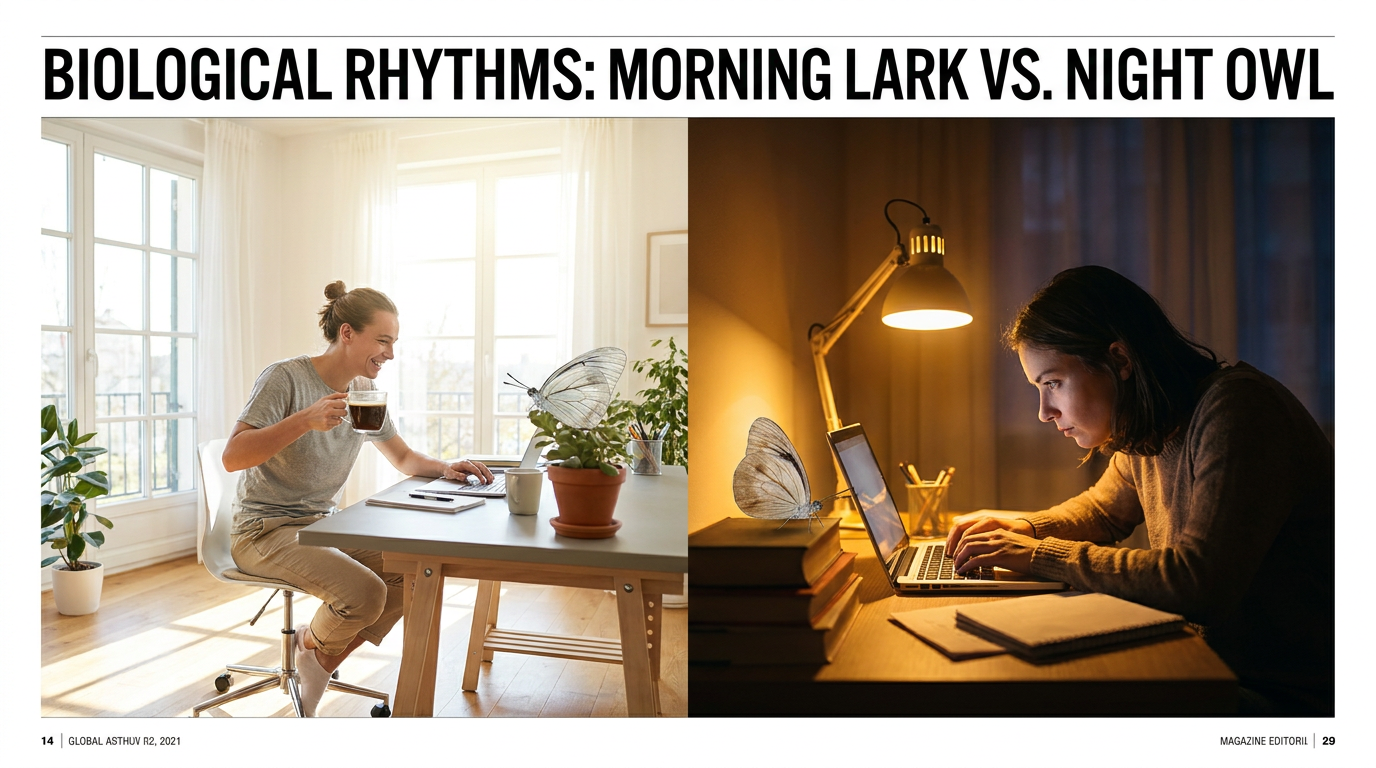
- Chronoworking Advocates
- Argue that aligning work with biological rhythms is essential for modern employee well-being and peak performance.
- Scientific & Medical Community
- Focus on the physiological realities of circadian rhythms and the measurable cognitive costs of misalignment.
- Organizational Managers
- Highlight the logistical challenges of asynchronous work, emphasizing the need for core collaboration hours and clear boundaries.
What's not represented
- · Hourly and Shift Workers
- · Client-Facing Service Professionals
Why this matters
By aligning work schedules with natural biological rhythms, chronoworking promises to reduce employee burnout and unlock higher levels of cognitive performance. For workers, it offers a path out of chronic fatigue, and for companies, it represents a zero-cost intervention to boost productivity and retain top talent.
Key points
- Chronoworking aligns employee schedules with their natural biological energy peaks rather than a rigid 9-to-5 clock.
- Research shows that forcing evening chronotypes into early schedules causes a 5.3% drop in health-related productivity.
- A recent survey indicates that 87% of working professionals want to trial chronoworking in their current roles.
- Successful implementation requires establishing 'core hours' for team collaboration while leaving the rest of the day flexible.
- The model shifts managerial focus from tracking hours logged at a desk to evaluating the actual quality of work produced.
For decades, the professional world has operated on a universal, unquestioned assumption: human productivity begins at 9:00 a.m. and ends at 5:00 p.m. But a growing movement across the corporate landscape is challenging the biological viability of the standard workday. Dubbed "chronoworking"—a term recently coined by British journalist Ellen Scott—this emerging trend advocates for aligning employee schedules with their natural circadian rhythms rather than forcing them into a rigid corporate clock. By allowing workers to tackle complex tasks when their bodies are naturally most alert, advocates argue that companies can unlock unprecedented levels of focus and creativity. The concept represents a fundamental shift in how we view labor, moving away from industrial-era timekeeping toward a more personalized, human-centric approach to daily output.[6][7]
The concept is rapidly moving from a niche wellness topic to a mainstream organizational strategy, driven by widespread employee demand for deeper flexibility. In a recent survey of 1,700 working professionals conducted by the recruiting firm Robert Walters, a staggering 87 percent of respondents expressed a desire to trial chronoworking in their current roles. The appeal lies in a simple, intuitive premise: if you allow people to work when their bodies are biologically primed for focus, they will produce better work in less time, while suffering significantly less burnout. As organizations struggle to retain top talent in a competitive market, offering schedule autonomy based on biological rhythms is increasingly viewed as a powerful differentiator that costs companies nothing to implement.[3][4]
To understand the mechanics of chronoworking, one must first understand the science of chronotypes. A chronotype is the natural, genetic disposition that dictates a person's sleep-wake cycle, core body temperature fluctuations, and cognitive energy peaks throughout a 24-hour period. While traditional corporate culture has long moralized early rising as a sign of discipline and ambition, sleep scientists and neuroscientists point out that our internal clocks are largely hardwired by our DNA. You cannot simply train a natural night owl to become a morning person without incurring a significant physiological cost. Recognizing this biological reality is the foundational step in transitioning a workforce from a rigid schedule to a chronotype-aware environment.[5][7]
Clinical psychologist and sleep expert Dr. Michael Breus popularized the categorization of these biological rhythms into four distinct animal profiles, which have since become the standard framework for chronoworking. "Lions," which make up roughly 15 percent of the population, wake up early and hit their cognitive peak in the morning. "Bears" represent the majority at 55 percent; their energy follows the rise and fall of the sun, making them the most naturally suited to a standard 9-to-5 schedule. "Wolves," another 15 percent, are classic night owls who hit their stride in the late afternoon and evening. Finally, "Dolphins," comprising the remaining 10 percent, tend to have fragmented sleep patterns and highly variable energy windows that require maximum day-to-day flexibility.[6]

When employees are forced to work against their natural chronotype—such as requiring a Wolf to lead an 8:00 a.m. strategy meeting—they experience a phenomenon researchers call "social jetlag." This biological mismatch doesn't just result in groggy mornings and an overreliance on caffeine; it has measurable, compounding impacts on cognitive performance, emotional regulation, and corporate bottom lines. Operating in a state of chronic social jetlag degrades executive function, making employees more prone to errors, less capable of complex problem-solving, and significantly more vulnerable to long-term burnout. Over time, the friction of fighting one's own biology leads to disengagement, proving that rigid schedules often sabotage the very productivity they were designed to enforce.[5]
A sweeping nationwide panel study conducted between 2022 and 2024 by the Korean Work, Sleep, and Health Study (KWSHS) quantified the exact toll of this misalignment. Published in the peer-reviewed Sleep Health journal, the research analyzed thousands of workers across various industries to determine how schedule friction impacts daily output. The findings were stark: evening chronotypes who were forced into standard morning-heavy schedules exhibited 2.29 times higher odds of poor work ability compared to their morning-type peers who were naturally aligned with corporate hours. This data dismantles the myth that night owls are simply less dedicated workers, revealing instead that they are operating at a severe, structurally imposed physiological disadvantage.[1]
Furthermore, the KWSHS data revealed that this circadian misalignment resulted in a 5.3 percent greater health-related productivity loss for the affected employees. The researchers concluded that forcing "Wolves" to perform complex, high-stakes tasks at 8:30 a.m. is not a matter of poor discipline, but a fundamental biological friction that costs companies both innovation and output. By ignoring the science of sleep, organizations are essentially paying for a fraction of their employees' actual capabilities, while simultaneously driving up their healthcare costs and turnover rates due to chronic fatigue. The study strongly recommended that workplaces implement flexible scheduling as a frontline health intervention, rather than merely a lifestyle perk.[1]

Furthermore, the KWSHS data revealed that this circadian misalignment resulted in a 5.3 percent greater health-related productivity loss for the affected employees.
Western institutions are finding similar results regarding creativity and complex problem-solving. A recent collaboration between the Wharton Neuroscience Initiative and the consulting firm Slalom explored how the time of day affects creative performance in corporate environments. In their "HabLab" experiment, employees completed a Morningness-Eveningness Questionnaire (MEQ) to determine their true chronotype, and were then tested on various ideation and productivity tasks at different points throughout the day. The goal was to see if aligning task timing with biological peaks could unlock higher tiers of cognitive performance, moving beyond simple efficiency into the realm of genuine innovation.[2]
The Wharton researchers found a clear and meaningful trend: participants generated both a higher volume of ideas and significantly more original concepts when they worked during their biological peak. Interestingly, the study also noted that 27 percent of participants were previously misaligned with their actual chronotype, highlighting a widespread lack of awareness about personal energy cycles. Many workers had spent years forcing themselves into a routine they believed was "correct," only to discover that their true creative potential lay in a completely different time window. This underscores the need for organizations to actively help employees discover their rhythms, rather than just passively offering flexible hours.[2]
For early corporate adopters, chronoworking is already reshaping daily operations and management philosophies. At the flexible-work platform Flexa, for instance, employees dictate their own hours entirely based on their personal energy peaks. Some team members log on at 7:30 a.m. and finish their deep work by mid-afternoon, while others start at 11:00 a.m. and work late into the evening. This model requires a profound shift in managerial mindset: the focus moves entirely from tracking "hours logged at a desk" to evaluating the actual outcomes, deliverables, and value produced by the employee. Trust becomes the foundational currency of the workplace, replacing the outdated metric of physical visibility.[6][8]
However, dismantling the synchronized workday is not without significant friction. The most obvious hurdle is team collaboration and cross-departmental communication. If a department consists of a Lion who logs off at 3:00 p.m. and a Wolf who doesn't hit their stride until 4:00 p.m., scheduling a simple brainstorming session or client call becomes a complex logistical puzzle. Managers must carefully balance the desire for individual biological optimization with the undeniable need for real-time, synchronous teamwork, especially in fast-paced or highly interdependent industries. Without a structured approach, the promise of ultimate flexibility can quickly devolve into operational chaos and missed deadlines.[4][7]
Human resources experts also warn that without careful management, chronoworking can inadvertently create a toxic "always-on" culture. If emails, project updates, and instant messages are flying across a company's servers at all hours of the day and night, employees may feel an unspoken pressure to respond outside of their own biological windows. This constant digital tethering effectively destroys the boundaries the system was meant to create, leading to a scenario where workers feel they must be available 24/7 to accommodate everyone else's unique schedules. Protecting the right to disconnect becomes paramount when the traditional 5:00 p.m. whistle no longer exists.[8]
To mitigate these risks, organizations that are successfully implementing chronoworking rely heavily on the concept of "core hours." A company might mandate that all employees, regardless of their individual chronotype, must be online and available for synchronous meetings between 10:00 a.m. and 2:00 p.m. The hours outside of that central window are entirely flexible, allowing Lions to front-load their day with deep work at dawn, and Wolves to back-load their day with creative tasks late into the evening, while still ensuring the team can connect when necessary. This hybrid approach offers the best of both worlds: biological alignment for individual tasks and guaranteed overlap for collaborative efforts.[5][8]

Another crucial element of a chronotype-aware workplace is the mastery of asynchronous communication. Teams must transition away from the expectation of immediate replies and rely more heavily on shared living documents, recorded video updates, and meticulously maintained project management boards. This requires a high-trust environment where managers evaluate performance based on the quality and timeliness of the final work, rather than the speed of a Slack response. It forces companies to become better at documenting processes and communicating clearly, which ultimately benefits the entire organization by reducing the reliance on constant, disruptive meetings.[8]
Ultimately, the rise of chronoworking reflects a broader, post-pandemic reckoning with how work fits into human life. By moving away from a one-size-fits-all industrial model and embracing the biological realities of the modern workforce, companies are discovering that flexibility is not just an employee perk—it is a fundamental driver of sustainable, high-level performance. As the science of circadian rhythms continues to prove the value of working in harmony with our bodies, the rigid 9-to-5 schedule may soon be remembered as an artifact of a less enlightened era of business. For organizations willing to adapt, the future of work is not about logging more hours, but about optimizing the right ones.[3][4]
How we got here
2018
Psychologist Dr. Michael Breus popularizes the four animal chronotypes (Lion, Bear, Wolf, Dolphin), bringing circadian science to the mainstream.
2020–2022
The global shift to remote work during the pandemic breaks the traditional 9-to-5 model, proving that asynchronous work is viable.
2024
Journalist Ellen Scott coins the term 'chronoworking,' sparking a viral corporate wellness trend.
2025–2026
Major clinical studies publish data proving the financial and cognitive costs of circadian misalignment in the workplace.
Viewpoints in depth
Chronoworking Advocates
Argue that aligning work with biological rhythms is essential for modern employee well-being and peak performance.
This camp views the traditional 9-to-5 schedule as an outdated relic of the industrial age that actively harms productivity. By allowing employees to work during their natural energy peaks, advocates argue that companies can eliminate "social jetlag," reduce burnout, and foster a culture of trust. They emphasize that when workers are evaluated on their actual output rather than their physical presence at a desk, overall job satisfaction and retention rates soar.
Scientific & Medical Community
Focus on the physiological realities of circadian rhythms and the measurable cognitive costs of misalignment.
Sleep researchers and neuroscientists approach chronoworking not as a corporate perk, but as a biological necessity. They point to clinical data showing that forcing "evening types" into early-morning schedules results in quantifiable drops in cognitive function, higher error rates, and increased health-related productivity loss. For this group, chronotypes are largely genetic and immutable, meaning that structural flexibility is the only scientifically sound way to optimize human performance.
Organizational Managers
Highlight the logistical challenges of asynchronous work, emphasizing the need for core collaboration hours and clear boundaries.
While acknowledging the benefits of flexible schedules, management professionals and HR leaders warn of the practical friction chronoworking introduces. They point out that highly collaborative teams suffer when members are online at vastly different times. Furthermore, they caution that without strict communication boundaries, chronoworking can inadvertently create an "always-on" culture where employees feel pressured to respond to late-night messages from their night-owl colleagues, ultimately exacerbating the burnout the policy was meant to cure.
What we don't know
- How easily chronoworking can be adapted for highly synchronous, client-facing industries like retail or emergency services.
- The long-term impact of chronoworking on team cohesion and corporate culture when employees rarely interact in real-time.
Key terms
- Chronoworking
- The practice of aligning an employee's work schedule with their natural biological energy peaks rather than a fixed corporate clock.
- Circadian Rhythm
- The internal 24-hour biological clock that regulates the sleep-wake cycle, body temperature, and hormone release.
- Chronotype
- A person's natural genetic disposition toward being awake, alert, and focused at certain times of the day.
- Social Jetlag
- The chronic fatigue and cognitive decline experienced when a person's required social or work schedule clashes with their biological chronotype.
- Asynchronous Communication
- Work communication that does not require an immediate response, such as shared documents or message boards, essential for flexible teams.
Frequently asked
Can I permanently change my chronotype?
While you can adjust your sleep schedule through strict routines and light exposure, your underlying chronotype is largely genetic. Forcing a change often results in chronic 'social jetlag.'
How do teams collaborate if everyone works different hours?
Most chronoworking companies implement 'core hours' (e.g., 10 a.m. to 2 p.m.) where everyone must be online for meetings, leaving the rest of the day flexible for individual deep work.
What is the most common chronotype?
The 'Bear' chronotype is the most common, making up about 55% of the population. Their natural energy cycle aligns closely with the sun and the traditional 9-to-5 workday.
Sources
Source coverage
8 outlets
3 viewpoints surfaced








[1]Sleep HealthScientific & Medical Community
Chronotype significantly influences work ability and health-related productivity loss
Read on Sleep Health →[2]Wharton Neuroscience InitiativeScientific & Medical Community
Putting Timing to Work: The Chronotype-Aware Workplace
Read on Wharton Neuroscience Initiative →[3]Association for Talent DevelopmentOrganizational Managers
The Productivity Puzzle: Night Owls vs. Early Birds at Work
Read on Association for Talent Development →[4]WorldatWorkOrganizational Managers
What the Heck Is Chronowork? And, Why Is It Trending?
Read on WorldatWork →[5]Employee Experience MagazineChronoworking Advocates
Boost Productivity by Aligning Work with Chronotypes
Read on Employee Experience Magazine →[6]Distinct RecruitmentChronoworking Advocates
What is Chronoworking?
Read on Distinct Recruitment →[7]ForbesChronoworking Advocates
What Is 'Chronoworking'?
Read on Forbes →[8]Hannover MesseOrganizational Managers
Chronoworking: The end of the 9-to-5 job?
Read on Hannover Messe →

Every angle. Every day.
Get lifestyle stories with full source coverage and perspective breakdowns delivered to your inbox.