
The Rise of 'Build-to-Rent': Why Entire Neighborhoods Are Now Designed for Tenants
As high mortgage rates keep homeownership out of reach, developers are building massive communities of single-family homes exclusively for renters. The booming 'build-to-rent' sector offers a new middle ground for families seeking suburban space without the financial burden of a mortgage.
By Factlen Editorial Team
- Institutional Developers
- Argue BTR adds crucial housing supply and professional management.
- Housing Policy Researchers
- Argue banning purpose-built rentals stifles new construction.
- Real Estate Market Analysts
- Focus on the demographic shift toward lifestyle-driven renting.
- Legislative Regulators
- Argue corporate landlords squeeze out individual homebuyers.
What's not represented
- · Local municipal zoning boards
- · First-time homebuyer advocacy groups
Why this matters
For millions of Americans priced out of buying a home, purpose-built rental communities offer a way to access yards, garages, and top-tier school districts—fundamentally redefining the traditional path of the American Dream.
Key points
- Build-to-rent (BTR) communities are entire subdivisions of single-family homes constructed exclusively for long-term renting.
- The sector now accounts for 7.2% of all single-family housing starts, driven by renters priced out of the purchase market.
- Unlike scattered-site rentals, BTR neighborhoods offer professional management and shared amenities similar to luxury apartments.
- A recent House vote exempted BTR developments from a proposed ban on institutional investors, ensuring continued growth for the sector.
- The trend highlights a generational shift, with many renters prioritizing suburban space and flexibility over traditional homeownership.
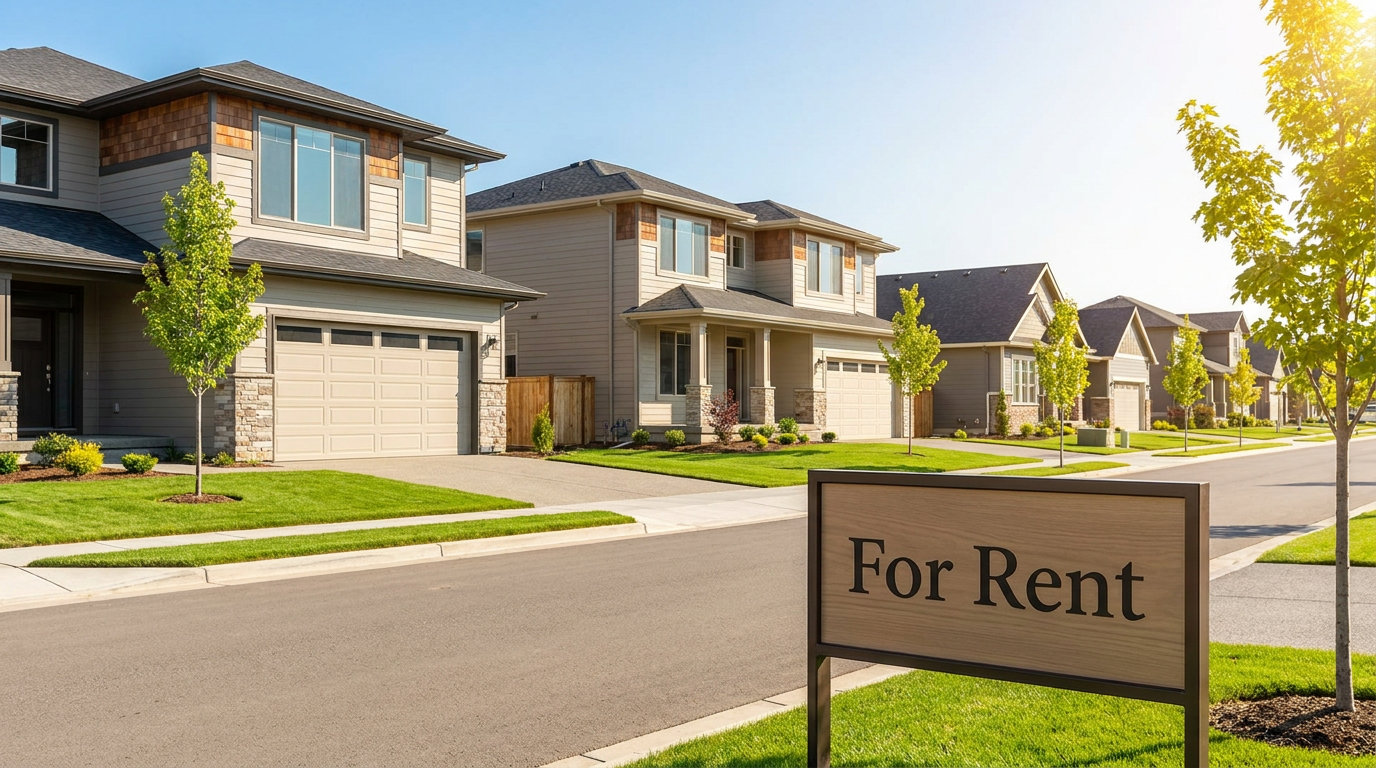
Across the American Sun Belt, a new kind of suburban neighborhood is taking root. The streets are lined with pristine, single-family homes featuring two-car garages, fenced backyards, and modern finishes. Yet, not a single resident in the community holds a mortgage. This is the "build-to-rent" (BTR) boom—a rapidly expanding real estate sector where entire subdivisions are constructed exclusively for long-term tenants.[1]
The scale of the shift is staggering. As of late 2025, single-family rental households reached a seven-year high of 14.6 million. Purpose-built rental communities are the primary engine of this growth, now accounting for 7.2% of all single-family housing starts in the United States—a massive jump from the historical average of 2.3%.[2][3]
Unlike the traditional "scattered-site" rental model—where mom-and-pop landlords or corporate investors buy individual existing homes across various towns—BTR developments are cohesive, master-planned communities. They operate much like luxury apartment complexes, complete with centralized professional management, on-site maintenance teams, and shared amenities like resort-style pools, fitness centers, and dog parks.[4][5]

The driving force behind this phenomenon is a stark economic reality: the widening gap between what American households want and what they can afford to buy. Elevated mortgage rates and stubbornly high home prices have effectively locked millions of prospective buyers out of the purchase market.[5][6]
However, the desire for the suburban lifestyle has not vanished. Millennials and older Gen Z renters are increasingly starting families, acquiring pets, and seeking out better school districts. They want the psychological comfort and physical space of a detached house, but they lack the down payment or the willingness to take on a 30-year financial anchor.[5][6]
Build-to-rent communities offer a highly appealing middle ground. They provide the privacy of a detached home without the unpredictable expenses of a new roof, a broken water heater, or rising property taxes. For many, it is the realization of the suburban dream, delivered as a flexible monthly subscription rather than a lifelong debt obligation.[1][5]
Wall Street and institutional investors have taken notice. Attracted by the sector's resilience, capital is pouring into BTR developments. These communities boast an impressive 94.9% occupancy rate, and tenant turnover is significantly lower than in traditional multifamily apartment buildings. Renters who move into a house are far more likely to stay for multiple years, providing investors with highly predictable, stabilized cash flow.[1][5][1]

Attracted by the sector's resilience, capital is pouring into BTR developments.
But the rapid corporatization of single-family housing has not gone unnoticed by lawmakers. In early 2026, the U.S. Senate advanced the "21st Century ROAD to Housing Act," a sweeping bill aimed at addressing the national housing shortage.[4]
A highly controversial provision in the Senate bill, known as Section 901, sought to ban large institutional investors—defined as those owning 350 or more single-family homes—from purchasing additional properties. Crucially, the original language mandated that developers of new build-to-rent communities sell those homes to individual buyers within seven years of completion.[4]
The proposed seven-year sell-off rule sent shockwaves through the real estate industry, effectively freezing capital for new BTR projects. Housing researchers and policy analysts quickly sounded the alarm. The Terner Center for Housing Innovation warned that forcing developers to liquidate their assets would introduce massive financial risk, ultimately chilling new construction and reducing the overall supply of rental housing.[7]
Free-market advocates echoed these concerns. Analysts at the Cato Institute argued that banning corporate investment in purpose-built rentals was a counterproductive policy driven by an irrational fear of corporations, noting that institutional capital is essential for funding large-scale residential development.[8]

The distinction between "buying up" and "building up" became the crux of the debate. While critics rightfully point out that corporate investors outbidding families for existing starter homes exacerbates the affordability crisis, BTR developers argue they are doing the exact opposite: adding net-new housing inventory to a starved market.[4]
In May 2026, the legislative tide turned. The U.S. House of Representatives passed an amended version of the ROAD to Housing Act by an overwhelming bipartisan margin of 396 to 13. The House version explicitly stripped the seven-year sell-off mandate for build-to-rent communities, carving out a vital exemption that allows institutional developers to continue building and operating purpose-built rental neighborhoods.[4]
This legislative clarity has provided the BTR sector with a green light to resume its aggressive expansion. Major developers are now focusing heavily on the Sun Belt—particularly metros like Dallas, Houston, Atlanta, and Charlotte—where job growth is strong, land is relatively affordable, and population inflows remain steady.[1][4]

As the sector matures, the design of these communities is evolving. Developers are moving beyond basic floor plans, incorporating smart-home technology, private fenced yards, and larger layouts specifically tailored to the way modern families live and work remotely.[5]
For the American renter, the permanent establishment of the build-to-rent asset class represents a fundamental shift in housing options. The binary choice between a cramped urban apartment and a heavily leveraged suburban mortgage has been broken.[5][6]
While BTR does not solve the underlying crisis of homeownership affordability, it provides a high-quality, durable alternative for those who prioritize flexibility and lifestyle. As entire neighborhoods continue to rise from the dirt with "For Rent" signs at the entrance, the American Dream is not necessarily disappearing—it is simply being leased.[1][3]
How we got here
2012–2022
Institutional investors begin buying up distressed single-family homes after the Great Financial Crisis, establishing the scattered-site rental model.
2021–2024
The build-to-rent niche explodes as developers shift from buying existing homes to constructing entire purpose-built rental communities.
Early 2026
The U.S. Senate advances the ROAD to Housing Act, including a controversial provision requiring BTR homes to be sold within seven years.
May 2026
The U.S. House passes an amended version of the bill, explicitly removing the sell-off mandate and protecting the BTR industry.
Viewpoints in depth
Institutional Developers
Argue that build-to-rent communities provide crucial new housing supply for those priced out of the purchase market.
Developers and institutional investors emphasize that purpose-built rentals are fundamentally different from corporate entities buying up existing starter homes. By constructing new neighborhoods from the ground up, they argue they are adding net-new inventory to a starved housing market. They point to high occupancy rates and low tenant turnover as proof that they are serving a permanent demographic of renters who desire the suburban lifestyle but prefer the flexibility and maintenance-free nature of a corporate-managed property.
Legislative Regulators
Concerned that large corporate landlords are monopolizing the single-family housing market.
Lawmakers behind initiatives like the ROAD to Housing Act argue that the unchecked expansion of institutional capital in the single-family sector artificially inflates local housing markets. They express concern that even if developers are building new homes, keeping entire subdivisions permanently off the purchase market deprives families of the opportunity to build generational wealth through home equity. Their initial push to force a seven-year sell-off was aimed at ensuring these homes eventually transition to individual owner-occupiers.
Housing Policy Researchers
Warn that overly broad bans on corporate ownership will stifle new construction and hurt renters.
Housing economists and think tanks, such as the Terner Center, take a nuanced view. While acknowledging the risks of corporate consolidation in existing housing stock, they strongly oppose policies that restrict purpose-built rentals. They argue that forcing developers to sell off BTR communities introduces massive financial risk, which would immediately halt new construction. In a national housing shortage, they maintain that any policy that reduces the creation of new rental units will ultimately drive up rents and harm the very families the legislation intends to protect.
Renters Seeking Space
Prioritize lifestyle, space, and flexibility over the traditional financial anchor of a mortgage.
For the end consumer, the debate is largely practical rather than ideological. Millennials and Gen Z renters increasingly view homeownership not as the ultimate goal, but as a financial burden characterized by high interest rates, property taxes, and maintenance costs. This demographic values the immediate utility of a home—a yard for their dog, a garage, and access to good schools—over the long-term equity. BTR communities offer them the exact lifestyle they want, packaged as a predictable monthly service.
What we don't know
- How the final reconciliation of the ROAD to Housing Act between the House and Senate will treat other forms of institutional real estate investment.
- Whether the premium rents commanded by BTR communities will hold steady if the broader multifamily apartment market experiences a glut of oversupply.
- The long-term impact on local municipal tax bases, as corporate landlords often challenge property tax assessments more aggressively than individual homeowners.
Key terms
- Build-to-Rent (BTR)
- Single-family homes or townhouses constructed specifically for long-term renting rather than for sale to individual buyers.
- Scattered-Site Rentals
- The traditional model where investors buy individual, existing homes across various neighborhoods to rent out.
- Institutional Investor
- Large-scale financial entities, such as private equity firms or real estate investment trusts (REITs), that pool capital to buy and manage extensive property portfolios.
- Purpose-Built Community
- A neighborhood designed from the ground up with a specific operational goal, featuring centralized management and shared amenities.
Frequently asked
Can I eventually buy my build-to-rent home?
Generally, no. These communities are designed to remain under single corporate ownership, though some developers are experimenting with rent-to-own models.
Are build-to-rent homes cheaper than apartments?
No. They typically command a premium over traditional multifamily apartments due to the added space, privacy, and single-family amenities.
Do corporate landlords just buy up existing homes?
While some do (known as scattered-site investing), the build-to-rent model specifically adds new housing supply by constructing homes from the ground up.
Sources
Source coverage
9 outlets
4 viewpoints surfaced









[1]Realtor.comReal Estate Market Analysts
Build-To-Rent Developers Take Over Entire Neighborhoods Across the U.S.
Read on Realtor.com →[2]CRE DailyInstitutional Developers
Single-Family Homes Rentals Hit Seven-Year High
Read on CRE Daily →[3]Arbor Realty TrustInstitutional Developers
Build-to-Rent Activity Stabilizes Above Historical Highs
Read on Arbor Realty Trust →[4]HousingWireLegislative Regulators
ROAD wins House nod, carving BTR out from institutional investor ban
Read on HousingWire →[5]Informa ConnectInstitutional Developers
Building the future: How build-to-rent is reshaping housing in 2026
Read on Informa Connect →[6]EliseAIReal Estate Market Analysts
The Shift to Build-to-Rent: What Does It Mean for the US Housing Market?
Read on EliseAI →[7]Terner Center for Housing InnovationHousing Policy Researchers
Comments on Build to Rent Provisions of the 21st Century ROAD to Housing Act
Read on Terner Center for Housing Innovation →[8]Cato InstituteHousing Policy Researchers
The ROAD to Letting Treasury Pick Winners and Losers in Investing
Read on Cato Institute →[9]FastExpertReal Estate Market Analysts
The Rise of Build to Rent Communities: What Buyers Should Know
Read on FastExpert →
Every angle. Every day.
Get real estate stories with full source coverage and perspective breakdowns delivered to your inbox.