
The Psychology of Visual Organizing: Why Aesthetic Storage Fails and Functional Systems Work
A growing movement is rejecting 'aesthetic' hidden storage in favor of functional, visual organizing systems designed to support executive function and reduce daily friction.
By Factlen Editorial Team
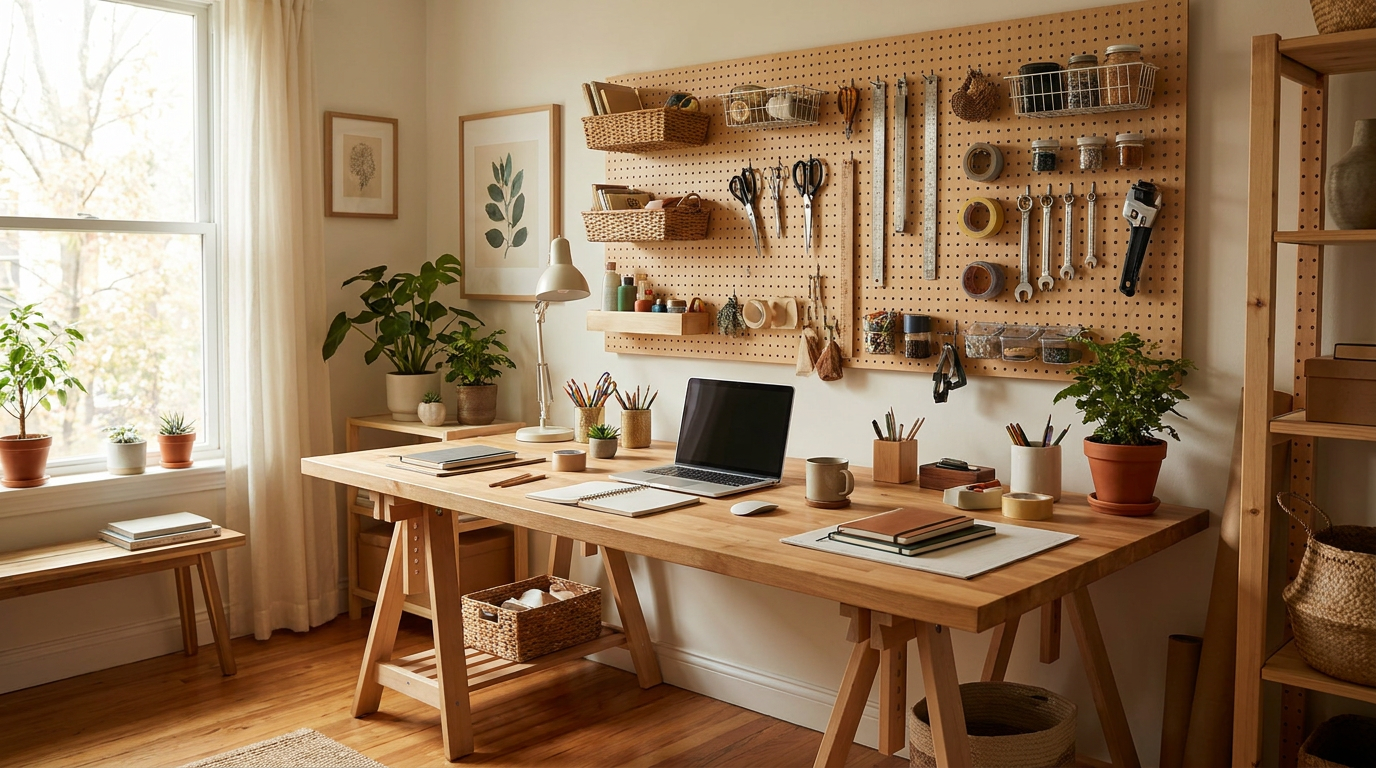
- Functional Organizers
- Advocates for systems that prioritize ease of use and visual cues over aesthetic perfection.
- Cognitive Researchers
- Scientists focused on how physical environments impact cortisol, working memory, and mental health.
- Aesthetic Minimalists
- Proponents of hidden storage and visual silence to create a calming home environment.
What's not represented
- · Interior designers focused purely on aesthetics
- · Minimalist lifestyle influencers
Why this matters
Traditional organizing advice often induces guilt when systems inevitably fail. Understanding the neuroscience of how your brain processes space allows you to build low-friction systems that actually reduce daily stress and save time.
Key points
- Traditional 'aesthetic' organizing often fails because hidden storage removes the visual cues required by neurodivergent brains.
- Studies show visual clutter increases cortisol by 30% and degrades working memory, creating a difficult balancing act for home organization.
- Functional organizing relies on 'point-of-use' storage, keeping items exactly where they are utilized rather than in arbitrary categories.
- Eliminating 'micro-barriers'—such as lids on boxes or nested drawers—is critical for maintaining a system long-term.
For years, the gold standard of home organization has been the "aesthetic pantry"—a visually silent space where every cereal, snack, and pasta shape is meticulously decanted into matching, labeled acrylic containers. It is a look perfected on social media and sold as the ultimate marker of having one's life together. But behind the perfectly curated cabinet doors, a quiet rebellion is brewing. For a growing number of people, these highly curated, high-friction systems fall apart within days, leaving behind a trail of guilt, expired food, and overflowing "doom boxes." The failure of aesthetic organizing isn't a lack of discipline; it is a fundamental mismatch of cognitive styles and neurobiology.[1]
Enter "functional organizing," a movement that is rapidly replacing the minimalist, hidden-storage ethos with systems designed for how human brains actually operate. Also known as visual organizing, this approach prioritizes ease of access and maintenance over magazine-ready aesthetics. It relies heavily on open shelving, point-of-use storage, and the aggressive elimination of "micro-barriers"—the tiny physical frictions that derail the habit of putting things away. By shifting the goal from visual perfection to cognitive ease, functional organizing is reframing messiness not as a moral failing, but as a system design flaw.[1][6]
To understand why traditional, hidden systems fail so many people, it is necessary to look at the neuroscience of clutter and cognitive load. The human brain is a prediction engine that constantly scans its environment, processing visual stimuli to understand its surroundings and assess potential threats. When a space is filled with disorganized, unrelated objects—from unsorted mail to scattered shoes—those items actively compete for limited neural resources. The brain subconsciously perceives these disorganized piles as a demanding visual to-do list, creating a low-grade, chronic stress response that drains cognitive energy long before any actual work or relaxation begins.[3][7]
A landmark study by the Center on Everyday Lives of Families (CELF) at UCLA quantified this physiological toll. Researchers tracked families in their homes and found that individuals—particularly women, who often bear the brunt of household mental load—living in highly cluttered environments experienced a 30% increase in cortisol, the body's primary stress hormone. The constant visual reminder of unfinished tasks kept their nervous systems in a heightened state of alertness, making it nearly impossible to fully relax in their own homes.[2][7]
The Princeton Neuroscience Institute further demonstrated the mechanics of this phenomenon, mapping how visual clutter literally restricts working memory and focus. Their research showed that multiple stimuli present in the visual field at the same time compete for neural representation. In practical terms, this means that trying to focus on a laptop while sitting next to a chaotic pile of mail and laundry physically degrades the brain's ability to process information, leading to cognitive fatigue and a 77% higher likelihood of experiencing anxiety symptoms.[3]

Traditional organizing attempts to solve this neurological tax by hiding everything behind closed doors and inside opaque boxes. This creates "visual silence," which successfully lowers cortisol for neurotypical individuals who can easily remember where they put things. But for individuals with ADHD, neurodivergence, or executive dysfunction, hidden storage creates a new, often more debilitating problem: the phenomenon of "out of sight, out of mind."[4][6]
Executive function encompasses the brain's management system—its ability to plan, prioritize, initiate tasks, and hold information in working memory. For neurodivergent individuals, working memory is often a primary challenge. If an item is placed in a beautiful, opaque woven basket and tucked inside a closed cabinet, the brain effectively forgets that the item exists. The visual cue required to trigger the memory has been completely erased in the name of aesthetics.[4]
This reliance on hidden storage leads directly to the "ADHD tax"—the financial and emotional cost of repurchasing items you already own because you cannot see them, or letting fresh produce rot in the opaque crisper drawer of the refrigerator. When the brain cannot reliably depend on internal working memory, it must externalize that memory into the physical environment. Visual cues are not just helpful for these individuals; they are a structural requirement for daily functioning.[6]
When the brain cannot reliably depend on internal working memory, it must externalize that memory into the physical environment.
Functional organizers solve this dilemma by borrowing a core concept from lean manufacturing and hospital supply chains: point-of-use storage. Instead of grouping items by strict, arbitrary categories—such as keeping all cleaning supplies in a distant laundry room—items are stored exactly where the action occurs. This minimizes the physical and mental steps required to initiate and complete a task, bridging the gap created by executive dysfunction.[1][5]
In a point-of-use system, scissors are kept in a cup by the front door specifically for opening packages. Coffee filters, mugs, and spoons sit on an open tray directly next to the coffee maker. The goal is to reduce the physical steps required to complete a daily routine to absolute zero. If you use a tool in the living room, it lives in the living room, regardless of whether it "belongs" in the garage.[5]

Productivity expert Julie Morgenstern refers to this highly effective spatial design as the "Kindergarten Model." Walk into any kindergarten classroom in the world, and the organization is flawless because it relies on distinct, self-contained activity zones. The art supplies aren't hidden in a hallway closet; they are in open bins right next to the easels. The reading zone has books facing outward. The environment does the heavy lifting for the brain.[5]
The second pillar of functional organizing is the ruthless elimination of micro-barriers. A micro-barrier is any extra step required to retrieve or put something away. Consider the traditional method of storing winter accessories: opening a hall closet, pulling out a storage bin, taking off the lid, placing the gloves inside, replacing the lid, and sliding the bin back onto the shelf. That is six distinct steps just to put away a single pair of gloves. While neurotypical individuals might process this automatically, others find the friction exhausting.[6]
For a brain struggling with executive function, those six steps form an insurmountable wall at the end of a long, exhausting day. The gloves will inevitably end up dropped on the nearest table. Functional organizing reduces this process to a single step: tossing the gloves into an open, lidless basket stationed right next to the door. The golden rule of functional systems is time-based: if a system takes more than five seconds to maintain, it is considered broken.[4][6]
This low-friction approach legitimizes strategies that traditional interior designers might view as messy or unfinished. Clear acrylic bins are heavily favored over opaque woven baskets so contents can be scanned instantly. Pegboards are utilized in offices and kitchens to keep tools and supplies visible but vertically contained. Even the infamous "doom box"—a basket dedicated to random, unsorted items—is embraced as a valid "drop zone" to keep primary work surfaces clear.[1][6]

Transitioning to visual organizing requires a profound psychological shift. It means accepting that a home is a dynamic working environment, not a static museum exhibit. The aesthetic might be busier and more textured than a minimalist ideal, but the cognitive load of navigating and maintaining the space drops dramatically. It trades visual perfection for operational peace.[1][4]
There is, however, a delicate balance to strike. While visual cues are necessary for executive function, too much visual noise will eventually trigger the cortisol spike identified in the UCLA studies. The uncertainty in this movement lies in finding each individual's unique "clutter threshold"—the precise point where helpful visibility crosses the line into stressful chaos.[2][7]
To manage this threshold, functional organizers recommend "contained visibility." A pegboard holds many items, but the rigid boundaries of the board itself signal order to the brain. A clear bin shows all the snacks inside, but the square edges of the bin prevent the visual noise from spilling across the pantry shelf. The items are visible, but their footprint is strictly limited.[1][6]
Ultimately, the functional organizing movement is an exercise in profound self-compassion. It stops asking people to fundamentally change their neurobiology to fit a rigid, aesthetic storage system. Instead, it asks how the physical environment can be redesigned to support the brain that actually lives there, proving that the best organizing system is simply the one you can actually maintain.[1]
How we got here
1990s
The rise of the minimalist interior design movement popularizes hidden storage and visually silent homes.
2009
UCLA's CELF study publishes landmark findings linking household clutter to spiked cortisol levels, particularly in women.
2011
The Princeton Neuroscience Institute maps how visual clutter physically degrades working memory and focus in the human brain.
2020
Pandemic lockdowns force a reckoning with home workspaces, sparking the 'aesthetic pantry' social media trend.
2024–2026
The functional organizing movement gains mainstream traction as neurodivergent creators popularize low-barrier, point-of-use systems.
Viewpoints in depth
Functional Organizers
Advocates for systems that prioritize ease of use and visual cues over aesthetic perfection.
This camp argues that a home is a working environment, not a museum. They believe that if an organizing system requires more than a few seconds to maintain, it is fundamentally broken. By utilizing open shelving, clear bins, and point-of-use storage, they aim to eliminate the 'micro-barriers' that prevent people from putting things away. For this group, the ultimate metric of success is how easily a space can be reset at the end of the day, even if it means accepting a higher baseline of visual noise.
Cognitive Researchers
Scientists focused on how physical environments impact cortisol, working memory, and mental health.
Researchers view home organization through the lens of cognitive load and neurobiology. They point to studies showing that visual clutter directly competes for neural resources, leading to spiked cortisol and chronic low-grade stress. However, they also recognize that executive dysfunction requires visual cues. This camp focuses on finding the optimal 'clutter threshold'—the precise balance where a space provides enough visual information to support working memory without triggering an anxiety response.
Aesthetic Minimalists
Proponents of hidden storage and visual silence to create a calming home environment.
This perspective maintains that the home should be a sanctuary from the chaotic outside world. They advocate for decanting products, using opaque matching bins, and keeping surfaces entirely clear. They argue that 'visual silence' is the most effective way to lower stress and promote relaxation. While they acknowledge that these systems require discipline to maintain, they believe the psychological payoff of a perfectly curated, visually quiet space justifies the daily effort.
What we don't know
- The exact neurobiological mechanism that determines an individual's specific 'clutter threshold' before visual cues turn into stressful noise.
- How long-term reliance on highly visible functional organizing systems impacts the development of executive function skills in children.
Key terms
- Functional Organizing
- A system prioritizing ease of access and maintenance over visual aesthetics, often utilizing open storage.
- Micro-barrier
- A small physical or mental obstacle, such as a box lid or a nested drawer, that prevents a task from being completed.
- Point-of-Use Storage
- The practice of keeping items exactly where they are used rather than grouped by arbitrary categories.
- Executive Dysfunction
- A cognitive disruption that makes it difficult to plan, focus attention, remember instructions, and juggle multiple tasks.
Frequently asked
What is the difference between decluttering and organizing?
Decluttering is the act of removing excess items from a space. Organizing is the creation of a logical system to store and access the items you choose to keep.
Why do traditional organizing systems fail for ADHD?
Traditional systems rely heavily on hidden storage and multi-step processes. For neurodivergent brains, 'out of sight' often means 'out of mind,' and multi-step put-away processes create insurmountable micro-barriers.
What is a micro-barrier in organizing?
A micro-barrier is any small physical friction that makes a task harder to complete, such as a lid on a box, a nested drawer, or a bin stored on a high shelf.
Sources
Source coverage
8 outlets
3 viewpoints surfaced








[1]Factlen Editorial TeamFunctional Organizers
Synthesis by Factlen editorial team
Read on Factlen Editorial Team →[2]Journal of Environmental PsychologyCognitive Researchers
The dark side of home: Assessing possession 'clutter' on subjective well-being
Read on Journal of Environmental Psychology →[3]Princeton Neuroscience InstituteCognitive Researchers
Interactions of top-down and bottom-up mechanisms in human visual cortex
Read on Princeton Neuroscience Institute →[4]Psychology TodayCognitive Researchers
The Executive Function of Organization
Read on Psychology Today →[5]Julie Morgenstern EnterprisesFunctional Organizers
Think Kindergarten: The Ultimate Organizing Model
Read on Julie Morgenstern Enterprises →[6]ADDitude MagazineFunctional Organizers
The ADHD Guide to Functional Organizing
Read on ADDitude Magazine →[7]Neuroscience NewsCognitive Researchers
How Clutter Impacts Cortisol and Cognitive Load
Read on Neuroscience News →[8]Architectural DigestAesthetic Minimalists
The Case for Hidden Storage and Visual Silence
Read on Architectural Digest →
Every angle. Every day.
Get home stories with full source coverage and perspective breakdowns delivered to your inbox.