
The Psychology of Clutter and the 'Container Concept' That Solves It
Research shows that physical clutter directly elevates stress hormones and impairs cognitive function. A decluttering framework known as the 'Container Concept' uses physical boundaries to bypass the emotional fatigue of organizing.

In short
- Physical clutter is not just an aesthetic issue; it acts as an environmental stressor that elevates cortisol levels and impairs cognitive function.
- Visual disarray overloads the brain's visual cortex, reducing working memory and causing decision fatigue.
- The 'Container Concept' is a decluttering framework that uses the physical limits of a space to dictate how much can be kept.
The visceral reaction to walking into a messy room—the feeling of the air thickening and sightlines shrinking—is a nearly universal experience. For decades, this discomfort was largely dismissed as a mere aesthetic preference or a moral failing of personal tidiness.
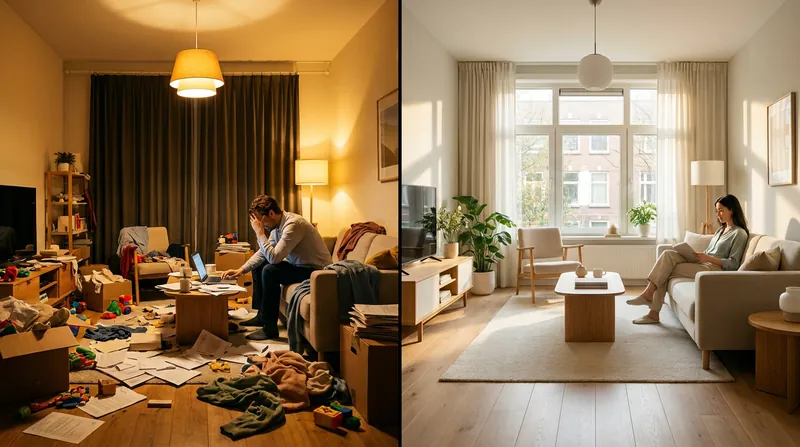
However, emerging research reveals that the impact of a chaotic environment is profoundly physiological. Clutter does not merely occupy physical space; it colonizes mental real estate, quietly chipping away at emotional well-being and severely straining the brain's executive functions. Understanding this link is the first step toward reclaiming both physical space and mental clarity.[1]
The connection between our surroundings and our nervous system is highly measurable. A landmark study conducted by researchers at UCLA found that high levels of clutter in the home directly correspond to elevated levels of cortisol, the body's primary stress hormone.
When the brain perceives a disorganized environment, it interprets the visual chaos as a loss of control, triggering a low-grade fight-or-flight response. This chronic elevation of stress hormones makes it significantly harder to focus, relax, or even sleep, transforming what should be a restorative sanctuary into a relentless source of chronic anxiety.
The cognitive toll extends far beyond emotional stress into actual neurological impairment. Studies from Princeton University's Neuroscience Institute have demonstrated that visual disarray forces the visual cortex to process irrelevant items, overloading the brain's processing capacity. Because every single object in a room competes for attention, this constant visual distraction reduces working memory and leaves fewer neural resources available for the task at hand. Order, by contrast, signals safety to the brain, freeing the prefrontal cortex to plan, reason, and execute daily tasks efficiently without the friction of environmental noise.[1]
Psychologists also point to the 'Zeigarnik Effect,' a well-documented cognitive phenomenon where the human mind becomes preoccupied with interrupted tasks or incomplete actions. In a cluttered home, every out-of-place item represents an unresolved choice or an unfinished chore—a shirt that needs folding, a bill that needs paying, or a sentimental object that requires a permanent decision. This constant barrage of micro-demands creates severe decision fatigue, draining an individual's mental energy and motivation before the day has even truly begun.
The traditional consumer response to this overwhelming accumulation is often to purchase more storage solutions. A multi-billion-dollar home organization industry thrives on the promise that the right combination of matching bins, color-coordinated baskets, and custom shelving will finally solve the problem. Yet, professional organizers and psychologists note that adding more storage often exacerbates the underlying issue. Buying new bins without reducing the sheer volume of possessions simply organizes the hoarding, allowing the accumulation to expand to fill the newly available space rather than addressing the root cause.[2]
Enter the 'Container Concept,' a paradigm-shifting decluttering framework popularized by author and home management expert Dana K. White. After years of battling chronic disorganization, White realized a fundamental misunderstanding about the nature of household storage. The traditional view treats containers as receptacles designed to hold as much stuff as humanly possible. The Container Concept flips this premise entirely on its head: a container's primary purpose is not to store items, but to serve as a strict, unyielding physical limit.[3]
Under this framework, every single space in a home is viewed as a container with a finite, non-negotiable boundary. A drawer is a container. A bookshelf is a container. A toy box is a container. Ultimately, the entire house or apartment is one large container.
The concept dictates that you can keep whatever you want, but only up to the physical limit of the designated space. Once the container is comfortably full, the space itself dictates that no more items can be kept, completely bypassing the need for agonizing emotional decisions.[2]
The implementation of the Container Concept is remarkably straightforward, relying entirely on spatial boundaries rather than emotional attachment. When tackling a specific category—such as kitchen utensils, books, or linens—the first step is to select the container. The second step is to place the absolute favorite, most frequently used items into that space first. You continue adding items in descending order of preference until the container is full. Anything that does not fit is automatically designated for donation or disposal, without further debate.[2]
What makes this method so psychologically powerful is that it entirely removes guilt from the decluttering process. Traditional methods often ask individuals to evaluate each item individually, asking if it sparks joy or if it might be needed in a hypothetical future. These questions frequently trigger anxiety, especially for those with sentimental attachments or a scarcity mindset. The Container Concept outsources the role of the 'bad guy' to the physical space. The shelf is not asking for better folding techniques; it is simply stating its maximum capacity.[3]
This shift in perspective leverages what behavioral psychologists call the 'framing effect.' Instead of focusing on the negative action of throwing things away, the individual is focused on the positive action of choosing their absolute favorite items to keep. By working within a specific, unchangeable limit, the goal shifts from achieving a minimalist aesthetic to finding a practical, functional solution. The decision is no longer 'Do I love this object?' but rather, 'Do I have room for this object in the life and space I actually have today?'[3]
For families and individuals struggling with executive dysfunction, such as ADHD, this boundary-based method is particularly transformative. Parents report that when children are given a specific bin and told they can keep whatever fits inside, the tantrums associated with decluttering often vanish entirely. The child understands the physical limit inherently, shifting their focus to curating their favorite toys rather than mourning the loss of the ones that must go. The container provides a tangible, visual rule in an otherwise abstract and overwhelming process.[3]
Maintaining this newfound order relies on a strict 'one-in, one-out' policy. When a container is full, introducing a new item requires the removal of an old one. If a new coffee mug is brought into a full cabinet, an existing mug must be donated to make room. This prevents the gradual, unnoticed creep of clutter and ensures that the physical boundaries of the home are continually respected, preserving both the physical space and the mental tranquility it provides over the long term.[2]
Ultimately, the intersection of psychology and spatial organization reveals that decluttering is not about achieving a magazine-perfect home to impress guests. It is a fundamental act of mental health preservation. By acknowledging the severe cognitive load of excess possessions and employing ruthless, space-based boundaries like the Container Concept, individuals can break the cycle of chronic stress and decision fatigue.
Definitions
- Cortisol
- The body's primary stress hormone, which has been shown to elevate in individuals living in highly cluttered environments.
- Zeigarnik Effect
- A psychological tendency for the mind to become preoccupied with interrupted tasks or incomplete actions, often triggered by the sight of unresolved clutter.
- Container Concept
- A home organization philosophy that uses the physical boundaries of a space to dictate how many items can be kept, removing emotional decision-making.
- Executive Function
- A set of mental skills that include working memory, flexible thinking, and self-control, which can be severely strained by visual disarray.
- Framing Effect
- A cognitive bias where people decide on options based on whether the options are presented with positive or negative connotations.
Questions & answers
What is the Container Concept?
It is a decluttering framework that treats every storage space—like a drawer or a shelf—as a strict physical limit rather than a receptacle to be filled. Once the space is comfortably full, no more items can be kept.
How does clutter affect mental health?
Research shows that visual clutter overloads the brain's processing capacity, leading to decreased working memory and focus. It also triggers the release of cortisol, the body's primary stress hormone, causing chronic anxiety.
What is the 'one-in, one-out' rule?
It is a maintenance strategy used alongside the Container Concept. Once a container is full, you must remove and donate an existing item before you can place a new item into that space.
Why doesn't buying more storage bins work?
Adding more storage without reducing the volume of possessions simply organizes the excess. It allows the underlying accumulation to expand to fill the newly available space, rather than solving the root problem of having too much stuff.
Analysis by camp
Neuroscientists & Psychologists
Focuses on the physiological and cognitive toll of disorganized environments.
This camp emphasizes that clutter is not a moral failing but an environmental stressor. Researchers point to elevated cortisol levels and the visual cortex's inability to filter out excessive stimuli. They argue that the brain is evolutionarily wired to scan environments for threats and resources, meaning a messy room forces the brain into a constant state of low-grade hypervigilance and cognitive overload.
Practical Organizers
Advocates for spatial limits over emotional sorting to bypass decision fatigue.
Home management experts argue that traditional decluttering advice—which relies on evaluating emotional attachment to every item—sets people up for failure. Instead, they champion the Container Concept, which outsources the decision-making to the physical boundaries of a space. By accepting that a shelf or a drawer has a finite limit, individuals can organize their homes without the paralyzing guilt of discarding perfectly good items.
Individuals with Executive Dysfunction
Highlights how boundary-based methods support neurodivergent individuals.
For those with ADHD or chronic disorganization, abstract organizing concepts often fail. This perspective values the Container Concept because it provides a concrete, visual rule. When the container is full, the task is over. This tangible boundary bypasses the executive dysfunction that typically makes multi-step sorting and categorizing impossible, offering a realistic path to maintaining a functional living space.
- Neuroscience & Psychology
- Emphasizes the physiological impact of clutter on the brain.
- Practical Organizers
- Advocates for spatial limits over emotional sorting.
- Editorial Synthesis
- Synthesizes the psychological research with practical home management frameworks.
Perspectives this story doesn't cover
- Interior Designers
- Minimalist Advocates
Sources
Source coverage
3 outlets
3 viewpoints surfaced



- [1]Nurture Your Nature PsychotherapyNeuroscience & Psychology
How Clutter Affects Our Mental Health
Read on Nurture Your Nature Psychotherapy → - [2]Apartment TherapyPractical Organizers
I Tried the 'Boundary Method' and It Got Rid of My Container Clutter
Read on Apartment Therapy → - [3]Factlen Editorial TeamEditorial Synthesis
Synthesis by Factlen editorial team
Read on Factlen Editorial Team →

More in Home
See all →Home Management
The Rise of 'Functional Organizing': How Science and Neurodiversity are Redefining the Tidy Home
2 sources

Wellness Science
The Science of Clutter: How Home Organization Alters Cortisol and Cognitive Load
6 sources
Home Psychology
The Neuroscience of Decluttering: How 'Visual Noise' Impacts Cortisol and Focus
4 sources

Organizational Psychology
The Science of Micro-Decluttering: How the 'One-Touch' Rule Lowers Cortisol and Restores Focus
3 sources

Comments
Every angle. Every day.
Get Home stories with full source coverage and perspective breakdowns, free every day.