
The New Space Economy: How Plummeting Launch Costs and Private Capital are Opening the Final Frontier
Driven by reusable rockets and massive private investments, the global space economy has surpassed $600 billion. As launch costs collapse, space is transitioning from a government-funded frontier to a hub of commercial infrastructure.
By Factlen Editorial Team
- Commercial Space Investors
- Focus on the massive financial returns and infrastructure potential of reusable rockets and mega-constellations.
- Macro Space Analysts
- Emphasize long-term economic modeling, market sizing, and the shift toward outcome-based satellite services.
- Launch Economics Trackers
- Focus strictly on the underlying unit economics, cost-per-kilogram metrics, and the historical context of launch vehicles.
What's not represented
- · Developing nations without domestic launch capabilities
- · Astronomers impacted by mega-constellations
Why this matters
The commercialization of space is creating a new industrial revolution in Low Earth Orbit. As the cost to launch cargo plummets, space-based services like global broadband, real-time climate monitoring, and orbital manufacturing will increasingly impact terrestrial business and daily life.
Key points
- The global space economy reached a record $613 billion in 2024, with 78% driven by the commercial sector.
- Reusable rockets have collapsed the cost of reaching Low Earth Orbit by roughly 95% since the Space Shuttle era.
- Value in the space sector is shifting from selling physical hardware to providing outcome-based services like global broadband and Earth observation.
- Financial institutions project the space economy could surpass $1 trillion by 2040, attracting massive institutional capital.
Gina Rinehart, Australia's richest person and a magnate whose vast fortune was built on the terrestrial extraction of iron ore, recently poured over $1 billion into the ultimate off-world venture: SpaceX. Her massive investment, executed through her closely held company Hancock Prospecting, was part of SpaceX's historic and heavily oversubscribed initial public offering. The market debut valued the rocket manufacturer at a staggering $2.1 trillion, minting founder Elon Musk as the world's first trillionaire and signaling a watershed moment for private capital in aerospace.[1][2]
Rinehart's strategic pivot from the red dirt of the Pilbara region to the vacuum of Low Earth Orbit is not merely an eccentric billionaire's whim. It represents a fundamental macroeconomic shift in how humanity approaches the cosmos. For the first half-century of the space age, orbital exploration was the exclusive, cash-burning domain of national governments, driven primarily by geopolitical prestige and military posturing. Today, that paradigm has inverted, with private enterprise and institutional capital taking the helm of orbital development.[1][7]
Space has definitively transitioned from a theater of scientific curiosity into a layer of critical industrial infrastructure. According to the Space Foundation's latest global report, the space economy reached an unprecedented $613 billion in 2024, reflecting a robust 7.8% year-over-year growth rate. Crucially, the commercial sector now accounts for a staggering 78% of that total economic footprint, dwarfing the contributions of traditional government space agency budgets. This commercial dominance is driven by a rapid monetization of space-based communications and Earth observation platforms that terrestrial businesses increasingly rely upon.[3][7]
Major financial institutions and global policy organizations are taking notice of this accelerating commercialization. Researchers at Morgan Stanley project that the global space economy will surge past the $1 trillion mark by 2040, fueled by scientific advancements and an influx of private cash. The World Economic Forum is even more bullish, modeling a potential $1.8 trillion market by 2035 if current capital formation trends hold and governments commit to long-term commercial procurement contracts. These projections suggest that space investment is moving rapidly from specialist venture capital enthusiasm into mainstream institutional portfolio consideration.[4][5]

To understand exactly how we arrived at this economic inflection point, one must look at a single, unglamorous metric that dictates the physics of aerospace: the cost per kilogram to orbit. For decades, this specific number acted as an insurmountable financial wall, keeping private enterprise earthbound and limiting space access to sovereign nations. Every business plan for orbital manufacturing or space tourism ultimately died on the launch pad because the freight costs were simply too exorbitant to justify the return on investment.[6][7]
During the Space Shuttle era, which began with high hopes in 1981, the promise of affordable, routine access to space evaporated almost immediately upon contact with operational reality. While the Shuttle was initially marketed as a vehicle that would reduce launch costs to a mere $600 per kilogram, its actual operational cost turned out to be closer to $54,500 per kilogram. That massive gap between promise and reality defined an entire era of frustration and stagnation in the commercial launch industry.[6][7]
The breakthrough that finally shattered this paradigm came not from the discovery of new propulsion physics, but from applying a Silicon Valley approach to manufacturing and mastering the complex engineering of reusability. By successfully landing and refurbishing the first stage of its Falcon 9 rockets, SpaceX fundamentally collapsed the historical cost curve. Instead of throwing away tens of millions of dollars of precision aerospace hardware into the ocean after every single flight, the company began operating rockets more like commercial airplanes.[6][7]
By successfully landing and refurbishing the first stage of its Falcon 9 rockets, SpaceX fundamentally collapsed the historical cost curve.
The economic results of this reusability revolution have been nothing short of staggering. Today, a flight-proven Falcon 9 rocket can deliver commercial payloads to Low Earth Orbit for approximately $1,500 to $2,700 per kilogram. This represents a monumental 95% reduction in launch costs compared to the Space Shuttle era. When the cost of reaching orbit falls by these orders of magnitude, space itself stops being a rare government event and transforms into an accessible environment for private enterprise.[6][7]

This dramatic collapse in launch costs acts as a powerful catalyst for entirely new orbital business models. When freight costs drop by an order of magnitude, the nature of the cargo fundamentally changes. We are currently witnessing a massive transition away from bespoke, billion-dollar government satellites that take a decade to build. In their place, the industry is rapidly deploying mass-produced, highly capable commercial satellite constellations that are cheaper to manufacture and launch in bulk. This shift mirrors the evolution of the mainframe computer to the personal laptop—democratizing access through volume and standardization.[5][7]
The most visible and financially lucrative manifestation of this new paradigm is the explosion of satellite broadband networks. Mega-constellations like SpaceX's Starlink are deploying thousands of low-cost satellites into Low Earth Orbit to provide high-speed, low-latency internet coverage to the most remote corners of the globe. By doing so, they are successfully turning orbital hardware into a massive engine for recurring subscription revenue, tapping into a global telecommunications market that dwarfs the traditional launch services sector.[1][7]
But the economic horizon of the space industry extends far beyond consumer telecommunications. Analysts at the World Economic Forum note that the most significant structural shift in the sector is how value is moving from selling physical assets in orbit to providing outcome-based services on Earth. Customers no longer want to buy and operate complex satellite hardware; they simply want to purchase the actionable intelligence and continuous connectivity that those orbital assets provide. This service-oriented model drastically reduces upfront capital requirements for end-users and accelerates the broader adoption of space technology across terrestrial industries.[5][7]
Earth observation companies perfectly illustrate this transition. By leveraging cheap launch costs, these firms are deploying vast networks of synthetic aperture radar and hyperspectral imaging satellites. These constellations provide real-time, high-resolution data that is sold as a service to agricultural firms monitoring crop health, logistics companies tracking global maritime shipping lanes, and governments assessing climate change impacts. The product is no longer the satellite; the product is the insight derived from the data it collects, creating a highly scalable and sticky revenue stream.[5][7]

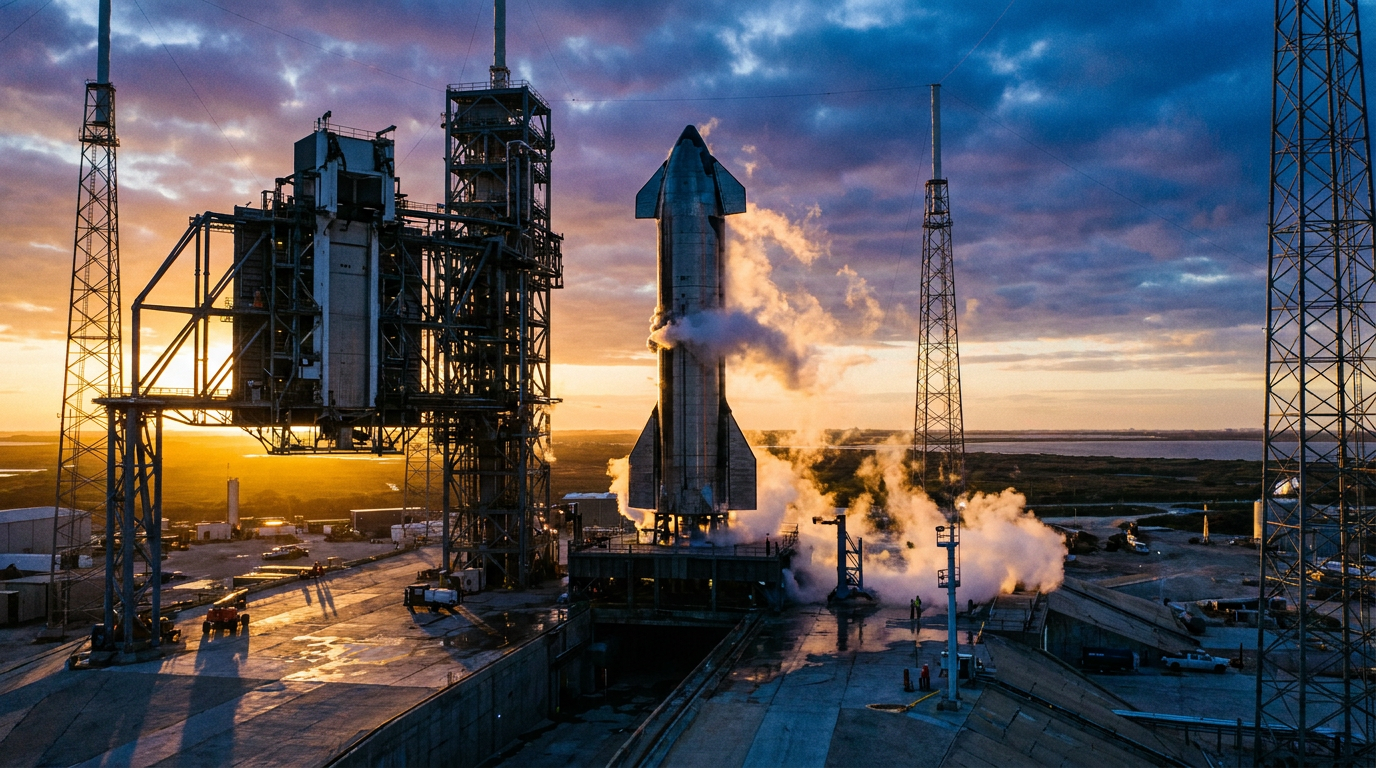
While the current market is booming, the next major step function in this economic evolution hinges on the successful deployment of super-heavy lift vehicles, most notably SpaceX's Starship. Designed from the ground up for full and rapid reusability of both its booster and upper stage, Starship is targeting an aspirational launch cost of just $100 to $200 per kilogram to orbit. Achieving this price point would represent another order-of-magnitude reduction, fundamentally rewriting the economics of aerospace once again.[6][7]
If sub-$200 per kilogram access to space becomes a reliable reality, it transitions the industry from merely deploying lightweight sensors to deploying heavy industrial infrastructure. At that price point, entirely new and highly lucrative markets open up that were previously confined to science fiction. It creates the mathematical foundation required for large-scale orbital manufacturing of advanced pharmaceuticals and fiber optics, the construction of space-based solar power stations, and the establishment of sustained, commercial logistics chains to the Moon and eventually Mars.[6][7]
However, this era of rapid commercialization is not without significant friction and systemic risk. The sheer volume of material currently being placed into Low Earth Orbit has raised urgent, international concerns about orbital congestion. Experts warn of the growing risk of Kessler Syndrome—a theoretical scenario where a single collision between satellites creates a cascading chain reaction of high-speed debris, potentially rendering entire orbital planes unusable for generations and crippling the very infrastructure the new space economy relies upon.[7]

Furthermore, the current commercial market remains heavily consolidated around a single dominant player. With SpaceX accounting for roughly 82% of private-company launches in recent years, the broader commercial ecosystem is highly dependent on one provider's continued success and pricing strategy. While competitors are racing to bring their own reusable medium and heavy-lift vehicles to market to provide alternative access to orbit, this temporary monopoly creates a single point of failure that institutional investors and government regulators are watching closely as they allocate capital.[5][7]
Despite these operational and regulatory hurdles, the overarching trajectory of the industry is unmistakably clear. Institutional capital is flowing freely, unit economics are steadily improving, and the final frontier is officially open for business. As traditional terrestrial industries—from agriculture to global finance—increasingly look upward for growth, efficiency, and critical data, the space economy is no longer a speculative venture. It is rapidly cementing itself as a foundational pillar of 21st-century global commerce, forever altering humanity's relationship with the stars.[7]
How we got here
1981
The Space Shuttle era begins, promising cheap access to space but ultimately costing over $54,000 per kilogram to orbit.
2008
SpaceX successfully launches the Falcon 1, becoming the first private company to put a liquid-fueled rocket into orbit.
2015
SpaceX lands a Falcon 9 first stage for the first time, proving the viability of orbital-class rocket reusability.
2019
The first batch of Starlink satellites is deployed, signaling the beginning of commercial mega-constellations in Low Earth Orbit.
2024
The global space economy officially surpasses $600 billion, driven overwhelmingly by commercial sector growth.
2026
SpaceX executes a historic IPO valuing the company at over $2 trillion, attracting massive institutional capital.
Viewpoints in depth
Commercial Space Investors
Viewing space as the next great infrastructure play.
This camp, heavily populated by venture capitalists and institutional investors, argues that space is no longer a niche R&D sector but a foundational layer of the global economy. They point to the collapse in launch costs as the catalyst that makes orbital business models viable. For these investors, companies like SpaceX are not just rocket builders; they are the railroads of the 21st century, laying the tracks for a multi-trillion-dollar ecosystem of orbital manufacturing, global broadband, and eventually, lunar logistics.
Macro Space Analysts
Focusing on the shift from hardware to outcome-based services.
Economic analysts and global policy forums emphasize that the true value of the space economy lies not in the rockets themselves, but in the data they enable. This perspective highlights the transition from selling bespoke satellites to selling recurring subscriptions for Earth observation, climate monitoring, and secure communications. They argue that as the barrier to entry falls, the most successful companies will be those that seamlessly integrate space-based data into terrestrial industries like agriculture, maritime shipping, and finance.
Launch Economics Trackers
Anchoring the hype in the hard physics and unit costs of rocketry.
This analytical viewpoint strips away the science-fiction narratives to focus purely on the math of orbital mechanics. They track the 'cost per kilogram to Low Earth Orbit' as the single most important metric in the industry. While acknowledging the massive 95% reduction in costs achieved by reusable rockets, they also caution that future projections rely on unproven super-heavy lift vehicles achieving unprecedented flight cadences. They serve as a grounding force, reminding the market that space remains an inherently hostile and capital-intensive environment.
What we don't know
- Whether super-heavy lift vehicles like Starship will successfully achieve their aspirational sub-$200 per kilogram cost targets.
- How international regulators will manage the growing risk of orbital debris as thousands of new satellites are launched annually.
- If the current commercial launch market can sustain multiple profitable providers, or if it will remain a monopoly dominated by a single company.
Key terms
- Low Earth Orbit (LEO)
- An orbit relatively close to Earth's surface, typically at an altitude of 2,000 kilometers or less, where most commercial satellites and the International Space Station operate.
- Cost per Kilogram
- The fundamental economic metric of spaceflight, measuring how much money it takes to deliver one kilogram of payload into orbit.
- Reusability
- The engineering practice of recovering and flying rocket components multiple times, which drastically reduces the cost of space launches compared to traditional expendable rockets.
- Kessler Syndrome
- A theoretical scenario where a single collision between satellites creates a cascading chain reaction of high-speed debris, potentially rendering entire orbital planes unusable.
Frequently asked
Why is the space economy growing so fast right now?
The primary driver is the dramatic reduction in launch costs. Reusable rockets have lowered the price of reaching orbit by over 95%, allowing private companies to launch large networks of commercial satellites.
How much is the space industry currently worth?
According to the Space Foundation, the global space economy reached a record $613 billion in 2024, with commercial activities making up 78% of that total.
What is 'cost per kilogram'?
It is the standard metric for launch economics, calculated by dividing the total price of a rocket launch by the maximum payload weight it can carry to a specific orbit.
How do commercial space companies make money?
While some build and launch rockets, the majority of revenue comes from space-enabled services. This includes selling satellite broadband subscriptions, Earth observation data, and secure communications to governments and private businesses.
Sources
Source coverage
7 outlets
3 viewpoints surfaced







[1]BloombergCommercial Space Investors
Billionaire Gina Rinehart Made 'Significant' SpaceX Investment
Read on Bloomberg →[2]CNBCCommercial Space Investors
SpaceX: To the moon for investors or a bumpy ride? Here's what experts say
Read on CNBC →[3]Space FoundationMacro Space Analysts
The Space Report 2025 Q2 Highlights Record $613 Billion Global Space Economy for 2024
Read on Space Foundation →[4]Morgan StanleyMacro Space Analysts
The New Space Economy
Read on Morgan Stanley →[5]World Economic ForumMacro Space Analysts
3 commercial trends propelling a $1.8 trillion space market
Read on World Economic Forum →[6]Orbital IntelLaunch Economics Trackers
Launch Cost Per Kg: From $54,500 to $1,500
Read on Orbital Intel →[7]Factlen Editorial TeamLaunch Economics Trackers
Synthesis by Factlen editorial team
Read on Factlen Editorial Team →
More in business
See all 5 stories →AI Infrastructure
SpaceX Raises Record $85.7 Billion in Historic IPO to Fund Orbital AI Infrastructure
7 sources
AI Economics
The Compute-First Era: How AI is Rewriting the Rules of Venture Capital
6 sources
Fed Watch
Federal Reserve Holds Rates Steady as New Chair Kevin Warsh Signals Hawkish Pivot
8 sources

Every angle. Every day.
Get business stories with full source coverage and perspective breakdowns delivered to your inbox.