
The Multimillion-Dollar Science Behind the 2026 World Cup's Perfect Grass
To meet FIFA's mandate for natural grass across 16 diverse North American stadiums, agronomists have engineered high-tech hybrid pitches capable of surviving indoors.
By Factlen Editorial Team
- Agronomy Researchers
- Scientists focused on the biological and mechanical challenges of standardizing living grass across extreme climates.
- Tournament Organizers
- FIFA officials prioritizing absolute uniformity, player safety, and broadcast aesthetics.
- Stadium Operators
- Venue managers balancing the temporary demands of the World Cup with their permanent infrastructure.
What's not represented
- · Environmental advocates concerned about the water and energy usage required to sustain indoor grass.
- · Sod farmers tasked with the high-pressure job of cultivating the exact seed blends to FIFA's flawless standards.
Why this matters
The unprecedented engineering required to keep natural grass alive in domed stadiums is pushing the boundaries of agronomy. The resulting innovations in drainage, hybrid reinforcement, and root-zone management will eventually trickle down to make local community sports fields safer and more durable.
Key points
- FIFA has mandated natural grass for all 2026 World Cup matches, requiring complex engineering for indoor and artificial-turf stadiums.
- Researchers from the University of Tennessee and Michigan State spent five years developing shallow, hybrid grass systems.
- The temporary pitches feature a 6-inch sand root zone, vacuum ventilation, and synthetic fibers to stabilize the surface.
- A custom 3D-printed mechanical foot called fLEX was invented to simulate a 168-pound player's impact on the grass.
- The ultimate goal is absolute uniformity, ensuring the pitch feels identical whether in Miami, Mexico City, or a domed stadium in Vancouver.
When the 2026 World Cup kicks off, an estimated two billion viewers will tune in to watch the greatest soccer players on earth navigate 104 matches across 16 stadiums in the United States, Canada, and Mexico. But for a select group of scientists, the most important athletes on the field won't be wearing jerseys. They will be the billions of individual blades of grass engineered to survive the most logistically complex sporting event in history.[4][5][8]
The core challenge stems from a strict mandate: FIFA requires all Men's World Cup matches to be played on natural grass. This presents a monumental hurdle for the 2026 tournament, as five of the selected venues are indoor or domed stadiums, and eight currently utilize artificial turf for their primary National Football League tenants. Growing elite-level natural grass inside a dark, climate-controlled dome is a biological paradox that has forced agronomists to completely rethink how a sports field is constructed.[1][4][7][8]
To solve this, FIFA commissioned a multimillion-dollar, five-year research project led by two of the world's foremost turfgrass experts: John Sorochan, a distinguished professor at the University of Tennessee, and John "Trey" Rogers III from Michigan State University. The duo, who previously collaborated on the indoor grass pitch for the 1994 World Cup at the Pontiac Silverdome, have spent the last half-decade turning university campuses into high-tech agricultural laboratories.[1][2][3]
The ultimate goal of their research is absolute uniformity. Whether a match is played in the sweltering humidity of Miami, the high altitude of Mexico City, or under the translucent roof of SoFi Stadium in Los Angeles, the surface must behave identically. When a player executes a high-speed cut or strikes a ball, the traction, bounce, and roll must be indistinguishable from one venue to the next, ensuring that the pitch never dictates the outcome of a game.[4][7][8]

Achieving this consistency indoors requires overcoming the complete absence of natural elements. In a domed environment, the grass is entirely cut off from the sunlight, rain, and ambient airflow it needs to photosynthesize and establish deep roots. To keep the grass alive and resilient enough to withstand the cleats of world-class athletes, the research team had to design a pitch that functions more like a massive, life-support machine than a traditional lawn.[2][5][7][8]
The foundation of this system is a remarkably shallow root zone. While a traditional soccer pitch might feature a soil profile up to 16 inches deep, the temporary World Cup fields are being built with a highly engineered sand base that is only about six inches thick. This shallow profile is necessary to accommodate the weight limits and logistical constraints of laying a temporary field over existing concrete floors or artificial turf.[6][7][8]
Beneath that six-inch sand layer lies a complex modular infrastructure. Crews install a rigid plastic drainage grid—often referred to as a Permavoid system—directly over the stadium's permanent floor. This grid is then covered with a permeable geotextile fabric that prevents the sand from washing away while allowing water to flow freely into the drainage channels below.[2][6][8]
Beneath that six-inch sand layer lies a complex modular infrastructure.
The grass itself is not purely natural; it is a highly advanced hybrid system. To provide the structural integrity needed for a shallow root zone, millions of synthetic fibers are stitched vertically into the sand. The natural grass roots grow down and entangle themselves with these synthetic threads, which act like rebar in concrete, stabilizing the surface and preventing players from tearing massive divots out of the pitch during aggressive tackles.[4][5][7][8]

Because the tournament spans multiple climate zones, the researchers divided the 16 venues into two distinct botanical families. For stadiums in warmer, southern climates, the team selected a specific, highly durable strain of Bermudagrass known as Tahoma 31. This warm-season grass thrives in intense heat and recovers quickly from the physical trauma of professional soccer.[4][8]
For the cooler northern cities and the indoor domed stadiums, the agronomists engineered a precise, custom seed mixture. After years of testing various ratios in shade structures designed to mimic stadium roofs, they settled on a blend of 84 percent Kentucky bluegrass and 16 percent perennial ryegrass. This specific combination provided the optimal balance of shade tolerance, visual color, and sheer tensile strength.[6][8]
To ensure these grass varieties could actually survive the tournament, Sorochan's team at the University of Tennessee invented a custom testing device known as the fLEX machine. The device features a 3D-printed mechanical foot and ankle, fitted with a standard soccer cleat, attached to a hydraulic press.[1][4][7]
The fLEX machine is programmed to simulate the exact downward force and rotational torque of a 168-pound soccer player—the average weight of athletes in the last two Men's World Cups. By repeatedly striking the test plots with this mechanical foot, researchers can measure the exact threshold at which the grass tears, allowing them to fine-tune the sand moisture and root density to prevent catastrophic ankle and knee injuries.[1][4][7]

Managing that moisture is perhaps the most critical variable in the entire system. Every World Cup pitch will be equipped with an active vacuum ventilation system connected to the drainage grid. If a sudden torrential downpour hits an open-air stadium, the system can literally suck the excess water down through the sand profile. Conversely, in a stagnant indoor dome, the system can be reversed to blow fresh, oxygenated air directly into the root zone to prevent the grass from suffocating.[2][7][8]
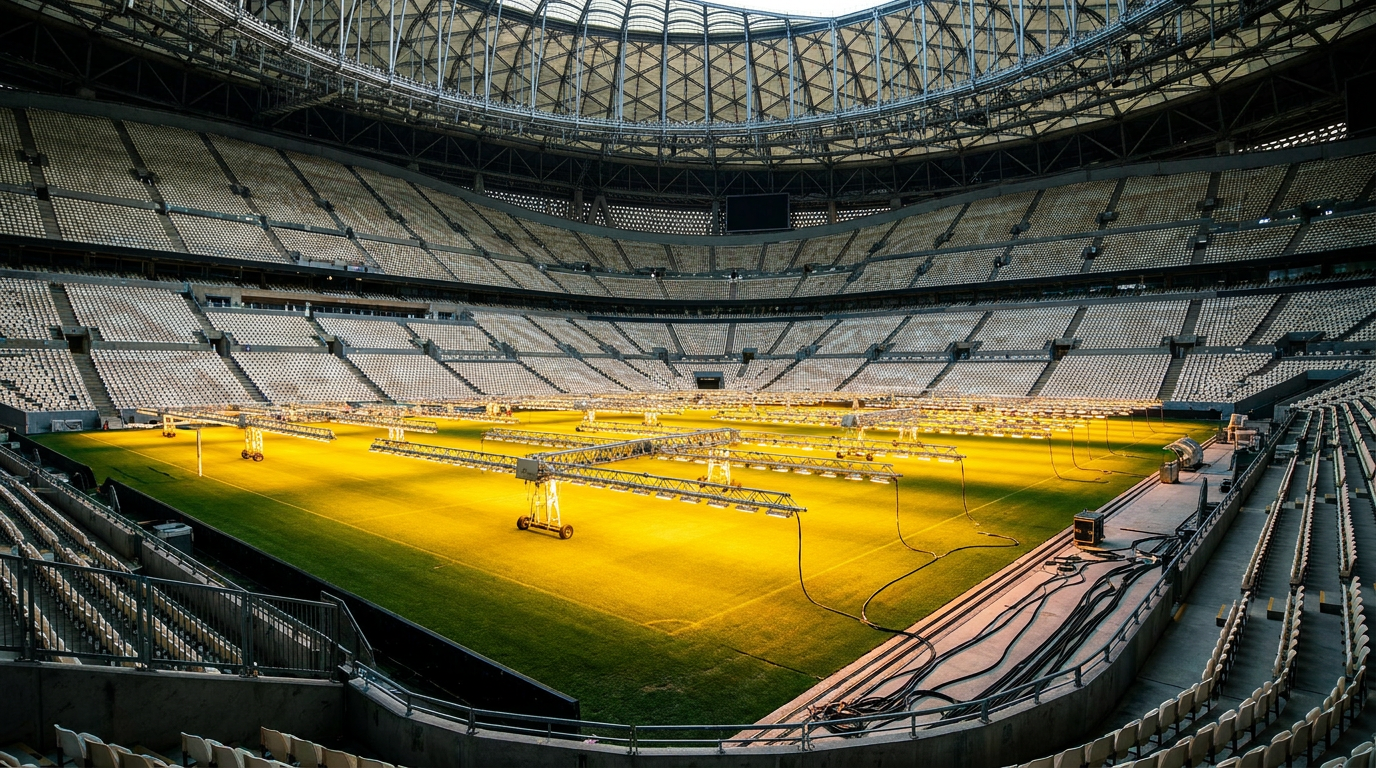
To compensate for the lack of sunlight in the indoor venues, stadium operators will deploy massive, mobile arrays of artificial grow lights. These towering rigs will be rolled onto the pitch between matches and training sessions, bathing the grass in specific wavelengths of light necessary for photosynthesis. Without this artificial sun, the high-performance turf would quickly thin out and succumb to mold in the dark, humid environment of a closed stadium.[3][5][8]
The final logistical hurdle is the installation itself. The grass is currently being cultivated on massive sheets of plastic at specialized sod farms across the continent. Just weeks before the tournament begins, the mature turf will be harvested in massive rolls, packed tightly into fleets of refrigerated semi-trucks, and driven hundreds of miles to the host cities, where it will be unrolled onto the prepared sand bases like a giant, living carpet.[3][4][8]

While this multimillion-dollar effort is entirely focused on a single 39-day tournament, the researchers emphasize that the science will have a lasting legacy. The data gathered on shallow root zones, hybrid reinforcement, and moisture management is already being shared with the broader agronomy industry. Ultimately, the techniques developed to protect millionaire athletes in 2026 will trickle down to make municipal parks and high school sports fields safer and more durable for everyday use.[7][8]
For Sorochan, Rogers, and their teams of graduate students, the ultimate metric of success will be complete anonymity. If the hybrid systems hold together, the vacuum drainage works flawlessly, and the grow lights keep the indoor grass vibrant, the billions of fans watching around the world will never give the pitch a second thought. In the high-stakes world of sports agronomy, absolute silence is the sound of a perfect scientific achievement.[4][8]
How we got here
1994
The Pontiac Silverdome hosts the first-ever indoor World Cup matches on a temporary grass pitch developed by Michigan State researchers.
June 2022
FIFA announces the 16 host cities for the 2026 World Cup and launches a five-year turfgrass research initiative.
April 2023
Michigan State University begins construction on specialized indoor testing facilities to simulate domed stadium conditions.
April 2024
FIFA hosts a massive Research Field Day in Tennessee, gathering 250 pitch managers to review the hybrid grass technology.
June 2026
The World Cup kicks off, putting the multimillion-dollar turfgrass science to the ultimate global test.
Viewpoints in depth
Agronomy Researchers
Scientists focused on the biological and mechanical challenges of standardizing living grass across extreme climates.
For the academic teams at the University of Tennessee and Michigan State, the World Cup is the ultimate stress test for modern agronomy. Their primary concern is overcoming the biological limitations of grass—specifically the lack of sunlight and airflow in domed stadiums. By treating the pitch as an engineered system rather than a traditional agricultural plot, they argue that natural grass can be manipulated to survive and perform in environments where it would naturally die within days.
Tournament Organizers
FIFA officials prioritizing absolute uniformity, player safety, and broadcast aesthetics.
FIFA's mandate for natural grass stems from a desire to protect elite athletes from the joint stress and unnatural ball bounces associated with artificial turf. Organizers view the multimillion-dollar investment in turf research as an insurance policy for the tournament's integrity. Their benchmark for success is absolute consistency: a player executing a high-speed cut in a humid Miami stadium must experience the exact same traction and surface feedback as they would in a climate-controlled dome in Vancouver.
Stadium Operators
Venue managers balancing the temporary demands of the World Cup with their permanent infrastructure.
For the operators of NFL stadiums that traditionally rely on artificial turf, the World Cup presents a massive logistical hurdle. Their priority is ensuring that the temporary natural grass systems do not damage their permanent infrastructure. They favor the shallow, modular 'sod-on-plastic' approach because it allows the massive grass carpets to be installed quickly over existing artificial turf and removed immediately after the tournament, minimizing disruption to their primary American football tenants.
What we don't know
- How the temporary natural grass systems will hold up to the unprecedented wear and tear of up to nine matches in a single month.
- Whether the massive logistical effort of transporting refrigerated sod across the continent will face delays due to extreme summer weather.
- Exactly how much the specialized grow lights and vacuum ventilation systems will add to the energy footprint of the tournament.
Key terms
- Hybrid Grass
- A natural grass playing surface reinforced with millions of synthetic fibers stitched into the root zone to improve durability.
- Permavoid System
- A modular, interlocking plastic sub-base used to create a drainage and aeration layer beneath the pitch.
- Vacuum Ventilation
- An underground system that can actively pull excess moisture out of the soil or blow air into the root zone.
- Root Zone
- The layer of sand and soil where the grass roots grow and establish their structural integrity.
- fLEX Machine
- A robotic testing device featuring a 3D-printed foot and cleat used to measure traction and simulate player impact on turf.
Frequently asked
Why doesn't FIFA just use artificial turf?
FIFA regulations mandate natural grass for all Men's World Cup matches to ensure consistent ball roll, reduce joint stress, and meet elite player expectations.
How do they grow grass in indoor stadiums?
Researchers use a combination of shade-tolerant grass blends, massive arrays of artificial grow lights, and advanced vacuum ventilation systems to replicate outdoor conditions.
What happens to the NFL stadiums' artificial turf?
The natural grass systems are built directly on top of the existing artificial turf using a protective layer and a shallow 6-inch sand base, allowing the stadiums to revert to artificial turf after the tournament.
Sources
Source coverage
8 outlets
3 viewpoints surfaced








[1]The New York TimesStadium Operators
The Secrets of a Soccer-Turf Master
Read on The New York Times →[2]University of TennesseeAgronomy Researchers
Taking on the challenge: UT experts tapped to develop the best and safest pitches
Read on University of Tennessee →[3]Michigan State UniversityAgronomy Researchers
MSU researchers develop turf systems for 2026 World Cup
Read on Michigan State University →[4]ForbesTournament Organizers
The Nuances Of World Cup Turfgrass
Read on Forbes →[5]FIFATournament Organizers
FIFA Pitch Research Project in Tennessee
Read on FIFA →[6]Fast CompanyAgronomy Researchers
How researchers designed the perfect grass for the 2026 World Cup
Read on Fast Company →[7]NPRStadium Operators
John Sorochan explains the agronomic feat needed for a perfect FIFA World Cup grass pitch
Read on NPR →[8]Factlen Editorial TeamTournament Organizers
Synthesis by Factlen editorial team
Read on Factlen Editorial Team →
Every angle. Every day.
Get science stories with full source coverage and perspective breakdowns delivered to your inbox.