
The Modern Heat Pump Explainer: How New Tech Works in Freezing Climates
Cold-climate heat pumps are replacing traditional gas furnaces across North America and Europe, maintaining high efficiency even at sub-zero temperatures. Here is how the technology works, the real-world cost savings, and what to know before upgrading in 2026.
By Factlen Editorial Team
- Electrification Advocates
- Argue that heat pumps are essential for decarbonizing the residential sector and offer superior long-term financial savings.
- HVAC Manufacturers
- Focus on the engineering breakthroughs, such as variable-speed compressors, that make cold-climate performance reliable.
- Pragmatic Installers
- Emphasize that while heat pumps are highly efficient, dual-fuel systems or gas furnaces still make economic sense in regions with cheap gas and extreme cold.
What's not represented
- · Natural Gas Industry Representatives
- · Homeowners in poorly insulated legacy homes
Why this matters
Heating and cooling account for roughly half of a typical home's energy use. Understanding how modern heat pumps operate in extreme cold can help homeowners cut utility bills by up to 45% while significantly reducing their household carbon footprint.
Key points
- Heat pumps outsold traditional gas furnaces by 26% in the United States in 2025.
- Modern Cold Climate Heat Pumps (CCHPs) can operate efficiently in temperatures as low as −23°F.
- By transferring heat rather than generating it, heat pumps achieve 200% to 400% efficiency.
- Homeowners can save an average of $650 annually on utility bills by switching from gas to a heat pump.
- While the federal 25C tax credit expired in 2025, state and utility rebates still offer up to $10,000 in incentives.
- In regions with extreme cold and cheap natural gas, hybrid dual-fuel systems remain a practical alternative.
The home heating landscape has crossed a definitive threshold. In 2025, heat pumps outsold traditional gas furnaces by 26% in the United States, marking the official arrival of the electric heating era. Yet, despite this surge in adoption, a persistent myth lingers among homeowners in northern climates: the belief that heat pumps simply do not work when the temperature drops below freezing. While that was true of older models designed for the American South, the technology has undergone a quiet revolution.[6][7]
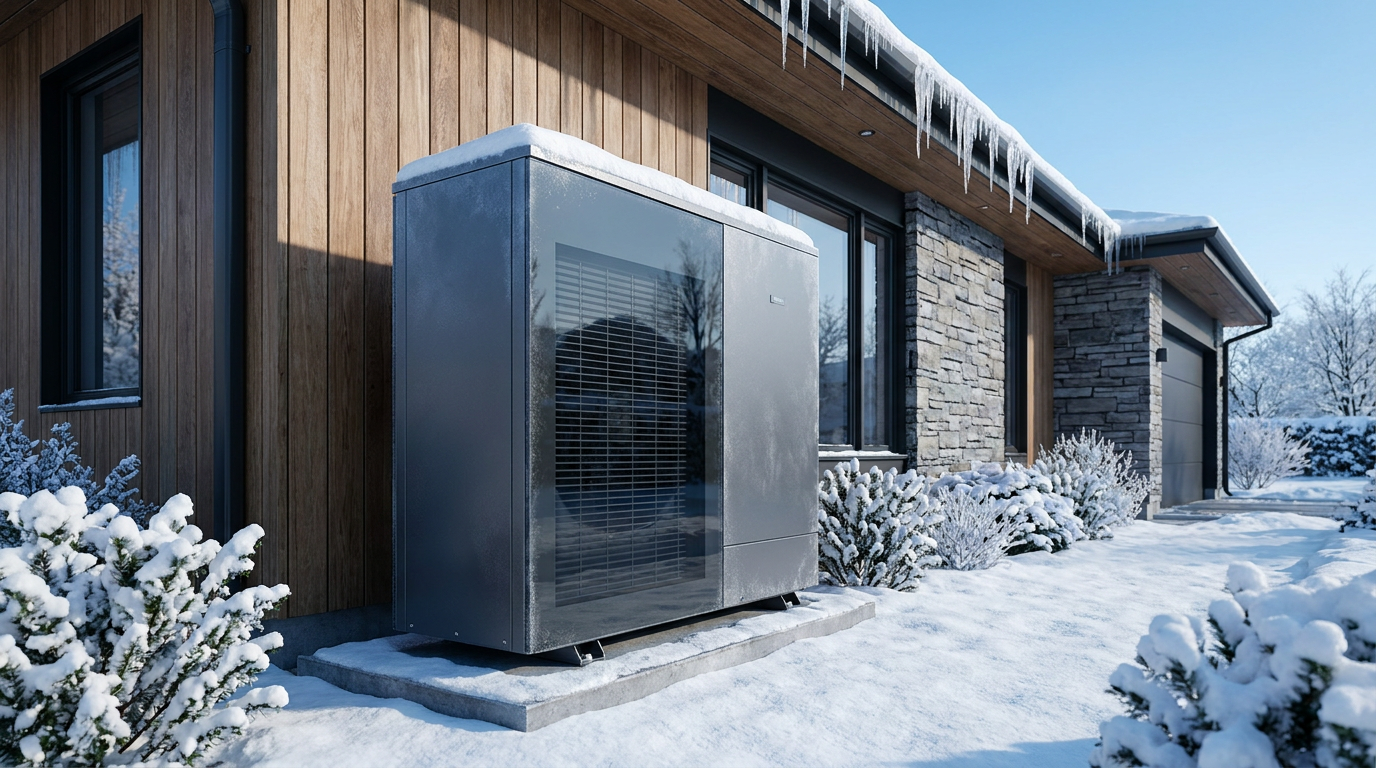
Today's Cold Climate Heat Pumps (CCHPs) are engineered specifically for brutal winters. Rather than shutting down or relying on expensive emergency electric resistance strips when the frost sets in, these advanced systems can extract heat from the outdoor air at temperatures as low as −23° Fahrenheit. To understand how this is possible, it helps to look at the fundamental mechanism of how a heat pump operates.[1][4]
Unlike a gas furnace, which burns fossil fuels to generate heat, a heat pump does not create heat at all—it merely moves it. The system uses a closed loop of specialized refrigerant to absorb ambient thermal energy from the outside air. Even when the air outside feels freezing to human skin, it still contains a significant amount of heat energy. The refrigerant absorbs this energy, turns into a gas, and is then heavily compressed. This compression drastically raises the temperature of the gas, which is then pumped indoors to warm the home.[4][7]

The engineering breakthrough that makes modern CCHPs so effective is the variable-speed, inverter-driven compressor. Older heat pumps operated like a light switch—they were either 100% on or 100% off. Modern inverter compressors act more like a dimmer switch, adjusting their output in tiny increments to match the exact heating demand of the house. Combined with enhanced vapor injection technology, which routes a portion of the refrigerant back through the compressor to boost its capacity, these systems can maintain their full heating power even when the thermometer hits 5°F.[2][4]
To accelerate this technology, the U.S. Department of Energy (DOE) launched the Cold Climate Heat Pump Technology Challenge. Partnering with the Pacific Northwest National Laboratory and major HVAC manufacturers like Trane, Carrier, and Bosch, the DOE set a rigorous benchmark: prototypes had to maintain 100% of their heating capacity at 5°F without relying on auxiliary heat. Field validations completed in 2025 proved highly successful, with several manufacturers pushing their units to operate efficiently down to −23°F.[1][2]
Department of Energy (DOE) launched the Cold Climate Heat Pump Technology Challenge.
Because they move heat rather than generate it, heat pumps operate at efficiency levels that defy traditional math. A top-tier gas furnace maxes out at an Annual Fuel Utilization Efficiency (AFUE) of 96%, meaning 4% of the energy is lost as waste exhaust. A heat pump, however, is measured by its Coefficient of Performance (COP). A modern CCHP typically operates at a COP of 2.0 to 4.0, meaning it delivers 200% to 400% more heating energy than the electrical energy it consumes.[5][6]
This massive efficiency advantage translates directly into lower utility bills. Real-world operating data from 2026 shows that in the Northeast United States, a cold-climate heat pump costs between $800 and $1,400 annually to run. In contrast, a comparable gas furnace costs between $1,200 and $2,200 per year. For a typical 1,800-square-foot home, switching from gas to a modern heat pump yields average annual savings of roughly $650.[5][6]

The financial calculus for installation, however, requires careful navigation in 2026. The federal Section 25C tax credit, which previously offered up to $2,000 for heat pump installations, expired on December 31, 2025. Despite this, the upfront cost barrier is being heavily mitigated by aggressive state and utility rebate programs. Programs like Mass Save in Massachusetts offer up to $10,000 for whole-home conversions, while the federally funded HEEHRA program provides point-of-sale rebates up to $8,000 for income-qualified households.[5][6]
The shift toward electrification is not limited to North America. In Europe, heat pump sales grew by 10.3% in 2025, reaching 2.62 million units sold across 16 countries. This rebound ended a two-year market decline and was driven by stabilized government subsidies and a continent-wide push for energy sovereignty. Countries like Belgium and the UK saw significant adoption spikes as policies restricted new fossil fuel boilers and reduced taxes on electricity.[3]

Despite the overwhelming advantages, industry analysts note that heat pumps are not a universal silver bullet for every single home. In regions with extremely cheap natural gas and unusually high electricity rates, the monthly operating cost of a gas furnace can still be competitive. Additionally, for poorly insulated homes in the deepest cold zones (like northern Minnesota or central Canada), installers often recommend a "dual-fuel" hybrid system. This pairs a high-efficiency heat pump for the vast majority of the winter with a gas furnace that only kicks on during the most extreme polar vortex events.[4][5]
For the vast majority of homeowners, however, the cold-weather debate is effectively settled. A cold-climate heat pump is no longer a compromise; it is a high-performance upgrade. By providing both hyper-efficient winter heating and powerful summer air conditioning in a single unit, the technology is fundamentally reshaping how the world controls its indoor climate.[6][7]
How we got here
2021
The US Department of Energy launches the Cold Climate Heat Pump Technology Challenge to spur innovation.
2024
Heat pumps outsell gas furnaces in the US for the first time, signaling a major shift in home heating.
2025
European heat pump sales rebound with a 10.3% growth, reaching 2.62 million units sold.
Dec 31, 2025
The federal Section 25C tax credit for heat pump installations expires, shifting the focus to state-level rebates.
Viewpoints in depth
Electrification Advocates
Argue that heat pumps are essential for decarbonizing the residential sector and offer superior long-term financial savings.
Environmental agencies and clean energy advocates view the mass adoption of heat pumps as a non-negotiable pillar of global decarbonization. Because heat pumps run on electricity, their carbon footprint shrinks every year as the broader electrical grid transitions to renewable sources like wind and solar. Groups like the European Heat Pump Association point to the 10.3% sales growth in 2025 as proof that consumers are recognizing the dual benefits of energy sovereignty and lower utility bills. For these advocates, the expiration of federal tax credits is a minor hurdle compared to the massive, compounding savings homeowners realize by ditching fossil fuels.
HVAC Manufacturers
Focus on the engineering breakthroughs, such as variable-speed compressors, that make cold-climate performance reliable.
For the engineers designing these systems, the narrative is about overcoming the laws of thermodynamics. Manufacturers like Trane and Carrier emphasize that today's units are fundamentally different machines from the heat pumps of the 1990s. By utilizing inverter-driven compressors and enhanced vapor injection, they have solved the 'cold blow' problem that plagued early adopters. Their focus is on educating consumers and contractors that a properly sized, modern Cold Climate Heat Pump can genuinely maintain 100% of its heating capacity at 5°F without relying on inefficient electric resistance strips.
Pragmatic Installers
Emphasize that while heat pumps are highly efficient, dual-fuel systems or gas furnaces still make economic sense in regions with cheap gas and extreme cold.
Contractors and building science analysts caution against a one-size-fits-all approach. While they acknowledge the incredible efficiency of modern heat pumps, they point out that the math changes depending on local utility rates. In regions where natural gas is exceptionally cheap and electricity is expensive, the monthly operating cost of a 96% AFUE gas furnace can still beat a heat pump. Furthermore, for older, drafty homes in the coldest climate zones, installers often recommend a hybrid 'dual-fuel' approach. This allows the homeowner to use the hyper-efficient heat pump for 90% of the winter, while keeping a gas furnace in reserve for the most extreme sub-zero nights.
What we don't know
- Whether the US Congress will introduce new federal tax incentives to replace the expired Section 25C credit.
- How quickly the electrical grid infrastructure in older neighborhoods can adapt to the increased winter load of whole-home electrification.
- The exact timeline for when next-generation refrigerants with ultra-low global warming potential will become the universal standard in all new units.
Key terms
- Cold Climate Heat Pump (CCHP)
- A specialized heat pump engineered to maintain high heating capacity and efficiency in sub-zero temperatures without relying heavily on backup electric resistance heating.
- Coefficient of Performance (COP)
- The efficiency metric for heat pumps, representing the ratio of heating or cooling provided to the electrical energy consumed. A COP of 3.0 means the unit is 300% efficient.
- AFUE (Annual Fuel Utilization Efficiency)
- The standard measurement of efficiency for gas and oil furnaces, representing the percentage of fuel that is successfully converted into usable heat.
- Inverter-Driven Compressor
- A modern compressor that can adjust its speed in small increments to precisely match a home's heating or cooling demand, rather than simply turning 100% on or off.
- Dual-Fuel System
- A hybrid HVAC setup that pairs an electric heat pump with a gas furnace backup, automatically switching to gas only during the most extreme cold snaps.
Frequently asked
Do heat pumps actually work in freezing temperatures?
Yes. Modern Cold Climate Heat Pumps (CCHPs) use advanced variable-speed compressors to extract heat from the air at temperatures as low as −23°F, maintaining full heating capacity even at 5°F.
Are heat pumps cheaper to run than gas furnaces?
In most climates, yes. Because they transfer heat rather than generate it, heat pumps operate at 200% to 400% efficiency, saving the average homeowner roughly $650 annually compared to a gas furnace.
Are federal tax credits for heat pumps still available in 2026?
The federal Section 25C tax credit expired at the end of 2025. However, many states and utility companies still offer substantial rebates, such as the HEEHRA program, which provides up to $8,000 for income-qualified households.
Do heat pumps also provide air conditioning?
Yes. A heat pump provides both heating and cooling. In the summer, a reversing valve changes the flow of the refrigerant, allowing the system to pull heat out of your home and vent it outside, functioning exactly like a central air conditioner.
Sources
Source coverage
7 outlets
3 viewpoints surfaced







[1]US Department of EnergyElectrification Advocates
Residential Cold Climate Heat Pump Technology Challenge
Read on US Department of Energy →[2]Pacific Northwest National LaboratoryHVAC Manufacturers
Field Validation of Cold Climate Heat Pumps
Read on Pacific Northwest National Laboratory →[3]European Heat Pump AssociationElectrification Advocates
European Heat Pump Market Data 2025-2026
Read on European Heat Pump Association →[4]Trane TechnologiesHVAC Manufacturers
Advancements in Cold Climate Heat Pump Technology
Read on Trane Technologies →[5]Building TalksPragmatic Installers
Heat Pump vs Furnace Cost 2026: The Decision Matrix
Read on Building Talks →[6]Flynzo HeatElectrification Advocates
The 2026 Home Heating Landscape: Heat Pumps Outsell Gas Furnaces
Read on Flynzo Heat →[7]Factlen Editorial Team
Synthesis by Factlen editorial team
Read on Factlen Editorial Team →
Every angle. Every day.
Get home stories with full source coverage and perspective breakdowns delivered to your inbox.