
The "Library of Things" Movement: How Local Communities Are Sharing More Than Just Books
A growing global network of community-run "Libraries of Things" is allowing residents to borrow power tools, camping gear, and appliances, saving money and reducing waste.
By Factlen Editorial Team
- Community Organizers
- Emphasize the social cohesion, skill-sharing, and mutual aid benefits of shared neighborhood resources.
- Circular Economy Advocates
- Focus on the environmental imperative of reducing overconsumption and minimizing landfill waste.
- Municipal Planners
- View item-sharing as a scalable public service that enhances equity and civic infrastructure.
What's not represented
- · Traditional hardware retailers
- · Tool manufacturers
Why this matters
As the cost of living and environmental concerns rise, the 'Library of Things' model offers a practical alternative to hyper-consumerism. By turning underused goods into shared community assets, neighborhoods are saving residents thousands of dollars while drastically reducing household waste and carbon emissions.
Key points
- Over 2,000 formal Libraries of Things now operate globally, allowing residents to borrow tools and appliances.
- The movement saves communities millions of dollars by eliminating the need to purchase rarely used items.
- Sharing physical goods drastically reduces manufacturing demand, lowering greenhouse gas emissions and landfill waste.
- Many public library systems are adopting the model, expanding their catalogs to include health kits, tech, and recreational gear.
- Beyond economics, these spaces act as vital community hubs that combat social isolation and foster skill-sharing.
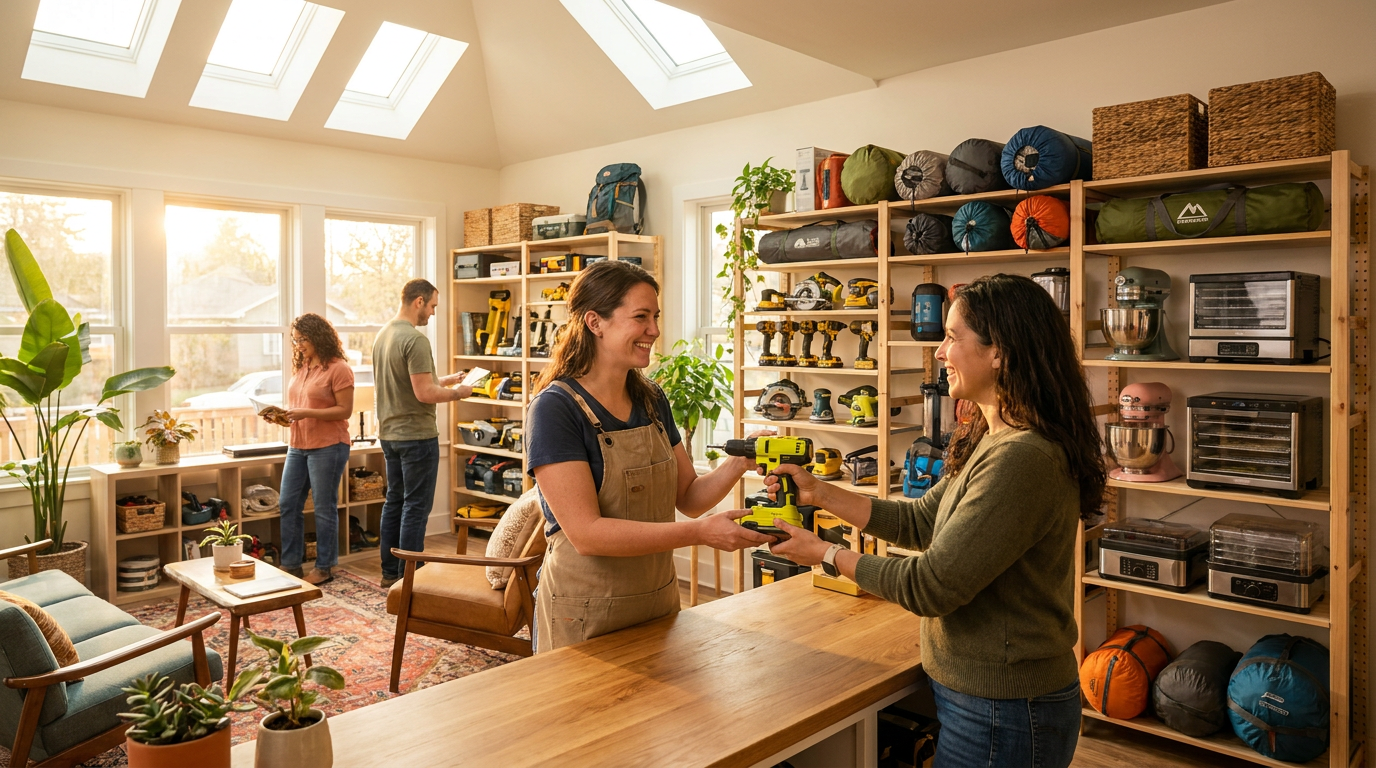
Imagine needing a power drill and an extendable ladder to renovate a living room. In a traditional consumer economy, a resident would spend hundreds of dollars on equipment that will likely sit untouched in a garage for the next decade. Instead, an increasing number of people are visiting their local "Library of Things," checking out both items for a few dollars, and returning them the following week.[7]
This simple transaction is playing out in thousands of neighborhoods worldwide. The "Library of Things" (LoT) movement—a network of community-run hubs that lend out everything from camping gear and sewing machines to pressure washers and projectors—is rapidly expanding. Moving far beyond the traditional scope of books and media, these spaces are redefining how communities access the physical goods they need to improve their homes and lives.[7]
According to a comprehensive report by the sharing-economy organization Shareable, there are now more than 2,000 formally established Libraries of Things operating globally, alongside countless informal neighborhood networks. While the concept isn't entirely new—the Berkeley Tool Library in California has been operating continuously since 1979—the movement has seen explosive growth over the past five years, driven by rising living costs and a growing awareness of environmental sustainability.[1]
The economic proposition is straightforward and highly appealing. For the cost of buying or even renting a single specialized tool at a big-box hardware store, a resident can purchase an annual LoT membership that grants access to hundreds of items. In the United Kingdom, the Library of Things network reports that its 40,000 members have collectively saved over £10 million by borrowing rather than buying, completing more than 75,000 affordable rentals since the organization's founding.[2]

Beyond individual financial savings, the movement serves as a highly practical application of the "circular economy." Environmental advocates point to the structural waste inherent in modern consumerism, noting that the average home is filled with equipment that is rarely used. By consolidating these items into a centralized library, communities can drastically reduce the demand for new manufacturing, cutting down on resource extraction, greenhouse gas emissions, and eventual landfill waste.[4][5]
The mechanics of these libraries vary widely depending on their funding and location. The vast majority are grassroots, volunteer-run operations with annual budgets of less than $10,000. These smaller hubs often operate out of donated spaces, such as church basements, community centers, or retrofitted shipping containers, relying heavily on community donations to build their initial inventories.[1]
The mechanics of these libraries vary widely depending on their funding and location.
However, the model is increasingly professionalizing to meet rising demand. Larger independent organizations, such as The Tool Library in Buffalo, New York, maintain inventories of over 3,400 tools and employ dedicated staff to manage logistics. To streamline operations, many modern LoTs utilize specialized inventory software and self-serve smart lockers, allowing residents to reserve items online and pick them up using a digital code—much like an Amazon locker, but designed for community sharing rather than consumption.[3]

Traditional public library systems are also taking notice, integrating "Things" into their existing catalogs. In Michigan, the Bloomfield Township Public Library introduced "VITALITY Kits" containing health information and assistive tools specifically designed for senior citizens. Other municipal libraries have begun lending out Wi-Fi hotspots, musical instruments, and even state park passes, viewing these items as a natural extension of their mandate to provide equitable access to information and resources.[7]
Local governments are beginning to recognize the immense civic value of these spaces. In Australia, the Sydney Library of Things launched a highly successful trial at a local sustainability center, prompting neighboring municipal councils to explore official partnerships. By integrating these libraries into local government frameworks, municipalities can ensure long-term financial stability for the groups while offering a highly visible, popular public service.[6]
Operating a Library of Things is not without its logistical challenges. Maintaining a fleet of power tools and electronics requires consistent labor and technical expertise. Volunteer burnout is a common hurdle for smaller operations, and navigating liability insurance for heavy machinery can be complex and expensive. To mitigate these risks, successful libraries focus heavily on routine maintenance workshops and require borrowers to sign comprehensive safety waivers.[3][7]

Yet, organizers argue that the maintenance challenges are far outweighed by the unexpected social benefits. These libraries frequently evolve into bustling community hubs. When people come to borrow a tile saw or a sewing machine, they often stay to ask for advice, leading to impromptu skill-sharing, mentorship, and collaboration among neighbors who might otherwise never interact.[4]
This social cohesion is a measurable outcome, not just a pleasant side effect. Surveys conducted by the UK Library of Things found that 65% of members reported feeling more connected to their neighborhood and prouder of their community after using the service. In an era marked by increasing social isolation, the simple act of sharing physical goods is proving to be a powerful catalyst for community building.[2]

As the movement looks to the future, advocates are focused on scaling the infrastructure. The goal is no longer just to open a single tool library in a progressive enclave, but to establish shared resource hubs in every neighborhood, particularly in affordable housing communities where the financial benefits of shared access are most impactful.[1][5]
By challenging the assumption that every household must be an island of individually owned appliances, the Library of Things movement is offering a compelling alternative. It is a quiet, practical revolution in consumption—one that prioritizes access over ownership, resilience over redundancy, and community connection over isolation.[7]
How we got here
1979
The Berkeley Tool Library opens in California, becoming one of the longest-running formal tool lending programs.
2014
The UK-based "Library of Things" begins as a community project in a South London shipping container.
2021
The Sydney Library of Things launches at the Coal Loader Centre for Sustainability, proving the model's viability for local councils.
2024
Shareable's global report identifies over 2,000 formal Libraries of Things operating worldwide.
Viewpoints in depth
Community Organizers
Emphasize the social cohesion and mutual aid benefits of shared resources.
For grassroots organizers, the primary value of a Library of Things isn't just the physical items—it's the interaction. Facilities often evolve into community hubs where neighbors teach each other skills, from basic carpentry to sewing. Organizers view these spaces as essential infrastructure for combating urban isolation and building neighborhood resilience, arguing that sharing physical goods naturally leads to sharing knowledge and support.
Circular Economy Advocates
Focus on the environmental imperative of reducing overconsumption.
Environmental groups point to the staggering carbon footprint of manufacturing rarely used household items. They argue that the traditional consumer model—where every house on a street owns a power drill used for an average of 13 minutes over its lifetime—is ecologically unsustainable. By maximizing the utility of a single item across dozens of households, advocates see the sharing model as a critical tool for reducing resource extraction and landfill waste.
Municipal Planners
View item-sharing as a scalable public service that enhances equity.
Forward-thinking city councils and public library directors are increasingly treating item libraries as core civic infrastructure. Planners note that low-income households are disproportionately burdened by the need to purchase expensive, single-use equipment for home repairs or specialized tasks. By integrating tool libraries into municipal budgets, cities can provide equitable access to essential resources, much like public transit or broadband internet.
What we don't know
- How traditional tool and appliance manufacturers will adapt their business models if community sharing reaches mass adoption.
- Whether smaller, volunteer-run libraries can secure the long-term municipal funding needed to survive volunteer turnover.
Key terms
- Library of Things (LoT)
- A community-based lending service that allows people to borrow physical items like tools and appliances instead of buying them.
- Circular Economy
- An economic model focused on minimizing waste and making the most of resources by sharing, repairing, and reusing existing products.
- Solidarity Economy
- A grassroots economic movement that prioritizes social profitability, mutual aid, and community well-being over financial maximization.
Frequently asked
What kind of items can I borrow from a Library of Things?
Inventories vary, but common items include power tools, camping gear, gardening equipment, sewing machines, and party supplies.
How much does it cost to join?
Many are free or operate on a sliding scale, while others charge a small annual membership fee (often $20 to $50) or a nominal pay-per-item rental cost.
Who pays for broken or damaged items?
Most libraries expect normal wear and tear and repair items in-house. Borrowers are typically only charged if an item is lost or subjected to gross negligence.
Are these replacing traditional public libraries?
No. In fact, many public libraries are integrating "Things" into their existing catalogs to expand their community services alongside books and media.
Sources
Source coverage
7 outlets
3 viewpoints surfaced







[1]ShareableCommunity Organizers
The State of Libraries of Things 2024 Report
Read on Shareable →[2]Library of Things UKCommunity Organizers
Impact Report: Getting Neighbourhoods Sharing
Read on Library of Things UK →[3]The Tool LibraryCommunity Organizers
Sharing tools to increase access, build power, and foster community
Read on The Tool Library →[4]Ellen MacArthur FoundationCircular Economy Advocates
Toronto Tool Library: A community hub for sharing
Read on Ellen MacArthur Foundation →[5]Center for Biological DiversityCircular Economy Advocates
A Library of Things: Promoting Cooperative Communities
Read on Center for Biological Diversity →[6]NSW GovernmentMunicipal Planners
The Sydney Library of Things Operations Report
Read on NSW Government →[7]Factlen Editorial TeamMunicipal Planners
Synthesis by Factlen editorial team
Read on Factlen Editorial Team →

Every angle. Every day.
Get community stories with full source coverage and perspective breakdowns delivered to your inbox.