
The Japanese Art of Kintsugi: How Golden Joinery Became a Global Metaphor for Healing
The 15th-century Japanese practice of repairing broken ceramics with gold has evolved from a meticulous artisan craft into a powerful modern framework for psychological resilience.
By Austin Blake

In short
- Kintsugi is the 15th-century Japanese art of repairing broken ceramics with gold-dusted lacquer.
- Rather than hiding damage, the practice highlights fractures to honor an object's history.
- The structural strength comes from urushi, a toxic tree sap that cures in high humidity.
The sound of a shattering bowl usually marks the end of its life. In Western culture, broken things are discarded or glued back together with clear adhesives designed to hide the damage. The goal is to pretend the fracture never happened. But in Japan, a fracture is not an ending—it is the beginning of a transformation. This shift in perspective turns destruction into an opportunity for creation, challenging the modern instinct to throw away anything that is no longer pristine.[5]
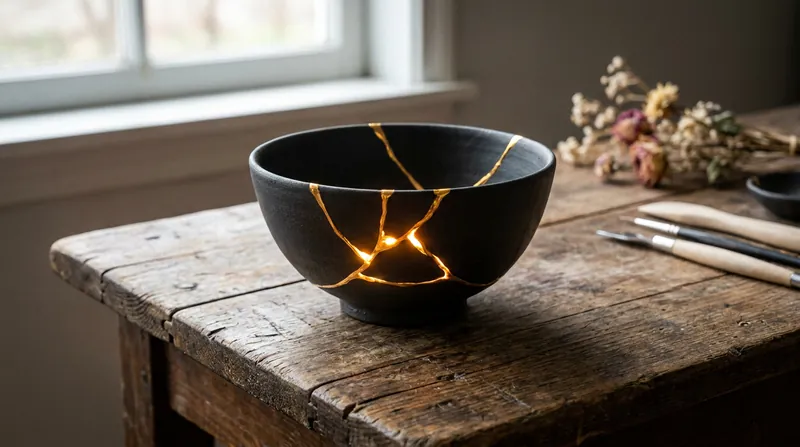
Kintsugi, which translates directly to "golden joinery," is the centuries-old Japanese art of repairing broken ceramics. Instead of using invisible glue to mask a mistake, master artisans mend the shattered pieces with a specialized, highly durable natural lacquer. Once the ceramic pieces are firmly bound together, the visible seams are meticulously dusted with powdered gold, silver, or platinum. The resulting object is laced with luminous metallic veins that trace the exact lines of its destruction, creating a striking visual contrast against the original glaze.[1]
Rather than disguising the damage, kintsugi deliberately highlights it. The underlying philosophy treats the breakage and the subsequent repair as a vital, beautiful part of the object's history, rather than a shameful failure that must be erased from memory. An item that has been restored using the kintsugi technique is often considered even more precious and visually arresting than it was before it fell to the floor. It becomes a completely one-of-a-kind artifact, carrying a permanent, physical map of its own survival and the care taken to save it.[1]
The technique's origins are widely traced to the late fifteenth century during Japan's Muromachi period. According to historical legend, the powerful Japanese shogun Ashikaga Yoshimasa accidentally broke a highly prized Chinese tea bowl. Desperate to save his favorite vessel, he sent the shattered pieces back to China for professional repairs. When the bowl finally returned to Japan, the shogun was dismayed to find it held together by ugly, utilitarian metal staples—the standard, purely functional repair method of that era.[1]
Displeased with the aesthetic ruin of his favorite bowl, the shogun tasked his own Japanese craftsmen with finding a more beautiful, elegant solution. The artisans realized that if they could not hide the cracks, they should elevate them. The resulting innovation of golden joinery flourished alongside the rise of the Japanese tea ceremony, known as chanoyu. Tea masters, heavily influenced by Zen Buddhism, began to intentionally cherish these repaired vessels, sometimes valuing them even more highly than perfectly intact pieces.[1][2]
While the glittering gold finish catches the eye, the true structural magic of kintsugi lies in a substance called urushi. Urushi is a natural lacquer created from the filtered sap of the Toxicodendron vernicifluum tree. It is an incredibly potent material that has been used as a powerful adhesive and waterproof coating in Japan since the Jomon period, around 7000 BCE. Because the tree is closely related to poison ivy, raw urushi contains urushiol, a compound that can cause severe allergic reactions until it is fully cured.[2]
Authentic kintsugi is a painstaking process of ancient chemistry and immense patience. Artisans begin by mixing raw ki-urushi with wheat flour or rice paste to create a thick, highly resilient binding putty. After the broken ceramic edges are meticulously cleaned and filed, they are pieced back together with this natural adhesive. However, unlike modern synthetic glues that dry quickly in the open air, the object cannot simply be left on a workbench. Urushi lacquer requires a highly specific, controlled environment to successfully undergo its chemical transformation and harden.[2]
The newly bound vessel is placed inside a specialized wooden drying cabinet called a muro. Urushi does not dry through the evaporation of water; instead, it hardens by absorbing oxygen and moisture directly from the air. The muro maintains a warm temperature and a high humidity level of around ninety percent, slowly curing the lacquer over a period of one to three weeks. This slow, deliberate curing process is what gives the lacquer its legendary durability, capable of withstanding heat, acid, and water.[2]
Once the structural joints are fully cured and sanded perfectly smooth, the artisan applies a final, hair-thin layer of red iron-oxide lacquer along the seams. Just before this final layer sets, incredibly fine gold powder is sprinkled over the cracks using a specialized brush. The gold adheres to the sticky red lacquer, creating the signature metallic veins. Finally, the piece is sealed with a sheer coat of raw urushi and polished to a brilliant shine using specialized tools made of agate or sea bream teeth.[2]
This meticulous, time-consuming craft is deeply intertwined with wabi-sabi, the foundational Japanese philosophy that embraces imperfection, impermanence, and the inherent beauty of natural aging. Wabi-sabi teaches that the marks of wear and tear on an object are not blemishes to be hidden, but rather the honorable evidence of its utility and its journey through time. However, cultural historians and philosophers note a distinct, important difference between the two concepts when applied to daily life, noting that they represent two different phases of acceptance.
While wabi-sabi is primarily a way of seeing—accepting a cracked, weathered bowl as beautiful just as it is—kintsugi is a way of acting. It requires a deliberate, active decision to intervene. When a rupture occurs, kintsugi demands that we choose to repair rather than discard, and to honor the history of the break with painstaking care. It transforms passive acceptance into an active ritual of restoration, proving that beauty can be intentionally coaxed out of unexpected disasters and sudden setbacks.
In recent years, kintsugi has transcended its origins as a ceramic craft to become a powerful, globally recognized framework in modern psychology. Therapists and mental health professionals increasingly use the "kintsugi metaphor" to help patients navigate severe trauma, grief, and complex emotional recovery. By applying the principles of golden joinery to human emotional health, psychologists encourage individuals to view their psychological scars not as permanent, shameful defects, but as beautiful markers of a life lived and survived. It shifts the therapeutic goal from erasing pain to integrating it.[5]
Psychologists closely align the practice of kintsugi with the clinical concept of "posttraumatic growth." Unlike the concept of resilience, which often implies bouncing back to exactly who you were before a crisis occurred, posttraumatic growth suggests something deeper. It posits that surviving a profound fracture can fundamentally transform a person into someone stronger, more empathetic, and more complex. Just as the gold makes the bowl more valuable, the process of healing can forge a richer, more resilient human character.[3]
This clinical framework gained particular traction in the medical community during the intense, unprecedented strain of the COVID-19 pandemic. Researchers at the National Institutes of Health published detailed studies on cultivating a "kintsugi mind" among doctors, nurses, and emergency responders. The research urged healthcare systems to help frontline workers actively integrate their traumatic experiences into a renewed sense of purpose, rather than expecting them to simply hide their psychological scars and return to normal functioning as if the crisis had never happened.[3]
The metaphor has even reached the technology sector in Silicon Valley, demonstrating its broad cultural resonance. A modern mental health platform named Kintsugi uses advanced voice-biomarker technology to detect subtle signs of clinical depression and anxiety in short, free-form audio clips. The company's core mission directly mirrors the ancient art form: to identify emotional fractures in real-time so they can be properly addressed, cared for, and ultimately healed, ensuring that invisible mental health struggles are brought into the light rather than swept under the rug.[4]
In an era dominated by mass production, disposable goods, and the immense social pressure to project flawless, unblemished lives on social media, the philosophy of golden joinery offers a radical counter-narrative. It insists that our breaks, our failures, and our subsequent repairs are not liabilities to be hidden away in shame. Instead, they are the very gold that makes us whole, proving that true beauty is found not in perfection, but in the courageous act of healing.[5]
Key terms
- Kintsugi
- The Japanese art of repairing broken pottery with lacquer dusted or mixed with powdered gold, silver, or platinum.
- Wabi-Sabi
- A Japanese aesthetic and philosophy that embraces imperfection, impermanence, and the beauty of natural aging.
- Urushi
- A highly durable, natural lacquer made from the sap of the Toxicodendron vernicifluum tree, used as the primary adhesive in Kintsugi.
- Muro
- A traditional wooden drying cabinet that maintains the specific heat and humidity required for urushi lacquer to cure.
- Posttraumatic Growth
- Positive psychological change experienced as a result of struggling with highly challenging life circumstances, resulting in a stronger sense of self.
Reader questions
Can you eat or drink from Kintsugi-repaired pottery?
Yes, traditional Kintsugi using pure urushi lacquer and real gold is completely food-safe once fully cured. However, modern synthetic DIY kits often use epoxy resins that are not safe for food contact.
How long does the authentic Kintsugi process take?
Authentic Kintsugi takes several weeks to months. The natural urushi lacquer requires specific high humidity and extended time to cure properly between each applied layer.
Is Kintsugi the exact same thing as Wabi-Sabi?
No. Wabi-Sabi is the broader Japanese philosophy of accepting imperfection and impermanence, while Kintsugi is the active, physical practice of repairing a broken object to honor its history.
Where opinion splits
Traditional Artisans
Focus on the meticulous craft, the mastery of urushi lacquer, and the historical preservation of ceramics.
For traditional Japanese craftsmen, kintsugi is fundamentally about the mastery of materials—specifically the volatile and highly toxic urushi sap. Artisans view the practice not merely as a philosophical metaphor, but as a rigorous discipline requiring years of apprenticeship to perfect the curing times, humidity controls, and delicate brushwork. They emphasize that true kintsugi is a structural repair meant to restore a vessel's functional utility for centuries, distinguishing authentic lacquer techniques from modern, purely decorative synthetic glues.
Zen Philosophers
View Kintsugi as an embodiment of Wabi-Sabi, emphasizing non-attachment and the acceptance of impermanence.
From a philosophical standpoint, kintsugi is the physical manifestation of wabi-sabi and mushin (no mind). Zen practitioners argue that the anxiety of modern life stems from an unnatural attachment to perfection and permanence. By elevating a broken bowl with gold, kintsugi visually demonstrates that destruction is simply a natural phase in an object's lifecycle. This perspective encourages individuals to release their grip on how things 'should' be, finding profound peace in the flawed, the weathered, and the transient.
Modern Psychologists
Utilize the art form as a clinical metaphor for posttraumatic growth, emotional resilience, and overcoming shame.
In the realm of clinical psychology, kintsugi has been widely adopted as a framework for trauma recovery. Mental health professionals contrast the 'golden repair' with the Western expectation that patients should simply 'bounce back' to their pre-trauma state. Instead, psychologists use the metaphor to validate a patient's suffering, teaching that emotional fractures do not render a person permanently damaged. The therapeutic goal becomes integrating the trauma into the patient's identity, allowing the 'scars' to become sources of unique strength and profound empathy.
- Modern Psychologists
- Utilize the art form as a clinical metaphor for posttraumatic growth, emotional resilience, and overcoming shame.
- Traditional Artisans
- Focus on the meticulous craft, the mastery of urushi lacquer, and the historical preservation of ceramics.
- Zen Philosophers
- View Kintsugi as an embodiment of Wabi-Sabi, emphasizing non-attachment and the acceptance of impermanence.
Perspectives this story doesn't cover
- Mass-market ceramic manufacturers
- Western art restoration purists
Sources
Source coverage
5 outlets
3 viewpoints surfaced





- [1]WikipediaZen Philosophers
Kintsugi
Read on Wikipedia → - [2]Japan House LondonTraditional Artisans
Kintsugi: The Japanese Art of Repairing Pottery
Read on Japan House London → - [3]National Institutes of HealthModern Psychologists
Stronger and more beautiful: Kintsugi mind in healthcare
Read on National Institutes of Health → - [4]Kintsugi HealthModern Psychologists
Scaling access to mental healthcare for all
Read on Kintsugi Health → - [5]Factlen Editorial TeamModern Psychologists
Synthesis by Factlen editorial team
Read on Factlen Editorial Team →
More in Culture
See all →Global Heritage
UNESCO Adds 24 New World Heritage Sites, Highlighting Nelson Mandela's Legacy and Rome's Via Appia
3 sources

Heritage Protection
Israeli Airstrike Damages Tyre's World Heritage Site, Triggering Global Heritage Protection Protocols
4 sources

Cultural Heritage
The Global Revival of Kintsugi: How the Ancient Art of Repair Became a Modern Movement
6 sources
Midsummer
The Magic of Midsummer: How the Nordic World Celebrates the Longest Day of the Year
4 sources

Comments
Every angle. Every day.
Get Culture stories with full source coverage and perspective breakdowns, free every day.