
The Gut-Brain Axis: How Your Diet Shapes Your Mental Health
Emerging research in nutritional psychiatry reveals that the trillions of microbes in your digestive tract play a direct role in regulating mood, anxiety, and stress. Here is how the gut-brain axis works, and what the science says about eating for mental well-being.
By Factlen Editorial Team

- Nutritional Psychiatrists
- Advocate for whole-food dietary interventions to reduce neuroinflammation and support mood.
- Microbiome Researchers
- Focus on the precise, strain-specific mechanisms of psychobiotics and urge rigorous clinical trials.
- Skeptical Clinicians
- Warn against viewing diet as a standalone cure for severe clinical psychiatric conditions.
- Wellness & Supplement Industry
- Promote targeted probiotic supplements and fermented foods for everyday stress management.
What's not represented
- · Patients with severe gastrointestinal disorders navigating mental health impacts
- · Public health officials addressing the affordability of microbiome-friendly diets
Why this matters
For decades, mental health was treated entirely from the neck up. Understanding that your daily dietary choices directly influence the neurochemicals regulating your mood, anxiety, and stress offers a powerful, accessible new tool for managing emotional well-being.
Key points
- The gut-brain axis is a two-way communication network linking the digestive system and the central nervous system.
- Roughly 90% of the body's serotonin is produced in the gut, highlighting the microbiome's role in regulating mood.
- Diets rich in fiber and fermented foods have been shown to reduce neuroinflammation and support emotional resilience.
- Psychobiotics are specific bacterial strains that may benefit mental health, though human clinical evidence remains mixed.
- Experts recommend prioritizing whole-food dietary changes over isolated probiotic supplements for optimal gut-brain health.
For decades, mental health treatment focused almost exclusively on the brain. But a paradigm shift is underway in psychiatry, looking downward to the digestive tract.[5]
The human gut is home to roughly 40 trillion microorganisms. This complex ecosystem, known as the gut microbiome, does much more than digest food. It actively communicates with the central nervous system.[4]
This bidirectional communication network is called the gut-brain axis. It explains why we feel "butterflies" in our stomach when nervous, or why chronic stress can lead to gastrointestinal distress.[1][4]
The physical highway of this connection is the vagus nerve, a thick cable of neurons running directly from the gut to the brain. But the communication is also highly chemical.[4]

Remarkably, an estimated 90% of the body's serotonin—the neurotransmitter targeted by many common antidepressants—is produced in the digestive tract, not the brain.[1]
Gut bacteria also produce other neuroactive compounds, including gamma-aminobutyric acid (GABA) and dopamine, which play critical roles in regulating emotion, sleep, and anxiety.[3]
When the microbiome is imbalanced—a state known as dysbiosis—it can trigger systemic inflammation. "Gut inflammation is brain inflammation," as researchers in the emerging field of nutritional psychiatry often note.[4]
This neuroinflammation is increasingly recognized as a contributing factor to depression, anxiety, and cognitive decline. Consequently, researchers are investigating how modifying the microbiome can improve mental well-being.[2][4]
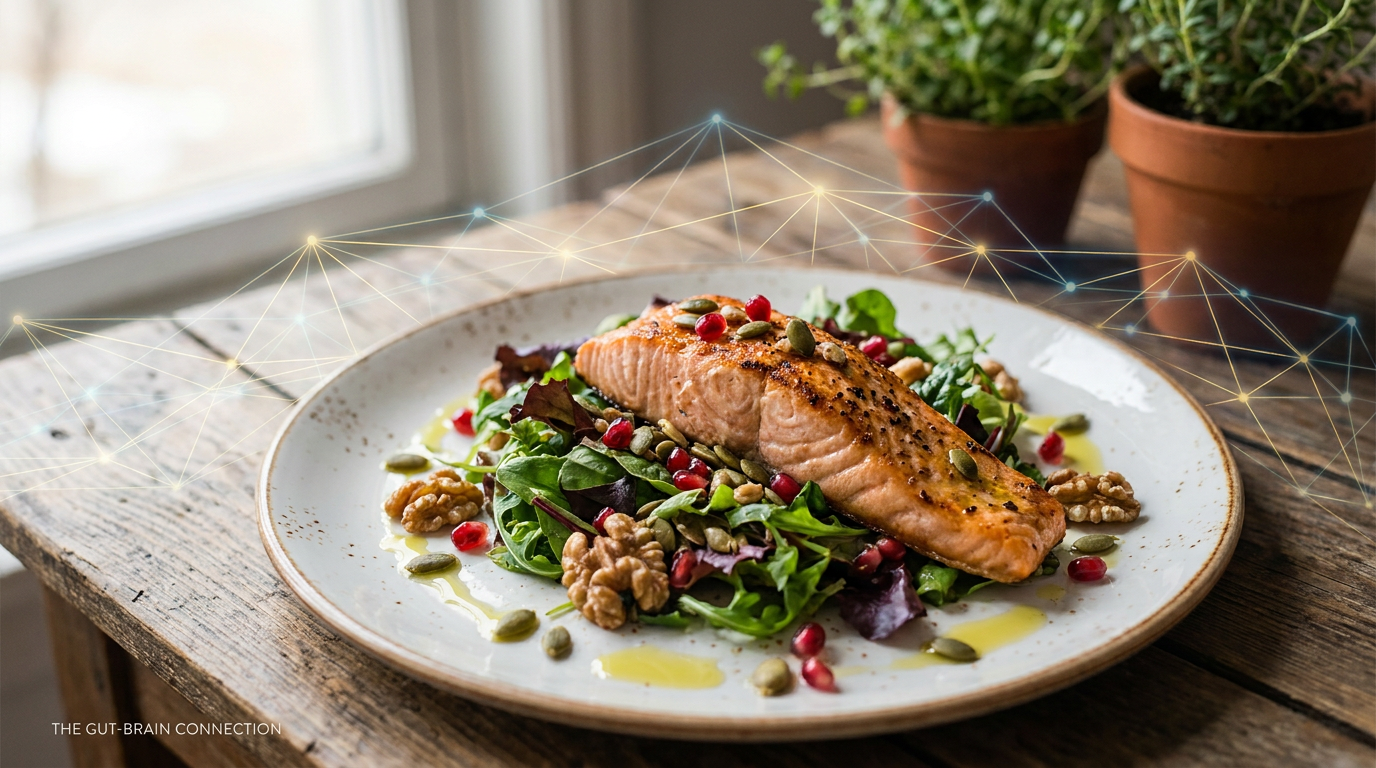
The most powerful, modifiable lever for shaping this microbial ecosystem is diet. Energy-dense, highly processed diets rich in refined sugars and industrial fats have been consistently linked to poorer mental health outcomes.[2]
The most powerful, modifiable lever for shaping this microbial ecosystem is diet.
Conversely, dietary patterns rich in fiber, such as the Mediterranean diet, provide the necessary fuel for beneficial bacteria. These non-digestible carbohydrates, known as prebiotics, act as fertilizer for the microbiome.[2][4]
When gut bacteria ferment these prebiotic fibers, they produce short-chain fatty acids (SCFAs) like butyrate. SCFAs help maintain the integrity of the intestinal barrier, preventing "leaky gut" and reducing the inflammatory signals sent to the brain.[2][3]
Beyond prebiotics, there is growing interest in "psychobiotics"—live bacteria that, when ingested in adequate amounts, confer a measurable mental health benefit.[3][5]
Fermented foods like kefir, kimchi, sauerkraut, and yogurt are natural sources of these beneficial microbes. In a recent large-scale study by the health science company ZOE, 47% of participants who increased their fermented food intake reported improvements in their mood.[1]

The supplement industry has also seized on this research, marketing specific probiotic capsules for stress and anxiety. Clinical trials have investigated specific strains like Lactobacillus rhamnosus and Bifidobacterium longum.[3][5]
Some of these trials show promise. For instance, certain bacterial strains have been shown to lower cortisol levels and improve overall sleep quality during periods of acute stress, such as university exam weeks.[3]
However, the evidence for commercial psychobiotic supplements remains mixed. Many robust effects observed in mouse models have failed to translate consistently to human trials, particularly in healthy populations with low baseline stress.[3][5]
Microbiome researchers caution that bacterial effects are highly strain-specific. A probiotic that aids digestion will not necessarily synthesize the neuroactive metabolites required to influence the central nervous system.[3]
Furthermore, individual microbiome variability means that a psychobiotic intervention that works for one person might be entirely ineffective for another. Personalized nutrition is the ultimate goal, but the science is still developing.[2]

How we got here
Early 2000s
Researchers begin identifying the complex bidirectional communication network between the gastrointestinal tract and the brain.
2013
The term 'psychobiotics' is coined to describe live organisms that, when ingested, produce health benefits in patients suffering from psychiatric illness.
2019
Large-scale population studies reveal strong correlations between specific gut bacteria profiles and the reported quality of life and depression levels.
2024–2026
Clinical trials increasingly focus on the impact of whole-food dietary patterns and fermented foods on stress resilience and mood regulation.
Viewpoints in depth
Nutritional Psychiatrists
Advocate for using whole-food dietary patterns as a foundational treatment for mental health.
This camp emphasizes that mental health cannot be separated from metabolic and digestive health. They point to robust epidemiological data showing that diets rich in fiber, healthy fats, and fermented foods—like the Mediterranean diet—correlate strongly with lower rates of depression and anxiety. Rather than focusing on single bacterial strains, they argue for a holistic approach that uses food to reduce systemic inflammation and provide the broad-spectrum nutrients the brain needs to function optimally.
Microbiome Researchers
Focus on the precise, strain-specific mechanisms of gut-brain communication.
Basic scientists and microbiologists are excited by the potential of the gut-brain axis but urge caution against overhyping current capabilities. They note that the effects of bacteria are highly strain-specific; a Lactobacillus strain that aids digestion might do nothing for mood. They argue that while mouse models have shown dramatic behavioral changes from microbiome manipulation, human trials are often confounded by individual variability, diet, and lifestyle, requiring much larger and more rigorous clinical studies before targeted 'psychobiotics' can be reliably prescribed.
Skeptical Clinicians
Warn against viewing diet and probiotics as a replacement for standard psychiatric care.
While acknowledging the reality of the gut-brain axis, this camp worries that the 'food as medicine' movement can inadvertently stigmatize patients with severe mental illness, implying they could cure their depression if they simply ate better. They stress that while a healthy microbiome can support emotional resilience and improve mild-to-moderate symptoms, it is not a substitute for SSRIs, targeted therapy, or other conventional psychiatric interventions for clinical disorders.
What we don't know
- Exactly which specific strains of bacteria are most effective for treating distinct psychiatric conditions in humans.
- How individual genetic differences and baseline microbiome compositions alter a person's response to psychobiotic interventions.
- The precise dosage and duration of probiotic supplementation required to achieve lasting changes in brain function.
Key terms
- Gut Microbiome
- The complex ecosystem of trillions of microorganisms, including bacteria, viruses, and fungi, that live in the human digestive tract.
- Vagus Nerve
- The longest cranial nerve in the body, serving as the primary physical communication highway between the gut and the brain.
- Prebiotics
- Non-digestible carbohydrates, primarily plant fibers, that serve as food or 'fertilizer' for beneficial gut bacteria.
- Short-Chain Fatty Acids (SCFAs)
- Beneficial compounds produced when gut bacteria ferment dietary fiber, known to reduce inflammation and support the intestinal barrier.
- Dysbiosis
- An imbalance in the gut microbial community, often associated with inflammation and various chronic health conditions.
Frequently asked
What is the gut-brain axis?
The gut-brain axis is the two-way communication network between your digestive tract and your central nervous system, operating through nerves, hormones, and the immune system.
What are psychobiotics?
Psychobiotics are specific strains of live bacteria (probiotics) or the fibers that feed them (prebiotics) that confer a mental health benefit when consumed in adequate amounts.
Can probiotics cure depression?
No. While a healthy microbiome can support mood and emotional resilience, dietary interventions and probiotics are not a replacement for conventional psychiatric treatments for clinical depression.
What foods are best for the gut-brain axis?
Diets rich in high-fiber plants (which feed good bacteria) and fermented foods like kefir, kimchi, and yogurt (which introduce beneficial live microbes) are most strongly linked to improved mental well-being.
Sources
Source coverage
6 outlets
4 viewpoints surfaced






[1]ZOE Science & NutritionWellness & Supplement Industry
Psychobiotics: Can probiotics improve your mood?
Read on ZOE Science & Nutrition →[2]Annual Review of Food Science and TechnologyNutritional Psychiatrists
From Fork to Feelings: How Foods Shape Mental Health via the Microbiota–Gut–Brain Axis
Read on Annual Review of Food Science and Technology →[3]Frontiers in NutritionMicrobiome Researchers
Psychobiotics and the Gut-Brain Axis: A Comprehensive Review
Read on Frontiers in Nutrition →[4]CureusNutritional Psychiatrists
The Gut-Brain Axis and Dietary Interventions for Mental Health
Read on Cureus →[5]Cambridge University PressMicrobiome Researchers
Psychobiotics and Depression: A Paradigm Shift in Psychiatry
Read on Cambridge University Press →[6]Factlen Editorial TeamSkeptical Clinicians
Synthesis by Factlen editorial team
Read on Factlen Editorial Team →
More in health
See all 9 stories →Dementia Research
The Shingles Vaccine Is Emerging as a Powerful Shield Against Dementia
7 sources

Exercise Mimetics
The Science of 'Exercise in a Pill': How New Longevity Drugs Mimic Physical Activity
7 sources
Brain Health
How Deep Sleep Washes the Brain: The Science of the Glymphatic System
7 sources

Longevity Science
The Postbiotic Promise: How Urolithin A Recycles Aging Cells
6 sources
Every angle. Every day.
Get health stories with full source coverage and perspective breakdowns delivered to your inbox.