
The First Working Nuclear Clock Heralds a New Era in Precision Timekeeping
Scientists have successfully demonstrated the world's first working nuclear clock using the thorium-229 isotope. By measuring time via the atomic nucleus rather than its electrons, the breakthrough promises unprecedented accuracy for deep-space navigation and fundamental physics.
By Factlen Editorial Team
- Quantum Metrologists
- Focuses on the engineering and precision of building the ultimate timekeeper.
- Fundamental Physicists
- Views the clock primarily as a highly sensitive probe for the deepest mysteries of the universe.
- Aerospace & Defense Engineers
- Prioritizes the ruggedness and miniaturization potential for field deployment.
What's not represented
- · Commercial GPS Providers
- · Telecommunications Infrastructure Operators
Why this matters
By shifting timekeeping from the fragile outer electrons to the heavily shielded core of the atom, nuclear clocks promise to unlock GPS-free navigation for submarines and spacecraft, while providing a revolutionary new tool to hunt for dark matter.
Key points
- Scientists have demonstrated the first working nuclear clock, using the thorium-229 isotope.
- Unlike atomic clocks that rely on electrons, nuclear clocks measure time using the atom's dense, shielded core.
- Thorium-229 is the only known nucleus with an energy state low enough to be manipulated by lasers.
- The solid-state design embeds trillions of nuclei in a crystal, making the clock highly robust.
- The technology could eventually enable autonomous deep-space navigation and GPS-free tracking on Earth.
For half a century, physicists have chased a theoretical holy grail: a clock that ticks not by the flutter of electrons, but by the ultra-stable heartbeat of an atomic nucleus. Today, that theoretical dream is a functioning reality. Researchers have successfully demonstrated the world's first working nuclear clock, a device that promises to redefine precision metrology and our understanding of the universe.[1]
The breakthrough, centered on a unique isotope known as thorium-229, represents a fundamental shift in how humanity measures time. By shifting the timekeeping mechanism from the outer electron shell to the dense, heavily shielded core of the atom, scientists have unlocked a method of timekeeping that is virtually immune to environmental interference.[2][3]
To understand the magnitude of this shift, one must look at how current atomic clocks operate. The modern gold standard—which synchronizes everything from global GPS networks to high-frequency financial trading—relies on measuring the energy transitions of electrons in atoms like cesium or strontium.[1]
When these atoms are hit with a specific frequency of laser light, their electrons jump to a higher energy state. The exact frequency of light required to trigger this jump serves as the clock's "tick." The best modern atomic clocks are so precise they would not lose a single second over billions of years.[3]

However, electrons are exposed. Because they orbit the outer edges of the atom, they are highly sensitive to external electromagnetic fields, temperature fluctuations, and physical stress. This sensitivity requires atomic clocks to be housed in massive, complex vacuum chambers with extreme cooling systems to maintain their accuracy.[4]
The atomic nucleus, by contrast, is a fortress. Protons and neutrons are bound together by the strong nuclear force, tightly packed in a space a hundred thousand times smaller than the atom itself. This dense core is naturally shielded from the chaotic electromagnetic noise of the outside world.[1][4]
The challenge has always been accessing that fortress. In most elements, exciting a nucleus requires massive amounts of energy—typically high-frequency X-rays or gamma rays, which cannot be produced or controlled with the precision needed to operate a clock.[2]
Enter thorium-229. This specific radioactive isotope is a freak of nature. It possesses an "isomeric state"—a slightly elevated energy level—that sits just 8.4 electron volts above its ground state. This is an exceptionally low energy gap, resulting from a rare, accidental cancellation between the strong nuclear force and the electromagnetic Coulomb force.[6]

Because the energy gap is so small, the thorium-229 nucleus can be excited not by gamma rays, but by vacuum ultraviolet (VUV) lasers. It is the only known atomic nucleus in the universe that can be manipulated with existing laser technology, making it the sole candidate for a nuclear clock.[2][4]
Because the energy gap is so small, the thorium-229 nucleus can be excited not by gamma rays, but by vacuum ultraviolet (VUV) lasers.
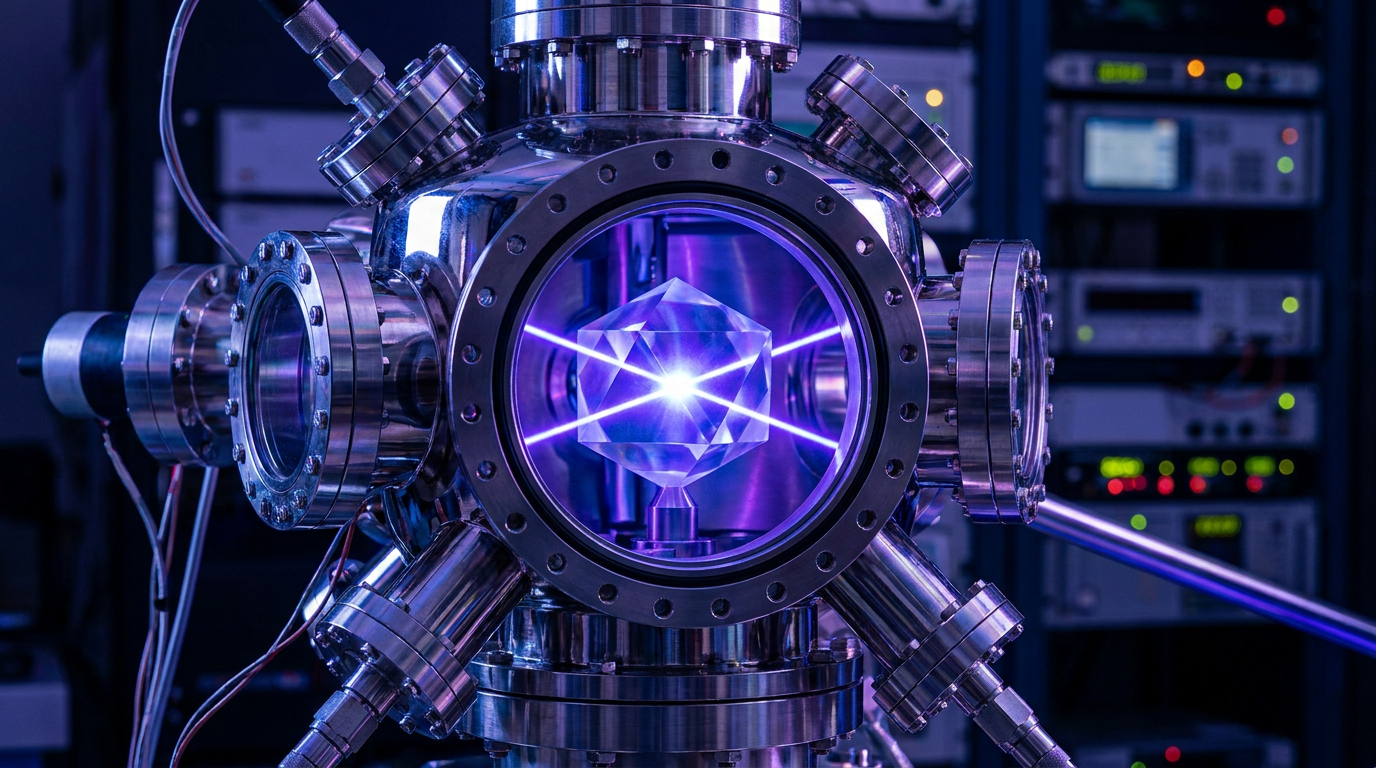
The recent demonstration involved embedding thorium-229 atoms into a solid, transparent crystal of calcium fluoride. Unlike atomic clocks, which require trapping individual ions in a vacuum, the solid-state approach allows trillions of thorium nuclei to be packed into a tiny crystal, massively amplifying the signal.[3][4]
Researchers then fired a specially designed ultraviolet laser at the crystal, successfully triggering the nuclear transition. Crucially, they used a device called a "frequency comb"—essentially a highly precise ruler for light—to measure the exact frequency of the transition and link it directly to a state-of-the-art strontium atomic clock.[2][3]
This direct frequency link is what elevates the experiment from a physics curiosity to a working clock demonstrator. It proves that the "ticks" of the thorium nucleus can be reliably read and translated into a usable timekeeping standard.[3]

Parallel breakthroughs are already accelerating the technology's miniaturization. Researchers recently discovered that by electroplating a microscopic layer of thorium onto steel—an old jeweler's trick—they could achieve the same nuclear excitation without the need for complex, delicate crystals.[5]
This electroplating method produces a measurable electric current when the nucleus is excited, offering a straightforward way to read the clock's signal. Such innovations suggest that nuclear clocks could eventually be miniaturized to the size of a microchip, a stark contrast to the room-sized apparatus required for top-tier atomic clocks.[5]
The implications for navigation are profound. Because nuclear clocks are highly stable and can be made compact, they could provide ultra-precise timekeeping for deep-space probes. Currently, spacecraft rely on constant communication with Earth to determine their position; a portable nuclear clock would allow them to navigate autonomously.[1][3]
Closer to home, miniaturized nuclear clocks could revolutionize navigation in "GPS-denied" environments. Submarines operating deep underwater, or military units in areas where satellite signals are jammed, could maintain perfect positional accuracy using onboard nuclear timekeepers.[5]

Beyond navigation, the thorium-229 clock offers a new lens for fundamental physics. Because the 8.4 eV transition energy is the result of a delicate balance between the strong force and electromagnetism, any minuscule change in the frequency over time would indicate that the fundamental constants of nature are shifting.[6][7]
This extreme sensitivity makes the nuclear clock an unprecedented tool for hunting dark matter. If ultra-light dark matter particles interact with the nucleus, they would cause tiny, periodic fluctuations in the clock's ticking rate, potentially revealing the invisible mass that makes up most of the universe.[6][7]
While the current prototype does not yet surpass the raw stability of the world's absolute best atomic clocks, the foundational architecture is now proven. The remaining hurdles are largely engineering challenges: developing more powerful, continuous-wave ultraviolet lasers and optimizing the host materials.[2][4]
How we got here
1976
Scientists first find indirect evidence of an exceptionally low-energy isomeric state in the thorium-229 nucleus.
2003
Physicists propose the theoretical framework for using the thorium-229 transition to build a nuclear clock.
2023
Researchers successfully measure the exact energy of the thorium-229 transition, pinpointing it at 8.4 electron volts.
2024
A team achieves the first direct laser excitation of the thorium-229 nucleus, proving it can be manipulated with light.
June 2026
Scientists demonstrate the first working nuclear clock prototype, successfully linking the nuclear transition to a frequency comb.
Viewpoints in depth
Quantum Metrologists
Focuses on the engineering and precision of building the ultimate timekeeper.
For metrologists, the nuclear clock is the logical evolution of timekeeping. Their primary goal is to surpass the fractional uncertainty of the best strontium and ytterbium atomic clocks. By leveraging the natural isolation of the atomic nucleus, they aim to build a frequency standard that is not only more accurate but significantly more robust against environmental noise, reducing the need for the massive cryogenic shielding required by today's top-tier clocks.
Fundamental Physicists
Views the clock primarily as a highly sensitive probe for the deepest mysteries of the universe.
Theoretical physicists see the thorium-229 clock as a tabletop observatory. Because the 8.4 eV transition energy is a delicate cancellation between the strong nuclear force and electromagnetic repulsion, any drift in the clock's frequency over time would indicate that the fundamental constants of nature are changing. This extreme sensitivity also makes it a prime candidate for detecting ultra-light dark matter, which could subtly alter the clock's ticking rate as it passes through the Earth.
Aerospace & Defense Engineers
Prioritizes the ruggedness and miniaturization potential for field deployment.
For aerospace and defense sectors, the appeal of the nuclear clock lies in its resilience. Current atomic clocks are too fragile and bulky for many field applications, leaving submarines and deep-space probes reliant on external GPS or Earth-based communications. Engineers are focused on solid-state designs—like embedding thorium in crystals or electroplating it on steel—that could lead to compact, shock-resistant clocks capable of providing autonomous, GPS-free navigation in the harshest environments.
What we don't know
- Whether the solid-state crystal approach or the single-ion trap approach will ultimately yield the highest precision.
- Exactly how soon the technology can be miniaturized into portable, field-ready devices.
- Whether the clock will successfully detect variations in the fundamental constants of nature once it reaches peak sensitivity.
Key terms
- Isomeric state
- A metastable, excited state of an atomic nucleus that lasts longer than typical nuclear excitations before decaying back to the ground state.
- Frequency comb
- A highly precise laser tool that emits a continuous spectrum of evenly spaced light frequencies, used as a ruler to measure exact colors of light.
- Vacuum ultraviolet (VUV)
- A spectrum of ultraviolet light that is strongly absorbed by air, requiring experiments to be conducted in a vacuum chamber.
- Strong nuclear force
- The fundamental force of nature that binds protons and neutrons together inside the atomic nucleus, overcoming the electromagnetic repulsion between protons.
Frequently asked
Why is a nuclear clock better than an atomic clock?
Atomic clocks rely on electrons, which are easily disturbed by stray magnetic fields and temperature changes. A nuclear clock uses the atom's core, which is naturally shielded from these environmental disturbances, making it far more stable.
Why can't we use other elements besides thorium?
In almost all elements, exciting the nucleus requires massive amounts of energy, like X-rays or gamma rays, which we cannot control precisely. Thorium-229 is a unique 'freak of nature' with an energy gap small enough to be reached by existing ultraviolet lasers.
Will this replace the atomic clock in my phone or GPS?
Eventually, yes. While current prototypes are laboratory-bound, new techniques like electroplating thorium onto steel suggest nuclear clocks could be miniaturized and mass-produced, potentially replacing atomic clocks in satellites and power grids.
Sources
Source coverage
7 outlets
3 viewpoints surfaced







[1]Factlen Editorial TeamQuantum Metrologists
Synthesis by Factlen editorial team
Read on Factlen Editorial Team →[2]NatureFundamental Physicists
Frequency ratio of the 229mTh nuclear isomeric transition and the 87Sr atomic clock
Read on Nature →[3]NISTQuantum Metrologists
NIST and JILA Demonstrate Key Technologies for World's First Nuclear Clock
Read on NIST →[4]TU WienQuantum Metrologists
Atomic Nucleus Excited with Laser: A Breakthrough after Decades
Read on TU Wien →[5]UCLAAerospace & Defense Engineers
An old jeweler's trick could unlock next-generation nuclear clocks
Read on UCLA →[6]European Research CouncilFundamental Physicists
Thorium Nuclear Clock Synergy Grant
Read on European Research Council →[7]UNSWFundamental Physicists
Thorium-229 nuclear clock theoretical breakthroughs
Read on UNSW →

Every angle. Every day.
Get science stories with full source coverage and perspective breakdowns delivered to your inbox.