
The First Working Nuclear Clock Heralds a New Era in Precision Timekeeping
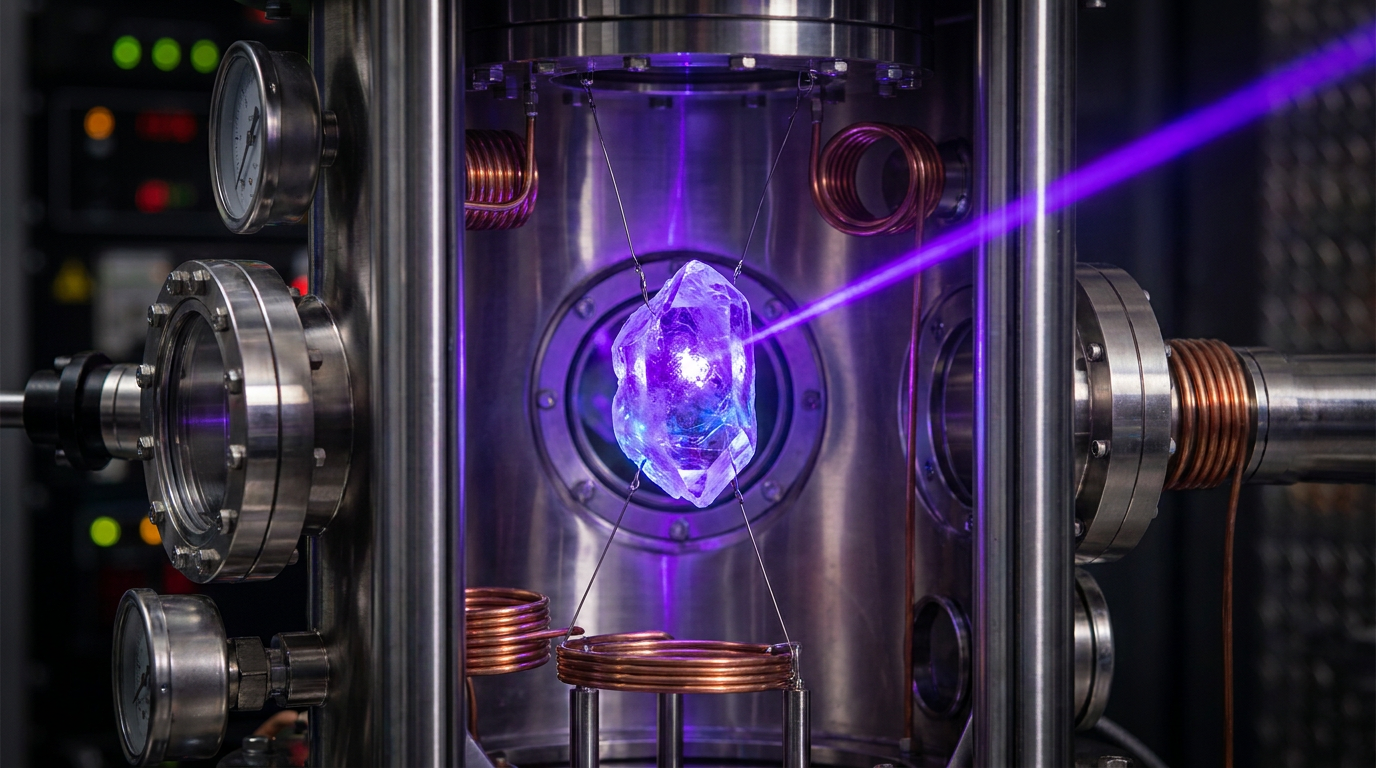
Following decades of theoretical research and a rapid series of recent breakthroughs, scientists have successfully demonstrated the world's first working nuclear clock. By using lasers to measure the nucleus of Thorium-229, the technology promises to be vastly more precise and rugged than traditional atomic clocks.
By Factlen Editorial Team
- Metrologists & Physicists
- Focused on the fundamental limits of precision and testing the laws of the universe.
- Space Exploration Advocates
- Focused on untethering deep-space probes from Earth's communication networks.
- Infrastructure & Security Analysts
- Focused on securing critical terrestrial systems against GPS spoofing and jamming.
What's not represented
- · Commercial GPS providers who may face disruption from decentralized, highly accurate local timing systems.
Why this matters
The successful demonstration of a nuclear clock paves the way for ultra-precise, GPS-independent navigation systems and offers physicists a revolutionary new tool to detect dark matter and test the fundamental laws of the universe.
Key points
- Scientists have demonstrated the first functional nuclear clock using the rare isotope Thorium-229.
- Unlike atomic clocks that rely on fragile electron orbits, nuclear clocks measure the tightly bound nucleus.
- The breakthrough was enabled by a new continuous-wave vacuum ultraviolet laser developed in early 2026.
- Solid-state designs embed trillions of Thorium nuclei into a single crystal, allowing for future miniaturization.
- The technology could eventually enable submarines and power grids to operate independently of GPS.
- Physicists plan to use the extreme precision to test fundamental constants and search for dark matter.
Timekeeping is the invisible scaffolding of modern civilization. From the synchronization of global financial markets to the routing of internet traffic and the precision of GPS navigation, ultra-accurate atomic clocks run the world.[6]
Yet, traditional atomic clocks possess a fundamental vulnerability. They keep time by measuring the energy jumps of electrons orbiting an atom's nucleus. Because these electrons sit on the outer edge of the atom, they are highly sensitive to the outside world—easily jostled by stray magnetic fields, temperature fluctuations, and electromagnetic interference.[4]
For decades, physicists have theorized a superior alternative: a clock that ticks using the nucleus itself. The nucleus is a dense, tightly bound fortress, naturally shielded from environmental noise by the very electrons that make atomic clocks so fragile.[5]
In June 2026, the scientific community finally crossed the finish line. Following a rapid succession of breakthroughs across the globe, the first fully functional nuclear clock prototypes have been demonstrated, heralding a paradigm shift in precision metrology.[4]

The journey to this moment spans half a century of theoretical dead-ends and incremental victories. The core challenge was finding a nucleus that could actually be manipulated. Most atomic nuclei require high-energy gamma rays to change states, and gamma rays cannot be controlled with the precision of a laser.[5]
Thorium-229 is the universe's only known exception. It possesses an isomeric state—a slightly elevated energy level—that sits just 8.35 electron volts above its ground state.[1]
This tiny energy gap corresponds to a wavelength of roughly 148.4 nanometers, placing it in the vacuum ultraviolet (VUV) spectrum. Crucially, this is the only nuclear transition in existence accessible to tabletop laser technology.[2]
The first major crack in the dam occurred in September 2024, when a coalition of researchers from JILA, NIST, and TU Wien successfully measured the exact frequency of this transition. By comparing the Thorium nucleus to a standard Strontium atomic clock, they mapped the exact color of light needed to trigger the tick.[1]
However, measuring the transition was only half the battle. To build a continuous, ticking clock, scientists needed a laser capable of sustaining a perfectly stable, continuous wave at exactly 148.4 nanometers—a notoriously difficult wavelength to produce.[2]

In early 2026, a team at Tsinghua University achieved exactly that. By utilizing a novel four-wave mixing technique in metal vapor, they created a continuous-wave VUV laser with a linewidth narrow enough to coherently drive the Thorium nucleus, solving the field's last core bottleneck.[2]
In early 2026, a team at Tsinghua University achieved exactly that.
Concurrently, researchers at UCLA demonstrated that Thorium could be embedded into solid, opaque crystals like Thorium Dioxide, rather than relying on delicate vacuum traps or transparent calcium fluoride.[3]
This solid-state approach is revolutionary. A single millimeter-sized crystal can hold trillions of Thorium nuclei, vastly amplifying the clock's signal. It also allows the core of the clock to be miniaturized into a rugged, portable device that can withstand extreme environments.[3]
The implications for navigation are profound. Currently, deep-space probes rely on Earth-based atomic clocks to determine their position, introducing crippling latency as signals take hours to travel across the solar system.[6]
A portable nuclear clock would allow spacecraft to self-navigate in real-time. Untethered from Earth's tracking networks, probes could execute complex, autonomous maneuvers in the outer solar system with unprecedented precision.[6]

Back on Earth, the technology promises to untether critical infrastructure from the vulnerabilities of GPS. Submarines could navigate underwater for months without surfacing for a satellite fix, and power grids could maintain perfect synchronization even if satellite networks were jammed or destroyed.[4]
Beyond practical applications, the nuclear clock offers a profound new tool for fundamental physics. Because the Thorium transition is governed by the strong nuclear force, rather than electromagnetism, it is exquisitely sensitive to the fundamental constants of nature.[5]
Physicists plan to use these clocks to test whether the laws of physics are truly constant, or if the fundamental forces of the universe are slowly shifting over cosmic time.[1]
They could also serve as ultra-sensitive detectors for dark matter. If dark matter interacts with the strong nuclear force even slightly as it washes over the Earth, a global network of nuclear clocks would detect the disturbance as a tiny, synchronized shift in their ticking rate.[6]

The transition from laboratory prototype to commercial device will still take years. Engineers must now focus on miniaturizing the complex vacuum ultraviolet lasers and optical frequency combs required to read the clock's signal.[4]
Yet, the fundamental physics hurdles have now been cleared. We are no longer asking if a nuclear clock can be built, but how quickly it can be deployed to reshape our understanding of time, space, and the universe itself.[6]
How we got here
1976
Physicists first identify that Thorium-229 possesses an unusually low-energy nuclear isomer.
2003
Researchers at Germany's PTB formally propose using the Thorium-229 transition to build a nuclear clock.
Sep 2024
A joint team from JILA, NIST, and TU Wien successfully measures the exact frequency of the Thorium transition using an ultraviolet frequency comb.
Dec 2025
UCLA researchers demonstrate that Thorium nuclei can be excited while embedded in an opaque, solid-state crystal.
Feb 2026
Tsinghua University develops the world's first continuous-wave 148nm laser, solving the final bottleneck for coherent nuclear excitation.
Jun 2026
The first fully functional, ticking nuclear clock prototypes are demonstrated, heralding a new era in metrology.
Viewpoints in depth
Metrologists & Physicists
Focused on the fundamental limits of precision and testing the laws of the universe.
For the physics community, the nuclear clock is less about navigation and more about probing the fabric of reality. Because the Thorium-229 transition is governed by the strong nuclear force rather than electromagnetism, it offers an entirely new lens through which to view the universe. Metrologists hope to use these clocks to test whether fundamental constants, like the fine-structure constant, are actually changing over cosmic time. Furthermore, a global network of nuclear clocks could act as a planetary-scale antenna for dark matter, detecting minute gravitational or strong-force disturbances as dark matter waves wash over the Earth.
Space Exploration Advocates
Focused on untethering deep-space probes from Earth's communication networks.
Space agencies view the nuclear clock as the key to true autonomy in the outer solar system. Currently, a probe around Jupiter or Saturn cannot determine its exact position without exchanging time-stamped signals with Earth—a process that takes hours due to the speed of light. A ruggedized, solid-state nuclear clock onboard the spacecraft would allow it to calculate its own trajectory in real-time. This eliminates the latency bottleneck, enabling probes to execute complex, split-second maneuvers through planetary rings or during atmospheric descents without waiting for human instructions.
Infrastructure & Security Analysts
Focused on securing critical terrestrial systems against GPS spoofing and jamming.
Security experts see the nuclear clock as the ultimate backup for a fragile global infrastructure. Modern power grids, financial trading platforms, and telecommunications networks rely entirely on the timing signals broadcast by GPS satellites. If those satellites were jammed, spoofed, or destroyed, the resulting desynchronization would cause catastrophic terrestrial failures. A portable nuclear clock stationed at critical infrastructure nodes would provide perfect, decentralized timing that is physically immune to electronic warfare, ensuring continuity of operations during a crisis.
What we don't know
- How quickly the massive vacuum ultraviolet laser systems can be miniaturized into a portable, chip-scale device.
- Whether the solid-state crystal approach will suffer from unforeseen long-term degradation when exposed to continuous VUV radiation.
- If the nuclear clock will actually reveal variations in the fundamental constants of nature once it achieves maximum precision.
Key terms
- Nuclear Isomer
- A metastable state of an atomic nucleus caused by the excitation of one or more of its protons or neutrons.
- Vacuum Ultraviolet (VUV)
- A band of the electromagnetic spectrum with wavelengths from 10 to 200 nanometers, which is strongly absorbed by air and requires vacuum chambers to propagate.
- Linewidth
- The width of the frequency spectrum of a laser beam; a narrower linewidth means a more precise, 'purer' color of light.
- Frequency Comb
- A specialized laser tool that acts as a ruler for light, allowing scientists to count the incredibly fast oscillations of light waves with extreme precision.
- Strong Nuclear Force
- The fundamental force of nature that holds protons and neutrons together inside the atomic nucleus, which governs the Thorium-229 transition.
Frequently asked
Why is a nuclear clock better than an atomic clock?
Atomic clocks rely on electrons, which are easily disturbed by stray magnetic fields and temperature changes. A nuclear clock uses the atom's nucleus, which is tightly bound and naturally shielded from environmental noise.
Why use Thorium-229 specifically?
Almost all atomic nuclei require massive amounts of energy, like gamma rays, to change states. Thorium-229 is the only known nucleus in the universe with an energy jump small enough to be triggered by a standard tabletop laser.
Will this replace the atomic clocks in GPS satellites?
Eventually, yes. Because nuclear clocks can be built into solid crystals, they have the potential to be ruggedized and miniaturized for spaceflight, offering far greater precision and resilience than current GPS clocks.
Can I buy a nuclear wristwatch?
Not anytime soon. While the Thorium crystal itself is small, the vacuum ultraviolet lasers and optical frequency combs required to read the time still fill a laboratory table.
Sources
Source coverage
6 outlets
3 viewpoints surfaced





[1]NatureMetrologists & Physicists
Frequency ratio of the 229mTh nuclear isomeric transition and the 87Sr atomic clock
Read on Nature →Continuous-wave vacuum ultraviolet laser excitation of the thorium-229 nucleus
Read on Nature →[3]Physical Review LettersMetrologists & Physicists
Host-Dependent Frequency Offsets in Th 229 Nuclear Clockwork
Read on Physical Review Letters →[4]New ScientistInfrastructure & Security Analysts
First working nuclear clock heralds a new era in timekeeping
Read on New Scientist →[5]PTBMetrologists & Physicists
Concept of a thorium-229 based nuclear optical clock
Read on PTB →[6]Factlen Editorial TeamSpace Exploration Advocates
Synthesis by Factlen editorial team
Read on Factlen Editorial Team →

Every angle. Every day.
Get science stories with full source coverage and perspective breakdowns delivered to your inbox.