
The Evidence on LED Face Masks: What Clinical Dermatology Actually Says About Red Light Therapy
At-home LED masks promise to reduce wrinkles and clear acne, but clinical evidence shows that while photobiomodulation is real, consumer devices often lack the necessary irradiance to deliver professional results.
By Factlen Editorial Team
- Clinical Dermatologists
- Medical professionals who evaluate the peer-reviewed evidence behind photobiomodulation.
- Consumer Testing Advocates
- Independent reviewers focused on the gap between marketing claims and real-world usability.
- Aesthetic Device Manufacturers
- The companies engineering and selling at-home LED therapy masks.
What's not represented
- · Regulatory bodies evaluating the classification of cosmetic light devices vs. medical devices.
- · Estheticians who integrate professional-grade LED panels into broader facial treatments.
Why this matters
Shoppers are spending hundreds of dollars on at-home LED masks based on social media hype. Understanding the clinical difference between wavelength and irradiance is the only way to avoid buying a useless glowing piece of plastic.
Key points
- Photobiomodulation uses specific light wavelengths to stimulate cellular energy and collagen production without causing thermal damage.
- Clinical studies show red and near-infrared light can modestly reduce fine lines and improve skin density over 12 weeks.
- Blue light at 415 nanometers effectively targets and kills the bacteria responsible for inflammatory acne breakouts.
- Many cheap consumer masks lack the required irradiance (power output) to trigger a biological response, rendering them ineffective.
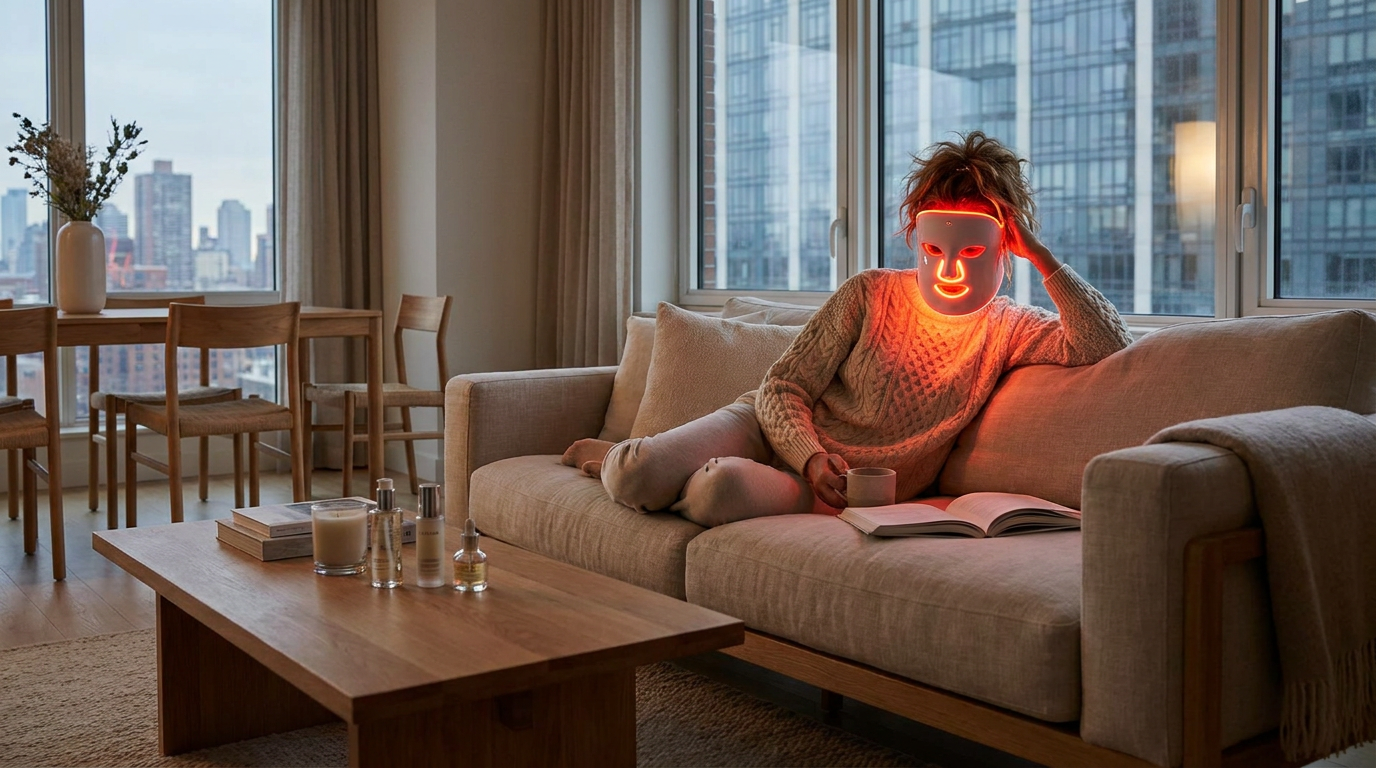
Glowing, Stormtrooper-like masks have become a ubiquitous fixture on social media, transforming the evening skincare routines of millions. These devices, once confined to high-end dermatology clinics and specialized aesthetic centers, are now widely available for home use, promising a futuristic, non-invasive solution to aging and acne. Influencers and celebrities frequently post selfies from behind these illuminated visors, driving a massive surge in consumer interest and normalizing the presence of clinical-looking technology in the average bathroom cabinet.[7]
The marketing claims surrounding these devices are both bold and comprehensive. Brands selling these masks for anywhere from $150 to well over $600 assert that wearing the device for just ten to twenty minutes a day can stimulate collagen production, erase fine lines, and clear stubborn breakouts. For shoppers bombarded by targeted advertisements and glowing testimonials, the central question is whether these expensive visors represent a genuine medical breakthrough in at-home care or simply an elaborate, high-priced placebo.[2][7]
The underlying science, known clinically as photobiomodulation, is highly legitimate and backed by decades of peer-reviewed research. Originally explored by NASA scientists in the 1980s as a method to promote tissue healing and plant growth for astronauts in space, low-level light therapy has a well-documented ability to alter cellular function. Unlike ultraviolet light or ablative lasers, LED therapy achieves these biological changes without causing thermal damage or trauma to the skin surface.[1][2]
The mechanism relies on specific wavelengths of light penetrating the skin barrier to reach the living cells below. When red light, typically calibrated between 630 and 660 nanometers, and near-infrared light, ranging from 810 to 850 nanometers, enter the dermis, they are absorbed by a specific chromophore. This target is cytochrome c oxidase, a crucial enzyme located within the mitochondria—the powerhouses of the skin cells.[1][4]

This targeted absorption triggers a cascade of beneficial biochemical reactions, most notably a significant surge in the production of adenosine triphosphate, or ATP. With this increased cellular energy available, fibroblasts—the specialized cells responsible for maintaining the skin's structural integrity—ramp up their synthesis of fresh collagen and elastin. Simultaneously, the light therapy modulates the local immune response, reducing localized inflammation and accelerating the tissue's natural repair processes.[1][5]
When evaluating the specific claims for anti-aging and wrinkle reduction, the clinical evidence is strong, provided the correct technological parameters are met. Controlled dermatological trials have demonstrated that consistent use of red and near-infrared light over a 12-week period can yield measurable structural changes. Studies utilizing ultrasound imaging have recorded up to a 38 percent decrease in the appearance of crow's feet and a 48 percent increase in overall collagen density following strict treatment protocols.[7]
However, dermatologists consistently emphasize that these results, while statistically significant in a laboratory setting, are visually modest in the mirror. Medical professionals caution patients against expecting the dramatic, overnight transformations associated with injectable neurotoxins, chemical peels, or professional laser resurfacing. The improvements generated by photobiomodulation are inherently slow and steady, requiring three to six months of dedicated, multi-day-a-week use before becoming noticeable to the naked eye.[1][5]
However, dermatologists consistently emphasize that these results, while statistically significant in a laboratory setting, are visually modest in the mirror.
For the treatment of acne, the clinical evidence shifts focus to an entirely different part of the visible light spectrum. Blue light, specifically calibrated at the 415-nanometer wavelength, does not penetrate as deeply into the dermis as red light. Instead, it remains near the surface where it is highly lethal to Cutibacterium acnes, the primary bacteria responsible for triggering inflammatory breakouts and cystic acne.[3][4]
A comprehensive 2025 meta-analysis published in JAMA Dermatology reviewed multiple clinical trials and concluded that at-home LED devices successfully reduced acne lesions by approximately 45 percent over a four to eight-week period. The consensus among dermatological researchers is that a dual-action approach—utilizing blue light to eradicate the underlying bacteria and red light to calm the associated inflammatory response—provides the most effective non-pharmacological intervention for acne-prone skin.[3][4]

Despite the proven underlying science, the consumer market is heavily saturated with ineffective, imitation products. The critical failure point for shoppers lies in the technical distinction between wavelength and irradiance—two crucial metrics that separate clinical-grade therapeutic tools from glowing pieces of novelty plastic. Understanding this difference is the only way consumers can navigate the deceptive marketing prevalent in the beauty tech industry.[2][7]
Wavelength, measured in nanometers, determines the depth of penetration and the specific cellular pathway that the light activates. If a consumer mask utilizes cheap, uncalibrated bulbs that merely emit a red color rather than the precise 633-nanometer frequency required for photobiomodulation, the light will fail to interact with the mitochondrial enzymes. In this scenario, the treatment is entirely useless, regardless of how bright the mask appears.[2][4]
Irradiance, measured in milliwatts per square centimeter, dictates the actual power and energy density reaching the tissue. Many budget-friendly consumer masks lack the necessary irradiance to deliver a therapeutic dose of energy within a standard ten-minute session. If the irradiance is too low, the cellular response is never triggered, meaning the user is simply resting under a colored lightbulb without receiving any biological benefit.[2][7]

From a safety perspective, red and near-infrared light therapy boasts an exceptionally strong profile. The American Academy of Dermatology affirms that these specific wavelengths do not emit ultraviolet radiation, meaning they carry zero risk of causing DNA damage, sunburns, or skin cancer. Across major clinical trials, the most commonly reported side effect is a mild, temporary redness immediately following the session, which typically dissipates within an hour.[1][2]
Blue light, however, requires significantly stricter safety protocols due to the well-documented risk of photochemical retinal damage. Clinical guidelines mandate that any device emitting blue light must be used in conjunction with opaque, protective eye shields. Several poorly designed consumer masks have faced regulatory scrutiny or outright recalls for failing to provide adequate ocular protection, highlighting the need for caution when purchasing multi-color devices.[2][6]
There are also specific medical contraindications that prospective shoppers must carefully consider. Dermatologists warn that individuals dealing with melasma or severe hyperpigmentation should approach LED masks with extreme caution. Certain light frequencies, combined with the mild heat generated by the diodes during a twenty-minute session, can inadvertently stimulate pigment-producing cells, potentially exacerbating the very dark spots the user is trying to fade.[2]
Independent consumer testing organizations have found that the biggest hurdle to real-world efficacy is simply user compliance. In practical trials, testers often report only minor improvements after six weeks, largely because the required regimen is demanding. Sitting tethered to an illuminated mask for up to twenty minutes, four times a week, requires a level of routine discipline that experiences a remarkably high abandonment rate among average consumers.[6]
Ultimately, the clinical consensus views high-quality, FDA-cleared LED masks as a valid, evidence-based adjunct to a comprehensive daily skincare routine. They are not a standalone miracle cure that can replace sunscreen or retinoids, but for consumers willing to invest in a device with verified irradiance and commit to months of consistent use, photobiomodulation offers a gentle, zero-downtime path to structurally healthier skin.[1][5]
Viewpoints in depth
Clinical Dermatologists
Medical professionals who evaluate the peer-reviewed evidence behind photobiomodulation.
Dermatologists acknowledge that the science of low-level light therapy is sound, with proven mechanisms for stimulating collagen and reducing acne-causing bacteria. However, they frequently caution patients that at-home devices offer only a fraction of the power found in clinical machines. They view LED masks as a supportive, long-term maintenance tool rather than a replacement for medical-grade topicals, chemical peels, or injectables, and stress that consistency over many months is required to see even modest results.
Consumer Testing Advocates
Independent reviewers focused on the gap between marketing claims and real-world usability.
Consumer advocates highlight the deceptive nature of the beauty tech market, where cheap devices use colored bulbs that mimic the look of red light without delivering the precise wavelengths or irradiance required for a cellular response. They also point out that the biggest point of failure isn't the technology itself, but user fatigue. The requirement to sit still with a mask on for 20 minutes, four times a week, leads to high abandonment rates, making even the best devices ineffective for the average buyer.
Aesthetic Device Manufacturers
The companies engineering and selling at-home LED therapy masks.
Manufacturers argue that their devices democratize access to treatments that previously required expensive, recurring visits to a dermatologist. By engineering FDA-cleared masks that deliver safe, non-thermal light, they provide consumers with a zero-downtime intervention that can be seamlessly integrated into a nightly routine. They emphasize that while the power output is lower than clinical machines to ensure home safety, the cumulative effect of daily use bridges the efficacy gap.
What we don't know
- The exact optimal irradiance (mW/cm²) required for at-home devices to match clinical efficacy, as dosing standards remain unstandardized across the industry.
- The long-term effects of daily LED mask use over multiple years, as most clinical trials track results for only 12 to 16 weeks.
- Whether the subtle benefits of at-home photobiomodulation are maintained if a user drops their usage frequency from three times a week to once a week.
Key terms
- Photobiomodulation
- The use of specific wavelengths of light to stimulate cellular responses, such as energy production and tissue repair.
- Wavelength
- Measured in nanometers (nm), this determines the color of the light and how deeply it penetrates the skin layers.
- Irradiance
- Measured in milliwatts per square centimeter (mW/cm²), this represents the actual power or energy output delivered to the skin tissue.
- Cytochrome c oxidase
- An enzyme in the mitochondria that absorbs red and near-infrared light, triggering increased cellular energy production.
- Fibroblasts
- Cells in the dermis layer of the skin responsible for producing collagen and elastin.
Frequently asked
Can an LED mask replace my retinol or Botox?
No. Dermatologists view LED masks as a supportive therapy that provides modest improvements to skin texture and tone, not a replacement for medical-grade topicals or injectables.
Is red light therapy safe for the eyes?
Red and near-infrared light are generally safe, but blue light carries a risk of photochemical retinal damage. Users should always wear the provided opaque eye shields.
How often do I need to use an LED mask?
Clinical studies typically require use 3 to 5 times per week for 10 to 20 minutes per session, with visible results taking 3 to 6 months to appear.
Will red light therapy cause cancer or skin damage?
No. LED masks do not emit ultraviolet (UV) light. The American Academy of Dermatology considers them safe, with no associated risk of DNA damage or skin cancer.
Sources
Source coverage
7 outlets
3 viewpoints surfaced







[1]Harvard Health PublishingClinical Dermatologists
Is red light therapy all hype?
Read on Harvard Health Publishing →[2]Dermatology TimesClinical Dermatologists
Social Media Mythbusters: At-Home Red Light Therapy
Read on Dermatology Times →[3]JAMA DermatologyClinical Dermatologists
Efficacy of Light-Emitting Diode Devices for Acne Vulgaris: A Meta-analysis
Read on JAMA Dermatology →[4]Journal of Clinical and Aesthetic DermatologyClinical Dermatologists
Phototherapy with Light Emitting Diodes: Treating a Broad Range of Medical and Aesthetic Conditions in Dermatology
Read on Journal of Clinical and Aesthetic Dermatology →[5]MedPage TodayClinical Dermatologists
Are Red Light Therapy Masks Worth the Hype?
Read on MedPage Today →[6]Which?Consumer Testing Advocates
Do LED face masks actually work?
Read on Which? →[7]Factlen Editorial TeamAesthetic Device Manufacturers
Synthesis by Factlen editorial team
Read on Factlen Editorial Team →

More in shopping
See all 5 stories →Kitchen Safety
Washington State's Near-Total Ban on Lead in Cookware: How the 5 ppm Limit Will Reshape the Metal Kitchenware Market
8 sources

Agentic Commerce
Autonomous vs. Human: The 2026 Trade-Off Analysis of Letting AI Agents Do Your Shopping
7 sources

Review Fraud
The $53,088 Fine: How the FTC's Active Enforcement of the Consumer Review Rule Will Clean Up E-Commerce Reviews
7 sources

Every angle. Every day.
Get shopping stories with full source coverage and perspective breakdowns delivered to your inbox.