
The Evidence on AI's Energy Footprint: What the Data Actually Shows
As artificial intelligence adoption accelerates, new data from global energy agencies reveals the true scale of its electricity demand and the looming strain on power grids.
By Factlen Editorial Team
- Grid Operators & Regulators
- Focused on grid reliability, interconnection queues, and preventing localized blackouts.
- Tech & Cloud Providers
- Focused on scaling AI infrastructure and investing in next-generation efficiency.
- Environmental Analysts
- Focused on the carbon footprint, water usage, and the need for standardized disclosures.
- Financial Analysts
- Focused on the massive capital expenditures and infrastructure investment opportunities.
What's not represented
- · Local communities near data centers
- · Renewable energy developers
Why this matters
The exponential energy demand of AI is fundamentally rewiring national power grids, threatening localized reliability and requiring hundreds of billions in new infrastructure investments. This massive capital expenditure will ultimately impact consumer electricity rates and dictate the pace of the global energy transition.
Key points
- Commercial electricity consumption in the U.S. is projected to surpass residential use in 2026 for the first time on record.
- Global data center electricity consumption could reach 1,000 TWh this year, roughly equivalent to the energy demand of Japan.
- Inference—the daily use of AI models—now accounts for 80% to 90% of total AI energy consumption, eclipsing the initial training costs.
- Grid interconnection queues and shortages of high-voltage transformers are creating acute physical bottlenecks for new data centers.
- Tech companies are increasingly exploring onsite natural gas and nuclear power to bypass grid congestion and secure 24/7 baseload power.
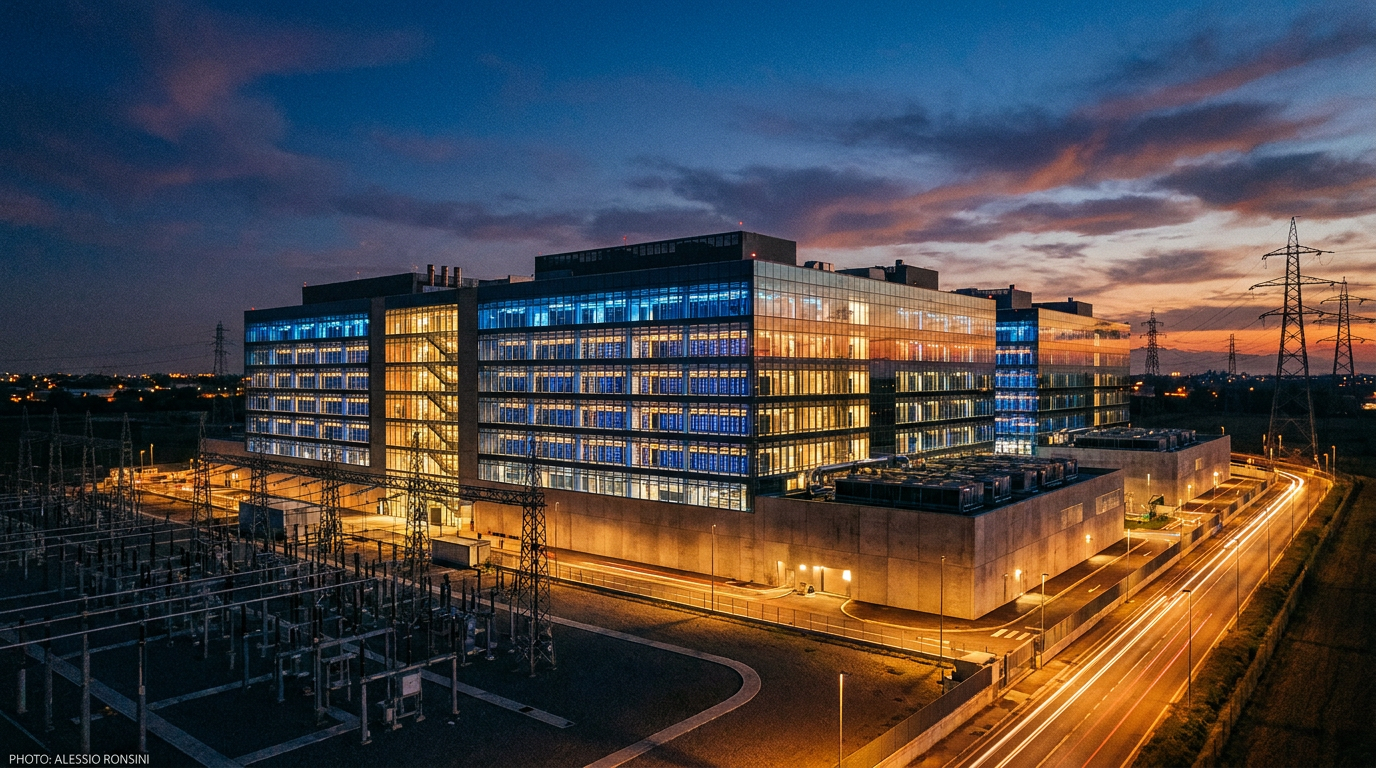
In 2026, the United States power grid is projected to cross a historic threshold: commercial electricity consumption will surpass residential use for the first time on record. This milestone, detailed in the U.S. Energy Information Administration's latest Short-Term Energy Outlook, marks a fundamental shift in how the nation draws its power. The primary driver behind this unprecedented surge is the explosive growth of artificial intelligence and the massive hyperscale data centers required to sustain it. As tech giants deploy increasingly complex generative models, the physical infrastructure of the internet is drawing power at a rate that is testing the limits of global electrical grids.[2][4][5]
For years, the technology industry managed a delicate balancing act. Despite the rapid digitization of the global economy, data center energy consumption remained relatively flat throughout the late 2010s and early 2020s. Hardware efficiency gains and the consolidation of smaller server rooms into massive cloud facilities effectively offset the growing workload, creating an illusion that the digital realm was largely decoupled from physical energy constraints. This decoupling allowed policymakers to focus on electrifying transportation and heavy industry without worrying about the internet's footprint. However, the sheer scale and computational intensity of modern AI architectures have shattered that paradigm, forcing a sudden reckoning for utility providers.[3][8]
The advent of generative AI has decisively broken that decoupling. The International Energy Agency's 'Electricity 2026' report projects that global data center electricity consumption could reach 1,000 terawatt-hours (TWh) this year under high-growth scenarios. To put that staggering figure into perspective, 1,000 TWh is roughly equivalent to the entire annual electricity consumption of Japan. The IEA now identifies AI-focused data centers as one of the fastest-growing sources of electricity demand globally, standing alongside electric vehicles and industrial electrification as primary drivers of grid expansion.[1][6]

Domestically, the numbers are equally stark. The EIA forecasts that total U.S. power demand will hit a record 4,271 billion kilowatt-hours in 2026, with the commercial sector absorbing the lion's share of the new load. This is not a temporary spike; the agency projects further growth into 2027, driven almost entirely by AI-hungry data centers and the broader push for electrification. For grid operators, this means planning for a future where baseload demand is permanently elevated, requiring a fundamental rethink of how capacity is forecasted and deployed across the country.[2][4]
The evidence reveals a significant shift in the nature of AI's energy footprint. During the initial boom, public attention focused heavily on the massive computational power required to train frontier models like GPT-4, which can consume as much electricity in a few months as hundreds of households use in a year. However, recent data indicates that 'inference'—the energy expended every time a user prompts an AI model to generate text, code, or images—now accounts for 80% to 90% of total AI energy consumption. As these models are integrated into search engines, productivity software, and enterprise tools, the cumulative cost of daily usage has eclipsed the initial training cost.[3][7]
The evidence reveals a significant shift in the nature of AI's energy footprint.
The disparity in energy intensity between traditional computing and AI is profound. A standard internet search consumes roughly 0.3 watt-hours of electricity, whereas a single generative AI query can require up to ten times that amount. When multiplied by billions of daily interactions across a global user base, the aggregate demand becomes a macroeconomic factor. This shift from training to inference means that AI's energy footprint is no longer a one-time capital expenditure, but a continuous, compounding operational draw on the grid.[8]

This surging demand is creating acute physical bottlenecks across the energy sector. The IEA highlights that grid interconnection queues are lengthening dramatically, and shortages of critical components like high-voltage transformers are limiting the rate at which new data centers can be brought online. In regions with high concentrations of digital infrastructure, such as Northern Virginia, the strain is already palpable. Local governments and utility providers are increasingly debating moratoria on new energy-intensive server farms to protect grid stability and ensure reliable power for residential customers.[1][3]
To bypass grid congestion and secure reliable baseload power, tech companies are aggressively exploring off-grid and alternative energy solutions. Satellite tracking data analyzed by the IEA shows a sharp rise in data center projects paired with onsite natural gas generation, a pragmatic but controversial move that complicates the industry's broader climate commitments. Simultaneously, there is a renewed push for nuclear energy. Major cloud providers are signing unprecedented power purchase agreements to secure zero-carbon, 24/7 electricity, effectively anchoring the financial viability of next-generation small modular reactors and extending the life of existing nuclear plants.[1][2][3][5]
The financial implications of this infrastructure overhaul are staggering. Goldman Sachs estimates that AI could add 200 TWh of annual electricity consumption globally by 2030, representing a 160% increase in data center power demand. Meeting this demand will require hundreds of billions of dollars in capital expenditure, not just for the data centers themselves, but for the transmission lines, substations, and generation facilities required to power them. This massive investment cycle is already reshaping the utilities sector and attracting significant attention from institutional investors.[6]

Despite these alarming top-line projections, there is transparent uncertainty regarding the long-term trajectory. The semiconductor industry is rapidly developing next-generation GPUs and specialized AI accelerators that promise significant efficiency gains, which could potentially blunt the steepness of the demand curve. Furthermore, environmental analysts caution that corporate disclosures around energy and water usage remain highly unstandardized. Without consistent reporting frameworks, it is difficult for regulators to mandate precise efficiency targets or accurately measure the net carbon impact of the AI boom, leaving a critical gap in the evidence base.[1][3][6]
Ultimately, the evidence points to a fundamental rewiring of national energy policy. The Department of Energy acknowledges that while AI poses a formidable grid challenge, advanced computing is also essential for optimizing future smart grids, discovering new battery chemistries, and accelerating the transition to renewable energy. Policymakers are now forced to navigate a complex trade-off. They must balance the strategic and economic imperative of leading the global AI race with the physical reality of a strained electrical grid, ensuring that the infrastructure of the future does not compromise the reliability of the present.[3][8]
How we got here
2020–2022
Data center energy use remains relatively flat due to hardware efficiency improvements despite growing digital demand.
Late 2022
The launch of generative AI triggers a massive arms race in model training, spiking demand for high-power GPUs.
2024
AI inference surpasses training as the primary driver of energy consumption as models are integrated into everyday software.
Early 2026
The IEA and EIA report that commercial electricity demand, driven by data centers, is set to outpace residential demand in the U.S. for the first time.
Viewpoints in depth
Grid Operators & Regulators
Focused on maintaining grid reliability and managing the physical bottlenecks of new data center interconnections.
For utility providers and federal energy regulators, the AI boom presents an immediate physical crisis. Their primary concern is the mismatch between the rapid deployment of AI hardware and the much slower pace of grid modernization. They point to lengthening interconnection queues and severe shortages of high-voltage transformers as evidence that the grid cannot simply absorb exponential growth. Their proposed solutions often involve localized moratoria on new data centers or requiring tech companies to bring their own power generation to the table.
Tech & Cloud Providers
Focused on scaling AI infrastructure while investing heavily in next-generation efficiency and alternative baseload power.
The hyperscalers argue that while the top-line energy figures are large, they are actively managing the footprint through unprecedented investments in efficiency. They emphasize that next-generation GPUs are exponentially more power-efficient per calculation than their predecessors. Furthermore, they highlight their role as the world's largest corporate buyers of renewable energy, arguing that their massive capital expenditures are actually accelerating the deployment of advanced nuclear and geothermal technologies that will ultimately benefit the entire grid.
Environmental Analysts
Focused on the net carbon impact, water usage, and the need for standardized corporate sustainability disclosures.
Environmental researchers remain deeply skeptical of the tech industry's 'green AI' claims. They argue that efficiency gains are consistently outpaced by the sheer volume of AI inference workloads—a phenomenon known as Jevons paradox. This camp points to the recent spike in data centers relying on onsite natural gas generation as proof that climate commitments are being compromised for the sake of the AI arms race. They are urgently calling for standardized, mandatory disclosures of both energy and water usage to accurately measure the industry's true ecological footprint.
What we don't know
- Whether next-generation AI chips will improve efficiency fast enough to offset the exponential growth in user queries.
- The exact water consumption footprint of these new data centers, as corporate disclosures remain largely unstandardized.
- How quickly new nuclear and geothermal baseload power can actually be brought online to replace interim natural gas solutions.
Key terms
- Inference
- The process of a trained AI model generating a response or prediction based on user input, which now accounts for the majority of AI's energy use.
- Terawatt-hour (TWh)
- A massive unit of energy equal to one billion kilowatt-hours, typically used to measure the annual electricity consumption of entire countries.
- Hyperscaler
- Large cloud service providers that operate massive, highly scalable data centers to support global computing workloads.
- Baseload Power
- The minimum level of electricity demand on a grid over a period of time, requiring power sources that can generate electricity consistently 24/7.
Frequently asked
Why does AI use so much more energy than regular computing?
AI requires specialized processors (GPUs) that draw significantly more power to perform complex mathematical calculations, both during the initial training phase and every time the model generates a response.
Will the AI boom cause power outages?
While widespread national blackouts are unlikely, grid operators warn that localized strain in data center hubs could lead to reliability issues if infrastructure upgrades do not keep pace with demand.
Are tech companies using renewable energy for AI?
Yes, major cloud providers are the largest corporate buyers of renewable energy, but the sheer volume of 24/7 power required is forcing some to explore onsite natural gas and nuclear power.
Sources
Source coverage
8 outlets
4 viewpoints surfaced








[1]International Energy Agency (IEA)Grid Operators & Regulators
Electricity 2026 – Analysis and Forecasts to 2030
Read on International Energy Agency (IEA) →[2]U.S. Energy Information Administration (EIA)Grid Operators & Regulators
Short-Term Energy Outlook: US power use to beat record highs in 2026
Read on U.S. Energy Information Administration (EIA) →[3]Brookings InstitutionEnvironmental Analysts
Global energy demands within the AI regulatory landscape
Read on Brookings Institution →[4]ReutersFinancial Analysts
US power use to beat record highs in 2026 and 2027 as AI use surges, EIA says
Read on Reuters →[5]Enlit WorldEnvironmental Analysts
AI and data centre electricity use continue to surge, IEA finds
Read on Enlit World →[6]Goldman SachsFinancial Analysts
AI is poised to drive 160% increase in data center power demand
Read on Goldman Sachs →[7]MIT Technology ReviewTech & Cloud Providers
The hidden energy cost of AI inference
Read on MIT Technology Review →[8]Department of Energy (DOE)Grid Operators & Regulators
Artificial Intelligence and Energy Infrastructure
Read on Department of Energy (DOE) →

More in ai
See all 7 stories →Edge AI
How On-Device AI and Quantization Are Moving LLMs Out of the Cloud
6 sources

Agentic AI
Agentic AI: How Large Action Models Are Automating Digital Chores
7 sources
Global AI Governance
EU Delays Key AI Act Enforcement as 'Brussels Effect' Fractures Under US Deregulation
8 sources

Drug Discovery
New AI Model Accelerates Molecular Simulations 10,000-Fold, Promising Faster Drug Discovery
6 sources

Every angle. Every day.
Get ai stories with full source coverage and perspective breakdowns delivered to your inbox.