
The Evidence Behind 'Missing Middle' Zoning Reforms and Housing Costs
A growing body of empirical data from Minneapolis, Austin, and Auckland demonstrates that eliminating single-family zoning successfully increases housing supply and curbs rent growth.
By Factlen Editorial Team
- Market Economists
- Argue that housing is subject to the laws of supply and demand, and that restrictive zoning is the primary driver of the affordability crisis.
- Pro-Density Advocates
- Support upzoning not just for affordability, but to create walkable, environmentally sustainable neighborhoods with a diversity of housing types.
- Local Control Advocates
- Express concern that upzoning strains local infrastructure, alters neighborhood character, and primarily enriches developers without guaranteeing affordable units.
What's not represented
- · Low-income renters facing immediate localized displacement
- · Municipal infrastructure planners managing increased density
Why this matters
For decades, the assumption that housing must inevitably become more expensive has driven young adults out of major cities and fueled a nationwide affordability crisis. New data proves that municipal policy choices—specifically, legalizing denser housing—can reverse this trend and make cities affordable again.
Key points
- Minneapolis increased its housing stock by 12% and kept rent growth to just 1% over five years.
- Auckland's 2016 upzoning directly resulted in 22,000 new homes being consented, significantly curbing rent increases.
- Austin added 120,000 housing units over nine years, causing median rents to fall by over $250.
- Austin's HOME Initiative has produced new units priced 53% lower than traditional single-family new builds.
- Economic data confirms that adding market-rate supply relieves price pressure on older, lower-cost apartments.
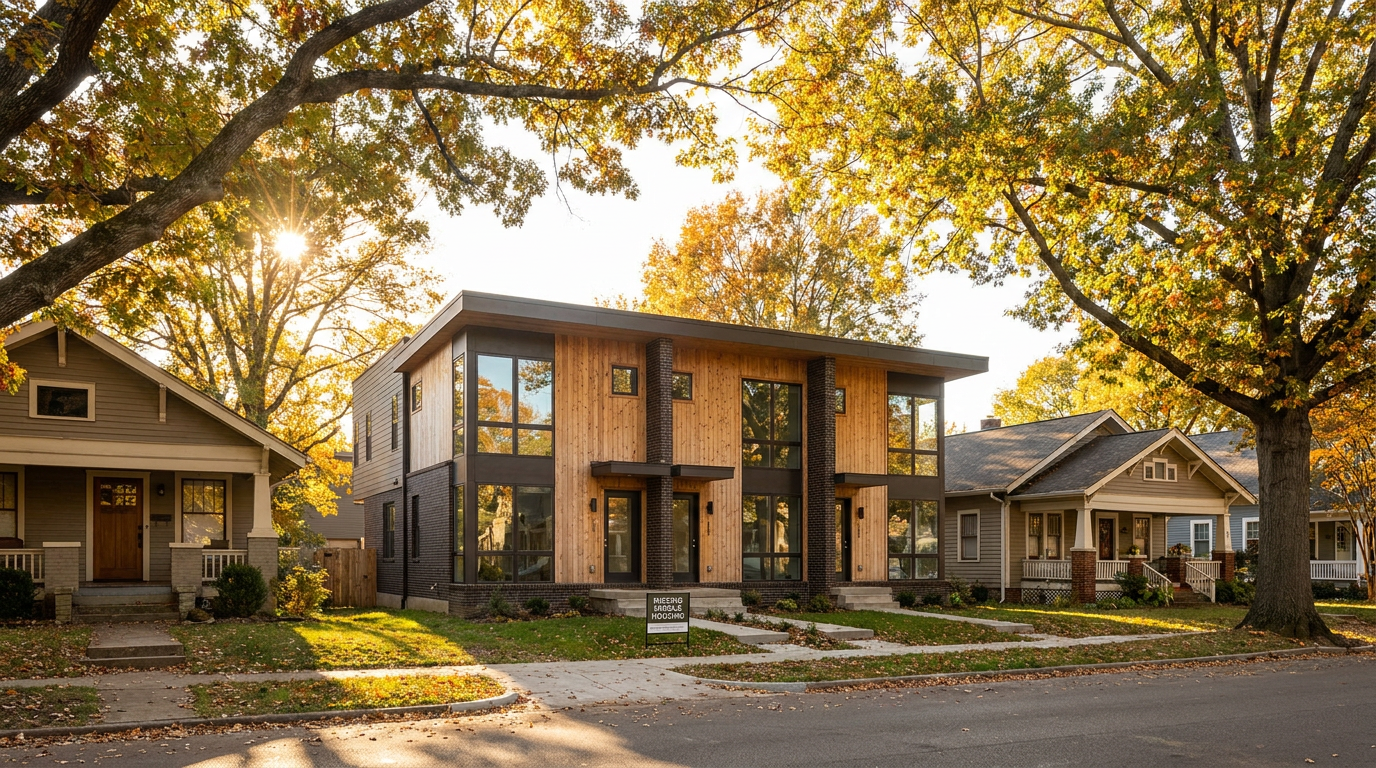
For decades, the American housing market has operated under a strict regulatory paradigm: single-family zoning. By legally mandating that only one detached house could be built on a given plot of land, cities artificially constrained their housing supply, driving up costs as populations grew. Recently, however, cities like Minneapolis, Austin, and Auckland, New Zealand, have conducted massive natural experiments by dismantling these rules to allow "missing middle" housing—duplexes, triplexes, and small apartment buildings.[7]
The central claim of housing economists is that relaxing land-use regulations directly and causally increases housing supply. The empirical evidence for this mechanism is now highly robust. In Auckland, which upzoned 75 percent of its residential land in 2016 through the Auckland Unitary Plan, researchers have isolated the policy's direct impact.[3][4][7]
A University of Auckland study found that 22,000 new homes consented between 2016 and 2021 were a direct result of the upzoning policy. This represents a 50 percent increase in dwellings consented compared to a counterfactual scenario without the unitary plan, providing strong causal evidence that zoning is a primary bottleneck to construction.[3]
The second major claim is that this localized surge in supply successfully curbs rent growth, protecting tenants from displacement. Data analyzed by the Pew Charitable Trusts provides high-confidence evidence supporting this outcome in the American Midwest.[1]
Between 2017 and 2022, Minneapolis increased its housing stock by 12 percent, while rents grew by just 1 percent. In stark contrast, the rest of Minnesota added only 4 percent to its housing stock over the same period and saw rents climb by 14 percent, despite both areas experiencing similar population growth.[1]

A 2025 peer-reviewed working paper from the Global Labor Organization utilized a synthetic control approach to further isolate the impact of the Minneapolis 2040 Plan. By comparing Minneapolis to a weighted average of 83 similar "donor" cities that did not reform their zoning, researchers could track the exact divergence in costs.[2]
The researchers found that five years post-implementation, Minneapolis rents were 17.5 to 34 percent lower than the counterfactual synthetic city. This statistically significant divergence began widening sharply in 2021, shortly after the zoning changes officially took effect, suggesting a strong causal link between the policy and the stabilization of living costs.[2]
The researchers found that five years post-implementation, Minneapolis rents were 17.5 to 34 percent lower than the counterfactual synthetic city.
The third claim is that aggressive supply expansion can actually reverse rent growth entirely, not just slow its ascent. Austin, Texas, serves as the primary case study for this phenomenon, having instituted an array of policy reforms starting in 2015 to encourage new development.[5]
From 2015 to 2024, Austin added 120,000 units to its housing stock—a staggering 30 percent increase that outpaced the national growth rate by more than three times. Consequently, Austin's median rent fell from a near-record peak of $1,546 in late 2021 to $1,296 by early 2026.[5]

Crucially, this rent deflation occurred even as the city's population continued to grow by tens of thousands of residents. In older, non-luxury buildings that cater to lower-income renters, rents declined by roughly 11 percent, demonstrating that adding market-rate supply relieves pressure on the lower end of the market.[5]
Furthermore, Austin's recent HOME Initiative, which allows up to three units on a single lot, has yielded early evidence that "missing middle" typologies offer significantly cheaper entry points for prospective homebuyers.[6]
According to the Austin Board of Realtors, the median sales price of a newly constructed HOME unit is $750,000. While still expensive, this represents a 53 percent decrease compared to the $1.58 million median price for a traditional single-family new construction home built in the same year.[6]

However, the evidence pack contains areas of uncertainty, particularly regarding the immediate impact on underlying land values and the potential for localized, parcel-level displacement.[7]
While upzoning lowers the cost of the final dwelling by dividing expensive land costs among multiple units, economic models suggest the policy can immediately increase the speculative value of underdeveloped land parcels, as developers price in the potential for denser construction.[4][7]
Additionally, the synthetic control study on Minneapolis noted an unexpected mechanism: the observed price reductions did not immediately correlate with a massive spike in physical supply, but rather stemmed partially from a softening of housing demand, likely driven by altered market expectations that housing would no longer be a scarce, rapidly appreciating asset.[2]
How we got here
2016
Auckland implements the Unitary Plan, upzoning roughly 75% of its residential land.
2018
Minneapolis passes the 2040 Plan, becoming the first major U.S. city to eliminate single-family zoning.
2021
Austin's median rent peaks at $1,546 amid a massive population influx.
2024
Austin finalizes the HOME Initiative, allowing up to three units on single-family lots to spur 'missing middle' development.
Viewpoints in depth
Market Economists
Focus on the empirical relationship between housing supply elasticity and price stabilization.
This camp relies heavily on synthetic control studies and long-term data sets to argue that housing behaves like any other market: when supply is artificially restricted by zoning laws, prices rise. They point to the data from Auckland and Minneapolis as definitive proof that legalizing density directly results in more construction, which in turn absorbs demand and prevents rents from skyrocketing. For economists, the solution to the housing crisis is fundamentally deregulatory.
Pro-Density Advocates
View upzoning as a tool for social equity and environmental sustainability.
Often operating under the 'YIMBY' (Yes In My Back Yard) banner, these advocates argue that single-family zoning has historically been used to segregate neighborhoods by income and race. They champion 'missing middle' housing not just to lower median rents, but to allow younger generations and essential workers to live near job centers. Furthermore, they emphasize that denser housing reduces urban sprawl and lowers per-capita carbon emissions.
Local Control Advocates
Express skepticism that market-rate development will solve affordability without destroying neighborhood character.
This perspective argues that upzoning primarily serves the financial interests of real estate developers rather than low-income residents. They point out that new construction is almost always priced at the top of the market, and worry that upzoning incentivizes the demolition of existing, naturally affordable homes to build expensive townhouses. They also frequently cite concerns about the strain that sudden density places on local infrastructure, such as parking, schools, and sewage systems.
What we don't know
- Whether the immediate increase in underlying land values caused by upzoning offsets the affordability gains of denser construction in the long run.
- The exact rate at which 'filtering' occurs—how long it takes for new luxury construction to make older housing affordable for low-income earners.
- How much of the rent stabilization in these cities is due to physical supply increases versus a psychological shift in market expectations.
Key terms
- Upzoning
- The process of changing local zoning codes to allow for denser, taller, or more varied types of real estate development on a given parcel of land.
- Synthetic Control Method
- A statistical technique used to evaluate policy effects by constructing a weighted combination of unaffected control groups to simulate what would have happened without the policy.
- Counterfactual
- An estimated scenario of what would have occurred in a specific location if a certain policy or event had not taken place.
- Filtering
- The economic process where older housing becomes more affordable as wealthier residents move into newly constructed, higher-priced units.
Frequently asked
What is 'missing middle' housing?
It refers to multi-unit housing types—like duplexes, triplexes, townhomes, and courtyard apartments—that fall between detached single-family homes and large mid-rise apartment buildings.
Did rents actually go down in Austin?
Yes. Following a 30% increase in the city's housing stock, Austin's median rent fell from $1,546 in late 2021 to $1,296 by early 2026.
Does building luxury apartments help lower-income renters?
Evidence suggests it does. By absorbing the demand of higher-income residents, new market-rate construction relieves price pressure on older, more affordable buildings, a process known as 'filtering'.
What was the Minneapolis 2040 Plan?
It was a comprehensive land-use reform passed in 2018 that made Minneapolis the first major U.S. city to eliminate single-family zoning citywide, allowing up to three units on any residential lot.
Sources
Source coverage
7 outlets
3 viewpoints surfaced






[1]Pew Charitable TrustsMarket Economists
Minneapolis' Land Use Reforms Offer a Blueprint for Housing Affordability
Read on Pew Charitable Trusts →[2]Global Labor OrganizationMarket Economists
Zoning Reforms and Housing Affordability: Evidence from the Minneapolis 2040 Plan
Read on Global Labor Organization →[3]Auckland CouncilMarket Economists
Auckland Economic Quarterly: The impact of the Auckland Unitary Plan
Read on Auckland Council →[4]Royal Society Te ApārangiMarket Economists
Evaluating the impact of Auckland's upzoning reforms
Read on Royal Society Te Apārangi →Austin's Housing Supply Reforms Reverse Rent Growth
Read on Pew Charitable Trusts →[6]KVUEPro-Density Advocates
Austin Board of Realtors report shows impact of HOME Initiative
Read on KVUE →[7]Factlen Editorial TeamPro-Density Advocates
Synthesis by Factlen editorial team
Read on Factlen Editorial Team →
Every angle. Every day.
Get real estate stories with full source coverage and perspective breakdowns delivered to your inbox.