
The Engineering Behind Gaming's Accessibility Revolution
From spatial audio systems that allow blind players to win races to highly modular controllers, the video game industry is treating accessibility as a core design pillar rather than an afterthought.
By Factlen Editorial Team
- Disabled Gamers & Reviewers
- Focus on the practical usability of the tools, celebrating software wins while critiquing physical hardware limitations.
- Accessibility Advocates
- Focus on breaking barriers and pushing industry standards to provide equal challenges for all players.
- Industry Developers
- Focus on integrating accessibility into the core development pipeline rather than as a post-launch afterthought.
What's not represented
- · Independent hardware modders who create custom 3D-printed solutions for specific disabilities.
Why this matters
For decades, millions of players with motor or visual disabilities were locked out of modern video games due to rigid hardware and visual-only cues. The recent wave of modular controllers and spatial-audio navigation systems is granting unprecedented independence, allowing disabled players to experience the exact same challenges and triumphs as anyone else.
Key points
- The PlayStation Access Controller allows extensive physical and software customization for players with motor disabilities.
- Players can map single buttons to act as sustained toggles or multi-button macros.
- Forza Motorsport's Blind Drive Assist uses spatial audio to guide blind players around race tracks.
- The audio system provides real-time cues for steering, braking, and corner apexes.
- Accessibility advocates emphasize that these tools provide equal challenge, not simplified gameplay.
For the vast majority of its history, the video game industry treated accessibility as an afterthought—a post-launch patch to add subtitles or a rudimentary colorblind filter. But over the last few years, a quiet revolution has fundamentally changed how games are engineered. Driven by a combination of dedicated hardware and deeply integrated software, developers are proving that complex, high-speed gaming can be made accessible to players with severe motor and visual disabilities.
This shift is best understood by looking at two distinct engineering breakthroughs that tackle different barriers: Sony’s highly modular PlayStation Access Controller, which addresses physical mobility, and Turn 10 Studios’ Blind Drive Assist in Forza Motorsport, which translates high-speed visual information into a complex auditory language.[1][3]
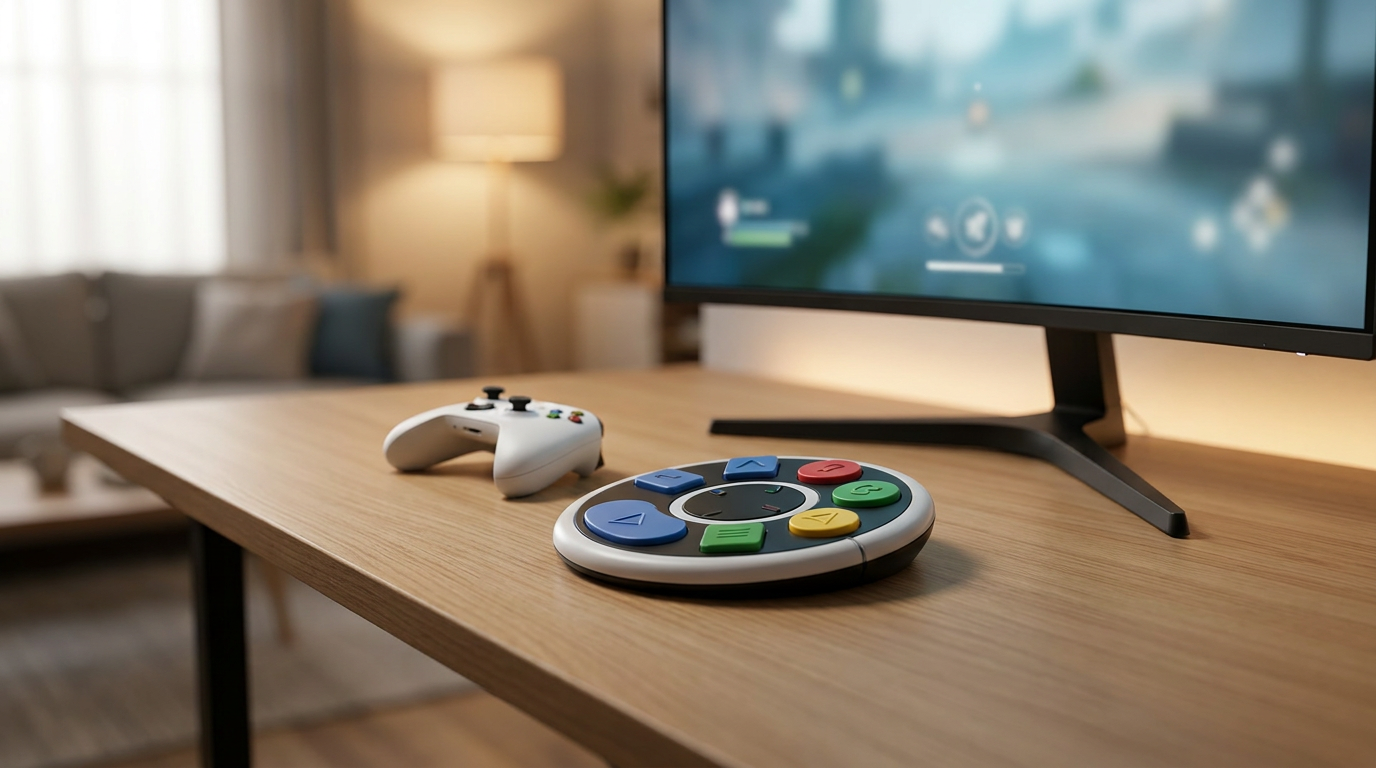
On the hardware front, the PlayStation Access Controller represents a major leap in out-of-the-box usability. Unlike traditional gamepads that require players to hold a device and operate twin thumbsticks simultaneously, the Access Controller is a circular, flat-laying device designed to be highly customizable. Players can swap out button caps for different shapes—such as flat, curved, or overhanging caps—to suit their specific motor capabilities.[3][4]
The true power of the Access Controller, however, lies in its software integration. Players can map any input to the device's buttons, but more importantly, they can fundamentally change how those buttons behave. A button can be set to act as a "toggle" for actions that normally require a sustained hold—like aiming a bow or accelerating a car—which is a massive relief for players with limited stamina. The system also allows a single button to execute a two-button macro, simplifying complex fighting game combos or context-specific actions.[5][8]

Furthermore, the PlayStation 5 allows players to pair up to two Access Controllers and one standard DualSense controller simultaneously. This "copilot" style setup means a player can transplant the controls they struggle with onto the Access Controller while continuing to use the standard gamepad for the inputs they can comfortably reach.[4][5]
However, the Access Controller also highlights a fundamental truth of inclusive design: accessibility is never one-size-fits-all. While the software is universally praised, the physical design presents hurdles for certain users. Reviewers with atrophied hands or limited reach have noted that the controller's circular shape makes it impossible to access all nine buttons without moving their entire arm. Additionally, the physical force required to press the profile-switching button can be too high for some, inadvertently forcing players to rely on a companion to change settings.[3][8]
However, the Access Controller also highlights a fundamental truth of inclusive design: accessibility is never one-size-fits-all.
While hardware engineers work to solve physical barriers, software developers are tackling sensory ones. Racing simulators are notoriously reliant on visual precision—judging the apex of a turn, monitoring track limits, and reading braking lines. To make this accessible to blind and low-vision players, Turn 10 Studios spent two years developing Blind Drive Assist (BDA) for Forza Motorsport.[1][6]
Instead of simply steering the car for the player, BDA acts as a highly sophisticated sonar system. It provides a constant stream of spatial audio cues that tell the player exactly where their car is on the track. A steering guide pans the sound of the car's engine and tires to the left or right ear, indicating which direction the player needs to turn to stay centered.[1][7]
This is layered with additional auditory information. Distinct beeps and tones indicate when a player is approaching a turn, when they have reached the apex, and when they are exiting. Another set of cues acts as an audio version of the traditional racing line, signaling exactly when to brake and when to accelerate. A voiceover, similar to a rally co-driver, announces the severity and direction of upcoming corners.[2][7]

The system was built by integrating accessibility consultants, like blind gamer Brandon Cole, directly into the development pipeline from day one, rather than bringing them in at the end of the project. This allowed the audio team to iterate on the feedback in real-time, ensuring the cues were distinct enough to be heard over the roar of a simulated V8 engine.[1][7]
Learning to use BDA is not easy. Players have described their first few laps as a "cacophony of sound." Users must meticulously adjust the pitch and volume of each individual cue—turning down engine noise and amplifying braking tones—to create a soundscape their brain can parse at 150 miles per hour. It requires immense concentration and a willingness to learn the track entirely by ear.[2][7]
But the results are undeniable. Once the learning curve is conquered, blind players are able to navigate complex tracks independently, passing AI opponents and winning races. As accessibility advocate Steve Saylor noted after securing a first-place finish using the system, the feature doesn't make the game easier; it simply provides disabled players with the right tools to face the exact same challenge as everyone else.[2][7]

These advancements represent a maturation of the medium. By proving that even the most visually and physically demanding genres can be adapted without compromising their core challenge, developers are setting a new baseline. The goal is no longer just to let disabled players watch a game unfold, but to hand them the keys and let them drive.[1][6]
How we got here
2018
Microsoft launches the Xbox Adaptive Controller, pioneering first-party accessible hardware.
2021
Forza Horizon 5 introduces on-screen sign language and game-speed modifiers, winning multiple accessibility awards.
April 2023
Turn 10 Studios unveils Blind Drive Assist for Forza Motorsport, developed alongside blind gamers.
December 2023
Sony releases the PlayStation Access Controller, offering a highly modular, circular gamepad for PS5.
Viewpoints in depth
Disabled Gamers & Reviewers
Celebrate the software freedom while highlighting remaining physical hardware barriers.
For players with motor disabilities, the ability to remap buttons, create toggles, and pair multiple devices is life-changing. However, reviewers with specific conditions—such as atrophied hands or limited reach—point out that circular hardware designs can still be physically exhausting. The force required to press certain profile-switching buttons often means players still have to rely on a companion to set up their game, showing that physical ergonomics remain a difficult puzzle to solve universally.
Accessibility Advocates
Focus on the philosophy of equal challenge rather than simplified gameplay.
Consultants and advocates stress that true accessibility does not mean making a game inherently easier or playing it for the user. Features like Forza's Blind Drive Assist are praised precisely because they have a steep learning curve. By providing the right auditory tools, developers allow blind players to experience the genuine challenge of learning a track, managing braking zones, and earning a victory on their own merits.
Industry Developers
Emphasize the necessity of integrating accessibility from the very beginning of development.
Hardware engineers and software developers advocate for moving away from post-launch accessibility patches. By integrating disabled consultants directly into the core development pipeline—as Turn 10 Studios did with their audio team—studios can build foundational systems that interact with the game's physics and engine in real-time, rather than just overlaying a filter at the end of production.
What we don't know
- How quickly third-party developers will adopt and standardize these complex audio-assist features in their own games.
- Whether future iterations of accessible hardware will offer lighter button-actuation force for players with muscle atrophy.
Key terms
- Blind Drive Assist (BDA)
- A feature set in Forza Motorsport that uses spatial audio cues and pitch changes to help blind and low-vision players navigate a race track.
- Spatial Audio
- Sound design that manipulates audio to make it seem like it is coming from a specific 3D location, used to guide players left or right.
- Macro
- A software feature that allows a single button press to execute a sequence of multiple button inputs simultaneously.
- Toggle Functionality
- An accessibility setting that changes an action requiring a sustained button hold into a simple on/off switch.
- Copilot Mode
- A system feature that allows two separate controllers to act as a single input device, letting players split controls across different hardware.
Frequently asked
Does the PlayStation Access Controller work on PC?
The Access Controller was designed specifically for the PlayStation 5 console, unlike the Xbox Adaptive Controller which features native PC support.
How do blind players know when to turn in Forza?
The game uses spatial audio panning, shifting the sound of the car's engine and tires to the left or right ear to indicate which direction the player needs to steer.
Can the Access Controller be used with a regular gamepad?
Yes, players can pair up to two Access Controllers and one standard DualSense controller simultaneously to create a customized control scheme.
Sources
Source coverage
8 outlets
3 viewpoints surfaced








[1]Xbox WireIndustry Developers
Forza Motorsport Accessibility Features: Blind Driving Assists
Read on Xbox Wire →[2]Video Games ChronicleAccessibility Advocates
A legally blind player has released a video explaining Forza Motorsport’s new Blind Drive Assist feature
Read on Video Games Chronicle →[3]IGNDisabled Gamers & Reviewers
PlayStation Access Controller Review
Read on IGN →[4]TechRadarDisabled Gamers & Reviewers
PlayStation Access controller review: an accessible gamepad that opens up new ways to play
Read on TechRadar →[5]Access-AbilityDisabled Gamers & Reviewers
PS5 Access Controller Review
Read on Access-Ability →[6]Centre For Accessibility AustraliaIndustry Developers
Forza Motorsport Drives Innovation with Accessibility Features
Read on Centre For Accessibility Australia →[7]KotakuAccessibility Advocates
Forza Motorsport's Blind Drive Assist Is A Breakthrough For Gaming Accessibility
Read on Kotaku →[8]Phenixx GamingDisabled Gamers & Reviewers
PlayStation Access Controller Review
Read on Phenixx Gaming →
Every angle. Every day.
Get gaming esports stories with full source coverage and perspective breakdowns delivered to your inbox.