
The End of the 'Final 5': How the WSL's 2026 Format is Reshaping the Championship Tour Race
The World Surf League has abandoned its one-day playoff in favor of a season-long points race, culminating in a high-stakes finale at Pipeline that heavily favors big-wave specialists.

Share this story
The 2026 World Surf League (WSL) Championship Tour has crossed its midpoint, and the race for the world title looks fundamentally different than it has in half a decade. As the world's elite wave riders pack up their boards following the Saquarema event in Brazil, the strategic calculus for the back half of the season is coming into sharp focus. The standings are no longer just about surviving a mid-year cut; they are about positioning for a grueling marathon that will test every facet of a surfer's repertoire.[4]
For the past several years, the WSL utilized the controversial "Final 5" format, which saw the top five men and women at the end of the regular season compete in a one-day, winner-take-all shootout at Lower Trestles in California. While that system generated guaranteed final-day drama for broadcasters, it frequently drew the ire of surfing purists who felt it undermined the integrity of a season-long points race.
A surfer could dominate the entire year, only to lose the world title in a single 40-minute heat in small, rippable waves. That era is officially over, and the athletes are adjusting to a reality where every single heat across the globe matters deeply to their final ranking.[4]
In a massive shakeup designed to coincide with the 50th year of professional surfing, the WSL has returned to a season-long points accumulation system, fundamentally altering how athletes approach the standings. The champion will no longer be the surfer who peaks on a single day in Southern California, but rather the one who demonstrates the most consistency across a grueling 12-event global marathon. This shift rewards versatility, requiring competitors to excel in everything from the high-performance beach breaks of Brazil to the terrifying reef passes of the South Pacific.[2]
The structural changes to the 2026 tour are sweeping and have completely rewritten the playbook for how surfers manage their seasons. The traditional mid-year cut, which ruthlessly sliced the field in half after just five events and often sent struggling rookies back to the Challenger Series before they could find their footing, has been eliminated.
Instead, all 36 men and 24 women are guaranteed entry into the first nine events of the season. This provides a much longer runway for slow starters to find their rhythm, accumulate points, and mount a comeback if they suffer early setbacks.
The first nine stops of the year—which began in the iconic point breaks of Australia and recently concluded its Latin American leg with events in El Salvador and Brazil—serve as the "regular season" for the tour. Under the new rules, surfers will count their best seven results from these nine events, allowing them to discard their two lowest scores. This safety net is absolutely crucial for athletes who suffer early-season injuries, equipment failures, or uncharacteristic early-round exits, ensuring that a single bad heat doesn't permanently derail a world title campaign.[2]
Following the ninth stop of the season at Lower Trestles in September, the field will face a delayed, but equally brutal, reduction. Only the top 24 men and 16 women on the standings leaderboard will advance to the newly minted "post-season." For those hovering around the cutline, the pressure during the late-summer events will be immense, as failing to advance means missing out on the massive points available in the final three competitions and potentially losing their spot on the Championship Tour for the following year.
This post-season consists of two highly contrasting events that will push the remaining surfers to their absolute limits: the artificial perfection of Surf Abu Dhabi in the United Arab Emirates, and the unpredictable, shifting beach breaks of Supertubos in Peniche, Portugal. These stops will test the athletes' adaptability in vastly different environments. Abu Dhabi offers a controlled, repetitive canvas for highly technical maneuvers, while Portugal demands quick wave-reading skills and the ability to navigate heavy, cold-water barrels in volatile weather conditions before the ultimate proving ground in December.[2]
The most significant change to the standings race, however, lies at the very end of the calendar. After years of crowning champions in the relatively benign waves of Southern California, the 2026 world champions will be decided at the Lexus Pipe Pro at the Banzai Pipeline in Hawai'i. This decision has been universally praised by athletes and fans alike, as it returns the sport's biggest moment to its spiritual home and ensures the title is won in waves that demand the utmost respect and courage.[1]
Pipeline is widely considered the most dangerous and iconic wave on the planet, a shallow, razor-sharp reef break that demands absolute commitment, flawless technique, and an intimate understanding of ocean dynamics. By moving the finale to Pipeline, the WSL has ensured that the ultimate prize will be decided in heavy, consequential surf. A surfer cannot simply finesse their way to a world title; they must be willing to throw themselves over the ledge into cavernous, spitting barrels with the entire surfing world watching.[3]
To raise the stakes even further and ensure maximum drama on the final day of the season, the Pipeline finale is worth 15,000 points to the winner—a massive 1.5x multiplier compared to the 10,000 points awarded at a standard Championship Tour event. This massive point swing means that no lead on the standings leaderboard is truly safe heading into December. A surfer sitting in third or fourth place could completely upend the final rankings with a deep run at Pipeline, making the event a true grand finale.[4]
This format shift has profound implications for the current standings and the types of surfers who are heavily favored to win. The previous Final 5 format at Trestles heavily favored high-performance, small-wave specialists who excelled at progressive aerial maneuvers and rapid-fire combinations. The 2026 schedule, by contrast, is a gauntlet of heavy water that heavily penalizes surfers who are uncomfortable in large, hollow waves. The race now favors the brave, the experienced, and those who have spent years mastering the art of barrel riding.[4]
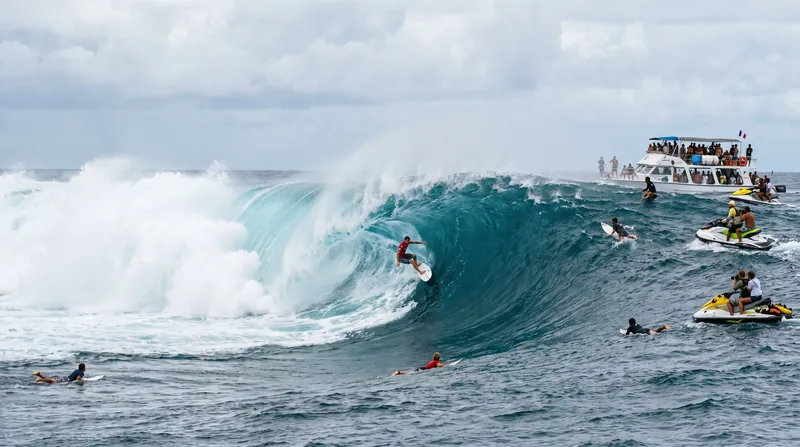
With upcoming stops at the hollow reef passes of Teahupo'o in Tahiti and Cloudbreak in Fiji, followed by the Pipeline finale, the back half of the season is a dream scenario for heavy-water specialists. These waves require a completely different skill set than the beach breaks of the early season. Surfers must know how to properly position themselves in the lineup, paddle into massive walls of water, and navigate the complex physics of riding inside the tube, all while managing the inherent physical risks of surfing over shallow coral.[2]
On the women's side, this shift plays directly into the hands of surfers like Australia's Molly Picklum and Brazil's Tatiana Weston-Webb, both of whom are currently surging in the standings. Picklum has built a reputation for charging harder than almost anyone on tour, blending raw Australian power with a fearlessness in heavy reef passes that allows her to drop massive scores when the waves get serious. Weston-Webb, an Olympic medalist, possesses a sharp, vertical goofy-foot attack that is perfectly suited for the left-hand barrels of Teahupo'o and Cloudbreak.[2]
Weston-Webb, an Olympic medalist, possesses a sharp, vertical goofy-foot attack that is perfectly suited for the left-hand barrels of Teahupo'o and Cloudbreak.
For the men, the Brazilian storm remains a dominant force in the standings, but the specific names at the top of the threat list are shifting to match the venues. Gabriel Medina, a multi-time world champion and arguably the greatest competitive barrel rider in history, is perfectly positioned to capitalize on the back-half schedule. His track record of dominance at Teahupo'o, Cloudbreak, and Pipeline is virtually unmatched in the modern era, making him a terrifying prospect for anyone currently sitting above him on the leaderboard.[4]
The schedule changes that facilitate this new standings race also included some notable geographic shifts that have altered the rhythm of the tour. To maintain the 12-event format while accommodating the new post-season structure, the iconic right-hand point break of Jeffreys Bay (J-Bay) in South Africa was removed from the 2026 calendar. This decision disappointed many purists who view J-Bay as one of the best high-performance waves on Earth, but it was a necessary sacrifice to make the math of the new season work.
In its place, the tour welcomed Raglan, New Zealand, as the fourth stop of the season. The long, peeling left-hand point break of Manu Bay provided a fresh canvas for the athletes in May and added a new strategic wrinkle to the early-season standings race. The addition of New Zealand was celebrated by the athletes, offering a cold-water contrast to the tropical stops and testing their endurance on rides that can last for hundreds of meters down the rocky shoreline.
As the tour prepares to cross the Pacific for the critical Teahupo'o and Cloudbreak events in August, the pressure on the athletes is mounting exponentially. Surfers currently sitting outside the top 24 men and 16 women are running out of time to secure their spots in the post-season, knowing that a poor result in Tahiti or Fiji could spell the end of their year. Meanwhile, those at the top are jockeying for position, desperate to build a points buffer ahead of the massive 15,000-point swing waiting for them in Hawai'i.[4]
Ultimately, the 2026 season is proving to be a true marathon, demanding a wider variety of skills, endurance, and sheer nerve than any tour in recent memory. To hoist the championship trophy this December, a surfer won't just need to be the best on a single sunny day in California; they will need to survive the world's heaviest waves, outlast their peers over twelve grueling events, and conquer the ultimate test at the Banzai Pipeline. The race is wide open, and the true test has only just begun.[1]
- Traditionalists & Heavy-Water Specialists
- Celebrate the return to points accumulation and the Pipeline finale, arguing it crowns the most complete surfer rather than the best small-wave aerialist.
- Progressive & Small-Wave Surfers
- Face a steeper climb, as the removal of Lower Trestles as the finale diminishes the advantage of high-performance aerial surfing in smaller, rippable conditions.
- Tour Management & Broadcasters
- View the 12-event structure and 1.5x multiplier at Pipeline as the perfect balance of season-long stakes and a dramatic, high-viewership finale.
Sources
Source coverage
4 outlets
3 viewpoints surfaced




- [1]ReutersTour Management & Broadcasters
Pipeline back as world surf tour finale in 2026
Read on Reuters → - [2]SportsbetTour Management & Broadcasters
WSL 2026 Schedule and Dates
Read on Sportsbet → - [3]Red BullProgressive & Small-Wave Surfers
WSL 2026 schedule calendar
Read on Red Bull → - [4]Factlen Editorial TeamTour Management & Broadcasters
Synthesis by Factlen editorial team
Read on Factlen Editorial Team →
More in Sports
See all →Injury
British Surfing Phenom Lukas Skinner Eyes Challenger Series Following Extensive Injury Rehabilitation
2 sources
Standings
WSL Standings Watch: Sawyer Lindblad and Luana Silva Surge into the Top 5 as the 2026 Women's Title Race Intensifies
7 sources
Injury
WSL Injury Report: Italo Ferreira Defies Knee Laceration to Retain Yellow Jersey as Jordy Smith Sidelined
2 sources
Standings
Lakey Peterson's Resurgence Shakes Up the 2026 WSL Title Race as Traditional Points Format Returns
4 sources
Comments
Every angle. Every day.
Get Sports stories with full source coverage and perspective breakdowns, free every day.