
The Emerging Science of Psychobiotics: How Gut Microbes Shape Mental Health
Recent meta-analyses and clinical trials reveal that specific strains of gut bacteria, known as psychobiotics, can significantly influence mood, anxiety, and cognitive resilience through the gut-brain axis.
By Factlen Editorial Team
- Microbiome Researchers
- Focusing on the biochemical and neural pathways connecting gut bacteria to brain function.
- Clinical Psychiatrists
- Evaluating psychobiotics as a promising but preliminary adjunct to traditional mental health treatments.
- Nutritional Scientists
- Advocating for whole-food dietary interventions over isolated probiotic supplements.
What's not represented
- · Regulatory Agencies
- · Gastroenterologists
Why this matters
Understanding the gut-brain axis empowers individuals to actively support their mental health and cognitive resilience through accessible dietary choices, shifting the treatment paradigm for mood disorders from purely brain-centric to whole-body wellness.
Key points
- The gut-brain axis is a bidirectional communication network linking the digestive system to the central nervous system.
- Gut bacteria produce approximately 90% of the body's serotonin, alongside other crucial neurotransmitters like GABA and dopamine.
- Psychobiotics—specific strains of beneficial bacteria—have been shown to significantly reduce symptoms of major depressive disorder in clinical trials.
- Communication between the gut and brain occurs via the vagus nerve, immune system modulation, and the production of short-chain fatty acids.
- Due to high individual variability in microbiomes, experts recommend a 'food first' approach utilizing fermented foods and prebiotic fibers.
The human brain has long been treated as an isolated fortress, protected by the blood-brain barrier and operating independently of the body's digestive system. But a paradigm shift in biology is rewriting the rules of neuroscience, revealing that our emotional wellbeing is deeply intertwined with our digestive tract.[1]
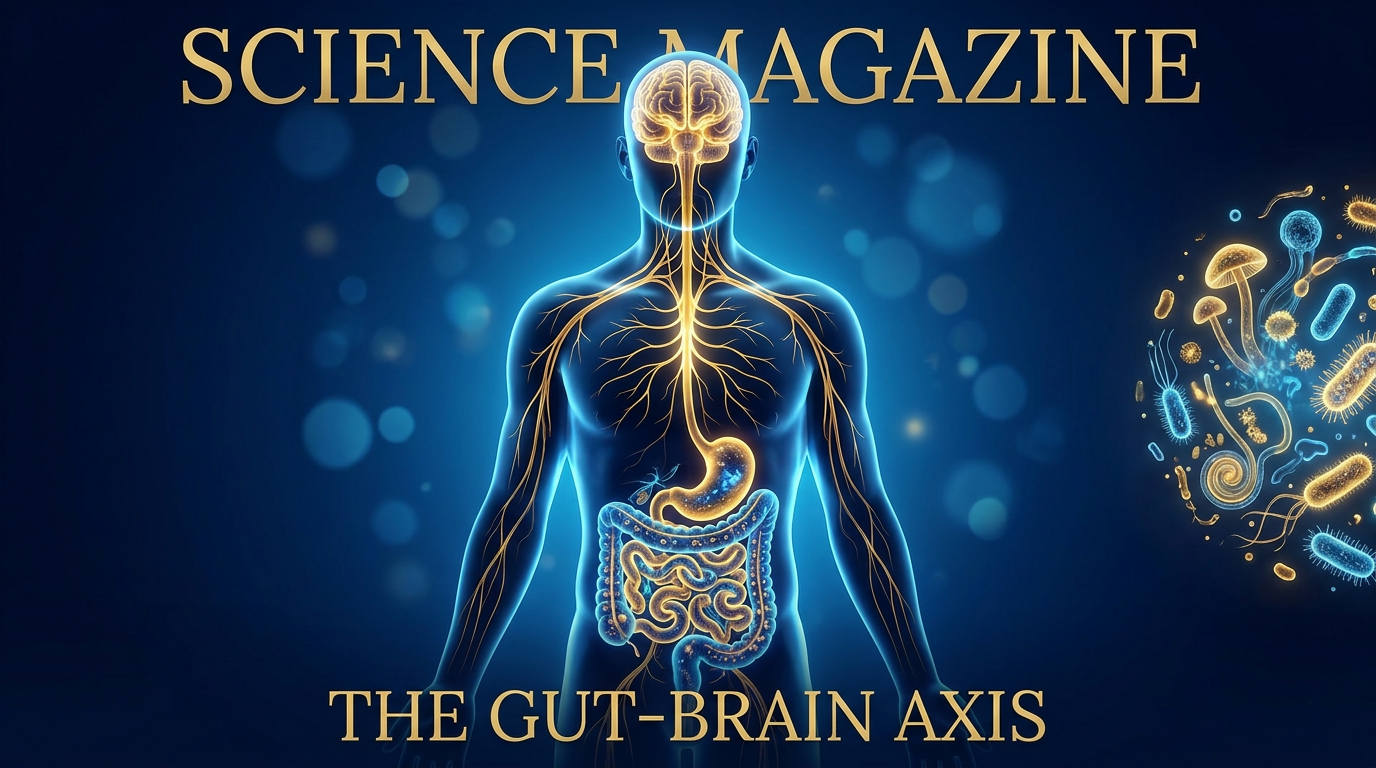
Researchers are increasingly focusing on the "gut-brain axis"—a bidirectional communication network linking the enteric nervous system of the gastrointestinal tract to the central nervous system. At the center of this network is the microbiome, a bustling ecosystem of an estimated 100 trillion bacteria, viruses, and fungi.[1][5]
This ecosystem is not merely a passive passenger; it is an active chemical factory. In fact, the gut produces approximately 90% of the body's serotonin and a significant portion of its gamma-aminobutyric acid (GABA) and dopamine—neurotransmitters fundamentally responsible for regulating mood, fear, and joy.[8]
This realization has given rise to the study of "psychobiotics." Originally coined to describe live organisms that confer mental health benefits when ingested, the term has expanded to include prebiotic fibers that feed these beneficial bacteria, creating a thriving environment for neuroactive microbes.[2]

The mechanisms driving this gut-to-brain communication are complex and multi-layered. The most direct route is the vagus nerve, a physical superhighway extending from the brainstem to the abdomen. Preclinical studies have shown that when the vagus nerve is severed in animal models, the mood-altering effects of certain gut bacteria completely disappear, proving the nerve's role as a primary conduit.[5]
Beyond direct neural signaling, gut microbes communicate via chemical messengers. When beneficial bacteria ferment dietary fibers, they produce short-chain fatty acids (SCFAs) like butyrate, propionate, and acetate. These SCFAs can cross the intestinal barrier, enter the bloodstream, and influence the blood-brain barrier's integrity while actively modulating neuroinflammation.[5][8]
A 2025 study utilizing advanced neuroimaging and metabolomics provided compelling human evidence of this chemical exchange. Researchers found that specific gut-derived metabolic pathways directly correlated with in vivo brain neurotransmitter concentrations, influencing both cognitive resilience and emotional health in healthy adults.[4]
The clinical implications for treating mood disorders are substantial. A comprehensive 2025 umbrella review of randomized controlled trials evaluated the efficacy of gut-targeted interventions on adults experiencing depressive and anxiety symptoms, seeking to quantify the real-world impact of these biological mechanisms.[3]

The clinical implications for treating mood disorders are substantial.
The meta-analysis revealed that probiotic interventions consistently provided significant benefits for major depressive disorder, yielding a standardized mean difference (SMD) reduction of −0.50 compared to controls. While the effects on anxiety were more modest and inconsistent across the broader population, specific subgroups still demonstrated measurable, statistically significant improvements.[3]
Animal models continue to shed light on how specific microbial compounds alleviate anxiety. A recent study from the Duke-NUS Medical School investigated mice raised in a germ-free environment. These mice exhibited heightened activity in the basolateral amygdala—the brain's fear center—and displayed severe anxiety-related behaviors.[6]
When researchers introduced live microbes into the germ-free mice, the amygdala activity normalized, and the anxious behaviors subsided. The team traced this calming effect to indoles, specific metabolites produced by gut bacteria that actively shape the chemical signals affecting stress responses and emotional balance.[6]
Despite these promising breakthroughs, the clinical application of psychobiotics remains fraught with complexity. The most significant hurdle is the extreme heterogeneity observed across clinical trials, with some meta-analyses reporting variance (I²) as high as 92%, indicating that results fluctuate wildly depending on the study design and population.[3]
This inconsistency stems from the highly individualized nature of the human microbiome. A probiotic strain that alleviates depression in one patient may be entirely ineffective in another whose baseline gut flora lacks the necessary synergistic bacteria to support the new strain's colonization and survival.[1]
Furthermore, psychobiotic effects are highly strain-specific. While specific strains of *Lactobacillus rhamnosus* or *Bifidobacterium longum* have demonstrated neuroactive potential in clinical trials, a generic, off-the-shelf probiotic supplement is unlikely to yield targeted psychiatric benefits without precise matching.[2]

Because of these variables, nutritional scientists increasingly advocate for a "food first" approach to microbiome modulation. Natural psychobiotic foods—such as kefir, kimchi, sauerkraut, tempeh, and kombucha—deliver diverse, live microbial cultures alongside the organic acids necessary for their survival through the digestive tract.[7]
Equally important are prebiotics—the complex carbohydrates and fibers found in whole grains, legumes, and polyphenol-rich fruits and vegetables. By feeding the endogenous beneficial bacteria already adapted to a patient's gut, dietary interventions can sustainably shift the microbial ecosystem without relying on transient probiotic supplements.[8]
As the science matures, clinical psychiatrists are beginning to view psychobiotics not as a replacement for traditional antidepressants or psychotherapy, but as a powerful adjunct treatment. By targeting peripheral pathways like systemic inflammation and oxidative stress, gut-directed therapies address biological variables that conventional psychiatric medications often miss.[1][3]
The gut-brain axis represents a profound shift in how we understand mental health, moving away from a purely brain-centric model to a holistic, whole-body perspective. As researchers continue to decode the microbial language of the gut, the prospect of treating the mind by nourishing the microbiome offers a hopeful, empowering new frontier in medicine.[1]

How we got here
2013
The term 'psychobiotics' is officially coined by researchers to describe live organisms that confer mental health benefits.
2019
Preclinical studies firmly establish the vagus nerve as a primary communication channel between gut microbes and the brain.
2022
Large-scale reviews begin linking specific gut microbiome dysbiosis to major depressive disorder and anxiety.
2025
Comprehensive meta-analyses confirm that targeted probiotic interventions significantly reduce symptoms of major depressive disorder in clinical trials.
2026
Advanced neuroimaging studies successfully map the direct influence of gut-derived metabolites on human brain neurotransmitter concentrations.
Viewpoints in depth
Microbiome Researchers
Focusing on the biochemical and neural pathways connecting gut bacteria to brain function.
This camp emphasizes the mechanistic evidence of the gut-brain axis, particularly how short-chain fatty acids (SCFAs) and vagus nerve signaling influence neuroinflammation and neurotransmitter production. They argue that decoding these specific microbial pathways is the key to developing targeted, next-generation psychobiotic therapies that can reliably alter brain chemistry and build cognitive resilience.
Clinical Psychiatrists
Evaluating psychobiotics as a promising but preliminary adjunct to traditional mental health treatments.
Psychiatrists are cautiously optimistic about the potential of gut-targeted interventions to alleviate depression and anxiety. However, they highlight the high heterogeneity in current clinical trials and the lack of standardized dosing. They advocate for using psychobiotics alongside, rather than instead of, established pharmacotherapy and psychotherapy until large-scale, rigorous human trials provide definitive clinical guidelines.
Nutritional Scientists
Advocating for whole-food dietary interventions over isolated probiotic supplements.
Rather than relying on single-strain probiotic pills, nutritional experts argue for a holistic dietary approach to microbiome health. They emphasize the consumption of fermented foods and prebiotic fibers to sustainably nourish the diverse microbial ecosystems already present in the gut, pointing out that whole foods provide a complex matrix of bioactive compounds that supplements cannot replicate.
What we don't know
- Which specific probiotic strains and dosages are universally effective for treating distinct psychiatric conditions.
- How an individual's baseline microbiome composition dictates their response to psychobiotic interventions.
- The long-term psychological effects of sustained psychobiotic supplementation over multiple years.
Key terms
- Psychobiotics
- Live bacteria or prebiotic fibers that provide mental health benefits by interacting with the nervous system.
- Gut-Brain Axis
- The bidirectional communication network linking the gastrointestinal tract and the central nervous system.
- Short-Chain Fatty Acids (SCFAs)
- Beneficial chemical byproducts produced when gut bacteria ferment dietary fiber, known to reduce inflammation and protect the blood-brain barrier.
- Vagus Nerve
- A major cranial nerve that acts as a physical superhighway transmitting signals between the gut and the brain.
- Dysbiosis
- An imbalance or reduction in the diversity of the gut microbiome, often linked to inflammation and disease.
- Neurotransmitters
- Chemical messengers, such as serotonin and dopamine, that transmit signals across nerve endings to regulate mood and cognition.
Frequently asked
What exactly are psychobiotics?
Psychobiotics are live microorganisms (probiotics) and the fibers that feed them (prebiotics) which, when ingested in adequate amounts, confer mental health benefits by interacting with the gut-brain axis.
How does bacteria in the gut affect the brain?
Gut bacteria communicate with the brain through three main channels: direct neural pathways via the vagus nerve, the production of chemical messengers like short-chain fatty acids and neurotransmitters, and the modulation of the body's immune system.
Can I just eat yogurt to improve my mood?
While fermented foods like kefir, yogurt, and kimchi support overall microbiome health, clinical psychiatric benefits are highly strain-specific. A general diet rich in prebiotics and fermented foods builds resilience, but may not treat clinical depression on its own.
Are psychobiotics a replacement for antidepressants?
No. Current medical consensus views psychobiotics as a promising adjunct (add-on) therapy to help manage symptoms and reduce neuroinflammation, but they are not currently recommended as a standalone replacement for prescribed psychiatric medications.
Sources
Source coverage
8 outlets
3 viewpoints surfaced








[1]Factlen Editorial TeamMicrobiome Researchers
Synthesis by Factlen editorial team
Read on Factlen Editorial Team →[2]Frontiers in PsychiatryClinical Psychiatrists
Psychobiotics and the Gut-Brain Axis: A Comprehensive Review of Clinical Trials
Read on Frontiers in Psychiatry →[3]National Institutes of HealthClinical Psychiatrists
Efficacy of gut microbiome-targeted interventions in improving mental health symptoms: A systematic review and meta-analysis
Read on National Institutes of Health →[4]bioRxivMicrobiome Researchers
Gut-derived metabolic influence on human brain neurotransmitter dynamics and mental wellbeing
Read on bioRxiv →[5]MDPIMicrobiome Researchers
Microbiota and the Brain: The Gut–Brain Axis Mechanisms
Read on MDPI →[6]SciTechDailyMicrobiome Researchers
A Surprising Gut-Brain Discovery Suggests Anxiety Could Be Treated With Probiotics
Read on SciTechDaily →[7]Agriculture and Food Bioactive CompoundsNutritional Scientists
Psychobiotics in Fermented Foods: Mechanisms and Cognitive Health
Read on Agriculture and Food Bioactive Compounds →[8]Vascular & Endovascular ReviewNutritional Scientists
Natural Psychobiotic Foods and Their Role in Gut–Brain Axis Modulation
Read on Vascular & Endovascular Review →
Every angle. Every day.
Get science stories with full source coverage and perspective breakdowns delivered to your inbox.