
The Digital Co-Pilot: How Radar and AI Are Revolutionizing Motorcycle Safety
Advanced Rider Assistance Systems (ARAS) are bringing adaptive cruise control, blind-spot detection, and emergency braking to motorcycles, promising to drastically reduce accidents without diluting the thrill of the ride.

In short
- Next-generation radar systems are bringing adaptive cruise control and emergency braking to motorcycles.
- The technology uses an Inertial Measurement Unit to account for the bike's lean angle during cornering.
- Emergency Brake Assist adds hydraulic pressure if a rider's braking input is insufficient to avoid a crash.
For over a century, riding a motorcycle has been an exercise in raw, unfiltered vulnerability. The thrill of being exposed to the elements comes with the stark reality that the rider is the sole processor of every hazard on the road. But the motorcycle is quietly getting a digital co-pilot. After years of development, the two-wheeled world is crossing a critical threshold in active safety, moving beyond simple anti-lock brakes into the realm of predictive, environment-aware intelligence.[4]
The years 2025 and 2026 mark the mainstream arrival of Advanced Rider Assistance Systems (ARAS). While the automotive industry has enjoyed radar-based cruise control and automatic braking for over a decade, miniaturizing and adapting these systems for the dynamic, leaning environment of a motorcycle has proven immensely complex. Now, a new generation of sensors is rolling off production lines, promising to drastically reduce the most common types of multi-vehicle motorcycle collisions without diluting the fundamental joy of riding.[3]
At the forefront of this shift is Bosch’s sixth-generation radar technology, which recently made its production debut on flagship adventure bikes like the KTM 1390 Super Adventure S EVO. This system utilizes compact radar emitters mounted at both the front and rear of the motorcycle, creating a 360-degree digital safety net. By continuously scanning the environment up to 160 meters ahead, the bike's central computer can anticipate traffic flow, track surrounding vehicles, and intervene when human reaction times fall short.[2]
Adapting radar for motorcycles presented a unique physics problem. In a passenger car, the radar unit remains relatively parallel to the horizon at all times. On a motorcycle, the vehicle leans deeply into corners. Early prototypes struggled with this dynamic, as a heavily leaned motorcycle would point its forward radar directly into the asphalt, causing the system to mistakenly identify the road surface as an impending brick wall. Solving this required teaching the radar to understand the bike's exact orientation in three-dimensional space.
The breakthrough came by pairing the radar sensors with a highly advanced Inertial Measurement Unit (IMU). Often described as the motorcycle's inner ear, the IMU measures the bike's pitch, roll, and yaw acceleration up to 100 times per second. By feeding this real-time lean-angle data into the radar's processor, the system dynamically adjusts its digital horizon. It knows exactly how far the bike is leaning and can successfully track a vehicle ahead through a sweeping curve without triggering false alarms from the tarmac.[1]
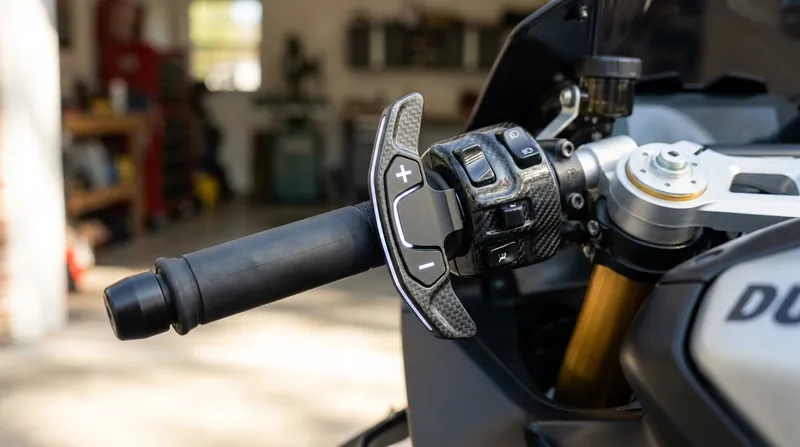
The most noticeable consumer-facing feature of this technology is Adaptive Cruise Control (ACC) with Stop & Go functionality. When engaged on the highway, the motorcycle automatically maintains a safe following distance from the vehicle ahead, modulating the throttle and brakes as traffic speeds fluctuate. In its latest iteration, when paired with the new automated manual gearboxes entering the market, the system can bring the motorcycle to a complete, dead stop in heavy traffic and smoothly pull away again once the congestion clears.[2]
For riders who prefer full manual control, the system offers Riding Distance Assist (RDA). Unlike cruise control, RDA does not maintain a set speed or apply the throttle. Instead, it acts as a dynamic buffer zone. If a rider is charging down a winding road and suddenly encounters a slow-moving tractor hidden around a bend, RDA detects the rapid closure rate and gently applies the brakes to shed speed. The rider remains fully responsible for the throttle, but the bike actively prevents them from rear-ending unexpected obstacles.[2]
In more extreme scenarios, Emergency Brake Assist (EBA) serves as a critical safety net. Crucially, EBA does not initiate autonomous emergency braking from zero—a sudden, unexpected brake application could easily throw an unprepared rider over the handlebars. Instead, if the radar detects an imminent collision and the rider begins to brake, but the system calculates that the human input is insufficient to stop in time, EBA instantly ramps up the hydraulic brake pressure to maximize stopping power and avoid the crash.[2]
The safety net extends to the rear of the motorcycle as well. Rear-facing radar units power Blind Spot Detection (BSD) and Rear Collision Warning systems. When a vehicle enters the rider's blind spot, a subtle LED warning illuminates in the corresponding rearview mirror.
If the rider activates their turn signal while a vehicle is occupying that space, the light flashes urgently. Furthermore, if the rear radar detects a vehicle approaching from behind at a dangerous closure rate while the bike is stopped at a traffic light, it can flash the hazard lights to warn the inattentive driver.
Engineers also had to solve the "Group Ride" problem. Motorcyclists frequently travel in staggered formations, which confuses standard automotive adaptive cruise control systems that expect vehicles to be centered in the lane. Bosch's Group Ride Assist (GRA) specifically calibrates the radar to recognize the staggered layout of single-track vehicles. It identifies both the closest rider in the opposite side of the lane and the rider further ahead on the same side, adjusting the bike's speed to maintain a tight, cohesive group formation without sudden, erratic braking.[2]
The proliferation of ARAS is made possible by decades of relentless hardware miniaturization. When Bosch introduced the first production-ready motorcycle Anti-lock Braking System (ABS) in 1995, the unit weighed a cumbersome 4.5 kilograms and took up significant space. Today, the latest ABS modules—which serve as the hydraulic actuators for all these advanced radar features—weigh just 450 grams. This massive reduction in weight and volume means the technology no longer compromises the performance or packaging of the motorcycle.[1]
While currently reserved for premium, $20,000-plus touring and adventure motorcycles, the technology is rapidly moving downmarket. Industry analysts project the motorcycle ARAS market to grow at a compound annual rate of over 10% through the next decade. Suppliers like Continental (now operating its two-wheeler division as Aumovio) and AI-vision startups like Luna Systems are developing cost-optimized radar and camera suites specifically designed for middle-weight commuter bikes and premium scooters, democratizing safety for everyday riders.[3]
The introduction of these systems has sparked a philosophical debate within the riding community. Traditionalists worry that an over-reliance on digital safety nets will erode fundamental riding skills, breeding complacency in an environment that demands hyper-awareness. Conversely, rider training advocates argue that technology and skill are not mutually exclusive. Data from advanced training platforms suggests that riders who understand and trust their bike's electronic limits actually ride with more confidence and smoother inputs, using the tech as a backup rather than a crutch.[2]
The introduction of these systems has sparked a philosophical debate within the riding community.
Ultimately, the goal of Advanced Rider Assistance Systems is not to automate the motorcycle or remove the rider from the equation. The joy of motorcycling is inherently tied to the physical act of control. Instead, these systems act as a vigilant digital co-pilot, processing the chaotic geometry of the road faster than humanly possible. By managing the margins of error, ARAS allows riders to focus on the pure, uplifting experience of the journey, confident that their machine is actively looking out for them.[4]
Key terms
- ARAS
- Advanced Rider Assistance Systems; a suite of electronic safety features including radar and cameras designed to help motorcyclists avoid collisions.
- IMU
- Inertial Measurement Unit; an electronic sensor that measures a motorcycle's pitch, roll, and yaw acceleration to determine its exact lean angle.
- Adaptive Cruise Control (ACC)
- A system that automatically adjusts the motorcycle's speed to maintain a safe following distance from the vehicle ahead.
- Blind Spot Detection (BSD)
- A safety feature that uses rear-facing radar to warn the rider of vehicles hiding in their rear three-quarter blind spots.
Frequently asked
Will the motorcycle brake automatically if I don't?
Not entirely from zero. Emergency Brake Assist requires the rider to initiate braking first; the system then adds pressure if it calculates you won't stop in time.
Does the radar work when the motorcycle is leaning in a corner?
Yes. The radar communicates with the bike's Inertial Measurement Unit (IMU) to adjust its digital horizon, preventing it from mistaking the road for an obstacle.
Can I turn these safety features off?
Most manufacturers allow riders to customize the sensitivity of the systems or disable specific features like Riding Distance Assist if they prefer full manual control.
Will this technology be available on cheaper motorcycles?
Yes. While currently on premium bikes, suppliers are actively developing cost-optimized radar and camera systems for middle-weight motorcycles and scooters.
Viewpoints in depth
Safety Technologists
Engineers and safety advocates focused on reducing motorcycle fatalities through active intervention.
This camp views the human element as the primary point of failure in motorcycle accidents. They point to data suggesting that radar-based systems could prevent up to one in six motorcycle crashes. For technologists, the goal is 'Vision Zero'—eliminating fatalities by building motorcycles that actively refuse to crash, using sensor fusion to compensate for rider fatigue, distraction, or slow reaction times.
Rider Training Advocates
Instructors who believe technology should supplement, not replace, fundamental riding skills.
Training professionals argue that while ARAS is a massive leap forward, it cannot rewrite the laws of physics. They emphasize the 'Skill, Craft, Mind' philosophy, warning that riders who rely too heavily on blind-spot monitors or automatic braking may lose their edge. They advocate for integrating tech-awareness into licensing courses, teaching riders how to work in partnership with their digital co-pilots rather than treating them as an infallible safety net.
Traditionalist Motorcyclists
Riders who prefer analog machines and view electronic intervention as a dilution of the riding experience.
For traditionalists, the appeal of motorcycling lies in its mechanical purity and the absolute responsibility placed on the rider. They express concern over the increasing complexity, weight, and cost of heavily computerized bikes. This camp often argues that a hyper-awareness of one's surroundings—checking mirrors, anticipating traffic, and mastering threshold braking—is a perishable skill that nanny-state electronics threaten to erode.
- Safety Technologists
- Advocates for maximum electronic intervention to reduce fatalities and human error.
- Rider Training Advocates
- Instructors who view tech as a backup that must be paired with proactive human skill.
- Traditionalist Motorcyclists
- Riders wary of digital complacency who prefer analog, unfiltered control.
Perspectives this story doesn't cover
- Automotive drivers interacting with ARAS-equipped motorcycles
- Insurance actuaries evaluating premium discounts for radar tech
Sources
Source coverage
4 outlets
3 viewpoints surfaced




- [1]Bosch MobilitySafety Technologists
Motorcycle stability control (MSC)
Read on Bosch Mobility → - [2]RevZillaTraditionalist Motorcyclists
Bosch’s New Radar-Based Rider Aids Explained
Read on RevZilla → - [3]Market.usSafety Technologists
Global Motorcycle Advanced Rider Assistance System Market
Read on Market.us → - [4]Factlen Editorial Team
Synthesis by Factlen editorial team
Read on Factlen Editorial Team →
More in Automotive & Transportation
See all →Motorsport Safety
The End of the Trackside Restart: How the FIM’s 2026 Rule Change Rewrites Motorcycle Racing Safety
2 sources
Smart Armor
The Evidence Pack: How AI and Smart Armor Are Rewriting Motorcycle Safety
5 sources
Hydrogen ICE
How Kawasaki is Trying to Save the Combustion Engine with Hydrogen
2 sources
Smart Transmissions
The Death of the Clutch Lever: How Smart Transmissions are Rewiring the Motorcycle
3 sources
Comments
Every angle. Every day.
Get Automotive & Transportation stories with full source coverage and perspective breakdowns, free every day.