
The Da Vinci Glow: What Earthshine Reveals About Our Dimming Planet
For centuries, the ghostly glow on the dark crescent moon was a beautiful mystery. Today, astronomers use this phenomenon to track a critical climate metric: Earth is losing its shine.
By Factlen Editorial Team
- Observational Astronomers
- Focus on the Moon as a precise, natural mirror for measuring Earth's reflectance.
- Climate Researchers
- Focus on how changes in albedo affect Earth's global energy budget and warming trends.
- Science Historians
- Focus on the historical leap of logic that allowed early scientists to understand the cosmos.
What's not represented
- · Meteorologists studying regional cloud formation
- · Astronauts who have observed Earthshine from space
Why this matters
Understanding Earth's albedo is crucial for predicting our climate future. By measuring how much light our planet reflects, scientists can determine exactly how much solar heat is being absorbed by our oceans and atmosphere.
Key points
- Earthshine, or the Da Vinci glow, is the faint illumination of the Moon's dark side caused by sunlight reflecting off Earth.
- Leonardo da Vinci first theorized the mechanics of this phenomenon in the early 16th century, decades before the Copernican revolution.
- Astronomers use Earthshine to measure Earth's albedo, or reflectance, which dictates how much solar energy our planet absorbs.
- Two decades of lunar observations reveal that Earth is dimming, reflecting about 0.5 fewer watts per square meter than it did in 1998.
- The decline in reflectivity is largely driven by warming oceans in the eastern Pacific, which have reduced the formation of bright, low-lying clouds.
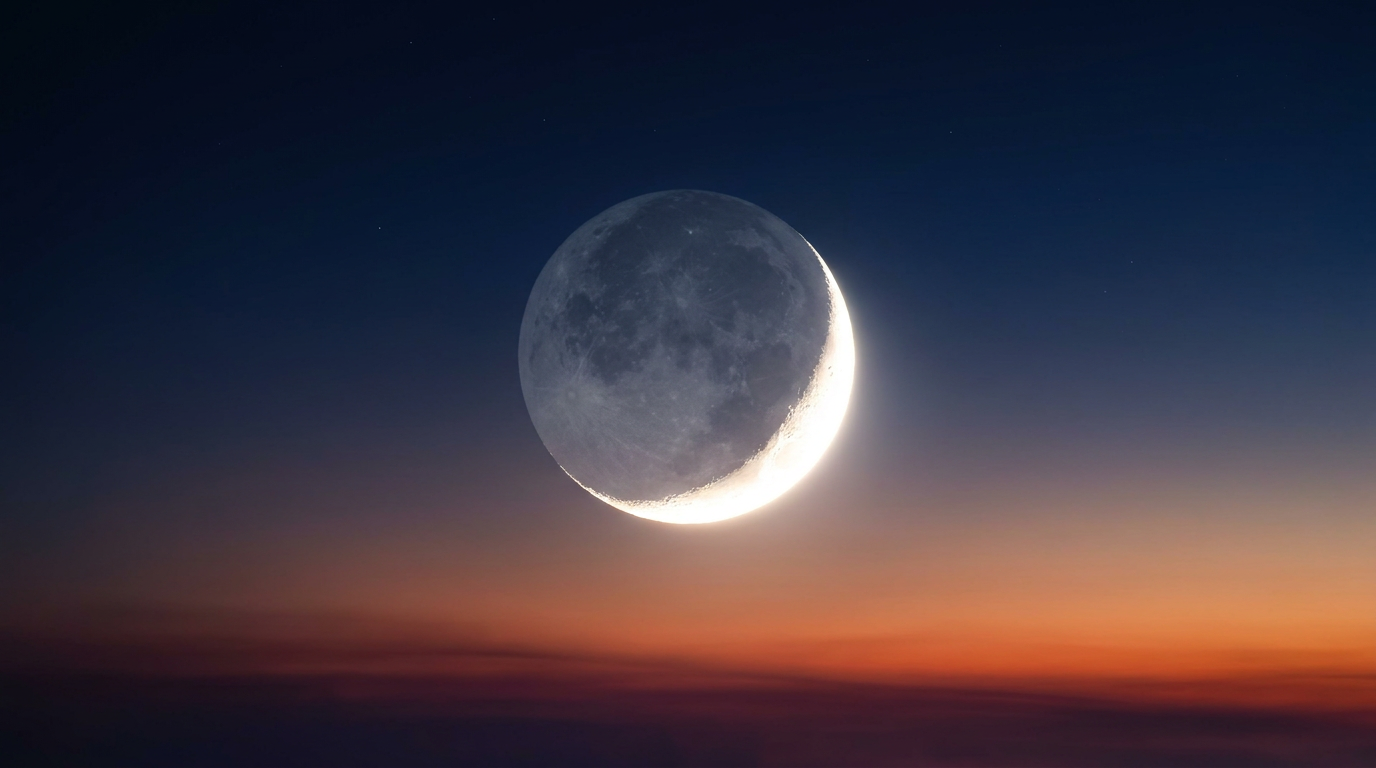
Look up at the night sky during a crescent moon, and you might notice something peculiar. While a thin sliver of the lunar surface shines brilliantly with direct sunlight, the rest of the moon is not entirely dark. Instead, it is bathed in a faint, ghostly illumination that allows the naked eye to make out the full lunar disk.[3]
For centuries, this ethereal sight was known poetically as "the old Moon in the new Moon's arms." Today, astronomers call it Earthshine, or the Da Vinci glow. It is a stunning visual reminder that our planet is a brilliant object in the solar system, acting as a cosmic mirror that casts its own light out into the void.[5]
The mechanism behind the glow is a remarkable game of celestial billiards. Sunlight travels 93 million miles to strike Earth. Our planet's clouds, ice caps, and oceans reflect a portion of that light back into space. Some of this reflected light hits the dark side of the Moon, and a fraction of that light bounces back to our eyes on Earth.[1]
Because the light is reflected twice—once by Earth and once by the Moon—it is incredibly faint by the time it reaches us. Yet, if you were standing on the lunar surface looking back at Earth, the view would be blinding. Earth is both larger and more reflective than the Moon, meaning "Earthlight" on the lunar surface can be up to 50 times brighter than a full moon on Earth.[3]

The first person to correctly deduce this mechanism was the Italian polymath Leonardo da Vinci. In the early 16th century, roughly 24 years before Nicolaus Copernicus published his heliocentric model of the solar system, da Vinci turned his mind to the riddle of the ashen glow.[5]
In the pages of his famous Codex Leicester, da Vinci sketched the Earth and the Moon, theorizing that the ghostly light was caused by sunlight bouncing off Earth's oceans. While his fundamental geometry was flawless, his assumption about the oceans was slightly off. Modern science reveals that while water reflects some light, Earth's brilliant white clouds and polar ice caps are the true engines of our planet's reflectivity.[1][3]
In astrophysics, this reflectivity is known as albedo. It is a critical metric for understanding our planet's energy budget. On average, Earth reflects about 30 percent of the incoming sunlight back into space. The remaining 70 percent is absorbed, driving weather systems, ocean currents, and the global climate.[1]
Measuring Earth's albedo with precision is notoriously difficult. Satellites can only see small patches of the planet at any given time, making it hard to calculate a global average. But the Moon, sitting 238,000 miles away, acts as a perfect, natural mirror that integrates the light from the entire sunlit hemisphere of Earth.[2]
Measuring Earth's albedo with precision is notoriously difficult.
Recognizing this, researchers at the Big Bear Solar Observatory (BBSO) in California launched the Earthshine Project in 1998. For two decades, astronomers pointed their telescopes at the dark side of the Moon, meticulously recording the intensity of the Da Vinci glow.[2]

By comparing the brightness of the earthlit portion of the Moon to the sunlit crescent, the BBSO team could calculate Earth's exact albedo on any given night. Because both the bright and dark sides of the Moon are viewed through the same atmospheric conditions on Earth, the method naturally cancels out local weather distortions, yielding incredibly precise data.[2][4]
The results of this two-decade endeavor, however, revealed a surprising and sobering trend. Earth is losing its shine.[5]
The BBSO data, which spans from 1998 to 2017, shows a gradual but climatologically significant decline in Earth's global albedo. Over those 20 years, the amount of light reflected by our planet dropped by approximately 0.5 watts per square meter.[2]
This dimming effect is equivalent to turning off one lightbulb on a panel of 200, but on a planetary scale, the energy implications are massive. When Earth reflects less light, it absorbs more heat.[5]
To verify these ground-based observations, scientists compared the BBSO earthshine data with measurements from NASA's Clouds and the Earth's Radiant Energy System (CERES) satellites. The two independent datasets matched almost perfectly, confirming that the dimming is a real, global phenomenon.[4]

The culprit behind the fading Da Vinci glow appears to be rooted in the eastern Pacific Ocean. As global temperatures rise, the waters off the western coasts of North and South America have warmed. This warming has disrupted the formation of highly reflective, low-lying stratocumulus clouds in the region.[2]
With fewer white clouds to act as a solar shield, more dark ocean water is exposed to the sun. The ocean absorbs the heat, warming the water further, which in turn prevents more clouds from forming—a classic climate feedback loop written in the fading light of the Moon.[5]
Despite the climate implications, the study of Earthshine remains a triumph of human curiosity. From a sketch in a Renaissance notebook to modern telescopes tracking fractional changes in lunar illumination, the Da Vinci glow proves that sometimes the best way to understand our own planet is to look away from it.[3]
In the coming years, as NASA's Artemis program returns humans to the lunar surface, astronauts will not need telescopes to study Earthshine. They will live and work by its light during the long lunar nights, experiencing firsthand the brilliant, shifting glow of their home world.[3]
How we got here
1510
Leonardo da Vinci theorizes the cause of Earthshine in the Codex Leicester.
1998
The Big Bear Solar Observatory begins the Earthshine Project to track lunar illumination.
2001
NASA launches the CERES satellites to measure Earth's albedo directly from space.
2021
Researchers publish data showing a 0.5 W/m² decline in Earth's reflectance over two decades.
Viewpoints in depth
Observational Astronomers
Focus on the Moon as a precise, natural mirror for measuring Earth's reflectance.
For astronomers, the Moon offers a unique vantage point that satellites cannot match. While low-Earth orbit sensors like CERES only see narrow swaths of the planet at any given moment, the lunar surface integrates light from the entire sunlit hemisphere of Earth simultaneously. By measuring the photometric ratio between the sunlit lunar crescent and the earthlit dark side, astronomers can cancel out local atmospheric distortions, achieving a highly precise, globally integrated measurement of our planet's albedo.
Climate Researchers
Focus on how changes in albedo affect Earth's global energy budget and warming trends.
Climate scientists view Earthshine data as a critical piece of the global warming puzzle. A reduction in albedo means the planet is absorbing more solar radiation rather than reflecting it back into space. The 0.5 watts per square meter decline observed over two decades represents a significant climate forcing. Researchers point to warming ocean temperatures in the eastern Pacific, which suppress the formation of highly reflective low-lying stratocumulus clouds, creating a feedback loop that accelerates heat absorption.
Science Historians
Focus on the historical leap of logic that allowed early scientists to understand the cosmos.
Historians marvel at Leonardo da Vinci's ability to deduce the mechanics of Earthshine purely through naked-eye observation and geometric reasoning. Working decades before the Copernican revolution, da Vinci correctly identified that Earth acts as a light source for the Moon. Although he mistakenly believed the oceans were the primary reflectors—rather than clouds and ice—his work in the Codex Leicester remains a landmark moment in human understanding of celestial mechanics.
What we don't know
- Whether the reduction in low-lying cloud cover over the eastern Pacific is a permanent shift or part of a longer, multi-decadal natural cycle.
- Exactly how much of the albedo decline is driven by human-induced climate change versus natural oceanic oscillations.
- How the continued melting of highly reflective polar ice caps will compound the dimming effect in the coming decades.
Key terms
- Earthshine
- The faint illumination of the dark part of the Moon caused by sunlight reflecting off Earth.
- Albedo
- The proportion of incident light or radiation that is reflected by a surface, such as a planet.
- Da Vinci Glow
- A historical and colloquial term for Earthshine, named after the polymath who first theorized its mechanism.
- Radiant Energy System
- The balance of sunlight absorbed by Earth and the thermal energy radiated back into space, which dictates global temperatures.
Frequently asked
When is the best time to see the Da Vinci glow?
It is most visible in the days immediately before and after a New Moon, during the waxing and waning crescent phases, just after sunset or before sunrise.
Did Leonardo da Vinci get the science completely right?
He correctly deduced that the glow was reflected sunlight from Earth, but he incorrectly assumed Earth's oceans were the primary reflectors. Today, we know clouds and ice reflect the most light.
Why is Earth's albedo decreasing?
Warming ocean temperatures, particularly in the eastern Pacific, have reduced the formation of highly reflective low-lying clouds, causing Earth to absorb more sunlight.
Sources
Source coverage
5 outlets
3 viewpoints surfaced





[1]NASA Earth ObservatoryClimate Researchers
Scientists Look at Moon to Shed Light on Earth's Climate
Read on NASA Earth Observatory →[2]Big Bear Solar ObservatoryObservational Astronomers
Earth's albedo 1998–2017 as measured from earthshine
Read on Big Bear Solar Observatory →[3]Middle Georgia State UniversityScience Historians
What exactly is the Da Vinci glow?
Read on Middle Georgia State University →[4]arXivObservational Astronomers
Earth's albedo variations 1998-2014 as measured from ground-based earthshine observations
Read on arXiv →[5]Factlen Editorial TeamClimate Researchers
Synthesis by Factlen editorial team
Read on Factlen Editorial Team →


Every angle. Every day.
Get science stories with full source coverage and perspective breakdowns delivered to your inbox.