
The Billion-Dollar Biology Experiment Behind the 2026 World Cup Turf
Agronomy researchers from the University of Tennessee and Michigan State University are leading an unprecedented five-year project to engineer identical, natural grass pitches for the 2026 FIFA World Cup. The initiative involves developing custom seed blends, mechanical testing robots, and temporary indoor growing systems to ensure player safety across 16 diverse stadiums.
By Factlen Editorial Team
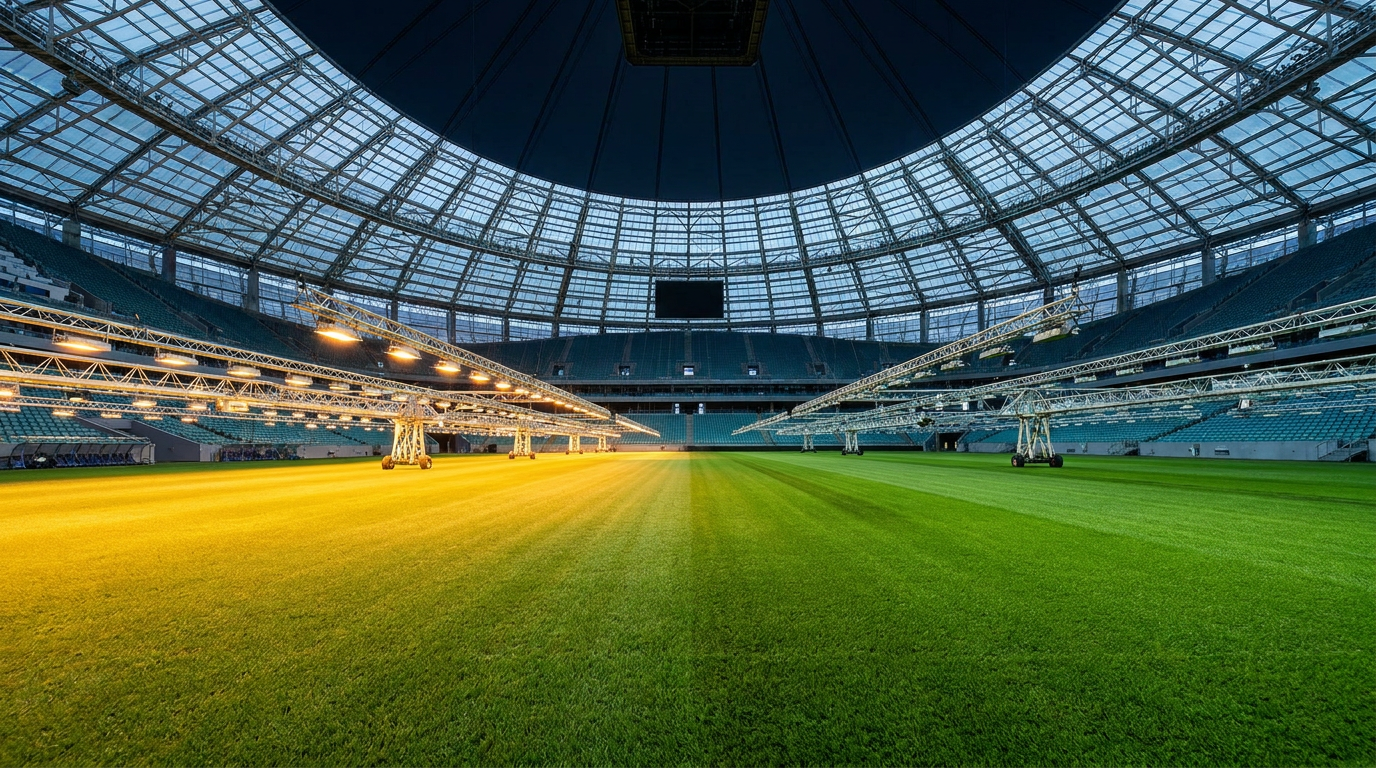
- Agronomy Researchers
- Focuses on the biological and mechanical hurdles of growing uniform, durable grass across diverse climates and indoor stadiums.
- Tournament Organizers
- Prioritizes absolute pitch uniformity and player safety to protect elite athletes and standardize the global viewing experience.
- Sports Science Observers
- Highlights the unprecedented scale, technological innovation, and lasting legacy of this multi-billion-dollar turf engineering project.
What's not represented
- · Stadium groundskeepers tasked with executing the daily maintenance
- · Professional players adapting to the temporary shallow-profile pitches
Why this matters
The 2026 World Cup is serving as a massive, $3.8 billion laboratory for turfgrass science. The innovations developed to keep grass alive indoors and protect elite athletes from injury will eventually trickle down to improve the safety and durability of local parks, university fields, and golf courses worldwide.
Key points
- FIFA requires all 2026 World Cup matches to be played on natural grass, despite eight stadiums having artificial turf.
- Researchers from the University of Tennessee and Michigan State University are leading a five-year project to engineer the pitches.
- The goal is absolute uniformity so players experience the exact same traction in Miami as they do in Vancouver.
- Grass is being grown in specialized trays to be temporarily installed over existing artificial surfaces in domed stadiums.
- A mechanical testing device called the fLEX machine simulates a 168-pound player to test the turf's durability.
- The innovations developed for the tournament are expected to eventually improve local parks and golf courses.
The 2026 FIFA World Cup is set to be the largest and most geographically complex tournament in the history of sports. Spanning 16 cities across the United States, Canada, and Mexico, the event will feature 48 teams playing 104 matches over 39 days. But behind the billion-dollar broadcast deals and the logistical hurdles of moving millions of fans lies a surprisingly biological challenge: the grass.[6][7][1][8]
FIFA, the global governing body for soccer, strictly mandates that all Men's World Cup matches be played on natural grass. This requirement presents a monumental engineering problem for the 2026 tournament, as eight of the 16 selected stadiums are enclosed or domed structures that currently utilize artificial turf. Natural grass does not innately survive in these sunless, climate-controlled environments.[4][5][3][7][1][6]
To solve this, FIFA initiated an unprecedented, multimillion-dollar agronomy project nearly five years before the first kickoff. The organization partnered with two of the world's leading turfgrass research institutions: the University of Tennessee, led by Distinguished Professor John Sorochan, and Michigan State University, led by Professor John "Trey" Rogers III. Their mandate is to research, develop, and maintain perfect, identical pitches across 10 wildly different climate zones.[3][4][2][7]
The core scientific objective is absolute uniformity. According to Sorochan, an athlete running and cutting in Miami must not feel any difference underfoot compared to playing in Mexico City at 7,200 feet of elevation, or indoors in Vancouver. If the surface behaves inconsistently, it can alter the bounce of the ball, affect the speed of the game, and, most critically, increase the risk of severe joint injuries for the world's most valuable athletes.[5][6][8]

Achieving this uniformity requires highly specific biological recipes. The researchers spent years testing different combinations of grass species to find blends that could withstand the intense shear forces of elite soccer. For northern stadiums, the team developed a precise mixture of 84 percent Kentucky bluegrass and 16 percent perennial ryegrass. In southern, warmer climates, the pitches will rely on 100 percent bermudagrass.[2][7]
But selecting the right seed is only the first step. The far greater hurdle is keeping that grass alive and structurally sound inside domed stadiums that lack natural sunlight. To study this, FIFA funded the construction of a state-of-the-art shade house at the University of Tennessee. This facility replicates the exact lighting and micro-climate conditions of the indoor venues, allowing researchers to test how different grasses respond to artificial grow lights and restricted airflow.[6][8][4]
Because eight stadiums cannot permanently install natural grass, the researchers had to engineer a temporary "shallow profile system." Instead of a traditional deep root zone, the grass is grown off-site in specialized hexagonal planters or plastic trays. These trays are then transported to the stadium and laid over a temporary foundation of aluminum concert flooring, gravel, and sand, which is installed directly on top of the existing artificial turf.[3][7]
This modular approach is not entirely without precedent. During the 1994 World Cup, which was also hosted in the United States, Rogers successfully pioneered a similar method using six-inch hexagonal planters to grow grass inside a domed stadium. However, the scale, duration, and athletic intensity of the 2026 tournament demand a surface that is vastly more durable than what was required three decades ago.[7][4]
However, the scale, duration, and athletic intensity of the 2026 tournament demand a surface that is vastly more durable than what was required three decades ago.
To ensure the temporary sod can withstand the modern game, the University of Tennessee team invented a mechanical testing device known as the fLEX machine. The device features a 3D-printed foot and ankle fitted with a standard soccer cleat. It is programmed to strike the turf with the exact force and rotational torque of a 168-pound athlete—the average weight of a player in the last two Men's World Cups.[2][5][6]

By repeatedly striking the grass with the fLEX machine, scientists can measure the surface's traction, impact absorption, and wear tolerance. This data allows them to adjust the soil composition and root density long before a human player ever steps onto the pitch. The researchers also utilize a ball-drop machine, which releases a soccer ball from six feet in the air and measures the acoustic signature of the bounce to analyze the surface's firmness.[2][6][5][8]
Despite these rigorous laboratory tests, significant uncertainties remain. The temporary indoor pitches must survive up to nine matches over a 39-day period, a grueling schedule that leaves very little time for the grass to recover between games. Agronomists are closely monitoring whether the seams between the modular sod trays might shift under the extreme shear forces generated by players accelerating and decelerating.[8][7]
Furthermore, the enclosed nature of domed stadiums creates unique micro-climates that can trap humidity and heat. These conditions are highly conducive to fungal diseases that can decimate a natural grass pitch in a matter of days. To mitigate this risk, the temporary fields are equipped with sophisticated vacuum ventilation systems to assist with water drainage and airflow, alongside in-ground irrigation networks.[1][8][3]

The logistical coordination required to execute this plan is staggering. In April 2024, FIFA hosted a massive Pitch Research Field Day in Tennessee, gathering over 200 pitch managers, industry suppliers, and stadium representatives to review the data and finalize the installation protocols. Every venue must adhere to strict maintenance schedules, utilizing the exact same mowing heights, watering frequencies, and lighting regimens.[4][6]
While the immediate goal is to provide a flawless stage for the 2026 World Cup, the researchers believe their work will have a lasting legacy. The innovations developed for this tournament—particularly the advances in shade-tolerant grass varieties and modular shallow-profile systems—could revolutionize how playing surfaces are managed globally.[3][8][7]
Beyond professional sports, the data gathered from the fLEX machine and the shade houses could eventually trickle down to improve the safety and durability of local municipal parks, university athletic fields, and golf courses. By pushing the boundaries of turfgrass science, the 2026 World Cup is proving that the foundation of the beautiful game is rooted just as deeply in the laboratory as it is on the pitch.[1][3][8]
How we got here
1994
Michigan State University researchers successfully grow natural grass indoors for the US-hosted World Cup.
June 2022
FIFA announces the 16 host cities for the 2026 tournament, spanning diverse climates across North America.
2023
The University of Tennessee and Michigan State University begin a five-year, multimillion-dollar turfgrass research project.
April 2024
FIFA hosts a massive Pitch Research Field Day in Tennessee to review indoor shade testing and fLEX machine data.
June 2026
The 2026 FIFA World Cup kicks off on the newly engineered natural grass pitches.
Viewpoints in depth
Agronomy Researchers
Focuses on the biological and mechanical hurdles of the project.
For the scientists at the University of Tennessee and Michigan State University, the World Cup is a massive biological puzzle. They emphasize the years of meticulous data collection required to keep grass alive indoors, from measuring shade-tolerance metrics to testing the shear-strength of roots. Their primary concern is ensuring the grass can biologically recover fast enough to survive up to nine matches in a 39-day window.
Tournament Organizers
Focuses on absolute uniformity and player safety.
FIFA's mandate is driven by the need to protect elite, highly valued athletes and standardize the global viewing experience. Their primary concern is ensuring that a pitch in a humid, sea-level city performs identically to one in a high-altitude, arid environment. By insisting on natural grass and funding this research, they aim to eliminate the unpredictable bounces and severe non-contact joint injuries often associated with artificial turf.
Sports Science Observers
Focuses on the unprecedented scale and technological innovation of the endeavor.
Observers in the sports media and science communities highlight how this massive investment in turf engineering transcends the tournament itself. They point out that the data gathered from the fLEX machine and the development of modular shallow-profile systems will eventually trickle down. The legacy of this $3.8 billion experiment could lead to safer, more durable playing surfaces for local municipal parks, university athletic fields, and standard stadium designs worldwide.
What we don't know
- How the shallow-profile natural grass will hold up to the cumulative wear and tear of nine matches in 39 days within enclosed stadiums.
- Whether the micro-climates inside specific domed stadiums will trigger unforeseen fungal diseases or rapid grass degradation.
- If the seams between the temporary sod trays can perfectly withstand the extreme shear forces generated by elite soccer players without shifting.
Key terms
- Turfgrass
- Specialized, highly durable living grass engineered specifically for athletic fields and high-traffic areas.
- Shallow profile system
- A method of growing grass in thin, portable trays or planters that can be temporarily installed over existing artificial surfaces.
- Root zone
- The layer of soil, sand, and nutrients beneath the grass surface where roots grow and stabilize the plant.
- fLEX machine
- A mechanical testing device that simulates the lower extremities of a human athlete to measure surface traction and impact absorption.
Frequently asked
Why doesn't FIFA just use artificial turf?
FIFA strictly mandates natural grass for the Men's World Cup to ensure consistent ball roll, reduce joint stress, and minimize the risk of severe non-contact injuries for players.
How do they grow grass in indoor stadiums?
Researchers developed a 'shallow profile system' where grass is grown off-site in specialized trays, then installed over the artificial turf alongside temporary irrigation and drainage systems.
What kind of grass is being used?
It depends on the climate zone. Northern stadiums use a precise blend of 84% Kentucky bluegrass and 16% perennial ryegrass, while southern venues rely on 100% bermudagrass.
How is the grass tested for safety?
Scientists use a custom-built machine called 'fLEX,' which features a 3D-printed foot and cleat that simulates the impact and traction of a 168-pound player.
Sources
Source coverage
8 outlets
3 viewpoints surfaced








[1]The New York TimesSports Science Observers
The Secrets of a Soccer-Turf Master
Read on The New York Times →[2]Michigan State UniversityAgronomy Researchers
Everything to know about the turfgrass for the 2026 FIFA World Cup
Read on Michigan State University →[3]University of TennesseeAgronomy Researchers
Tackling turfgrass: UT experts lead FIFA World Cup 26 pitch research
Read on University of Tennessee →[4]FIFATournament Organizers
FIFA Pitch Research Project in Tennessee striving to create the perfect pitches for 2026
Read on FIFA →[5]NPRSports Science Observers
John Sorochan explains the agronomic feat needed a perfect FIFA World Cup grass pitch
Read on NPR →[6]ForbesSports Science Observers
Nuances Of World Cup Turfgrass
Read on Forbes →[7]Fast CompanySports Science Observers
How researchers grew the perfect grass for the 2026 World Cup
Read on Fast Company →[8]Factlen Editorial TeamSports Science Observers
Synthesis by Factlen editorial team
Read on Factlen Editorial Team →
Every angle. Every day.
Get science stories with full source coverage and perspective breakdowns delivered to your inbox.