
The ATP's Split Reality: Carlos Alcaraz Reclaims World No. 2, But Alexander Zverev Dominates the Race to Turin
Despite being sidelined with a wrist injury since April, Carlos Alcaraz has edged past Alexander Zverev in the 52-week ATP Rankings, creating a massive divergence from the year-to-date Race to Turin where Zverev holds a nearly 3,000-point advantage.
By Xia Wu


- Ranking Traditionalists
- Argue that the 52-week rolling system is the truest measure of a player's baseline quality over a full calendar cycle.
- Race Advocates
- View the Year-to-Date race as the only accurate reflection of current form and momentum in the sport.
- Player Strategy View
- Focus on the practical implications of the split, where the 52-week ranking dictates favorable draws, but the Race dictates year-end bonuses.
Why this matters
The split between the rolling rankings and the year-to-date race directly impacts the upcoming US Open. Alcaraz's ranking protects his seeding, ensuring he avoids World No. 1 Jannik Sinner until the final, while Zverev's massive race lead guarantees him a lucrative spot in the year-end ATP Finals.
Key points
- Carlos Alcaraz has reclaimed the World No. 2 spot in the 52-week ATP Rankings despite not playing since April.
- Alexander Zverev trails Alcaraz by 40 points in the rolling rankings but leads him by 2,900 points in the 2026 Race to Turin.
- The 52-week ranking will dictate US Open seedings, giving Alcaraz a structural advantage to avoid Jannik Sinner until the final.
- Zverev's massive Race lead is fueled by his maiden Grand Slam victory at Roland Garros and a finals appearance at Wimbledon.
- The North American hard-court swing will serve as the battleground for players chasing the final qualification spots for the ATP Finals.
The August 2026 update to the men's tennis standings has produced one of the most glaring statistical anomalies in recent ATP Tour history, highlighting the complex math that governs the sport. Despite being sidelined from competition with a right wrist injury since April, Carlos Alcaraz has officially reclaimed the World No. 2 spot in the 52-week ATP Rankings. The Spanish phenom edges out Germany's Alexander Zverev by a razor-thin margin of just 40 points, sitting at 8,160 to Zverev's 8,120. This mathematical quirk has reshuffled the top of the men's game just weeks ahead of the final Grand Slam of the year, even as one of its main protagonists remains off the court.[1][4]
Yet a glance at the year-to-date ATP Race to Turin—which tracks only points earned during the current 2026 calendar year—tells a completely inverted and far more lopsided story. In the Race, Zverev is not just ahead of Alcaraz; he is dominating him. The German star sits firmly in second place with 6,550 points, holding a massive 2,900-point advantage over the Spaniard, who trails in third place with 3,650 points. This nearly 3,000-point chasm reflects the reality of the current season, where Zverev has been an omnipresent force in tournament finals while Alcaraz has been forced to watch from the sidelines for the entire summer.[1][3]
This split reality highlights the mechanical differences between the ATP Tour's two primary tracking systems, which serve entirely different purposes. The official ATP Rankings operate on a 52-week rolling basis, dropping points earned from the exact same week in the previous year and adding newly earned ones. This rolling system is the lifeblood of the tour, determining tournament entry eligibility and, crucially, event seedings. The Race to Turin, however, wipes the slate clean, starting at zero every January. It strictly measures current-season performance to determine which eight players will qualify for the prestigious, season-ending ATP Finals in Italy.[3][4]
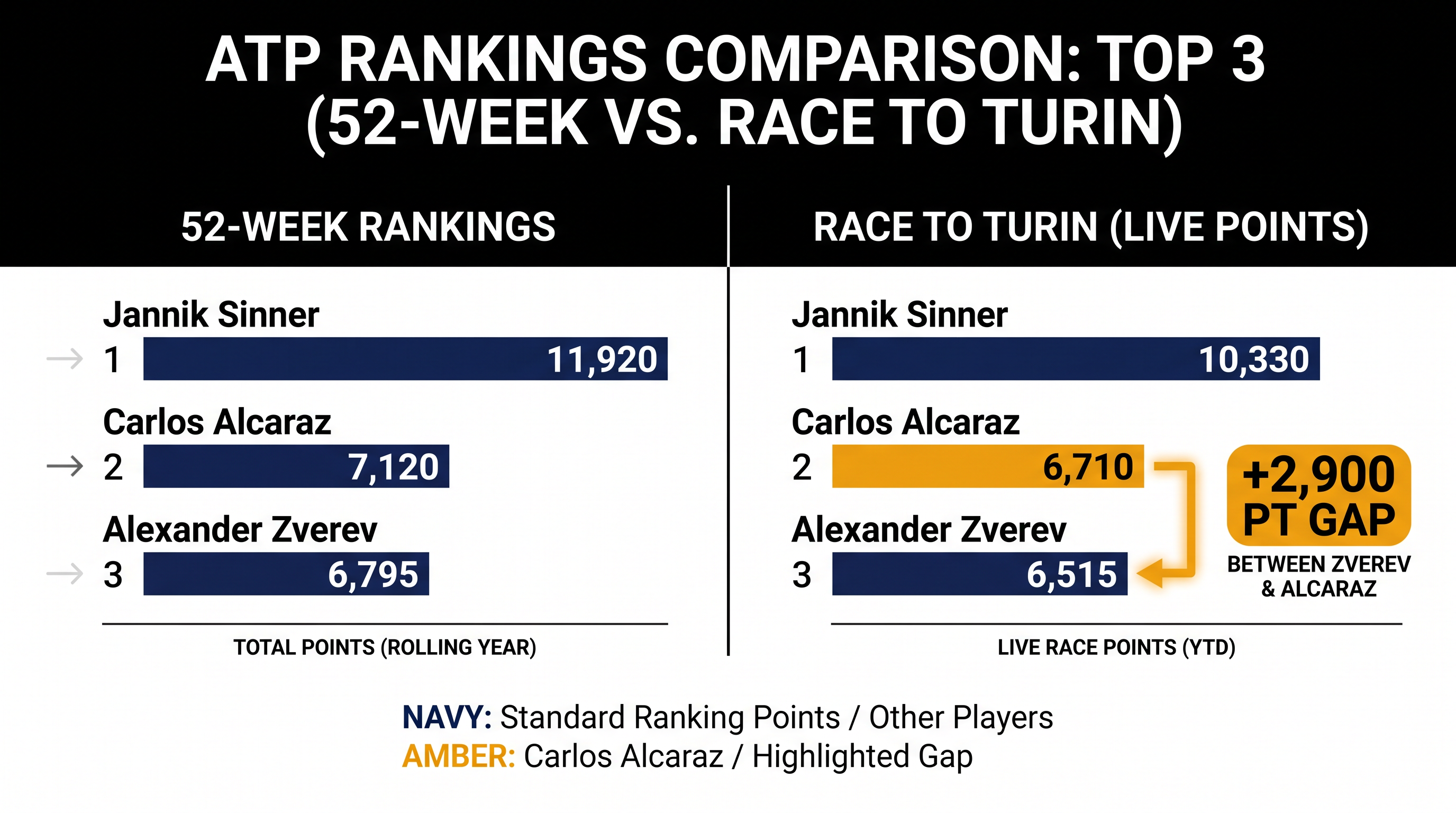
Alcaraz's ascent to World No. 2 without hitting a competitive ball in over three months is entirely a product of the rolling calendar's design. While the 23-year-old Spaniard has been diligently rehabbing his wrist, he has retained the massive points haul from his late-season hard-court dominance in the autumn of 2025. Zverev, meanwhile, saw a significant chunk of his own 2025 points drop off the ledger this week. Because Zverev could not defend those specific historical points, Alcaraz was able to mathematically leapfrog him in the official standings without stepping onto a match court.[1][5]
Analysts have been quick to point out the divergence as the tour heads into a critical stretch. 'In the ATP Singles Rankings, Alcaraz holds a slight edge over Zverev,' noted tennis correspondents at Sports Illustrated, highlighting the standings quirk. 'As for the Race to Turin rankings, Zverev still holds a massive lead... This should change again soon as Zverev competes in Canada while Alcaraz continues to prepare for his return to action.' The gap between the two metrics is expected to fluctuate wildly as the North American hard-court swing progresses.[1]
Analysts have been quick to point out the divergence as the tour heads into a critical stretch.
Zverev's towering total in the 2026 Race is the direct result of a career-best, highly consistent season. He captured his long-awaited maiden Grand Slam title at Roland Garros in June and followed it up with a dominant run to the Wimbledon final in July, where he ultimately fell to World No. 1 Jannik Sinner in a four-set battle. Those two deep Grand Slam runs alone account for the vast bulk of his 6,550 Race points, cementing his undeniable status as one of the two best players of the current calendar year, regardless of what the 52-week rolling computer says.[2][3]
The divergence between the two lists carries immediate, real-world stakes as the tour pivots to the high-profile North American hard-court swing. Because the 52-week rankings dictate tournament seedings, Alcaraz's return to the No. 2 spot is highly consequential for the upcoming US Open. If he can maintain that exact ranking heading into New York, he will be seeded on the opposite half of the draw from the top-ranked Sinner. This placement ensures the sport's two biggest draws cannot eliminate each other before the championship match, providing a massive structural advantage.[4][6]
Zverev, conversely, is utilizing the current Masters 1000 events to chase down Sinner in both metrics and reclaim his seeding advantage. With Sinner sitting on a mountainous 13,450 points in the 52-week rankings and 7,950 in the Race, the Italian remains the undisputed, unified king of the tour. But Zverev is the only player within realistic striking distance in the 2026 Race. He is actively competing at the National Bank Open in Montreal this week to close the gap, while Alcaraz is targeting a return at the Cincinnati Open to defend his 2025 title there and protect his rolling points.[1][2]
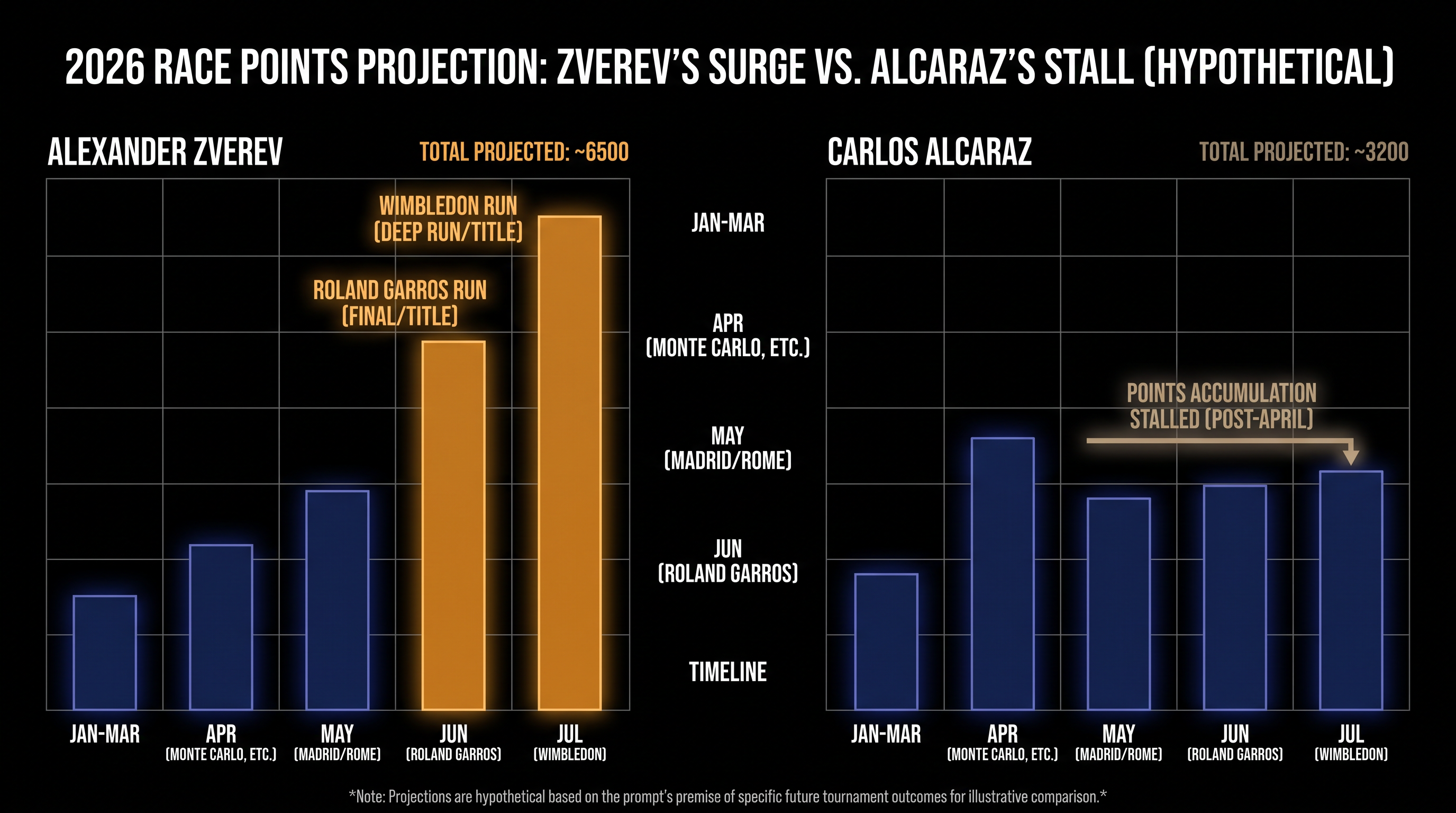
For Alcaraz, the autumn schedule will be an urgent sprint to secure his Turin qualification. While his 52-week ranking is heavily insulated by past glory, his 2026 Race total of 3,650 leaves him somewhat vulnerable to the chasing pack. Players like Flavio Cobolli, currently sitting fourth with 3,020 points, and Daniil Medvedev, in fifth with 2,520 points, are actively accumulating points every week. Alcaraz cannot afford a slow start upon his return to the court if he wants to guarantee his spot in the lucrative eight-man season finale.[2][5]
Ultimately, the current standings anomaly serves as a textbook example of the ATP's dual systems working exactly as designed, balancing historical achievement with current form. The 52-week ranking rewards Alcaraz's sustained 12-month excellence, protecting his hard-earned seeding status while he recovers from a legitimate physical setback. Simultaneously, the Race to Turin accurately reflects the unvarnished reality of the 2026 season: a breakaway two-horse race between Jannik Sinner and Alexander Zverev, with the rest of the tour fighting desperately to catch up before the year runs out.[3][4]
How we got here
April 2026
Carlos Alcaraz is sidelined from competition due to a right wrist injury.
June 2026
Alexander Zverev captures his maiden Grand Slam title at Roland Garros, surging in the Race to Turin.
July 2026
Zverev reaches the Wimbledon final, further cementing his massive lead over Alcaraz in the 2026 Race.
August 2026
Alcaraz reclaims the World No. 2 spot in the 52-week rankings as Zverev's 2025 points drop off the ledger.
Viewpoints in depth
Ranking Traditionalists
Argue that the 52-week rolling system is the truest measure of a player's baseline quality over a full calendar cycle.
Traditionalists maintain that the 52-week ranking system is the only fair way to seed tournaments, as it protects players who suffer short-term injuries but have otherwise proven their elite status over a full 12-month cycle. From this perspective, Alcaraz's No. 2 ranking is entirely justified by his late-2025 dominance, and penalizing him in Grand Slam seedings for a summer absence would artificially skew the draw and punish historical excellence.
Race Advocates
View the Year-to-Date race as the only accurate reflection of current form and momentum in the sport.
Proponents of the Race to Turin argue that the year-to-date standings are the true barometer of the sport's hierarchy at any given moment. They point to Zverev's 6,550 points as proof that he is undeniably the second-best player in the world right now, having reached the finals of the last two Grand Slams. To Race advocates, the fact that a player who hasn't competed in three months can mathematically overtake the Roland Garros champion exposes a flaw in how the sport markets its top stars during the summer swing.
Player Strategy View
Focus on the practical implications of the split, where the 52-week ranking dictates favorable draws, but the Race dictates year-end bonuses.
For the players and their coaching camps, the dual systems require a delicate balancing act of scheduling and physical management. The primary goal of the 52-week ranking is to secure a top-two seed at Grand Slams to avoid the World No. 1 until the final—a structural advantage Alcaraz currently enjoys. However, the Race to Turin dictates access to the year-end ATP Finals, which offers millions in prize money and massive prestige. Players must constantly weigh the need to defend historical points against the urgency of accumulating fresh Race points.
What we don't know
- Whether Carlos Alcaraz will be fully recovered in time to defend his points at the Cincinnati Open.
- If Alexander Zverev can close the 40-point gap in the 52-week rankings before the US Open draw is finalized.
Key terms
- ATP Rankings
- The official 52-week rolling points system used to determine tournament entry eligibility and seedings on the men's tennis tour.
- Race to Turin
- A year-to-date leaderboard that tracks only points earned in the current calendar year to determine the eight players who qualify for the season-ending ATP Finals.
- Masters 1000
- A series of nine top-tier tennis tournaments on the ATP Tour, ranking just below the four Grand Slams in prestige and points awarded.
Frequently asked
Why did Carlos Alcaraz pass Alexander Zverev without playing?
The ATP Rankings operate on a 52-week rolling basis. Alcaraz moved up to No. 2 because points Zverev earned during the same week in 2025 dropped off his total, allowing Alcaraz to mathematically overtake him.
What is the difference between the ATP Rankings and the Race to Turin?
The ATP Rankings track a player's performance over a rolling 52-week period and determine tournament seedings. The Race to Turin starts at zero every January and only counts points earned in the current calendar year to determine qualifiers for the ATP Finals.
Does the Race to Turin affect US Open seedings?
No. Grand Slam seedings are based entirely on the 52-week ATP Rankings, meaning Alcaraz's No. 2 ranking will protect his draw at the US Open regardless of his lower position in the Race.
Sources
Source coverage
6 outlets
3 viewpoints surfaced






[1]Sports IllustratedPlayer Strategy View
Alcaraz Surpasses Zverev in ATP Rankings
Read on Sports Illustrated →[2]Tennis365Player Strategy View
The latest Race to Turin rankings
Read on Tennis365 →[3]Perfect TennisRace Advocates
ATP Singles Race Rankings – Race To Turin
Read on Perfect Tennis →[4]WikipediaRanking Traditionalists
Current tennis rankings
Read on Wikipedia →[5]Live TennisRace Advocates
ATP Live Rankings(Turin) 2026-08-03
Read on Live Tennis →[6]Tennis ExplorerRanking Traditionalists
WTA and ATP rankings on - 03.08.2026
Read on Tennis Explorer →

More in sports
See all 30 stories →Injury
Global Handball Injury Desk: Lichtlein and Remili Headline Summer Returns as Kos Begins Hand Rehab
7 sources

Standings
Expanded 24-Team EHF Champions League Group Stage Fixtures Confirmed for 2026/27 Season
5 sources

Injury
Global Volleyball Injury Report: Hakas Returns for Hawai'i as Wisconsin's Lopez Faces Setback
6 sources

Standings
Evandro and Arthur Lanci Surge to World No. 2 as Plavins and Fokerots Crack Top Five in Latest Beach Pro Tour Standings
6 sources
Every angle. Every day.
Get sports stories with full source coverage and perspective breakdowns delivered to your inbox.