
The Mechanics of Retirement Advice: DOL Reinstates 1975 'Five-Part Test' for Fiduciaries
The Department of Labor has officially withdrawn its 2024 Retirement Security Rule, reverting to a decades-old standard that redefines when financial professionals must act strictly in a client's best interest. The shift provides regulatory certainty for the industry while requiring savers to ask more direct questions about how their advisors are compensated.


- Brokerage & Insurance Industry
- Argues that strict, blanket fiduciary rules limit access to financial advice for middle-income savers by making commission-based models legally unviable.
- Consumer Advocates
- Argues that loopholes in the 1975 test allow advisors to steer retirees into high-fee, high-commission products during one-time 401(k) rollovers.
- Regulatory Pragmatists
- Believes the SEC's existing Regulation Best Interest provides sufficient consumer protection, making the DOL's overlapping ERISA rules unnecessary.
Why this matters
For millions of Americans rolling over 401(k)s or buying annuities, the legal standard governing their financial advisor has fundamentally shifted. Understanding the 1975 'Five-Part Test' ensures you know whether your broker is legally required to put your interests first, or simply required to recommend products that are 'suitable.'
Key points
- The DOL has officially withdrawn the 2024 Retirement Security Rule after facing industry lawsuits and federal court stays.
- The agency reinstated the 1975 'Five-Part Test' to determine who qualifies as an investment advice fiduciary.
- One-time advice, such as a 401(k) rollover, often does not trigger fiduciary duties under the reinstated rules.
- Financial professionals are still governed by the SEC's Regulation Best Interest (Reg BI), providing a baseline of protection.
- Investors are encouraged to ask their advisors directly about their fiduciary status and compensation structures.
The Department of Labor (DOL) has formally withdrawn its controversial 2024 Retirement Security Rule, ending a multi-year legal and regulatory battle over who qualifies as an investment advice fiduciary under the Employee Retirement Income Security Act (ERISA). The withdrawal, published in the Federal Register, officially reinstates the agency's 1975 'Five-Part Test' as the governing standard for financial professionals handling retirement assets.
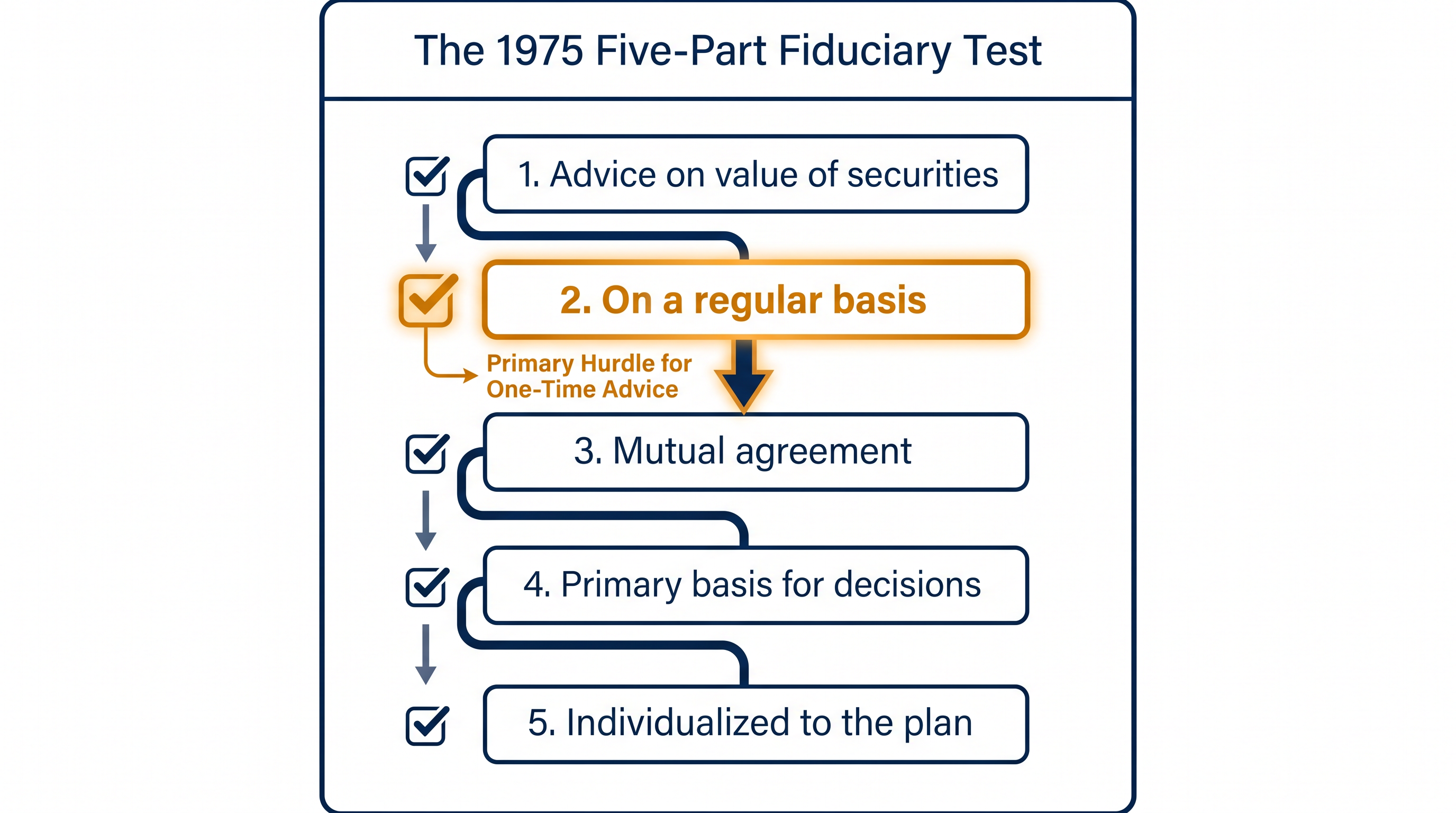
The 1975 framework requires a financial professional to meet five specific criteria before they are legally bound as a fiduciary. They must (1) render advice as to the value of securities or other property, (2) on a regular basis, (3) pursuant to a mutual agreement, (4) where the advice serves as a primary basis for investment decisions, and (5) the advice must be individualized to the specific needs of the plan or IRA.[2]
If a financial professional fails to meet even one of these five prongs, they are not considered an ERISA fiduciary. The most significant hurdle in this test is the 'regular basis' requirement. Because of this specific phrasing, one-time financial advice—such as a recommendation to roll over a $500,000 401(k) balance into an Individual Retirement Account (IRA) or an annuity—often does not trigger fiduciary status under the 1975 rules.[2][3]
The now-withdrawn 2024 Retirement Security Rule was specifically designed by the DOL to close this perceived loophole. The 2024 rule sought to classify one-time rollover advice as fiduciary advice, arguing that a rollover is often the single most important financial decision a retiree makes, and therefore should be subject to the highest standard of care regardless of whether the advisor and client have an ongoing relationship.
However, the 2024 rule faced immediate and fierce resistance from the brokerage and insurance industries. Trade groups filed multiple lawsuits, arguing the DOL had overstepped its statutory authority and ignored previous court rulings. Following federal court stays that halted the rule's implementation, the DOL opted for a formal withdrawal rather than pursuing a lengthy and uncertain appeals process.[1]
Industry groups have widely celebrated the return to the 1975 standard. Organizations representing independent broker-dealers and insurance agents argue that strict, blanket fiduciary rules dramatically increase compliance costs and legal liabilities. They contend that these costs are inevitably passed down to consumers, potentially forcing firms to abandon lower- and middle-income savers who do not have enough assets to justify a fee-based fiduciary model.[1]
Industry groups have widely celebrated the return to the 1975 standard.
Research commissioned by industry advocates supports this 'advice gap' theory. Studies suggest that when strict fiduciary mandates are applied to commission-based products like annuities, financial institutions often raise minimum account balances, effectively pricing out retail investors who rely on transactional advice rather than ongoing portfolio management.
Conversely, consumer protection advocates view the reinstatement of the 1975 test as a setback for retirement savers. Analysts point out that without a strict fiduciary mandate for rollovers, brokers are legally permitted to recommend products that pay them higher commissions, provided the product is deemed broadly 'suitable' for the investor. This can lead to the sale of complex, high-fee annuities that lock up retiree capital.[3]
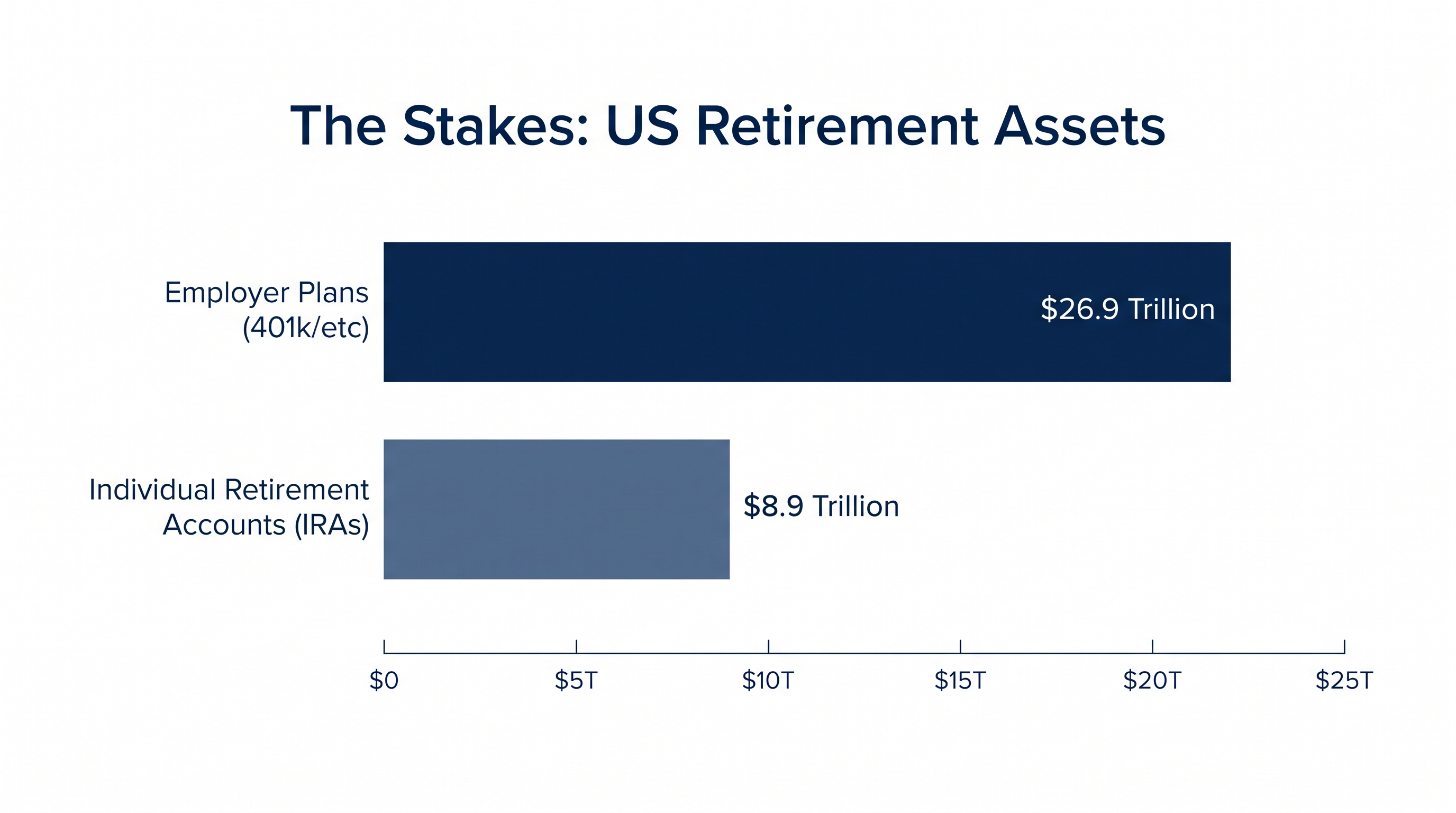
Evidence on the cost of conflicted advice is substantial. Previous analyses have estimated that non-fiduciary advice costs American retirement savers billions of dollars annually in the form of elevated fees and sub-optimal investment returns, particularly during the critical transition phase when workers move assets from institutional 401(k) plans into retail IRAs.
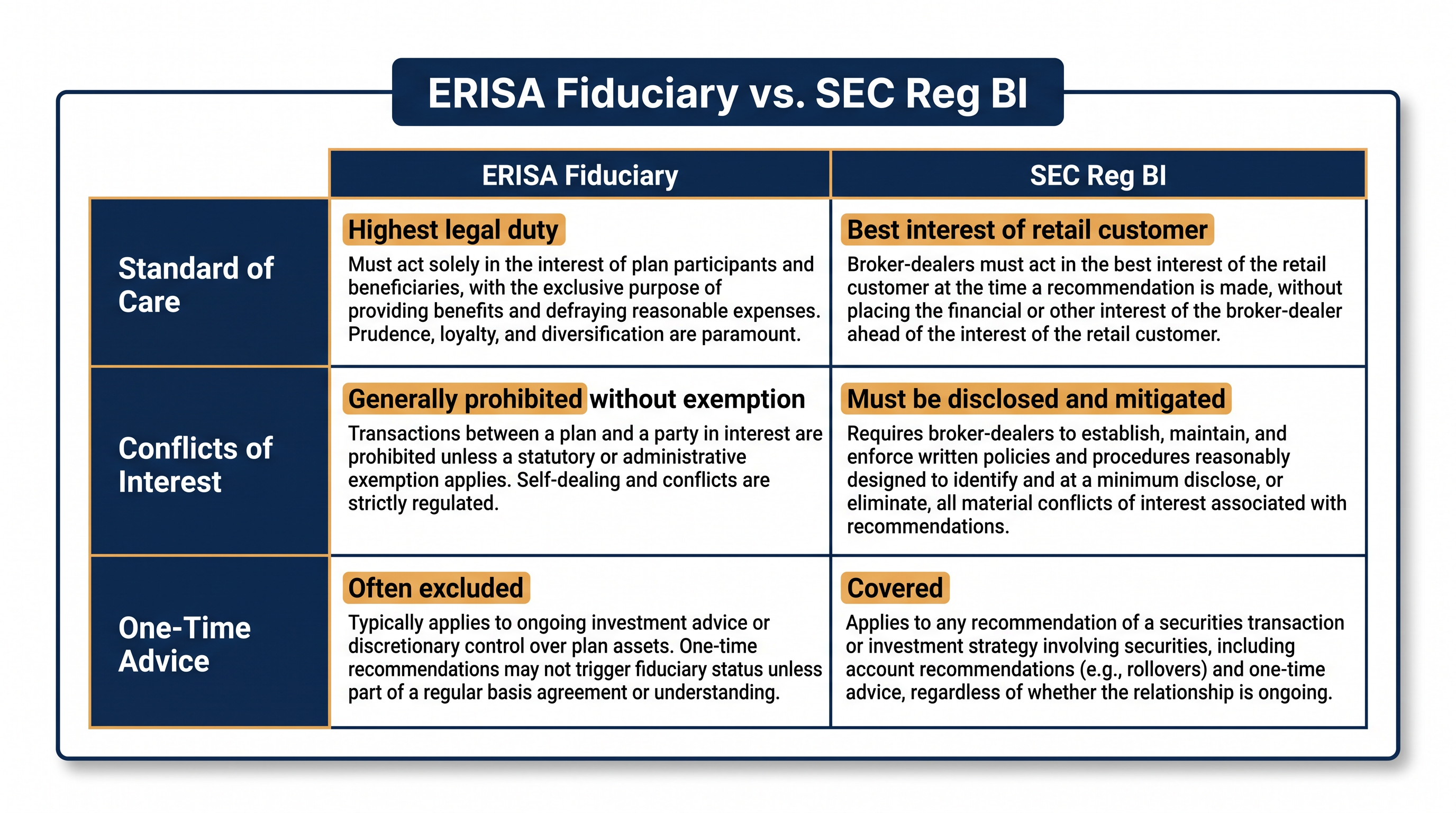
Despite the withdrawal of the DOL rule, the regulatory landscape is not a free-for-all. Financial professionals who are not ERISA fiduciaries are still governed by the Securities and Exchange Commission's Regulation Best Interest (Reg BI). Implemented in 2020, Reg BI requires broker-dealers to act in the best interest of their retail customers and prohibits them from placing their financial interests ahead of the client's.
While Reg BI provides a robust baseline of protection, regulatory analysts note it differs from ERISA's fiduciary standard. ERISA is generally considered the gold standard of consumer protection, carrying stricter prohibited transaction rules and harsher penalties for conflicts of interest. Reg BI allows for certain conflicts provided they are properly disclosed and mitigated, whereas ERISA often forbids them entirely unless a specific exemption is granted.[3]
For the average retirement saver, the reinstatement of the 1975 test shifts the burden of diligence back to the consumer. Financial planners recommend that investors explicitly ask their advisors, 'Are you acting as a fiduciary under ERISA for this specific transaction?' and request the answer in writing. Understanding how an advisor is compensated—whether by a flat fee, an hourly rate, or a product commission—remains the most effective way to gauge potential conflicts.[3]
Looking ahead, the formal withdrawal brings a measure of stability to a sector that has experienced regulatory whiplash for over a decade. Since 2010, three different presidential administrations have attempted to rewrite or modify the definition of a fiduciary, leading to constant compliance overhauls. With the 1975 test firmly back in place, financial institutions can now finalize their compliance frameworks with a higher degree of certainty.[1][3]
How we got here
1975
The Department of Labor establishes the Five-Part Test under ERISA to define investment advice fiduciaries.
2016
The Obama administration attempts to broaden the fiduciary rule, which is later struck down by a federal appeals court in 2018.
April 2024
The Biden administration finalizes the Retirement Security Rule, seeking to close the one-time advice loophole.
July 2024
Federal courts issue stays against the 2024 rule amid multiple lawsuits from the insurance and brokerage industries.
August 2026
The DOL formally withdraws the 2024 rule, officially reinstating the 1975 standard.
Viewpoints in depth
Brokerage & Insurance Industry
Argues that strict fiduciary rules limit access to advice for middle-income savers.
Industry groups maintain that the 2024 rule was an existential threat to the commission-based business model. They argue that if every interaction—including a one-time rollover recommendation—requires the strict liability of an ERISA fiduciary, firms will simply stop serving accounts with lower balances. By reverting to the 1975 test, they believe the DOL has preserved access to financial guidance for middle-class Americans who cannot afford the ongoing, asset-based fees typically charged by pure fiduciaries.
Consumer Advocates
Argues that loopholes allow conflicted advice on high-commission products.
Consumer protection organizations view the 1975 test as dangerously outdated for the modern retirement landscape. When the five-part test was written, most workers relied on defined-benefit pensions. Today, workers are responsible for managing their own 401(k)s and IRAs. Advocates argue that allowing a broker to recommend a high-fee, complex annuity during a rollover without acting as a fiduciary exposes retirees to predatory sales tactics that drain their life savings through hidden costs.
Regulatory Pragmatists
Believes the SEC's Reg BI is sufficient and DOL's overlap was unnecessary.
Legal and regulatory analysts often point out that the debate ignores the existence of the SEC's Regulation Best Interest (Reg BI). Implemented in 2020, Reg BI already requires brokers to mitigate conflicts and act in the retail customer's best interest. Pragmatists argue that the DOL's attempt to overlay ERISA's stricter, less flexible framework onto brokers created unnecessary jurisdictional overlap and compliance confusion, and that enforcing Reg BI is a more efficient way to protect consumers.
What we don't know
- How state-level regulators might respond by implementing their own localized, stricter fiduciary standards.
- Whether the DOL will attempt a narrower, more targeted rulemaking in the future to address specific rollover abuses.
Key terms
- ERISA
- The Employee Retirement Income Security Act of 1974, a federal law setting minimum standards for retirement plans in private industry.
- Fiduciary
- A professional legally obligated to act strictly in the best financial interest of their client, avoiding or eliminating conflicts of interest.
- Regulation Best Interest (Reg BI)
- An SEC rule requiring broker-dealers to act in their retail customers' best interest, though it differs slightly from the stricter ERISA fiduciary standards.
- Rollover
- The process of moving retirement savings from an employer-sponsored plan, like a 401(k), into an Individual Retirement Account (IRA).
Frequently asked
Does this mean my advisor is no longer a fiduciary?
Not necessarily. If your advisor is a Registered Investment Advisor (RIA) charging a flat fee or percentage of assets, they are generally always fiduciaries. If they are a broker, it depends on the specific transaction and the five-part test.
What is the 'regular basis' prong?
Under the 1975 test, advice must be provided on a regular, ongoing basis to trigger fiduciary status. This phrasing often excludes one-time recommendations, such as a single meeting to discuss a rollover.
How does this affect my 401(k) rollover?
A one-time recommendation to roll over a 401(k) into an annuity or IRA may not be considered fiduciary advice under the reinstated rules, meaning the advisor may be allowed to recommend products that pay them a commission.
Are brokers completely unregulated now?
No. Brokers are still heavily regulated by the SEC and must adhere to Regulation Best Interest (Reg BI), which requires them to act in your best interest and disclose conflicts, even if they aren't ERISA fiduciaries.
Sources
Source coverage
3 outlets
3 viewpoints surfaced



[1]ThinkAdvisorBrokerage & Insurance Industry
Industry celebrates as DOL withdraws Retirement Security Rule
Read on ThinkAdvisor →[2]Department of Labor
Employee Benefits Security Administration: Definition of an Investment Advice Fiduciary
Read on Department of Labor →[3]Factlen Editorial TeamRegulatory Pragmatists
Synthesis by Factlen editorial team
Read on Factlen Editorial Team →
Every angle. Every day.
Get finance stories with full source coverage and perspective breakdowns delivered to your inbox.