
Majority of U.S. Workers Expect AI to Increase Job Pressure and Deepen Workplace Inequality
A sweeping new survey reveals that two-thirds of American workers believe artificial intelligence will make their jobs harder, highlighting a stark disconnect between executive optimism and frontline anxiety.


- Frontline Workers
- Anticipate that AI will eliminate jobs and drastically increase daily performance pressure, rather than acting as a helpful assistant.
- Corporate Executives & Tech Proponents
- View AI as a necessary tool to drive long-term economic growth, efficiency, and overall workplace productivity.
- Labor Advocates & Think Tanks
- Warn that the unchecked implementation of AI will exacerbate existing inequalities and create a K-shaped economy.
- Organizational Psychologists
- Focus on the severe mental health toll of AI anxiety and advocate for transparent, inclusive change management.
Why this matters
Understanding the widespread anxiety surrounding artificial intelligence is crucial for both employees and employers. If companies fail to address these fears and transparently manage the transition, the AI boom risks causing severe workforce burnout and deepening economic inequality rather than delivering promised productivity gains.
Key points
- Two-thirds of U.S. workers expect AI to make their jobs harder by increasing pressure and eliminating roles.
- Only 30% of surveyed employees believe AI will improve their daily experience by assisting with challenging tasks.
- AI optimism is heavily concentrated among college-educated and high-income workers.
- 38% of workers worry AI will make their job duties obsolete, leading to significantly higher rates of workplace stress.
- Organizational psychologists warn that deploying AI without employee input fosters a damaging environment of insecurity.
The corporate narrative surrounding artificial intelligence paints a picture of a liberated workforce, where algorithms handle the drudgery and humans are freed to focus on creative, high-level strategy. Yet, on the ground, the American workforce is experiencing a very different reality. Rather than embracing the technology as an economic savior, a sweeping new survey reveals that employees are actively bracing for its impact. The disconnect between executive optimism and frontline anxiety has emerged as one of the defining labor tensions of the decade, raising fundamental questions about who will actually reap the rewards of the AI revolution.[3][5]
A comprehensive study released by the progressive think tank Groundwork Collaborative, in partnership with the polling firm Ipsos, quantifies this growing apprehension. The survey of over 1,500 employed and job-seeking adults found that two-thirds of American workers expect artificial intelligence to make their overall employment experience worse. Instead of viewing the technology as a helpful assistant that automates tedious chores, the majority of respondents anticipate that AI will eliminate positions and drastically increase the daily performance pressure on the staff who remain.[1][2][3][4]
"Workers know bosses who say AI will make their jobs easier and allow them to be more productive are pulling a fast one," noted Elizabeth Pancotti, vice president of policy, advocacy, and research at Groundwork Collaborative. The data suggests that employees broadly reject the utopian framing offered by tech proponents. Only 30 percent of those surveyed believe the technology will improve their daily experience by assisting with challenging tasks. For the rest, the prevailing sentiment is that AI will simply raise the baseline for productivity, forcing workers to accomplish more in less time without a corresponding increase in compensation.[1][3][5]
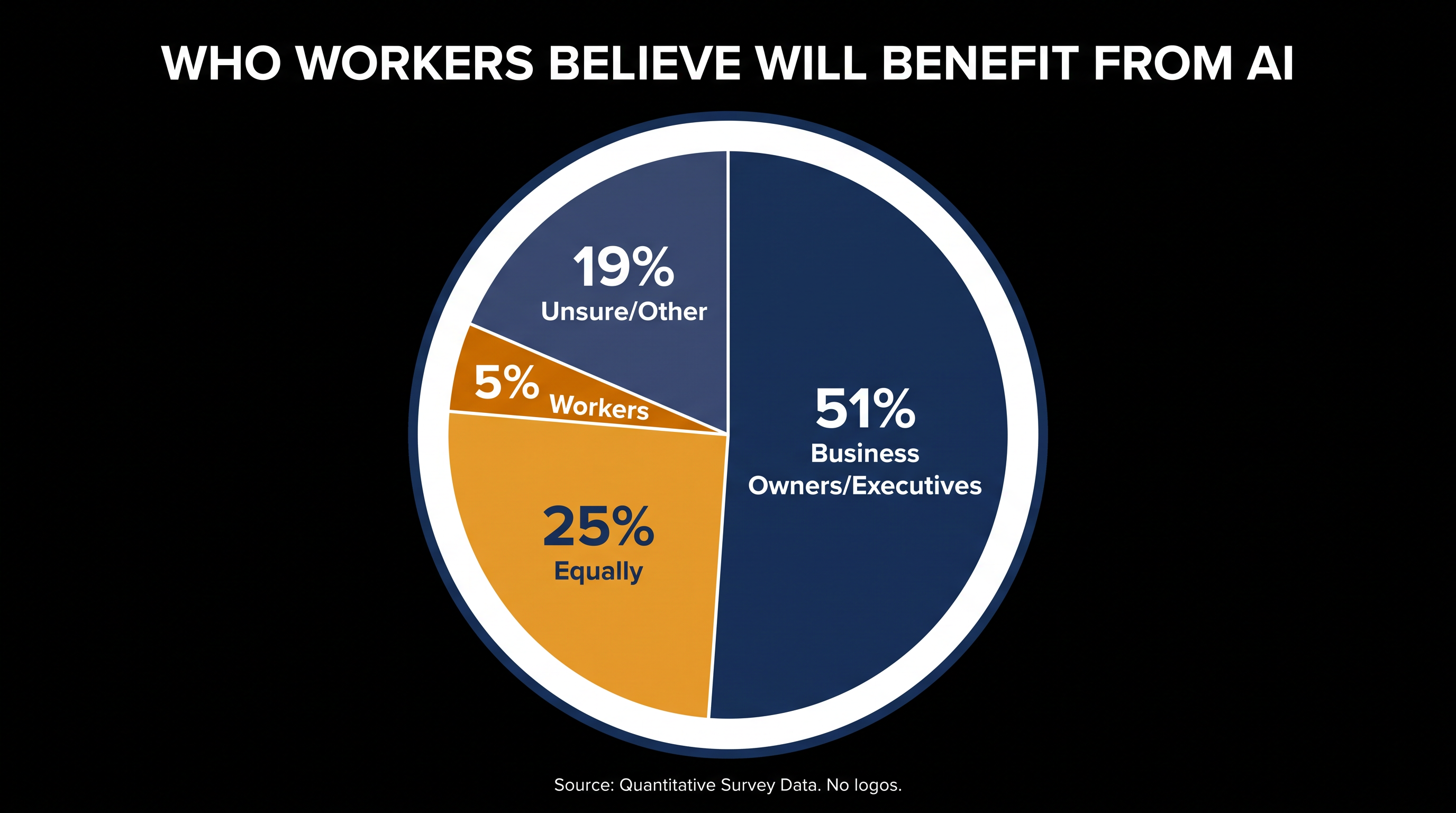
This skepticism is deeply intertwined with concerns about widening economic inequality. According to the Ipsos data, 51 percent of workers believe that the widespread implementation of AI will only or mostly benefit business owners and corporate executives. A mere 5 percent of respondents thought the technology would primarily benefit the workers themselves, while just over a quarter felt the gains would be distributed equally. This points to fears of an increasingly "K-shaped" economy, where the financial windfalls of automation are concentrated at the top while the disruptions are borne by those at the bottom.[1][5]
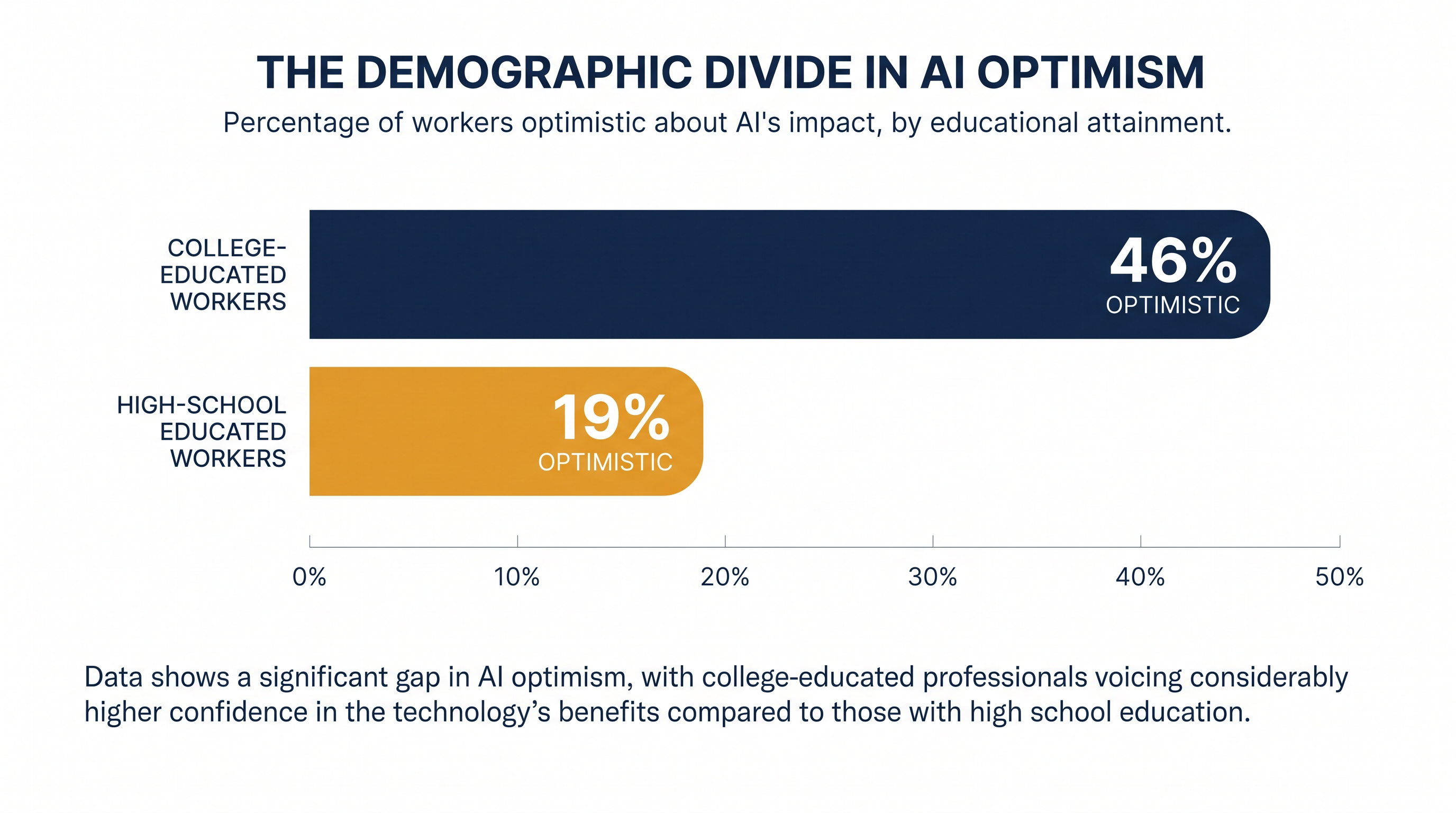
The divide in AI optimism splits sharply along educational and income lines. Nearly half of workers with a college degree, and four in ten of those earning over $100,000 annually, believe AI will ultimately help them perform their duties and improve their specific jobs. In stark contrast, only 19 percent of workers with a high school education or less share that optimism. Among those earning less than $50,000 a year, more than one in five believe AI will make their jobs actively worse by rendering tasks harder or less fulfilling.[1][4]
These diverging outlooks mirror the current reality of AI adoption, which remains highly uneven across the labor market. While three in ten workers report using AI tools at least once a week, that regular usage is heavily concentrated among higher earners and white-collar professionals. Roughly half of respondents earning six figures or holding a bachelor's degree use AI tools multiple times a month. Meanwhile, half of workers earning under $50,000 without a college degree report never using AI in the workplace at all.[1][2][4]
The anxiety surrounding automation also reveals significant racial disparities. The Groundwork Collaborative survey found that Black workers are three times more likely than their white counterparts to fear that artificial intelligence will replace them in the workplace outright, with 12 percent of Black respondents expressing this concern compared to just 4 percent of white respondents. This disparity highlights how historical inequities in the labor market are shaping the psychological response to the current wave of technological disruption.[1][3]
The anxiety surrounding automation also reveals significant racial disparities.
The stress of the AI transition is not limited to those currently employed; it is also reshaping the experience of looking for work. Unemployed job seekers are notably more pessimistic, with 41 percent reporting that AI is already having a negative impact on their specific line of work, compared to 27 percent of employed workers. Automated resume screening and AI-driven hiring platforms have created what some analysts describe as a "purgatory" for applicants, where companies can rapidly post listings and process candidates without ever providing human feedback.[1][3]
Beyond the immediate economic concerns, the looming threat of automation is taking a measurable toll on the psychological well-being of the American workforce. Data from the American Psychological Association's Work in America survey provides crucial context for this phenomenon, revealing that 38 percent of workers worry that AI may make some or all of their job duties obsolete in the future. This "AI anxiety" is strongly correlated with broader workplace distress and burnout.[7][8]
The APA findings show that workers who harbor fears about AI are significantly more likely to experience negative mental health outcomes. Over half of those worried about automation report that their work has a negative impact on their mental health, compared to just 29 percent of workers who are not concerned about AI. Furthermore, nearly two-thirds of those stressed about AI report typically feeling tense during the workday, suggesting that the mere anticipation of technological displacement is enough to degrade the daily employee experience.[7]
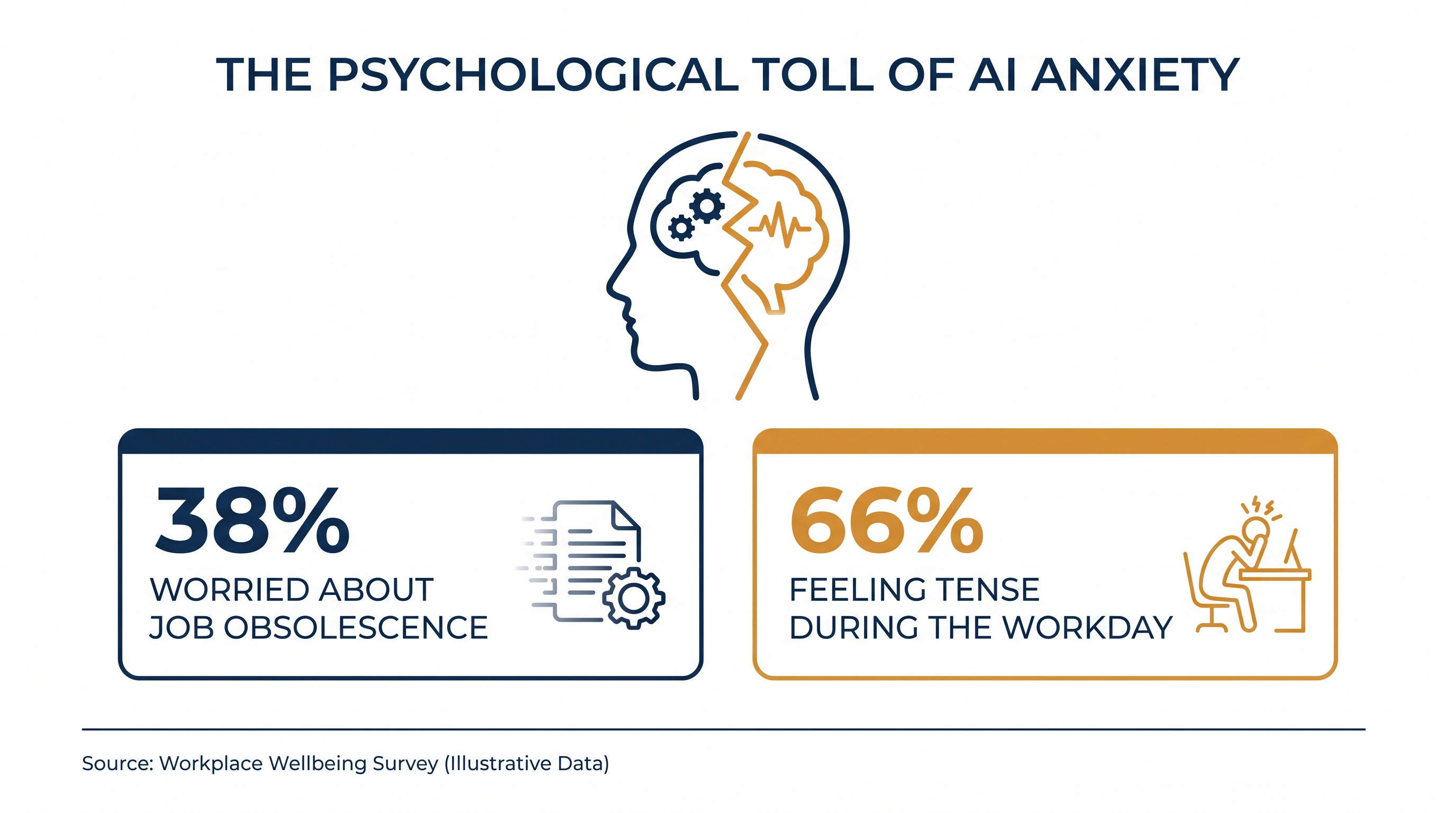
This psychological strain is compounded by a profound sense of disconnect between employees and management. The APA data indicates that workers worried about AI are far more likely to feel undervalued and micromanaged. Strikingly, 66 percent of those with AI anxiety believe their employer thinks the workplace is much mentally healthier than it actually is. This perception gap suggests that corporate leaders may be severely underestimating the emotional toll that rapid technological integration is taking on their teams.[7][8]
While much of the current anxiety is anticipatory, early economic indicators suggest that the structural shifts feared by workers are already beginning to materialize. Research analyzing real wage data alongside AI exposure indexes has found that certain highly exposed occupations are already experiencing wage compression. For example, roles like statistical assistants and software quality assurance analysts—positions with a high percentage of tasks that can be performed by AI—have seen real wages decline over the past two years, even as the broader economy grew.[6]
However, the data also reveals nuances that complicate the narrative of universal displacement. Workers who possess deep "tacit knowledge"—the practical, experience-based intuition that is difficult to codify into an algorithm—may find themselves better insulated from the AI shock. Senior employees who can identify when an AI system is hallucinating, or who understand the complex human dynamics of a client relationship, are increasingly valuable in an automated environment. In some fields, roles with moderate AI exposure, such as personal finance advisors, have actually seen wage growth, suggesting that AI can act as a multiplier for those positioned to leverage it.[6]
Navigating this transition will require a fundamental shift in how organizations manage technological change. Organizational psychologists emphasize that the fear of the unknown is a primary driver of occupational stress. When companies deploy AI systems without transparent communication or employee input, they inadvertently foster an environment of surveillance and insecurity. Conversely, organizations that involve workers in the integration process and provide clear pathways for retraining can mitigate much of this anxiety.[7][8]
Ultimately, the success of the artificial intelligence revolution will depend as much on human change management as it does on the underlying technology. If the current trajectory holds, the American workplace risks fracturing further into a two-tiered system: a highly compensated managerial class that utilizes AI to amplify its output, and a heavily monitored frontline workforce that bears the brunt of increased productivity demands. Bridging that divide will require corporate leaders to look beyond the promise of efficiency and address the very real human anxieties that are currently defining the AI era.[1][5][7]
How we got here
Nov 2022
Generative AI enters the mainstream workplace with the public launch of ChatGPT.
Mar 2023
Major financial institutions publish reports estimating AI could eventually automate up to 300 million jobs globally.
Sep 2023
The APA Work in America survey reveals that 38% of workers are already experiencing 'AI anxiety' regarding job obsolescence.
Aug 2026
A comprehensive Groundwork/Ipsos survey confirms that two-thirds of U.S. workers now expect AI to worsen their employment experience.
Viewpoints in depth
Frontline Workers' View
Anticipate that AI will eliminate jobs and drastically increase daily performance pressure.
For many frontline and blue-collar workers, the promises of artificial intelligence ring hollow. Rather than viewing the technology as a liberator from mundane tasks, these employees anticipate that AI will simply raise the baseline for productivity. They argue that the financial windfalls of automation will bypass them entirely, leaving them to manage increased workloads and heightened surveillance without a corresponding increase in compensation or job security.
Corporate Executives' View
View AI as a necessary tool to drive long-term economic growth and overall workplace productivity.
Corporate leaders and tech proponents maintain that artificial intelligence is a vital engine for future economic growth. They argue that by automating repetitive tasks, AI will eventually free human workers to focus on higher-level, creative problem-solving. From this perspective, the current friction is a temporary symptom of a necessary transition, and the long-term benefits of increased efficiency will ultimately create new categories of jobs and elevate the overall standard of living.
Organizational Psychologists' View
Focus on the severe mental health toll of AI anxiety and advocate for transparent change management.
Mental health professionals and organizational psychologists warn that the psychological toll of the AI transition is being severely underestimated by corporate leadership. They point to data showing that the mere anticipation of technological displacement is enough to degrade daily employee well-being and drive burnout. This camp argues that companies must prioritize transparent communication, offer robust retraining programs, and actively involve workers in the AI integration process to prevent a widespread crisis of workplace morale.
What we don't know
- The exact timeline for when AI-driven productivity gains will offset the initial disruptions to the labor market.
- How future labor regulations might evolve to protect workers from AI-driven surveillance and wage compression.
- Whether the current 'AI anxiety' will subside as the technology becomes more normalized, or if it represents a permanent shift in workplace morale.
Key terms
- K-shaped economy
- An economic shift where different segments of the population experience divergent trajectories, with one group prospering while another struggles.
- Tacit knowledge
- Practical, experience-based intuition and skills that are difficult to transfer to another person or codify into an artificial intelligence system.
- AI anxiety
- The psychological stress and uncertainty experienced by workers regarding the potential for artificial intelligence to disrupt their employment or increase workplace surveillance.
Frequently asked
Are most workers currently using AI on the job?
No. While adoption is growing, only about three in ten workers report using AI tools at least once a week, with usage heavily concentrated among higher-income, white-collar professionals.
Do workers believe AI will automate their boring tasks?
Most do not. Two-thirds of surveyed workers rejected the idea that AI would simply automate tedious tasks, instead anticipating that it will eliminate jobs and increase overall performance pressure.
How is AI anxiety affecting mental health?
The American Psychological Association found that workers worried about AI are significantly more likely to report that their work negatively impacts their mental health, and they frequently experience feelings of being undervalued or micromanaged.
Sources
Source coverage
8 outlets
4 viewpoints surfaced








[1]Groundwork CollaborativeLabor Advocates & Think Tanks
Majorities believe AI implementation will make work worse, direct benefits only to the top
Read on Groundwork Collaborative →[2]IpsosOrganizational Psychologists
A new Ipsos survey conducted on behalf of The Groundwork Collaborative
Read on Ipsos →[3]Common DreamsLabor Advocates & Think Tanks
Workers Expect AI to Deepen Workplace Inequality
Read on Common Dreams →[4]Tampa Free PressFrontline Workers
Majority Of American Workers Expect AI To Worsen Labor Conditions
Read on Tampa Free Press →[5]TribLiveFrontline Workers
Despite AI boom, workers skeptical of benefits
Read on TribLive →[6]Business InsiderCorporate Executives & Tech Proponents
AI exposure and real wages
Read on Business Insider →[7]American Psychological AssociationOrganizational Psychologists
2023 Work in America Survey
Read on American Psychological Association →[8]WysaOrganizational Psychologists
Anxiety abounds as AI advances
Read on Wysa →

More in lifestyle
See all 5 stories →Cognitive Health
Landmark Study: Just Five Minutes of Daily Cognitive Training Universally Boosts Mental Health and Clarity
8 sources

Mental Health Metrics
Landmark Study Establishes World's First Consensus Definition of Mental Wellbeing
8 sources

Supply Chain
US-China Tariffs Force 'Great Supply Chain Reset,' Redrawing Global Apparel Map
8 sources
Every angle. Every day.
Get lifestyle stories with full source coverage and perspective breakdowns delivered to your inbox.