
UCI Imposes Sweeping Equipment Rules: Aero Helmets Banned, Wheel Depth and Handlebar Widths Mandated to Slow Peloton
In a bid to improve rider safety by curbing speeds, cycling's governing body has enacted strict new regulations for 2026 that ban extreme aero helmets, limit wheel depth, and mandate minimum handlebar widths.
By Jun Zhao


- Regulatory Body
- Argues that containing aerodynamics is necessary to reduce speeds and mitigate the severity of crashes.
- Rider Biomechanics & Fitters
- Argues that arbitrary width minimums discriminate against smaller riders and risk causing overuse injuries.
- Equipment Manufacturers
- Frustrated by the lack of consultation and the financial impact of sudden bans on years of R&D.
Why this matters
The new regulations fundamentally alter how professional and amateur cyclists optimize for speed, forcing a shift away from extreme aerodynamic hacks in favor of standardized safety measures. Because major brands design their consumer models to comply with racing regulations, these rules will dictate the geometry and equipment of mass-market bikes for years to come.
Key points
- The UCI has banned 'time trial' style aero helmets in mass-start races, requiring at least three vents and no ear covers.
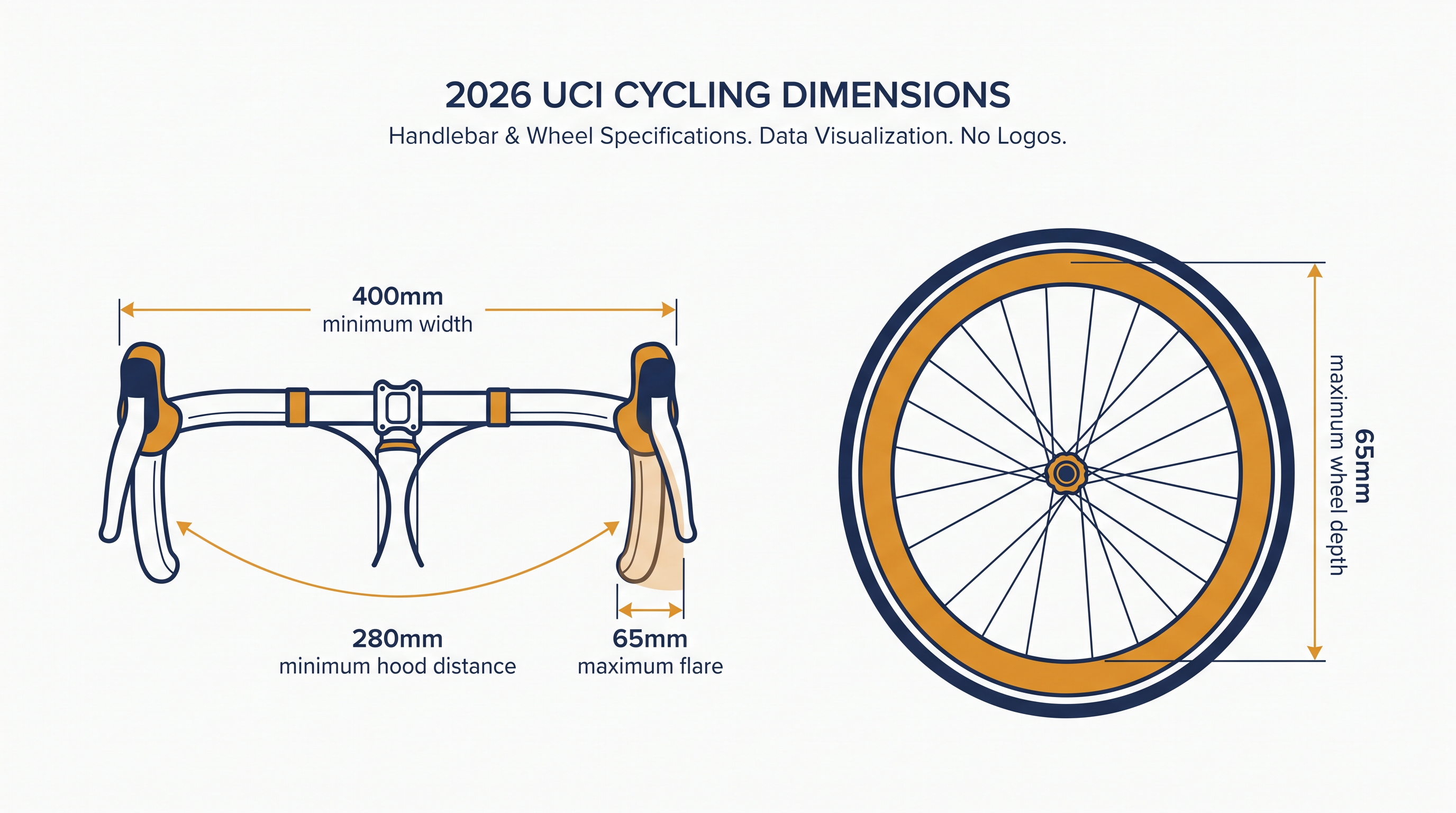
- Handlebars must now measure a minimum of 400mm wide, halting the trend of ultra-narrow aerodynamic setups.
- Wheel rim depths are capped at 65mm to improve crosswind stability, frustrating several wheel manufacturers.
- The UCI compromised on brake hood distance, lowering the minimum to 280mm after backlash from female and smaller riders.
- Front-mounted jersey pockets are banned starting July 2026 to prevent riders from using nutrition as an aerodynamic fairing.
The 2026 professional cycling season has commenced with a radically altered aesthetic and a slightly slower pace. On January 1, the Union Cycliste Internationale (UCI) implemented one of the most sweeping overhauls of technical regulations in the sport's modern history.[1][2]
Driven by a mandate to improve rider safety, cycling's global governing body has drawn a hard line against the relentless pursuit of aerodynamic "free speed." The new rulebook effectively bans the extreme aero helmets, ultra-narrow handlebars, and massive wheel depths that had come to define the modern WorldTour peloton.
The logic behind the clampdown, spearheaded by the UCI's "SafeR" project, is straightforward: professional cyclists are racing faster than ever before, and higher speeds translate to more devastating injuries when crashes occur. By mandating equipment that increases aerodynamic drag, regulators hope to naturally throttle the pace of the pack.[1]
The most visible casualty of the new regulations is the "time trial" style helmet in mass-start road races. Over the past few seasons, riders increasingly adopted bulbous, visor-equipped helmets with covered ears to slice through the wind, prioritizing aerodynamics over ventilation.
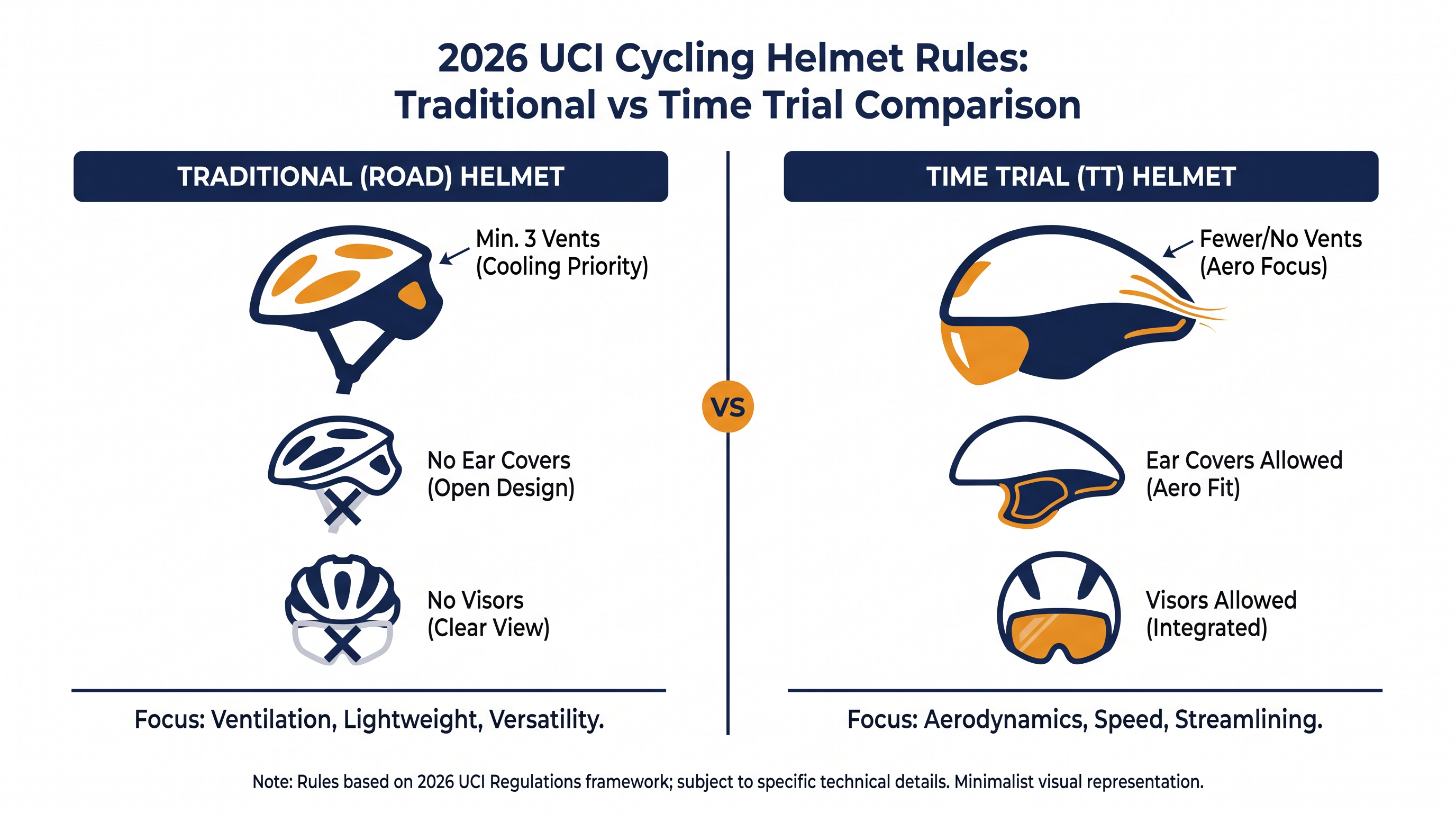
Under the 2026 rules, helmets are strictly bifurcated into "traditional" and "time trial" categories. Helmets worn in standard road races must now feature at least three ventilation holes, cannot cover or obstruct the rider's ears, and are prohibited from featuring integrated or detachable visors.
This immediate ban renders several high-profile designs illegal for standard road stages. Models like the POC Procen Air, heavily utilized by EF Education-EasyPost, and the Kask Nirvana, worn by the Ineos Grenadiers, fail the new criteria due to their ear fairings and visor integrations.[1]
While the helmet ban changes the look of the peloton, the UCI's new handlebar dimensions have sparked the most intense biomechanical debate. In recent years, riders had adopted drastically narrow handlebars—sometimes measuring less than 300mm across—to pull their shoulders inward and reduce their frontal aerodynamic profile.[1][2]
The UCI has now mandated that road and cyclocross handlebars must measure a minimum of 400mm across their widest point (outside-to-outside). Furthermore, the flare of the handlebar drops is capped at 65mm, preventing manufacturers from designing bars that are narrow at the top but wide at the bottom.[2]
The UCI has now mandated that road and cyclocross handlebars must measure a minimum of 400mm across their widest point (outside-to-outside).
The most contentious metric, however, is the distance between the brake hoods. The UCI initially proposed a minimum inner width of 320mm, a figure that triggered a massive uproar from female riders, smaller men, and professional bike fitters.[1]
Critics pointed out that forcing smaller riders onto 320mm setups would unnaturally splay their arms, jacking up their shoulders, straining their wrists, and potentially triggering a cascade of overuse injuries. An audit by the international association of pro cycling teams revealed that the vast majority of current WorldTour bikes would fail the initial standard.
In a rare concession, the UCI walked back the 320mm requirement, settling on a 280mm minimum distance between the brake hoods for the 2026 season. While this compromise appeased some, biomechanics experts argue that a flat minimum width remains discriminatory, suggesting that a sliding scale based on rider shoulder width would be a safer, more equitable solution.[1]
Beyond the cockpit, the UCI has also targeted the wheels and frames. In mass-start events, wheel rim depth is now strictly capped at 65mm. The governing body argues that deeper rims are dangerously susceptible to crosswind deflection, which can cause sudden instability in a tightly packed peloton.[2]
This ruling blindsided several equipment manufacturers. Swiss Side, a prominent wheel brand, published an open letter revealing that the 65mm limit banned their newly developed 68mm wheelset just weeks before its launch, rendering years of six-figure research and development obsolete.[1][2]
Frame design has also been reined in. The UCI has imposed maximum width limits on fork legs (115mm) and rear seatstays (145mm). This regulation effectively outlaws the ultra-wide, aerodynamically sculpted forks seen on recent superbikes, forcing designers back to more traditional, narrower profiles.[2]
The regulatory crackdown even extends to rider apparel. After observing a trend where riders stuffed nutrition products down the front of their jerseys to create an aerodynamic chest fairing, the UCI has outlawed front-mounted jersey pockets entirely, effective July 2026.
The governing body noted that these "nutrition" items were rarely consumed during the race and were placed solely to alter the rider's body shape. The ban aims to restore sporting fairness while preventing riders from carrying rigid objects that could exacerbate injuries in a chest-first impact.
For the everyday consumer, these WorldTour regulations will inevitably dictate the future of mass-market bicycles. Because major brands rely on professional racing to market their flagship models, the 2026 UCI rulebook will shape the geometry, wheel depth, and handlebar widths of the bikes sold in local shops for years to come.[2]
Whether these sweeping interventions will actually achieve their primary goal—reducing the frequency and severity of crashes—remains a subject of fierce debate. While the UCI insists that slower speeds equate to safer racing, many riders argue that true safety reform must address hazardous course designs, dangerous road furniture, and the chaotic dynamics of modern race convoys.[1]
How we got here
June 2025
The UCI initially proposes a 320mm minimum brake hood width, sparking widespread industry backlash.
September 2025
Following an audit of WorldTour bikes, the UCI revises the handlebar rule to 280mm and finalizes helmet regulations.
January 2026
The sweeping new equipment regulations officially take effect for road and cyclocross mass-start events.
July 2026
A ban on front-mounted jersey pockets takes effect to prevent riders from using nutrition as an aerodynamic fairing.
Viewpoints in depth
The UCI and Safety Advocates
Argue that containing aerodynamics is necessary to reduce speeds and mitigate the severity of crashes.
The UCI's 'SafeR' initiative operates on the premise that modern professional cycling has become dangerously fast. By targeting the equipment that provides 'free speed'—such as ultra-narrow handlebars and time-trial-style helmets—regulators believe they can artificially throttle the pace of the peloton. Safety advocates within the governing body argue that while these measures may frustrate manufacturers and purists, reducing the kinetic energy involved in high-speed crashes is a necessary step to protect riders from life-altering injuries.
Riders and Biomechanics Experts
Argue that arbitrary width minimums discriminate against smaller riders and risk causing overuse injuries.
For female riders, smaller men, and professional bike fitters, the UCI's equipment mandates are seen as a blunt instrument that ignores human biomechanics. Critics point out that forcing a rider with narrow shoulders onto a 400mm handlebar forces their arms outward, straining the wrists and shoulders. While the UCI compromised on the brake hood distance (reducing the minimum from 320mm to 280mm), fitters argue that a flat minimum width remains inherently discriminatory. They advocate for a sliding scale based on individual rider height or shoulder width, similar to the regulations already used for time trial extensions.
Equipment Manufacturers
Frustrated by the lack of consultation and the financial impact of sudden bans on years of R&D.
The cycling industry invests millions of dollars and years of wind-tunnel testing into developing aerodynamic frames, wheels, and helmets. Manufacturers have expressed intense frustration over the abrupt nature of the 2026 rule changes. Wheel brands like Swiss Side discovered that their newly developed 68mm rims were banned just weeks before launch, resulting in massive financial losses. Industry leaders argue that the UCI's equipment limits—such as capping wheel depth to improve crosswind stability—are often based on flawed physics, noting that tire width and steering geometry play a far greater role in bike handling than rim depth alone.
What we don't know
- Whether the new equipment regulations will actually result in a statistically significant reduction in crash frequency or severity.
- How strictly the UCI will enforce the new dimensions during pre-race commissaire checks.
- If the UCI will eventually adopt a sliding scale for handlebar widths based on rider height, as requested by biomechanics experts.
Key terms
- Mass-start race
- A standard road race where all competitors start simultaneously in a peloton, as opposed to an individual time trial.
- Brake hoods
- The rubberized covers over the brake and shift levers where riders commonly rest their hands while cruising.
- Rim depth
- The vertical measurement of a wheel's rim; deeper rims are generally more aerodynamic but are regulated due to crosswind concerns.
- Flare
- The outward angle of the lower portion (drops) of a handlebar relative to the narrower top portion.
Frequently asked
Why did the UCI ban aero helmets?
The UCI banned 'time trial' style helmets in mass-start races to reduce aerodynamic advantages, aiming to slow down the peloton and decrease the severity of crashes.
How do these rules affect amateur cyclists?
While amateurs aren't strictly bound by UCI rules, major bike brands design their consumer models to comply with them, meaning mass-market bikes will soon adopt these new standards.
Why were female riders upset about the handlebar rules?
The initial minimum width proposals were too wide for the narrower shoulders of many female and smaller male riders, forcing them into unergonomic positions that risked biomechanical injury.
Sources
Source coverage
2 outlets
3 viewpoints surfaced


[1]VeloRider Biomechanics & Fitters
The 3 Key Rule Changes for 2026
Read on Velo →[2]BikeRadarEquipment Manufacturers
The UCI rule changes for 2026 you need to know about
Read on BikeRadar →
Every angle. Every day.
Get fitness stories with full source coverage and perspective breakdowns delivered to your inbox.