
Evidence Pack: IRGC Claims Strike on U.S. Base in Kuwait Amid Tenth Night of Airstrikes
Iran claims to have destroyed U.S. drone hangars in Kuwait, an assertion CENTCOM denies as the U.S. conducts its tenth consecutive night of airstrikes. Regional mediators have proposed a 10-day ceasefire to halt the escalating conflict.

- U.S. Central Command
- Asserts that U.S. strikes are necessary defensive measures to protect global shipping and denies that Iranian retaliatory strikes have caused significant damage.
- Iranian Revolutionary Guard
- Frames its missile strikes as successful retaliation against U.S. aggression and vows to continue operations until American forces leave the region.
- Regional Mediators
- Focuses on the severe economic and infrastructural fallout of the conflict, pushing urgently for a diplomatic ceasefire to stabilize the region.
Perspectives this story doesn't cover
- Kuwaiti civilians affected by the attacks on power and water infrastructure
- Commercial shipping companies navigating the blockaded straits
Why this matters
The conflicting claims over damage to U.S. military installations highlight the volatile nature of the ongoing conflict, which has already disrupted global energy markets and threatened regional infrastructure. Understanding the evidence behind these claims is crucial for assessing the likelihood of a broader regional war versus a negotiated ceasefire.
The military confrontation between the United States and Iran has reached a critical juncture, marked by a tenth consecutive night of U.S. airstrikes and a highly contested Iranian missile attack on a U.S. base in Kuwait. As the conflict extends deeper into its fifth month, the informational landscape has become as fractured as the physical battlefield. Both Washington and Tehran are projecting narratives of tactical success, issuing conflicting damage assessments that complicate international efforts to gauge the true scale of the escalation. This evidence pack examines the primary claims surrounding the latest exchange of fire, mapping the assertions made by U.S. Central Command (CENTCOM) against those broadcast by Iran's Islamic Revolutionary Guard Corps (IRGC), and evaluating the strength of the available evidence.[1][2]
Claim 1: U.S. airstrikes are systematically degrading Iranian military infrastructure. According to official statements from CENTCOM, the tenth night of American aerial operations targeted a broad spectrum of Iranian assets, including military command centers, maritime capabilities, air defense systems, and launch sites for ballistic missiles and drones. The U.S. asserts that these strikes are a necessary defensive measure designed to reopen the Strait of Hormuz, a vital global shipping artery that has been effectively closed by Iranian attacks on commercial vessels. The U.S. military maintains that its operations are precisely calibrated to neutralize the specific capabilities Iran uses to project power across the Gulf.[1][2][6]
The evidence supporting the U.S. narrative relies heavily on official Pentagon briefings and the observable reduction in certain types of Iranian maritime harassment, though independent battle damage assessments remain sparse. Furthermore, the U.S. military's transparency regarding the human cost of the conflict has been challenged. Following reports that the military withheld information on casualties, the Pentagon acknowledged that nearly 100 U.S. troops had sustained injuries—primarily minor concussions—over the past two weeks. This admission highlights the inherent friction in relying solely on primary combatant sources for real-time casualty and damage figures during active hostilities.[1]
Claim 2: The IRGC inflicted severe damage on U.S. assets at the Ali Al Salem Air Base in Kuwait. In a series of communiqués amplified by Iranian state media, the IRGC claimed that its aerospace forces executed "Operation Nasr 2," a retaliatory missile strike that successfully penetrated Kuwaiti airspace. The IRGC specifically asserted that the attack set fire to and completely destroyed two drone hangars and a fuel storage depot utilized by U.S. military aircraft and helicopters. Tehran frames this operation as a direct response to recent U.S. airstrikes and has reiterated its strategic objective of forcing a complete withdrawal of American forces from the Middle East.[3][4][5]
The IRGC specifically asserted that the attack set fire to and completely destroyed two drone hangars and a fuel storage depot utilized by U.S.
The evidence for the IRGC's claim is heavily contested and currently lacks independent visual corroboration. CENTCOM issued a categorical denial of the Iranian assertions, stating unequivocally that "no US aircraft were destroyed or damaged in recent attempted Iranian attacks." According to the U.S. military, all incoming Iranian missiles and drones were either successfully intercepted by allied air defense systems or failed to reach their intended targets. Without access to commercial satellite imagery or independent on-the-ground reporting from the highly secure Ali Al Salem Air Base, the IRGC's claims of widespread destruction remain unverified and directly contradict the official U.S. account.[3]
Claim 3: The conflict is causing severe collateral damage to regional infrastructure and threatening global energy markets. Beyond the direct military-on-military engagements, the operational theater has expanded to include critical civilian and economic infrastructure. The Kuwaiti government reported that recent Iranian attacks were aimed at its domestic power and water facilities, indicating a willingness by Tehran to pressure U.S. allies through infrastructural disruption. Simultaneously, Iran-aligned Houthi militants in Yemen announced a maritime blockade on Saudi Arabia, specifically targeting the Bab el-Mandeb Strait in retaliation for Saudi military actions.[1][6]
The evidence for these broader regional impacts is robust, reflected in the immediate reactions of global commodities markets and the rerouting of international shipping. Brent crude prices have surged past $88 per barrel as the dual threats in the Strait of Hormuz and the Red Sea compound concerns over a potential 7 percent reduction in the global energy supply. The disruption of these maritime chokepoints, through which a massive percentage of the world's traded crude oil and natural gas passes, provides concrete evidence that the tactical military exchanges are generating profound strategic and economic consequences.[2][6]
Claim 4: A diplomatic resolution is actively being negotiated through regional intermediaries. Despite the intense kinetic activity, backchannel diplomatic efforts appear to be accelerating. Citing regional intelligence sources, reports indicate that a coalition of mediators—including Qatar, Egypt, and Pakistan—has presented Washington and Tehran with a formal proposal for a 10-day ceasefire. This diplomatic push is further evidenced by the recent travel of Iranian Interior Minister Eskandar Momeni to Islamabad for high-level talks aimed at de-escalating the crisis.[1][2]
The evidence for a potential diplomatic off-ramp is credible but highly contingent. While U.S. negotiators are reportedly "exploring" the ceasefire framework, the collapse of a similar temporary agreement last month casts a long shadow over current efforts. The fact that both the U.S. and Iran continue to launch major strikes while simultaneously engaging with mediators suggests a dual-track strategy: maximizing leverage on the battlefield to secure more favorable terms at the negotiating table. Until a formal cessation of hostilities is announced, the situation remains highly fluid and susceptible to further rapid escalation.[1][2]
How we got here
Last month
A temporary ceasefire agreement between the U.S. and Iran collapses, leading to renewed hostilities.
Past two weeks
Nearly 100 U.S. troops sustain minor injuries during various Iranian attacks across the region.
July 20, 2026
The U.S. military begins its tenth consecutive night of airstrikes against Iranian targets.
July 21, 2026
The IRGC claims to have destroyed U.S. drone hangars in Kuwait; CENTCOM denies any damage occurred.
Current
Mediators from Qatar, Egypt, and Pakistan propose a 10-day ceasefire to halt the escalation.
Sources
Source coverage
6 outlets
3 viewpoints surfaced






- [1]The American ConservativeU.S. Central Command
State of the Union: The U.S. and Iran continue to trade blows as mediators propose new ceasefire
Read on The American Conservative → - [2]The Daily JagranU.S. Central Command
US launches tenth night of airstrikes on Iran
Read on The Daily Jagran → - [3]Nepal NewsIranian Revolutionary Guard
Drone hangars, fuel depot destroyed at US base in Kuwait: IRGC
Read on Nepal News → - [4]Iran InternationalIranian Revolutionary Guard
IRGC says attack set fire to drone hangars, fuel tank at US base in Kuwait
Read on Iran International → - [5]News.azIranian Revolutionary Guard
IRGC claims strike destroys drone hangars at US base in Kuwait
Read on News.az → - [6]Frequent Business TravelerRegional Mediators
U.S. shells Iran for 10th straight night
Read on Frequent Business Traveler →
Comments
More in Defense & Security
See all →Strategic Planning
The Comparison of Capabilities, Concepts, and Context: How Net Assessment Defines Long-Term Military Competition
7 sources

Orbital Reconnaissance
The GSD-Swath Trade-Off: How Ground Sample Distance and Coverage Area Dictate Satellite Reconnaissance Utility
7 sources

Arms Sales
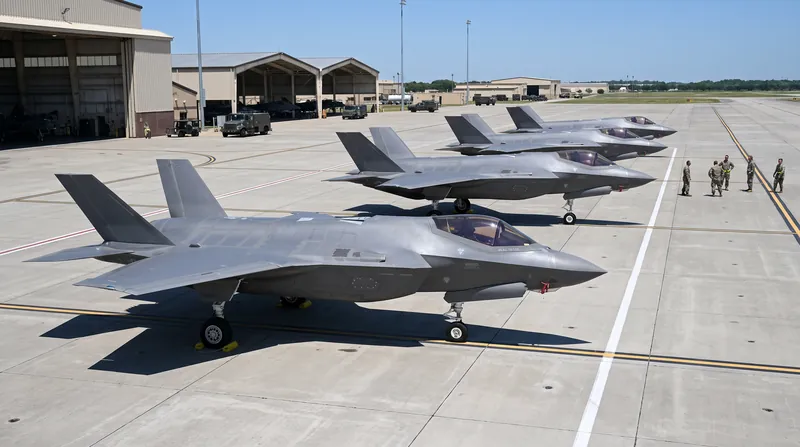
US Approves $24.3 Billion Sale of 48 F-35 Stealth Fighters to Saudi Arabia
5 sources
Cyber Warfare Law
The Equivalent Kinetic Effect: How Physical Damage Defines a Cyber Operation as a Use of Force
2 sources

Every angle. Every day.
Get Defense & Security stories with full source coverage and perspective breakdowns delivered to your inbox.