
Firing Over 200 THAAD Interceptors in Operation Epic Fury Halved U.S. Stockpiles
The U.S. expended over 200 advanced interceptors during recent Middle East hostilities, exposing vulnerabilities in the defense industrial base and the high cost of kinetic missile defense.
By Hao Li

Share this story
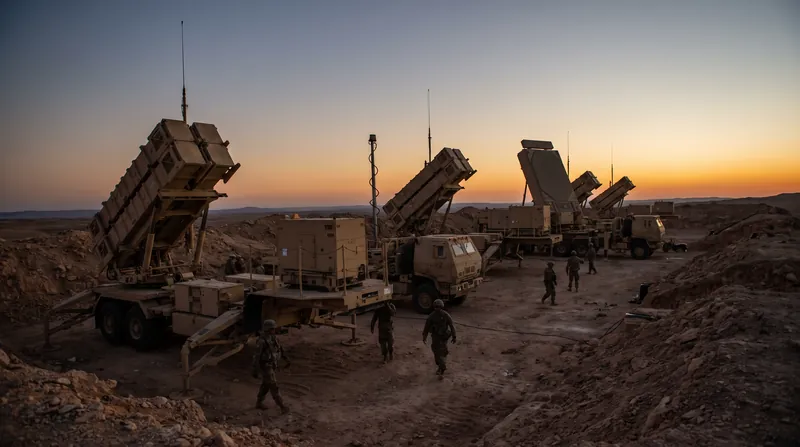
The United States military expended roughly half of its Terminal High Altitude Area Defense (THAAD) interceptor inventory during recent hostilities in the Middle East, alongside hundreds of Standard Missiles (SM-3 and SM-6). According to Defense Department assessments detailed in recent reports, over 200 THAAD interceptors were launched to counter Iranian medium-range ballistic missiles during the intense 12-day span of Operation Epic Fury.
The U.S. Navy simultaneously expended over 100 SM-3 and SM-6 interceptors from Arleigh Burke-class destroyers and other vessels stationed in the Eastern Mediterranean and the Red Sea. This unprecedented expenditure rate represents the most significant test of the U.S. integrated air defense architecture in its history, successfully neutralizing the vast majority of incoming threats but severely drawing down the nation's strategic reserves in the process.[1]
The underlying data reveals a stark disparity in munition expenditure between allied forces operating within the same theater. While the U.S. drew heavily from its advanced stockpiles to intercept high-altitude threats, Israeli forces conserved their own domestic magazines, firing fewer than 100 Arrow interceptors and approximately 90 David's Sling interceptors.
This imbalance has sparked a public debate regarding alliance burden-sharing, with some defense analysts and political figures suggesting the U.S. absorbed the bulk of the complex missile defense mission to allow Israel to preserve its own reserves for future contingencies. The dynamic has raised questions about the equitable distribution of defense costs, especially given the multi-billion-dollar price tag of the U.S. munitions expended during the brief conflict.[1]
However, defense strategists and military planners argue that evaluating the conflict through a simple ledger of national expenditures fundamentally misinterprets how integrated air defense architectures are designed to function. THAAD and SM-3 systems are specifically optimized for the altitude, velocity, and trajectory of medium-range ballistic threats.
Because the U.S. military owns these specific fire-control assets in the greatest depth, allocating American interceptors to the most complex incoming threats represents the system working exactly as intended, rather than a failure of burden-sharing. Every interceptor fired by either country contributed to the same unified objective of protecting civilian populations and military personnel, demonstrating the operational success of a deeply integrated, multi-layered defensive shield.
The primary vulnerability exposed by the operation is not tactical performance, but industrial capacity. The U.S. defense industrial base currently produces approximately 100 THAAD interceptors annually, constrained by complex supply chains and specialized manufacturing requirements. Consequently, the munitions expended over a matter of weeks represent multiple years of manufacturing output.
Analysts warn that this depletion rate raises serious questions about long-term U.S. military readiness and the capacity to sustain global security commitments if conflicts erupt in multiple theaters simultaneously. Rebuilding these stockpiles will require sustained funding and a significant expansion of production facilities, a process that cannot be achieved overnight.[1]
The economic asymmetry of the conflict further complicates the strategic outlook for the United States and its allies. A single THAAD interceptor costs approximately $15 million, while the Iranian Shahed drones and older ballistic missiles they are intercepting cost a fraction of that amount—often as little as $40,000 for a mass-produced one-way attack drone.
This highly unfavorable cost-exchange ratio is a structural threat to stockpile sustainability, as adversaries can mass-produce cheap offensive weapons faster and cheaper than the U.S. can manufacture high-end kinetic interceptors. If this economic dynamic is not addressed, the financial burden of sustained air defense could become prohibitive.
For two decades, the U.S. defense industrial base was optimized for peacetime efficiency, prioritizing lean production lines and just-in-time manufacturing over deep, resilient reserves. The rapid depletion of the THAAD stockpile is forcing a strategic pivot toward what military planners call 'magazine depth'.
Defense leaders are now pushing to aggressively expand interceptor production capacity, diversify the fragile supply chains supporting them, and increase co-production agreements with allied nations to distribute the manufacturing burden. This shift acknowledges that in an era of mass-produced drone and missile threats, industrial capacity is as critical to national security as the technological sophistication of the weapons themselves.
To permanently alter the cost-exchange ratio and relieve the pressure on kinetic interceptor stockpiles, the Pentagon is accelerating investments in alternative interception technologies. Directed energy weapons, such as high-energy lasers and high-power microwaves, are being rapidly developed and tested to defeat drone swarms and lower-tier threats at a cost of dollars per shot, rather than millions.
By shifting the burden of intercepting cheap drones to directed energy systems, the military can reserve its high-end, multi-million-dollar kinetic interceptors strictly for complex ballistic missile threats. Until these advanced systems are widely fielded, however, the U.S. and its allies will remain heavily reliant on expensive traditional interceptors to protect critical infrastructure.
Significant uncertainties remain regarding the long-term sustainability of this defensive posture as the geopolitical landscape evolves. While the exact number of remaining U.S. interceptors is highly classified, intelligence assessments suggest that Iran retains up to 70% of its pre-war missile stockpile, alongside heavily fortified underground production facilities that have largely survived recent strikes.
Whether the U.S. industrial base can scale production fast enough to replenish its magazines before the next major crisis emerges remains the central question for defense planners. The outcome of this industrial race will likely define the future of integrated air and missile defense for decades to come.[1]
Key points
- The US expended roughly half of its THAAD interceptor stockpile defending Israel during recent hostilities.
- US forces launched over 200 THAADs and 100 Standard Missiles, while Israel fired fewer than 190 of its own interceptors.
- The disparity has sparked debates over burden-sharing, though strategists note the US systems were best suited for the specific threats.
- A single THAAD interceptor costs $15 million, creating an unsustainable cost-exchange ratio against cheaper drones and missiles.
What we don’t know
- The exact number of THAAD and Standard Missile interceptors remaining in the classified US inventory.
- How quickly the defense industrial base can scale up production to replenish the expended stockpiles.
- The precise timeline for when directed-energy weapons will be widely fielded to offset kinetic interceptor usage.
How we got here
Oct 2023 - Apr 2024
Initial surges in interceptor usage begin in the Red Sea and during the first wave of ballistic missile attacks.
Early 2025
US Army THAAD systems are redeployed to the Middle East to reinforce the integrated air defense architecture.
June 2025
Operation Epic Fury sees the US expend roughly half its THAAD stockpile over a 12-day period.
July 2026
Defense Department assessments reveal the extent of the depletion, prompting calls for industrial base expansion.
- Integrated Defense Advocates
- Argues that the U.S. firing more interceptors is the system working as designed, matching the best weapon to the threat.
- Burden-Sharing Critics
- Argues the imbalance leaves the U.S. vulnerable globally while allies conserve their own stockpiles.
- Industrial Base Analysts
- Focuses on the unsustainable cost-exchange ratio and the urgent need to scale production.
Perspectives this story doesn't cover
- Indo-Pacific Command Planners
- Defense Industry Manufacturers
Sources
Source coverage
1 outlets
3 viewpoints surfaced

- [1]The Washington PostBurden-Sharing Critics
U.S. military depleted advanced interceptor stockpile defending Israel
Read on The Washington Post →
More in Defense & Security
See all →Missile Defense
Germany's Secret Ballistic Missile Test Signals €12 Billion Shift to Long-Range Deterrence
7 sources
Defense Procurement
NATO Procurement Agency Opens Direct Military Supply Pipeline to Ukraine
5 sources

Defense Industry
Turkey, Qatar, Pakistan and Indonesia Sign Four-Way Defense Production Pact in Doha
6 sources
Maritime Law
Equidistance Versus Natural Prolongation: How the ICJ Divides Overlapping Continental Shelf Boundaries
3 sources

Comments
Every angle. Every day.
Get Defense & Security stories with full source coverage and perspective breakdowns, free every day.