
Japan Prepares $71 Million Subsidy to Accelerate Global Anime and Manga Releases Using AI
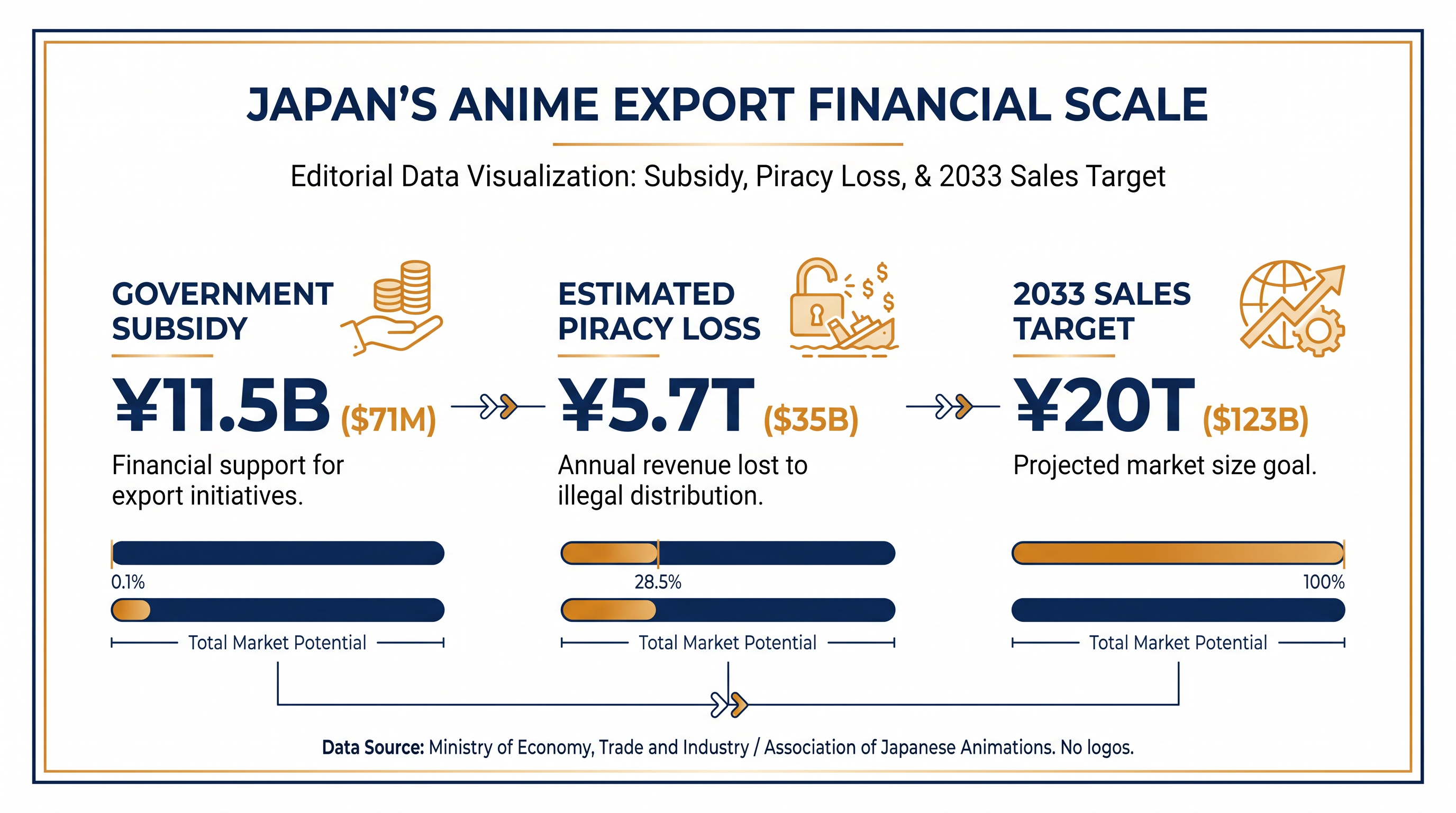
Japan's Ministry of Economy, Trade and Industry is planning an 11.5 billion yen subsidy package to help 15 major entertainment companies use generative AI for faster localization. The initiative aims to combat piracy and triple overseas content sales by 2033.

- Economic Policymakers
- Focus on maximizing export revenue and protecting domestic intellectual property from international piracy.
- Industry Publishers
- View AI as a logistical solution to the bottleneck of localization, enabling simultaneous global releases.
- Localization & Fan Communities
- Emphasize the importance of translation quality, cultural nuance, and the potential impact on human localization jobs.
Why this matters
By automating the initial heavy lifting of translation, official releases could launch globally on the same day they debut in Japan. This shift promises to dramatically reduce the wait times that historically drove international fans to unauthorized piracy sites.
Key points
- Japan's METI is preparing an 11.5 billion yen ($71M) subsidy for 15 entertainment companies.
- The funds will encourage the use of generative AI to accelerate the translation of manga, anime, and games.
- The initiative aims to combat piracy, which cost the industry an estimated 5.7 trillion yen in 2025.
- Japan hopes to triple its overseas entertainment sales to 20 trillion yen ($123B) by 2033.
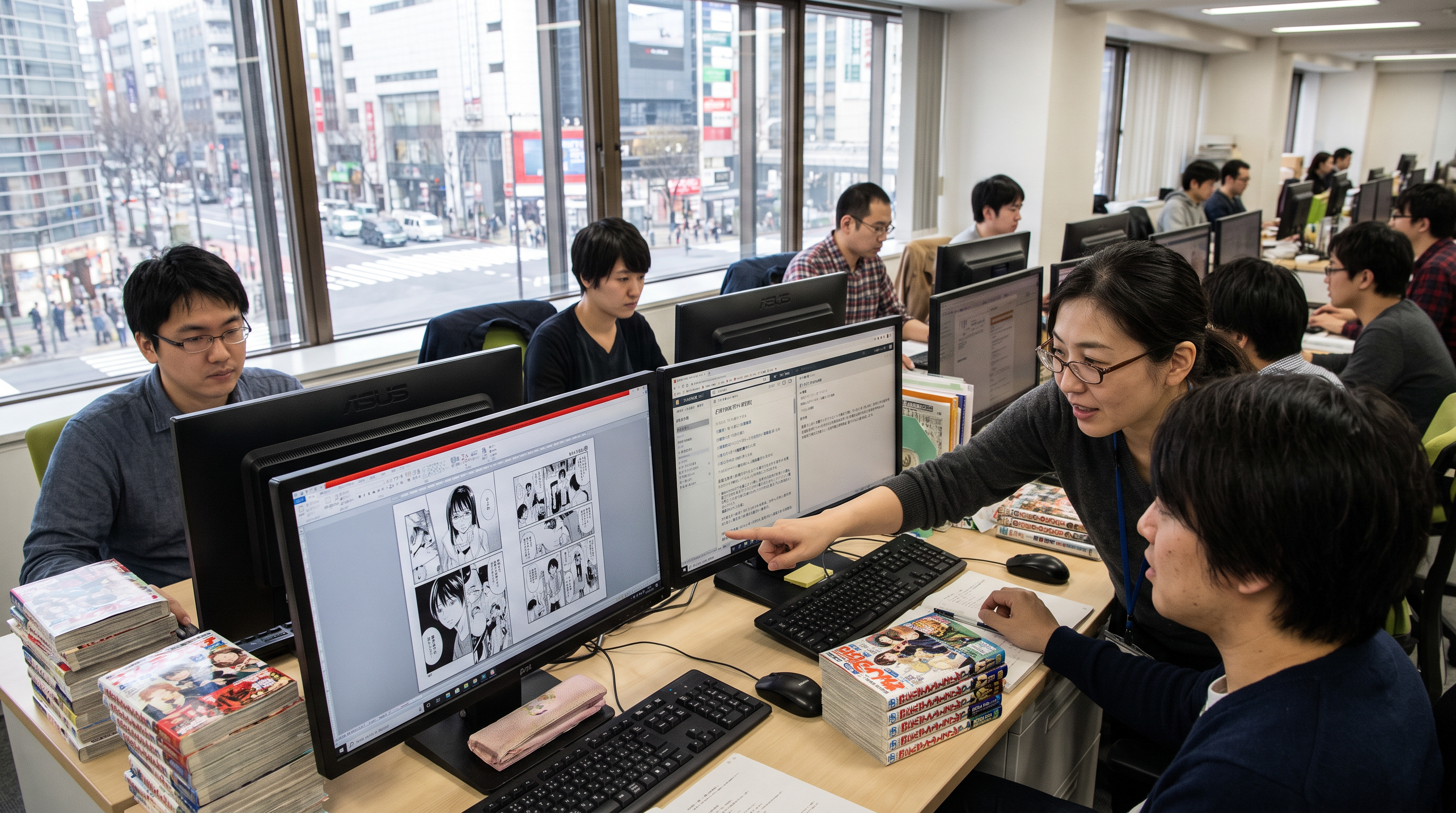
Japan is preparing to make a massive financial push to ensure its cultural exports reach global audiences faster than ever before. The Ministry of Economy, Trade and Industry (METI) is reportedly finalizing an 11.5 billion yen (approximately $71 million) subsidy program designed to accelerate the overseas expansion of the country's most prominent entertainment companies. At the heart of this initiative is a strong government directive encouraging publishers and studios to integrate generative artificial intelligence into their translation pipelines. By automating the heavy lifting of localization, the government hopes to eliminate the delays that have historically plagued international releases.[1][2]
The envisioned subsidy package will cover up to half of the eligible overseas promotion costs for 15 selected companies. These funds are specifically earmarked for translating works into foreign languages, launching international advertising campaigns, and participating in major overseas industry events and conventions. Rather than simply funding traditional localization methods, METI is explicitly pushing for the adoption of generative AI to produce official translations at a vastly accelerated pace. This technological pivot is viewed as a necessary evolution for an industry struggling to meet the insatiable, immediate demand of a global fanbase.[1]
While the government has yet to officially publish the final list of recipients, industry reports indicate that nine of the 15 slots will go to heavyweights in the anime and manga sectors. The expected beneficiaries include publishing giants Shueisha and Kodansha, gaming and multimedia conglomerate Square Enix, entertainment holding company Bandai Namco, and Sony's dedicated anime streaming platform, Crunchyroll. Together, these companies control the vast majority of Japan's most lucrative and globally recognized intellectual properties, making them the natural vanguard for this state-sponsored localization push.[2]
The remaining six companies slated to receive the subsidy will reportedly span the music, gaming, and live-action television sectors. This broad inclusion underscores the government's holistic approach to cultural exportation. While anime and manga often dominate international headlines, Japan's broader entertainment ecosystem—from J-pop to live-action drama—faces similar localization bottlenecks. By subsidizing AI translation across multiple mediums, METI aims to create a rising tide that lifts the entire Japanese content industry on the global stage.[3]
The primary catalyst driving this aggressive government intervention is the staggering economic damage inflicted by international piracy. For decades, a significant gap has existed between the domestic Japanese release of a manga chapter or anime episode and its official availability in foreign languages. This temporal vacuum created a thriving black market of unauthorized "scanlation" and subtitling sites, which rapidly translate and distribute copyrighted material to millions of global users long before official channels can react. By closing this window, publishers hope to recapture a massive audience that currently consumes their intellectual property outside of monetized ecosystems.[3]
The financial toll of this unauthorized distribution has reached crisis levels. According to government estimates, piracy-related losses for Japanese media companies hit a record 5.7 trillion yen (roughly $35 billion) in 2025. When factoring in the downstream impact on related merchandise and licensing, total losses skyrocketed to an estimated 10.4 trillion yen ($64 billion). By utilizing generative AI to achieve simultaneous global releases, the government hopes to fundamentally undercut the demand for pirated content by providing fans with immediate, high-quality official alternatives.[2]
The integration of AI into the translation process is not intended to entirely replace human localizers, but rather to fundamentally alter their workflow. Generative models can instantly translate raw Japanese text into dozens of languages, providing a highly accurate baseline draft in seconds. Human editors and localization specialists can then focus their efforts on refining the prose, ensuring cultural nuances are preserved, and adapting character-specific slang or idioms that machines often misinterpret. This hybrid approach drastically reduces turnaround times while attempting to maintain the artistic integrity of the original work.[3]
The integration of AI into the translation process is not intended to entirely replace human localizers, but rather to fundamentally alter their workflow.
The groundwork for this AI-driven future has already been laid through strategic investments by both the public and private sectors. Major publishers have recently poured capital into specialized AI translation startups. For example, Orange Inc., a company developing proprietary manga translation technology, recently launched the "emaqi" platform for North American audiences with the ambitious goal of translating 500 manga volumes per month. Similarly, AI translation platform Mantra has secured backing from Shueisha, Shogakukan, and Kadokawa, and its technology is already being deployed on Shueisha's popular Manga Plus application.[3]
This subsidy program is a key component of a much larger economic strategy championed by Prime Minister Sanae Takaichi's administration. The government has officially designated the content industry as one of 17 priority fields for national investment and growth. Recognizing that Japan's traditional economic pillars face increasing global competition, policymakers are aggressively pivoting toward cultural exports as a primary driver of future GDP growth, treating intellectual property with the same strategic importance historically reserved for automotive manufacturing and consumer electronics.[1][2]
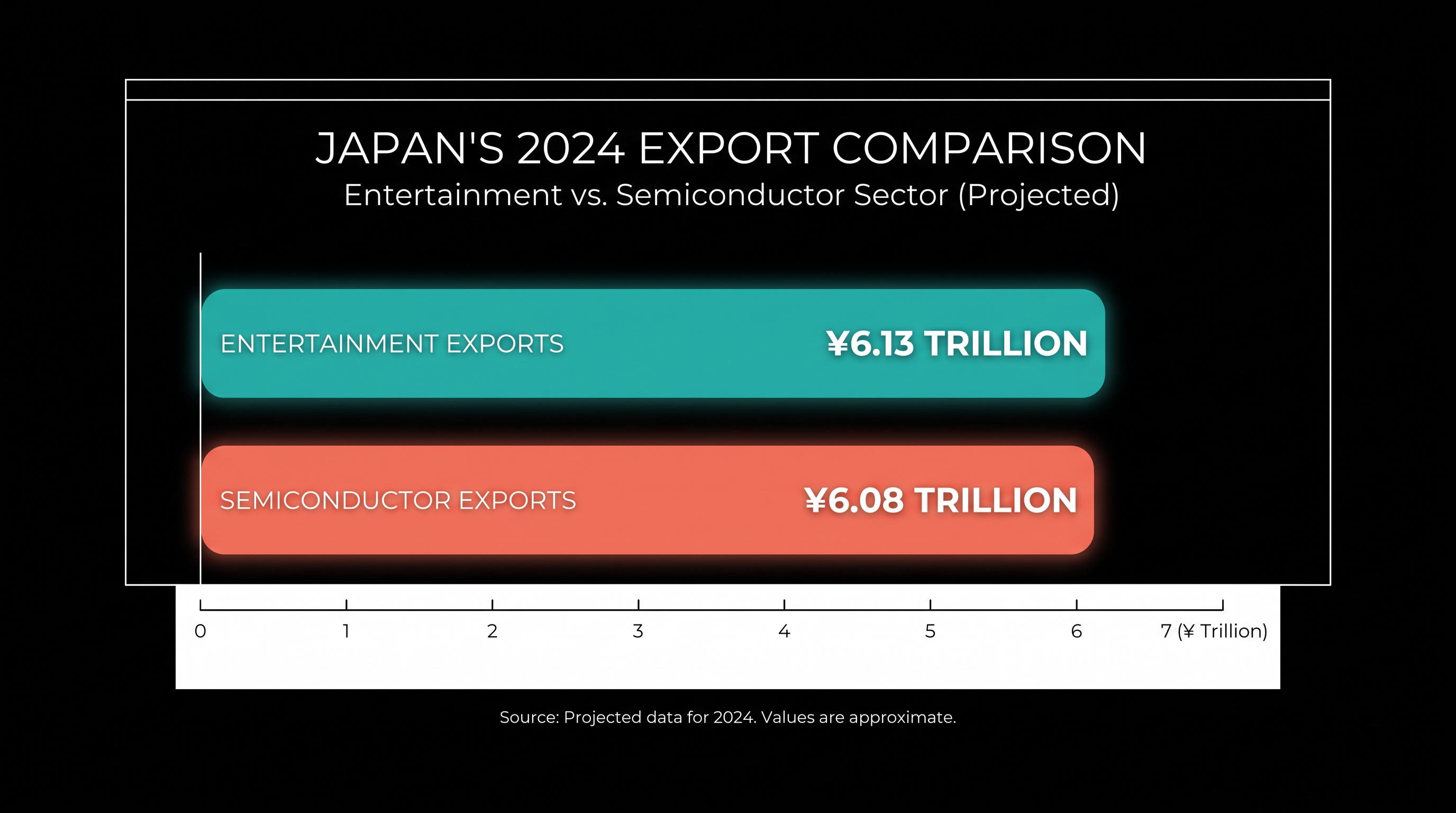
The economic data strongly supports this strategic shift. In a watershed moment for the Japanese economy, overseas sales of Japanese entertainment reached 6.13 trillion yen ($37.9 billion) in 2024. This figure officially surpassed the export value of Japan's semiconductor industry, which totaled 6.08 trillion yen during the same period. This milestone proved to policymakers that anime, manga, and gaming are no longer niche cultural exports, but rather foundational elements of Japan's modern economic engine.
Building on this momentum, METI has set highly ambitious long-term targets for the content sector. The government aims to more than triple overseas entertainment sales to 20 trillion yen (approximately $123 billion) by the year 2033. Achieving this exponential growth will require Japanese companies to penetrate new emerging markets in Latin America, Southeast Asia, and the Middle East—regions where rapid, cost-effective localization into local languages will be the primary barrier to entry. AI translation is viewed as the only scalable solution to service these diverse linguistic markets simultaneously.[1][2]
Alongside revenue targets, the subsidy program is tied to massive audience expansion goals. The government hopes to increase the combined global subscriber base of the participating companies' streaming and reading services from the current 100 million users to 300 million. Platforms like Crunchyroll, which currently boasts over 21 million paid subscribers, and Shueisha's Shonen Jump+ app are viewed as the primary vehicles for capturing and monetizing this massive influx of new international consumers.[2][3]
The entertainment subsidy also aligns perfectly with METI's broader technological ambitions, specifically the Generative AI Accelerator Challenge (GENIAC). Launched in early 2024, GENIAC is a national project designed to build domestic Japanese AI foundation models, reducing the country's reliance on foreign tech giants. By encouraging entertainment companies to utilize AI, the government is simultaneously creating a massive domestic market for Japanese-developed natural language processing tools, creating a symbiotic relationship between the tech and content sectors.[4]
Despite the clear economic incentives, the transition to AI-assisted localization is not without significant uncertainty. Translating manga and anime is a highly complex art form that requires a deep understanding of cultural context, humor, and subtext. Critics and localization professionals have expressed valid concerns that an over-reliance on generative AI could result in sterile, literal translations that strip the soul and distinct voice from beloved characters, potentially alienating the very international fans the government is trying to attract.[3]
The ultimate success of the 11.5 billion yen subsidy will depend entirely on execution. If publishers can successfully implement a hybrid workflow where AI handles the volume and human experts ensure the quality, they could effectively eliminate the piracy gap and unlock unprecedented global revenue. However, if the push for speed compromises the artistic integrity of the medium, the initiative risks damaging the global reputation of Japanese pop culture. As the program rolls out, the entire global entertainment industry will be watching to see if AI can truly bridge the language barrier at scale.[1]
How we got here
Feb 2024
METI launches the GENIAC project to boost domestic generative AI capabilities.
2024
Japanese entertainment exports surpass semiconductor exports for the first time.
2025
Piracy-related losses for Japanese media companies hit a record ¥5.7 trillion.
June 2026
Reports emerge of METI's planned ¥11.5 billion subsidy for AI translation.
Viewpoints in depth
Economic Policymakers
The government views cultural exports as a critical pillar of Japan's future economic growth.
For decades, Japan's economy has been anchored by automotive manufacturing and consumer electronics. However, as global competition in those sectors intensifies, policymakers are increasingly looking to intellectual property as the country's next great economic engine. By subsidizing AI translation, the government aims to eliminate the friction of language barriers, allowing Japanese entertainment to scale globally with the same efficiency as software. The ultimate goal is to transform the 5.7 trillion yen currently lost to piracy into legitimate, taxable export revenue.
Publishers & Streaming Platforms
Media companies see AI as the only scalable way to meet the immediate demands of a global fanbase.
The traditional localization pipeline—where human translators, editors, and letterers work sequentially—is fundamentally too slow to support simultaneous worldwide releases across dozens of languages. Publishers argue that this delay is the primary driver of piracy, as international fans refuse to wait months for official localized versions. By deploying generative AI to handle the initial translation pass, companies like Crunchyroll and Shueisha believe they can finally close the release window, offering day-and-date global launches that capture maximum revenue and cultural momentum.
Localization Professionals
Translators warn that over-reliance on AI could strip the cultural nuance and distinct voice from beloved works.
While acknowledging the need for speed, professional localizers caution that manga and anime are highly contextual mediums. Generative AI often struggles with character-specific speech patterns, regional dialects, and culturally specific humor that doesn't map cleanly to English or other target languages. The localization community advocates for a hybrid model where AI is strictly used as a drafting tool, ensuring that human experts retain final editorial control to preserve the artistic integrity and emotional resonance of the original Japanese works.
What we don't know
- The exact breakdown of how the 11.5 billion yen will be distributed among the 15 companies.
- Whether AI translations will meet the quality standards expected by international fan communities.
- How the widespread adoption of AI will impact employment for human translators and localizers in the long term.
Key terms
- METI
- Japan's Ministry of Economy, Trade and Industry, the government agency driving economic and industrial policy.
- GENIAC
- Generative AI Accelerator Challenge, a Japanese national project to build domestic AI foundation models.
- Scanlation
- The unauthorized scanning, translation, and distribution of comics, typically done by fans before official releases are available.
- Localization
- The process of adapting translated content to the cultural context and nuances of a specific target market.
Frequently asked
Which companies are receiving the subsidy?
While not officially announced, reports indicate 15 companies will receive funds, including Crunchyroll, Shueisha, Kodansha, Square Enix, and Bandai Namco.
Will AI completely replace human translators?
No. The industry is moving toward a hybrid model where AI performs the initial rapid translation, which is then refined by human editors for cultural nuance and accuracy.
How much money is Japan losing to piracy?
In 2025, Japanese media companies lost an estimated ¥5.7 trillion ($35 billion) to piracy, a figure that rises to ¥10.4 trillion when including unauthorized merchandise.
Sources
Source coverage
4 outlets
3 viewpoints surfaced




[1]The Japan NewsEconomic Policymakers
Govt to subsidize anime, manga exports; 15 firms to get ¥11.5 bil. to boost overseas sales
Read on The Japan News →[2]Anime News NetworkIndustry Publishers
Japanese Govt. to Consider Providing Subsidies for AI Translation, Overseas Sales Generation to Companies Like Shueisha, Crunchyroll
Read on Anime News Network →[3]AnimehunchLocalization & Fan Communities
Japan To Pay Shueisha, Bandai & Crunchyroll Millions To Utilize AI Translations
Read on Animehunch →[4]Ministry of Economy, Trade and IndustryEconomic Policymakers
About GENIAC (Generative AI Accelerator Challenge)
Read on Ministry of Economy, Trade and Industry →


Every angle. Every day.
Get entertainment stories with full source coverage and perspective breakdowns delivered to your inbox.