
The AI in Your Pocket: How Small Language Models Are Taking AI Offline
A new generation of compact artificial intelligence models is moving processing out of the cloud and directly onto smartphones and laptops, offering instant responses and total data privacy.
By Factlen Editorial Team
- Privacy Advocates
- Celebrate on-device AI as the return of data sovereignty and user control.
- Enterprise IT & Compliance
- Value the predictable costs and elimination of data-leakage risks.
- Cloud AI Proponents
- Argue that massive cloud models will always be needed for complex reasoning.
What's not represented
- · Hardware Manufacturers
- · Open-Source Developers
Why this matters
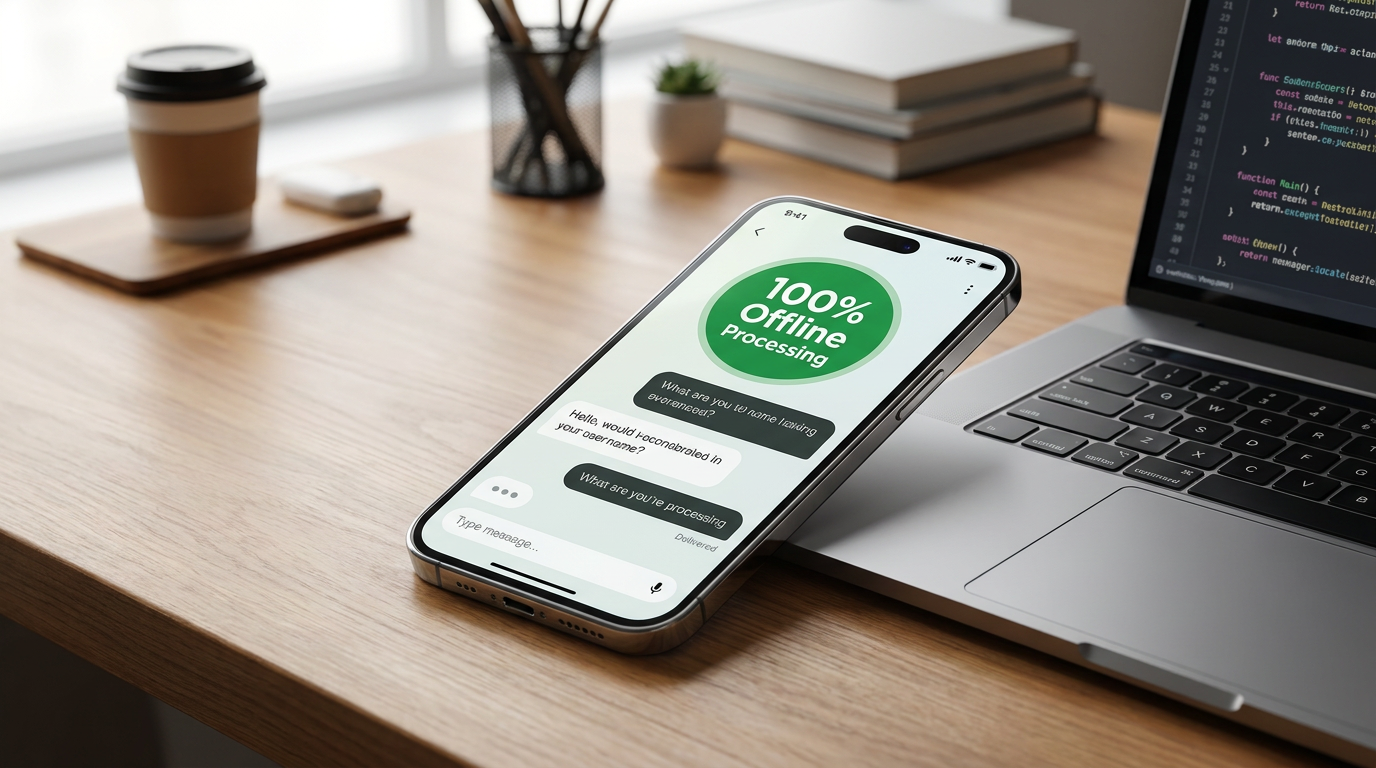
If you have hesitated to use AI for sensitive work or personal data, on-device AI solves the privacy problem by keeping your information strictly on your own hardware, while also working seamlessly without an internet connection.
Key points
- Small Language Models (SLMs) are shifting AI processing from remote cloud servers directly onto consumer smartphones and laptops.
- By processing data locally, on-device AI ensures that sensitive personal and corporate information never leaves the physical hardware.
- Local processing eliminates network latency, providing instant responses and allowing AI features to function entirely offline.
- Software compression techniques like quantization and pruning allow these models to retain 80% to 90% of a massive model's capabilities at a fraction of the size.
- While highly efficient for specific tasks, SLMs still rely on larger cloud models for complex, multi-step reasoning and vast knowledge retrieval.
The artificial intelligence revolution of the past three years was defined by massive scale. Models like OpenAI's GPT-4 and Google's Gemini Ultra grew to encompass over a trillion parameters, requiring vast warehouses of specialized processors and constant internet connections to function. When you asked a question, your prompt was beamed to a server farm hundreds of miles away, processed, and beamed back. It was undeniably powerful, but it came with a catch: you were essentially renting a supercomputer by the second, and handing over your personal data to do it.[7]
In 2026, the pendulum has swung in the opposite direction. The technology industry is quietly undergoing a massive architectural shift away from the cloud and back to the device in your pocket. The catalyst for this decentralization is a new class of artificial intelligence known as Small Language Models, or SLMs.[1][7]
Unlike their massive cloud-based cousins, SLMs are designed to run entirely locally on a smartphone, tablet, or laptop. They typically range from 1 billion to 13 billion parameters—a fraction of the size of a frontier model. Yet, thanks to breakthroughs in how these neural networks are trained and compressed, they are now delivering 80 to 90 percent of the capabilities of massive models for everyday tasks.[2][3]
Major technology companies have aggressively pivoted to this space to capture the edge-computing market. Microsoft's Phi-4 mini packs just 3.8 billion parameters but punches well above its weight class in reasoning and coding. Meta's Llama 3 8B and Google DeepMind's Gemma 2 2B have become standard building blocks for independent developers. Meanwhile, Google has integrated Gemini Nano directly into the Android operating system, allowing everyday applications to tap into local AI without writing custom neural networks.[1][4]

The mechanism that makes this possible relies on two major software breakthroughs: quantization and pruning. A neural network is essentially a massive collection of mathematical weights, usually stored as high-precision 32-bit floating-point numbers. Quantization compresses these weights into lower-precision formats, like 8-bit or even 4-bit integers.[3]
Think of quantization like converting a massive, uncompressed RAW photograph into a crisp, lightweight JPEG. You lose a tiny fraction of the mathematical nuance, but the file size shrinks by 75 percent or more. Pruning takes this optimization a step further by identifying and severing the neural connections that the model rarely uses, streamlining the architecture so it can fit into the limited memory of a mobile device.[1][3]
But software compression is only half the story. The hardware inside consumer devices has fundamentally changed to accommodate these models. Modern laptops and smartphones now ship with Neural Processing Units, or NPUs—dedicated silicon designed specifically to handle the complex matrix math required by artificial intelligence.[5]
Before NPUs, running an AI model locally would hijack a device's central processor, causing the battery to drain in minutes and the chassis to overheat. NPUs handle these specific calculations with remarkable energy efficiency, allowing a smartphone to generate text, summarize documents, or translate audio in real-time without burning through its battery life.[5]

Before NPUs, running an AI model locally would hijack a device's central processor, causing the battery to drain in minutes and the chassis to overheat.
The most immediate and transformative benefit of this hardware-software synergy is absolute privacy. For years, professionals in healthcare, finance, and law were barred from using generative AI because uploading confidential client data to a third-party cloud server violated strict compliance laws and data sovereignty mandates.[2][5]
On-device AI solves the data sovereignty problem by design. Because the model lives entirely on the hardware, the data never leaves the device. For example, clinical AI tools like Heidi Remote now use local SLMs to transcribe doctor-patient consultations directly on a wearable device. The audio is processed and encrypted locally, eliminating the risk of interception during transmission or exposure to a cloud provider's servers.[6]
Beyond privacy, local AI eliminates the latency inherent in cloud computing. Cloud models require a network roundtrip, resulting in the familiar delay as the server generates a response. On-device models process tokens instantly. For tasks like live translation, real-time meeting transcription, or predictive text, this zero-latency response is the difference between a seamless feature and a frustrating gimmick.[4]
This local processing also severs the tether to the internet. On-device AI works flawlessly in airplane mode, in remote field locations with patchy cellular service, or in secure enterprise environments where external network access is strictly firewalled. Field workers can now use AI to analyze technical manuals or summarize inspection reports while entirely offline.[5]

The shift to SLMs is also radically altering the economics of artificial intelligence. Cloud AI operates on a tollbooth model: developers pay API fees for every token generated, meaning a popular application can quickly rack up massive server bills. By offloading the compute to the user's NPU, software companies eliminate these recurring costs. The user's device does the heavy lifting, making AI features financially sustainable to operate at scale.[4]
However, the transition to Small Language Models is not without trade-offs. While an 8-billion parameter model is exceptionally good at specific, bounded tasks—like summarizing an email, formatting data, or answering questions based on a provided document—it lacks the vast, encyclopedic knowledge of a 100-billion parameter model.[3]
SLMs are less capable of handling complex, multi-step reasoning puzzles, and they exhibit lower performance in open-ended creative writing. They are specialists rather than generalists. If you need an AI to write a complex software application from scratch or synthesize five different philosophical theories, a cloud model is still required. But if you need an AI to quickly draft a polite decline to a calendar invite, an SLM is more than sufficient.[3]

Looking ahead, the next frontier for on-device AI is federated learning. Currently, AI models are static once downloaded. Federated learning allows the model to learn from your specific usage patterns—adapting to your vocabulary, your writing style, and your preferences—without ever uploading your personal data to a central server.[1]
Instead of sending your data to the cloud, federated learning sends a tiny, anonymized summary of the mathematical improvements the model made locally. These tweaks are aggregated from millions of devices to improve the global model, while your actual personal data remains locked securely on your phone.[1]
The era of treating artificial intelligence purely as a remote oracle accessed through a web browser is ending. By shrinking the models and upgrading the silicon, the technology industry is turning AI into a localized utility—as private, fast, and ubiquitous as the calculator application on your phone.[7]
How we got here
Late 2023
The AI industry focuses heavily on massive cloud-based models, with parameters exceeding one trillion, requiring constant internet connectivity.
December 2023
Google announces Gemini Nano, signaling the first major push to integrate a lightweight, on-device AI model directly into a mobile operating system.
April 2024
Microsoft releases the Phi-3 family of models, proving that models with under 4 billion parameters can rival the performance of much larger systems.
Mid 2025
Hardware manufacturers standardize the inclusion of Neural Processing Units (NPUs) in consumer laptops and smartphones to support local AI.
Early 2026
Small Language Models become the default architecture for enterprise applications requiring strict data privacy and zero-latency processing.
Viewpoints in depth
Privacy Advocates
Celebrate on-device AI as the return of data sovereignty and user control.
For privacy advocates, the shift to local processing is the most important development in consumer technology since end-to-end encryption. They argue that the cloud-first AI era normalized the mass extraction of personal data, forcing users to trade their privacy for convenience. By keeping sensitive inputs—like medical queries, financial data, and personal journals—strictly on the physical hardware, Small Language Models eliminate the risk of third-party data breaches and unauthorized training data scraping.
Enterprise IT & Compliance
Value the predictable costs and elimination of data-leakage risks.
Corporate IT departments view Small Language Models as the key to safely deploying AI across their workforces. Cloud-based models present a constant risk of employees accidentally pasting proprietary code or confidential client data into public servers. Furthermore, cloud APIs charge by the token, making costs unpredictable. On-device AI solves both problems simultaneously: it satisfies strict data-sovereignty regulations by keeping data in-house, and it shifts the compute cost from a recurring cloud bill to a one-time hardware purchase.
Cloud AI Proponents
Argue that massive cloud models will always be needed for complex reasoning.
While acknowledging the benefits of local AI, proponents of frontier models argue that Small Language Models are inherently limited by their physical size. They point out that true artificial general intelligence (AGI) and complex, multi-step reasoning tasks require the massive parameter counts and vast knowledge bases that only data centers can provide. In their view, SLMs are excellent 'edge agents' for simple tasks, but the cloud will remain the indispensable brain for heavy lifting, coding, and deep analysis.
What we don't know
- It remains unclear how quickly legacy software applications will rewrite their codebases to take advantage of local NPUs instead of relying on easier cloud APIs.
- The long-term hardware lifespan of early 'AI PCs' is uncertain, as the rapid growth in model complexity may quickly outpace first-generation NPU capabilities.
- It is not yet known if federated learning will be widely adopted by consumers who remain skeptical of any background data-sharing, even if anonymized.
Key terms
- Small Language Model (SLM)
- An AI model with a relatively low parameter count (typically 1 to 13 billion) designed to run efficiently on local consumer hardware rather than massive cloud servers.
- Neural Processing Unit (NPU)
- A specialized microchip built into modern smartphones and laptops specifically designed to handle the complex mathematics required by artificial intelligence.
- Quantization
- A compression technique that shrinks the file size of an AI model by reducing the mathematical precision of its internal weights, allowing it to fit on mobile devices.
- Pruning
- The process of removing redundant or rarely used connections within an AI's neural network to make the model run faster and consume less power.
- Federated Learning
- A privacy-preserving training method where devices learn from user behavior locally and only share anonymous mathematical improvements with the central server, never the raw data.
Frequently asked
Can on-device AI work without an internet connection?
Yes. Because the entire AI model is downloaded and stored on your device's physical hardware, it can process text, translate languages, and summarize documents even in airplane mode.
Will running AI locally drain my smartphone's battery?
Modern devices use dedicated Neural Processing Units (NPUs) to handle AI tasks. These chips are highly energy-efficient, meaning local AI processing uses significantly less battery than relying on the main CPU.
Is a Small Language Model as smart as ChatGPT?
Not quite. While SLMs are excellent at specific tasks like summarizing emails or fixing grammar, they lack the vast encyclopedic knowledge and complex reasoning capabilities of massive cloud models.
How does on-device AI improve my privacy?
With cloud AI, your prompts and data are sent to a remote server for processing. On-device AI processes everything locally, meaning your sensitive information never leaves your phone or laptop.
Sources
Source coverage
7 outlets
3 viewpoints surfaced







[1]AimindCloud AI Proponents
Discover why small language models and edge AI are transforming technology in 2026
Read on Aimind →[2]Knolli AIEnterprise IT & Compliance
What are Small Language Models (SLMs) & How do They Differ from Large Language Models?
Read on Knolli AI →[3]KanerikaEnterprise IT & Compliance
Deploying Small Language Models in Your Enterprise
Read on Kanerika →[4]IntuzEnterprise IT & Compliance
10 Best Small Language Models of 2026
Read on Intuz →[5]Dell TechnologiesEnterprise IT & Compliance
The On-Device Intelligence Advantage
Read on Dell Technologies →[6]IatroxPrivacy Advocates
Heidi Remote and the privacy architecture of clinical AI
Read on Iatrox →[7]Factlen Editorial TeamPrivacy Advocates
Synthesis by Factlen editorial team
Read on Factlen Editorial Team →


Every angle. Every day.
Get meta stories with full source coverage and perspective breakdowns delivered to your inbox.