
The 2026 Sleep Tracker Showdown: Oura Ring vs. Whoop vs. Apple Watch
A side-by-side analysis of the top sleep wearables reveals distinct trade-offs between holistic wellness, athletic performance, and all-in-one medical screening.
By Factlen Editorial Team
- Holistic Wellness Advocates
- Focuses on comfort, sleep staging accuracy, and overall lifestyle readiness.
- Performance Athletes
- Prioritizes actionable training guidance, strain measurement, and recovery optimization.
- General Smartwatch Users
- Values all-in-one utility, daytime productivity, and clinical health screening.
- Clinical Sleep Researchers
- Evaluates consumer devices against medical-grade polysomnography and demands algorithm transparency.
- Neutral Analysts
- Synthesizes the trade-offs across all form factors and pricing models.
What's not represented
- · Budget-conscious consumers
- · Android smartwatch loyalists
Why this matters
Choosing the right sleep tracker dictates what kind of health data you receive and how it influences your daily habits. Understanding the trade-offs prevents you from overpaying for athletic features you don't need or missing out on critical recovery insights.
Key points
- The Oura Ring 4 offers the highest clinical accuracy for sleep staging due to its finger-based sensor design.
- Whoop 5.0 excels at translating overnight sleep data into actionable athletic strain and recovery targets.
- The Apple Watch Series 11 provides unmatched daytime utility and FDA-cleared sleep apnea detection, but struggles with battery life.
- Subscription costs drastically alter the long-term value, with Whoop costing over $700 across three years compared to the Apple Watch's flat upfront price.
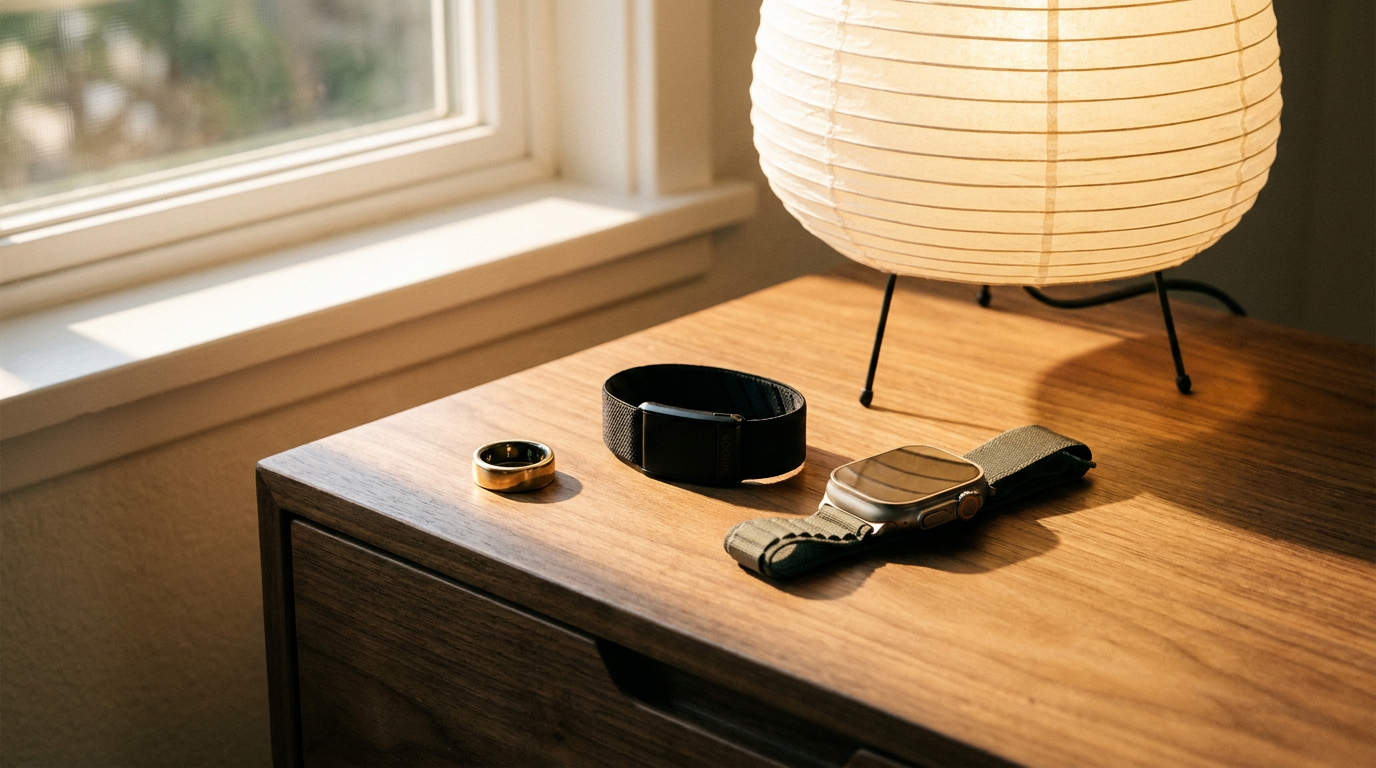
The era of simple step counters is over. Today's wearables are sophisticated biometric laboratories, and sleep tracking has become the ultimate battleground for consumer health technology. Three devices dominate the 2026 conversation: the Oura Ring 4, the Whoop 5.0, and the Apple Watch Series 11.[1]
Choosing between them is no longer about which device has the best app; it is about fundamentally different philosophies of health tracking. The market has fractured into distinct camps: holistic wellness, athletic performance, and all-in-one medical screening.[7]
Before comparing features, the clinical evidence sets a baseline. A 2026 study at Brigham and Women's Hospital compared these consumer devices against polysomnography (PSG), the clinical gold standard. The evidence showed that finger-based sensors yield cleaner photoplethysmography (PPG) signals overnight than wrist-based alternatives, largely due to the density of capillaries in the finger.[2][6]
For the Oura Ring 4, the primary argument is accuracy and comfort. Weighing just 3 to 5 grams, the titanium ring houses an 18-path sensor system. The evidence for Oura is strong: clinical validation shows it achieves a 76.0 to 79.5 percent sensitivity across four-stage sleep classification, outperforming wrist-based competitors in deep sleep detection.[2][4]

The argument against Oura centers on its daytime limitations and recurring costs. While it excels at overnight recovery metrics, it lacks the dynamic, real-time workout strain tracking that serious athletes demand. Furthermore, users must pay a $349 upfront hardware cost plus a $5.99 monthly subscription to access their data.[5][6]
For the Whoop 5.0, the primary argument is the seamless integration of sleep data into a comprehensive athletic strain pipeline. Whoop does not just tell users how they slept; it dictates how hard they should train the next day based on overnight heart rate variability (HRV) and accumulated sleep debt.[5][7]
The evidence supporting Whoop lies in its continuous 24/7 monitoring and impressive 10-to-14-day battery life, ensuring zero data gaps. However, the argument against Whoop is its steep price and narrow focus. At $239 per year with no screen for time or notifications, it is a specialized tool that can feel like overkill for casual users who do not train four days a week.[4][6]
The evidence supporting Whoop lies in its continuous 24/7 monitoring and impressive 10-to-14-day battery life, ensuring zero data gaps.
For the Apple Watch Series 11, the primary argument is unmatched daytime utility combined with proactive medical screening. With the FDA clearance of its sleep apnea detection feature, the Apple Watch transitions from a fitness tracker to a potential lifesaver, all while managing notifications, calls, and apps.[3][7]

The evidence for the Apple Watch's sleep tracking improved significantly with WatchOS 26, which introduced a comprehensive Vitals app and a restorative sleep score. Yet, the argument against the Apple Watch remains its battery life. At 18 to 36 hours, it requires daily charging, which often forces users to choose between daytime wear and overnight tracking.[4][7]
When evaluating these devices side-by-side, the divergence in how they calculate recovery becomes apparent. Oura uses a Readiness Score that forgives a hard workout if overall lifestyle metrics are balanced. Whoop uses a Recovery Score that is notoriously strict, heavily weighting acute cardiovascular strain and nervous system stress.[1][5]
The Apple Watch takes a more passive approach. Rather than giving a prescriptive readiness score, it presents the raw data and highlights outliers in heart rate or respiratory rate, leaving the interpretation up to the user.[1][7]
Another critical point of comparison is algorithm transparency. Clinical sleep researchers caution that consumer wearables rely on proprietary algorithms that change without notice. The evidence suggests that while these devices are excellent at tracking personal trends over time, comparing a Whoop deep-sleep score directly to an Oura deep-sleep score is fundamentally flawed due to different calculation methods.[2][6]

Cost over a three-year lifespan also reveals stark differences. The Apple Watch Series 11 requires a single upfront payment of roughly $399. The Oura Ring 4 costs $349 upfront plus $215 in subscription fees over three years. The Whoop 5.0, which includes the hardware for free, costs over $700 in subscription fees across the same period.[6][7]
Ultimately, the right choice depends entirely on the user's lifestyle conditions. The Oura Ring 4 fits well when comfort is the top priority, when the user wants the most accurate sleep staging available, and when they prefer a holistic view of wellness over intense athletic coaching. It does not fit well for users who want real-time pacing data during a marathon.[1][3]
The Whoop 5.0 fits well when the user is a dedicated athlete, when training load needs to be carefully balanced against recovery, and when wearing a traditional mechanical watch on the other wrist is preferred. It does not fit well for casual gym-goers or those who balk at high annual subscription fees.[1][5]

The Apple Watch Series 11 fits well when the user is already entrenched in the iPhone ecosystem, when daytime smartwatch features are non-negotiable, and when screening for conditions like sleep apnea is a priority. It does not fit well for users who suffer from tracker fatigue or who cannot commit to a daily charging routine.[1][7]
How we got here
Late 2024
Apple receives FDA clearance for sleep apnea detection, shifting the Apple Watch toward medical screening.
Late 2025
Whoop releases the 5.0 band, introducing medical-grade sensors and longer battery life.
Early 2026
Oura launches the Gen 4 ring with an 18-path sensor system and a lighter titanium shell.
May 2026
Clinical studies confirm finger-based PPG sensors outperform wrist-based sensors for overnight sleep staging.
Viewpoints in depth
Holistic Wellness Advocates
Focuses on comfort, sleep staging accuracy, and overall lifestyle readiness.
This camp argues that the best sleep tracker is the one you forget you are wearing. They champion the Oura Ring for its unobtrusive form factor and its Readiness Score, which takes a forgiving, big-picture view of health. Rather than punishing a user for skipping a workout, this perspective values long-term behavioral changes, stress reduction, and circadian alignment over acute athletic performance.
Performance Athletes
Prioritizes actionable training guidance, strain measurement, and recovery optimization.
For serious athletes, raw sleep data is useless unless it dictates the next day's training load. This camp favors Whoop because it directly connects overnight heart rate variability to a daily strain target. They argue that a dedicated, screenless wearable prevents distractions and provides the strict, uncompromising recovery feedback necessary to prevent overtraining and injury.
Clinical Sleep Researchers
Evaluates consumer devices against medical-grade polysomnography and demands algorithm transparency.
Researchers remain skeptical of proprietary algorithms that calculate 'sleep scores' behind closed doors. While they acknowledge that devices like the Oura Ring have achieved impressive sensitivity in peer-reviewed studies, they caution users against treating consumer wearables as diagnostic tools. This camp emphasizes that wearables are best used for tracking personal baseline trends rather than absolute clinical accuracy.
What we don't know
- How upcoming non-wearable radar technologies (like smart mattresses and bedside lamps) will disrupt the wearable market.
- Whether consumer wearables will eventually achieve true parity with clinical EEG brainwave measurements for sleep staging.
Key terms
- Polysomnography (PSG)
- The clinical gold standard for sleep studies, measuring brain waves, blood oxygen, and breathing.
- Heart Rate Variability (HRV)
- The variation in time between each heartbeat, used as a key indicator of physical recovery and nervous system stress.
- Photoplethysmography (PPG)
- Optical sensor technology used in wearables to measure blood flow and heart rate using light.
- Sleep Architecture
- The cyclical pattern of sleep stages, including light, deep, and REM sleep, experienced during the night.
Frequently asked
Do consumer sleep trackers measure brainwaves?
No, they use heart rate, movement, and temperature to estimate sleep stages. Only clinical polysomnography uses EEG.
Can the Apple Watch detect sleep apnea?
Yes, starting with Series 9 and expanded in Series 11, the Apple Watch has FDA-cleared sleep apnea detection.
Do I have to pay a subscription?
Whoop and Oura require ongoing subscriptions for full data access, while the Apple Watch has no subscription fees after the initial purchase.
Which device is the most comfortable?
The Oura Ring is widely considered the most comfortable due to its lightweight, 3-5 gram titanium ring design.
Sources
Source coverage
7 outlets
5 viewpoints surfaced







[1]Factlen Editorial TeamNeutral Analysts
Synthesis by Factlen editorial team
Read on Factlen Editorial Team →[2]The Longevity StoreClinical Sleep Researchers
The Best Sleep Trackers of 2026: Rings, Bands, and Smart Mattresses Compared
Read on The Longevity Store →[3]Sleep FoundationHolistic Wellness Advocates
Best Sleep Trackers of 2026
Read on Sleep Foundation →[4]WareableHolistic Wellness Advocates
The best sleep trackers we've tested
Read on Wareable →[5]Runner's WorldPerformance Athletes
Oura vs Whoop: Which is better for runners?
Read on Runner's World →[6]Motion Sync HealthPerformance Athletes
Clinical Accuracy of 2026 Sleep Trackers
Read on Motion Sync Health →[7]Simple Wearable ReportGeneral Smartwatch Users
Best Wearable for You — Oura vs Whoop vs Apple Watch (2026)
Read on Simple Wearable Report →
Every angle. Every day.
Get shopping stories with full source coverage and perspective breakdowns delivered to your inbox.