
The 2026 Guide to Electric Motorcycles: Range Breakthroughs, NACS Charging, and Tax Credits Explained
With prices dropping below $8,000 and ranges pushing past 300 miles, electric motorcycles have officially crossed the threshold of practicality. Here is what riders need to know about the 2026 market.
By Factlen Editorial Team
- Urban Commuters
- Value the instant torque, zero clutch fatigue, and the convenience of waking up to a fully charged bike every morning.
- Performance & Off-Road Enthusiasts
- Embrace the massive, instantaneous torque and adjustable power mapping that electric drivetrains provide on the track and trail.
- Long-Distance Tourers
- Remain skeptical due to highway range degradation and the need to meticulously plan routes around fast-charging infrastructure.
- Policy & Financial Analysts
- Focus on the shifting landscape of federal tax incentives and the long-term total cost of ownership compared to gas bikes.
What's not represented
- · Independent motorcycle mechanics facing a transition away from combustion engine repairs.
- · Traditional gas-station operators adapting to the loss of commuter fuel revenue.
Why this matters
For years, electric motorcycles were expensive novelties with severe range limitations. In 2026, the arrival of solid-state batteries, universal fast-charging, and sub-$8,000 models from legacy brands means riders can finally switch to electric without sacrificing practicality or their budget.
Key points
- Legacy brands like Honda and Can-Am have introduced capable electric motorcycles priced under $10,000.
- Solid-state battery technology is pushing maximum ranges past 300 miles on premium models.
- The integration of NACS ports allows new electric motorcycles to utilize Tesla Superchargers.
- The $7,500 federal vehicle tax credit expired in 2025, but a $1,000 home charger credit remains active.
- Electric dirt bikes now outperform their gas-powered equivalents in peak horsepower and torque.
The electric motorcycle market has officially crossed the threshold from experimental novelty to practical reality. For years, riders interested in battery-powered two-wheelers faced a stark choice: spend upward of $20,000 on a premium machine or settle for an underpowered urban scooter. In 2026, that binary has shattered, replaced by a diverse lineup of capable, affordable, and technologically advanced motorcycles that directly challenge internal combustion engines.[1][2]
The most significant shift this year is the aggressive entry of legacy manufacturers into the middleweight segment. Rather than chasing headline-grabbing top speeds, major brands are focusing on the urban commuter and weekend rider. This pivot has drastically lowered the barrier to entry and brought the build quality of traditional OEMs to the electric space.[1][3]
Honda's release of the WN7 marks a turning point for the industry. As the company's first full-size production electric street motorcycle, the WN7 delivers practical ergonomics, a 68 mph top speed, and roughly 70 to 80 miles of realistic range. Priced around $7,499 and backed by Honda's massive global dealer network, it is arguably the most accessible entry point for new riders looking to abandon gasoline.[1][3]
Can-Am has also revived its two-wheeled heritage with the Pulse, an $8,999 street bike powered by a 35 kW Rotax drivetrain. Delivering 47 horsepower and instant torque, the Pulse offers a 100-mile city range and can charge from 20% to 80% in just 50 minutes on a Level 2 charger. It proves that established manufacturers are finally taking the sub-$10,000 electric market seriously.[1][4]

While affordability is improving at the entry level, the premium segment is solving the electric motorcycle's oldest problem: range anxiety. The introduction of solid-state battery technology in production models has dramatically increased energy density without adding prohibitive weight to the chassis.[5][8]
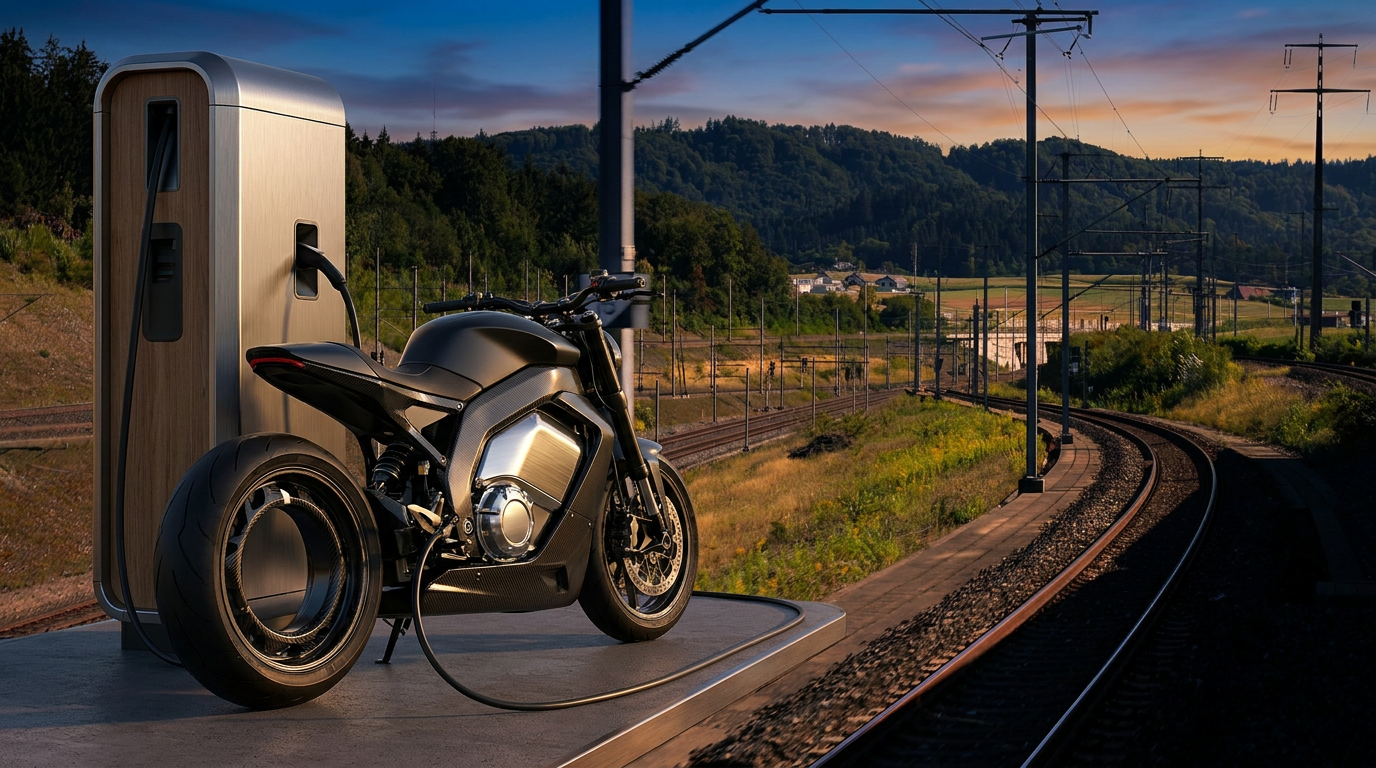
The Verge TS Ultra stands at the forefront of this battery revolution. Equipped with a massive 33.3 kWh solid-state pack, the TS Ultra boasts a staggering maximum range of 370 miles. Beyond its battery, the bike features a radical hubless rear-wheel motor that eliminates the chain drive entirely, delivering a mind-bending 737 lb-ft of torque directly to the pavement and achieving 0-60 mph in 2.5 seconds.[5][8]
Of course, a massive battery is only useful if it can be recharged quickly. The 2026 model year marks the widespread integration of the North American Charging Standard (NACS) across the electric motorcycle industry. By abandoning fragmented proprietary plugs, manufacturers are unlocking a vastly superior infrastructure network.[5]
Of course, a massive battery is only useful if it can be recharged quickly.
With native NACS ports, bikes like the Verge TS Ultra can plug directly into Tesla Superchargers and other high-power networks without cumbersome adapters. This allows riders to fast-charge from 0 to 80% in under 25 minutes, transforming long-distance electric riding from an exercise in meticulous logistical planning into a genuinely spontaneous experience.[5][8]

For city dwellers, the sweet spot remains the urban sport category. Models like the LiveWire S2 Del Mar and the Zero SR/F offer the perfect blend of agility and power. In stop-and-go traffic, the absence of a clutch and the immediate delivery of torque make electric bikes objectively superior to their gas-powered counterparts, while overnight home charging eliminates the need to ever visit a gas station.[1][3]
The disruption is not limited to the pavement. The off-road segment has been completely upended by electric power, where instant torque and silent operation offer massive advantages on the trail. The Stark VARG has proven that electric motocross is not a gimmick; with adjustable power mapping and competition-ready suspension, it is currently the most powerful production dirt bike available, electric or gas.[1][3]
For casual trail riders, the Sur-Ron Light Bee X continues to dominate the lightweight category. Weighing just 103 pounds and priced under $4,500, it has cultivated a massive aftermarket community. Its approachable power and near-silent operation allow riders to explore trails and suburban environments without drawing the noise complaints associated with two-stroke engines.[1][2]
As the hardware improves, the financial calculus of buying an electric motorcycle has shifted. The federal tax landscape underwent a major change when the $7,500 New Clean Vehicle Credit expired on September 30, 2025. Buyers purchasing an electric motorcycle in 2026 can no longer claim a direct federal rebate on the vehicle itself.[6][7]
However, crucial infrastructure incentives remain intact. The Alternative Fuel Vehicle Refueling Property Credit (Section 30C) is active through June 30, 2026. This allows homeowners to claim a 30% tax credit—up to $1,000—on the hardware and installation costs of a Level 2 home charging station, significantly reducing the upfront cost of setting up a home garage.[6][7]

When factoring in the total cost of ownership, the economics heavily favor electric models for daily commuters. The elimination of oil changes, valve adjustments, spark plug replacements, and fluctuating gasoline prices means that bikes like the Honda WN7 and Can-Am Pulse often pay for their slight price premiums within the first few years of ownership.[4]
Despite these massive strides, long-distance touring remains the final frontier for electric motorcycles. While bikes like the Energica Experia offer an impressive 261 miles of city range, sustained highway speeds still drain lithium-ion batteries rapidly. For riders who regularly log 400-mile days across rural routes, internal combustion still holds a logistical edge.[1][3]

Yet, for the vast majority of motorcyclists who ride less than 100 miles a day, the 2026 lineup leaves little room for excuses. With prices dropping, ranges expanding, and charging infrastructure finally standardizing around NACS, the debate over electric motorcycles is no longer about whether they work—it is simply about which one to buy.[1][2]
How we got here
2019
Harley-Davidson launches the LiveWire, proving a legacy brand can build a high-performance electric motorcycle.
2023
The Stark VARG begins deliveries, completely disrupting the gas-dominated motocross industry.
Late 2025
The $7,500 federal New Clean Vehicle Credit expires for electric vehicles and motorcycles.
Early 2026
Honda and Can-Am release sub-$10,000 electric commuter motorcycles, signaling a shift toward mass-market affordability.
Mid 2026
The Alternative Fuel Vehicle Refueling Property Credit (30C) for home chargers is set to expire in June.
Viewpoints in depth
Urban Commuters
For city riders, the electric motorcycle is already the superior tool for the job.
Commuters emphasize that the traditional metrics of motorcycling—top speed and highway range—are irrelevant in stop-and-go city traffic. Instead, they value the absence of engine heat, the elimination of clutch fatigue, and the linear, instant torque that allows them to safely dart through congested streets. Furthermore, the ability to plug the bike into a standard 120V or 240V outlet at home overnight completely removes the need to visit gas stations, making daily logistics frictionless.
Long-Distance Tourers
Touring enthusiasts argue that the technology is not yet ready for cross-country travel.
Riders who regularly cover hundreds of miles a day point out that electric motorcycles suffer from severe range degradation at sustained highway speeds. Unlike city riding, where regenerative braking recovers energy, highway cruising drains lithium-ion batteries rapidly. While bikes like the Energica Experia and Verge TS Ultra are making strides, tourers argue that relying on public fast-chargers—which can be broken, occupied, or non-existent in rural areas—adds unacceptable stress to what should be a liberating experience.
Performance & Off-Road Enthusiasts
Dirt bike riders and track enthusiasts are embracing the sheer mechanical advantage of electric motors.
In the off-road and performance sectors, the debate is effectively over. Enthusiasts point to machines like the Stark VARG, which produces more horsepower than any gas-powered 450cc dirt bike while allowing riders to customize power delivery via a smartphone app. The lack of a gearbox means riders are always in the right 'gear,' and the near-silent operation is saving local motocross tracks and trail networks from being shut down due to noise complaints.
What we don't know
- How quickly rural charging infrastructure will expand to support long-distance electric motorcycle touring.
- Whether the federal government will introduce new point-of-sale tax rebates for electric two-wheelers in future legislative sessions.
- How the long-term resale value of first-generation electric motorcycles will hold up as battery technology rapidly advances.
Key terms
- NACS
- The North American Charging Standard, originally developed by Tesla, which is becoming the universal fast-charging plug for electric vehicles and motorcycles.
- Solid-State Battery
- An advanced battery technology that uses a solid electrolyte instead of a liquid one, offering higher energy density, faster charging, and greater safety.
- Level 2 Charging
- A 240-volt charging system, typically installed at home, that can fully recharge an electric motorcycle in a few hours.
- Hubless Motor
- An electric motor integrated directly into the rim of the wheel, eliminating the need for a traditional chain or belt drive.
- Regenerative Braking
- A system that captures the kinetic energy usually lost during braking and converts it into electricity to recharge the battery.
Frequently asked
Do electric motorcycles qualify for the federal tax credit in 2026?
The $7,500 New Clean Vehicle Credit expired on September 30, 2025. However, buyers can still claim a 30% credit (up to $1,000) for installing a home charging station through June 2026.
Can I charge an electric motorcycle at a Tesla Supercharger?
Yes, models equipped with a North American Charging Standard (NACS) port can plug directly into Tesla Superchargers. Older models require a specific adapter.
How long do electric motorcycle batteries last?
Most manufacturers offer 3-to-5-year warranties, but lithium battery packs typically retain 70% to 80% of their original capacity after 8 to 10 years of normal riding.
Are electric dirt bikes street-legal?
Dedicated off-road models like the Stark VARG and Sur-Ron Light Bee X are not highway-legal. Street-legal dual-sport models require turn signals, mirrors, and a motorcycle license endorsement.
Sources
Source coverage
8 outlets
4 viewpoints surfaced








[1]MotorWattLong-Distance Tourers
Best Electric Motorcycles & Dirt Bikes 2026
Read on MotorWatt →[2]RiderGuideUrban Commuters
Best Electric Motorcycles, Tested (2026)
Read on RiderGuide →[3]BikeBoundPerformance & Off-Road Enthusiasts
The Best Electric Motorcycles of 2026
Read on BikeBound →[4]MOTAWILLUrban Commuters
12 Cheapest Electric Motorcycles You Can Buy in 2026
Read on MOTAWILL →[5]Top SpeedPerformance & Off-Road Enthusiasts
The Electric Motorcycle With The Highest Range In 2025
Read on Top Speed →[6]SolarReviewsPolicy & Financial Analysts
EV Tax Credit 2026: The One Big, Beautiful Bill Cutoff Deadline
Read on SolarReviews →[7]Internal Revenue ServicePolicy & Financial Analysts
IRC Section 30D(g) Qualified 2- or 3-Wheeled Plug-In Electric Drive Motor Vehicles
Read on Internal Revenue Service →[8]Verge MotorcyclesPerformance & Off-Road Enthusiasts
Verge Motorcycles – The Hubless Electric Motorcycle
Read on Verge Motorcycles →


Every angle. Every day.
Get shopping stories with full source coverage and perspective breakdowns delivered to your inbox.