
The 20-Year Battery: The Science of EV Degradation and How to Maximize Lifespan
New telematics data from over 22,000 electric vehicles reveals that modern battery packs degrade at just 2.3 percent per year. Understanding the science of thermal management and state-of-charge can help owners push that lifespan even further.

In short
- Telematics data from 22,700 vehicles shows modern EV batteries degrade at an average rate of just 2.3 percent per year.
- An average electric vehicle will retain approximately 81.6 percent of its original factory capacity after eight years of daily use.
- Keeping the battery's daily charge level between 20 and 80 percent significantly reduces internal chemical stress and extends lifespan.
The transition to electric vehicles brings a fundamental shift in how we think about automotive longevity. For a century, vehicle health was measured in oil changes, transmission fluid, and timing belts. Today, the single most expensive and scrutinized component of an electric vehicle is its lithium-ion battery pack. Because most consumers base their understanding of batteries on smartphones—which often struggle to hold a charge after two years—a pervasive fear exists that EV batteries will require catastrophic, wallet-draining replacements.[2][4]
However, a massive new dataset is dismantling that anxiety. In early 2026, fleet telematics company Geotab released an exhaustive report analyzing the real-world battery health of over 22,700 electric vehicles across 21 different models. The findings reveal that modern EV batteries are exceptionally resilient, degrading at an average rate of just 2.3 percent per year.[1][3]
To put that number into perspective, an average electric vehicle driven under normal conditions will still retain 81.6 percent of its original factory capacity after eight years of daily use. According to consumer automotive analysts, this degradation curve suggests that the vast majority of EV batteries will easily last 15 to 20 years. In many cases, the battery pack will outlive the car's chassis, suspension, and interior.[2][3]
Understanding why EV batteries outlast consumer electronics requires looking at the underlying chemistry and the sophisticated engineering that protects it. Battery degradation is not a mystery; it is the predictable result of two distinct forces: cyclic aging and calendar aging. Cyclic aging occurs every time lithium ions physically move back and forth between the battery's cathode and anode during charging and discharging. Calendar aging is the slow, inevitable chemical breakdown that happens over time, regardless of whether the vehicle is driven.[4]
The most significant driver of calendar aging is the continuous growth of the Solid Electrolyte Interphase (SEI) layer. The SEI is a protective film that forms on the battery's negative electrode. While essential for the battery's stability, this layer slowly thickens over the years, permanently trapping lithium ions and increasing the battery's internal electrical resistance. As resistance climbs, the total amount of usable energy the pack can store gradually shrinks.
This chemical reality explains why EV battery degradation follows a predictable "S-curve." Owners typically see a slightly steeper drop in capacity during the first year or two as the initial SEI layer settles. After this initial break-in period, the degradation flattens out into a long, slow plateau, losing only a fraction of a percent annually for a decade or more, before eventually accelerating at the very end of the battery's life.[3]
While owners cannot stop calendar aging, they have immense control over the physical stress placed on the battery. The most critical habit involves managing the vehicle's State of Charge (SOC). Lithium-ion cells are chemically stressed when they are stuffed to absolute capacity or drained completely empty. Pushing a battery to 100 percent forces lithium ions into a tightly packed configuration, increasing internal pressure and accelerating micro-fractures within the electrode structure.
For this reason, automotive engineers universally recommend keeping an EV's daily charge level between 20 and 80 percent. Modern EVs make this effortless by allowing owners to set a maximum charge limit in the vehicle's software. Reserving a 100 percent charge strictly for long road trips, and relying on the 80 percent limit for daily commuting, drastically reduces cyclic wear and extends the pack's lifespan by years.[1]
But if extreme states of charge are the battery's first enemy, extreme heat is its ultimate destroyer. Lithium-ion batteries have a "Goldilocks zone" for optimal operation, generally between 20°C and 40°C (68°F to 104°F). When temperatures climb above this threshold, the chemical reactions inside the cell accelerate violently. Prolonged exposure to high heat speeds up the decomposition of the liquid electrolyte and thickens the SEI layer at an exponential rate.[4]
To combat this, modern electric vehicles are equipped with complex Battery Thermal Management Systems (BTMS). Unlike early EVs that relied on passive air cooling—which famously led to rapid degradation in hot climates—today's vehicles use active liquid cooling. A network of channels circulates specialized coolant throughout the battery pack, absorbing excess heat during heavy acceleration or fast charging and venting it away from the sensitive cells.
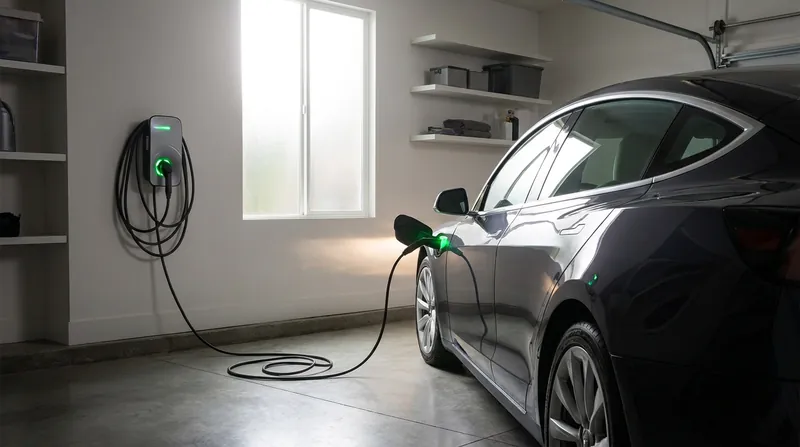
This thermal management system is why manufacturers advise owners to leave their vehicles plugged in during extreme weather, even if the battery is already charged. When plugged into a Level 2 home charger, the vehicle can draw power directly from the electrical grid to run the BTMS, actively cooling or warming the battery to keep it in the Goldilocks zone without draining the car's stored range.
The critical role of temperature also explains the data surrounding DC fast charging. Level 3 fast chargers, which can pump electricity into a vehicle at rates exceeding 100 to 350 kilowatts, are essential for cross-country travel. However, forcing that much electrical current into the battery pack in a matter of minutes generates immense thermal friction. If the BTMS cannot dissipate the heat fast enough, localized hot spots can form within the cells.[1]
The Geotab telematics report quantified this impact clearly. Vehicles that habitually relied on high-power DC fast charging for more than 12 percent of their charging sessions experienced an accelerated degradation rate of up to 3.0 percent per year—roughly double the rate of vehicles that primarily used slower, cooler AC Level 2 charging. While occasional fast charging on road trips is perfectly safe, treating a supercharger like a daily gas station will measurably shorten the battery's life.[1][3]
Cold weather presents a different set of challenges, though it is generally less destructive than heat. Freezing temperatures increase the viscosity of the battery's electrolyte, slowing down the movement of lithium ions. This results in a temporary loss of driving range and power output, but it does not cause permanent chemical degradation. The danger in winter only arises if an owner attempts to fast-charge a freezing battery.[4]
Forcing high current into a cold battery can cause "lithium plating," a condition where lithium ions pile up on the surface of the anode rather than absorbing into it, permanently killing capacity and creating safety risks. To prevent this, modern EVs use a feature called preconditioning. When a driver navigates to a fast charger in the winter, the vehicle automatically uses its heating system to warm the battery pack to the optimal temperature before arrival, ensuring it can safely accept the high-voltage charge.
To prevent this, modern EVs use a feature called preconditioning.
Ultimately, maximizing an electric vehicle's lifespan requires a shift in ownership mentality. Instead of adhering to a schedule of mechanical maintenance and fluid replacements, EV longevity is dictated by daily software habits. By setting an 80 percent charge limit, prioritizing slow home charging, and letting the vehicle's thermal management system do its job, drivers can ensure their battery packs deliver reliable, emission-free miles for decades.[4]
Key terms
- State of Charge (SOC)
- The current energy level of a battery, expressed as a percentage, similar to a traditional fuel gauge.
- Degradation
- The gradual, irreversible loss of a battery's ability to hold a charge and deliver power over time.
- Battery Thermal Management System (BTMS)
- An active liquid cooling and heating system that circulates fluid through the battery pack to maintain an optimal operating temperature.
- DC Fast Charging
- High-power commercial charging (Level 3) that delivers direct current straight to the battery, allowing for rapid top-ups but generating significant heat.
- Solid Electrolyte Interphase (SEI)
- A protective chemical layer that forms inside the battery; its continuous thickening over time is the primary cause of age-related capacity loss.
- Preconditioning
- The process of using grid power to actively warm or cool the battery to its ideal temperature before driving or fast charging.
Reader questions
Should I charge my EV to 100 percent every night?
No. For daily driving, it is best to limit your charge to 80 percent to reduce chemical stress on the battery. Reserve 100 percent charges for long road trips.
Does fast charging damage the battery?
Occasional use is perfectly safe, but habitual use of high-power DC fast chargers can double the annual degradation rate due to the intense heat generated.
What happens to the battery in freezing weather?
Cold weather temporarily reduces your driving range because the chemical reactions slow down, but it does not cause permanent degradation unless you attempt to fast-charge a freezing battery.
Will I eventually need to replace my EV battery?
It is highly unlikely. Telematics data shows modern EV batteries are designed to last 15 to 20 years, often outlasting the vehicle's chassis and suspension.
Where opinion splits
Fleet Data Analysts
Focus on the macro-level telematics and real-world performance data.
For fleet managers and data scientists, the conversation around EV batteries has shifted from anxiety to optimization. By analyzing millions of miles of telematics data, organizations like Geotab have proven that catastrophic battery failure is statistically negligible. Their data shows that degradation is highly predictable and generally slower than consumers fear, making electric vehicles financially viable for long-term commercial use. They emphasize that while fast charging does increase wear, the baseline durability of modern packs provides a massive buffer.
Battery Chemists & Engineers
Focus on the micro-level physics and the critical importance of thermal management.
Researchers at national laboratories and thermal engineering firms view battery longevity as a battle against unwanted chemical reactions. They focus on the physical mechanisms of aging, such as the thickening of the SEI layer and the dangers of lithium plating. From their perspective, the battery cell itself is only as good as the thermal management system surrounding it. They argue that the future of EV longevity relies on advanced liquid cooling architectures and predictive software that can actively manage cell temperatures down to the degree.
Automakers & Consumer Advocates
Focus on translating complex battery science into simple, automated software habits.
For vehicle manufacturers and consumer advocates, the goal is to abstract the complex chemistry away from the driver. They recognize that consumers do not want to think about SEI layers or lithium plating; they just want their cars to work. Therefore, this camp focuses on software automation—such as default 80 percent charge limits and automatic preconditioning—to enforce best practices without requiring technical knowledge. Their message is simple: plug the car in, let the software manage the heat, and drive without range anxiety.
- Fleet Data Analysts
- Focus on real-world telematics and aggregate data to prove that EV batteries reliably outlast their warranties.
- Battery Chemists & Engineers
- Focus on the physical mechanisms of aging, emphasizing the critical role of thermal management and chemical stability.
- Automakers & Consumer Advocates
- Focus on translating complex battery science into simple, automated software habits for everyday vehicle owners.
Perspectives this story doesn't cover
- Independent EV Repair Shops
- Used EV Dealerships
Sources
Source coverage
4 outlets
3 viewpoints surfaced




- [1]GeotabFleet Data Analysts
How long do electric vehicle batteries really last? The updated guide to real-world EV battery health
Read on Geotab → - [2]Car and DriverAutomakers & Consumer Advocates
How Long Does an Electric Car Battery Last?
Read on Car and Driver → - [3]Electric AutonomyFleet Data Analysts
Geotab's 2026 report on EV battery degradation is good news for fleet owners
Read on Electric Autonomy → - [4]Factlen Editorial TeamAutomakers & Consumer Advocates
Synthesis by Factlen editorial team
Read on Factlen Editorial Team →
More in Automotive & Transportation
See all →EV Ownership
The Ultimate Guide to EV Maintenance: What Actually Breaks and How to Prevent It
4 sources
Right to Repair
House Committee Advances Federal REPAIR Act, Mandating Automaker Access to Vehicle Data for Independent Shops
6 sources

AV Safety Data
US Senators Demand NHTSA Review of Autonomous Vehicle Safety Claims Amid Data Transparency Push
3 sources
Right to Repair
House Committee Advances 'Right to Repair' Bill, But Critics Say It Fails to Address Modern Telematics Data Lockout
6 sources
Comments
Every angle. Every day.
Get Automotive & Transportation stories with full source coverage and perspective breakdowns, free every day.