
Supreme Court Blocks Federal Order, Reinstating Missouri's 2022 Congressional Map
The U.S. Supreme Court temporarily blocked a federal judge's order that would have required Missouri to use a Republican-drawn 2025 congressional map, ensuring the state will use its 2022 district boundaries for the November midterm elections.

- Referendum Advocates
- Argue that citizens have a constitutional right to veto legislative redistricting through a statewide vote.
- State Republican Leadership
- Argue that mid-election map changes violate the Elections Clause and disenfranchise primary voters.
Perspectives this story doesn't cover
- Local election administrators tasked with implementing the sudden district changes.
- Voters in the 5th Congressional District whose representation was directly contested.
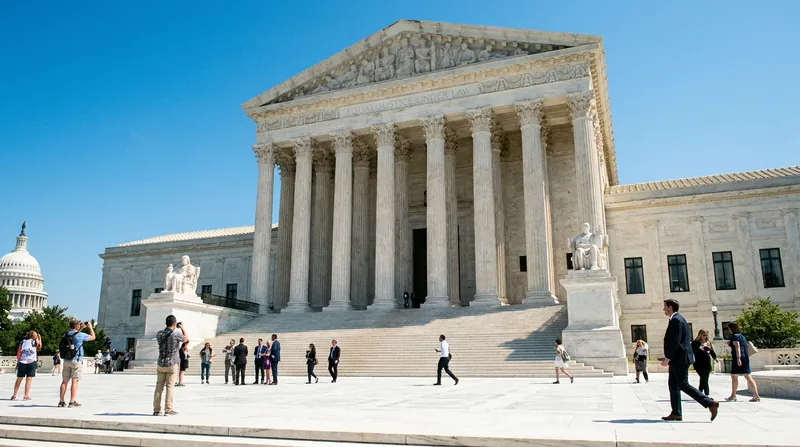
The United States Supreme Court has temporarily blocked a federal judge's order that would have required Missouri to use a newly drawn, Republican-backed congressional map for the November 2026 midterm elections. The unsigned emergency order, issued Thursday with no noted dissents, ensures that the state will conduct its general election using the older district boundaries established in 2022.[1]
The justices' intervention resolves a direct conflict between the state and federal judiciaries that had left Missouri election officials with contradictory instructions less than two months before Election Day. By staying the federal order, the Supreme Court deferred to a prior ruling by the Missouri Supreme Court, which had concluded that the new map never legally took effect because it is currently the subject of a citizen-led veto referendum.[2][6]
The dispute centers on House Bill 1, a redistricting measure passed by the Republican-controlled Missouri General Assembly in September 2025. The legislation was part of a broader mid-decade redistricting push encouraged by President Donald Trump, aimed at expanding the Republican Party's narrow majority in the U.S. House of Representatives.[5]
House Bill 1 specifically targeted Missouri's 5th Congressional District, a Kansas City-based seat held by Democratic Representative Emanuel Cleaver since 2005. The new boundaries dismantled the urban district, dispersing its Democratic-leaning voters into three neighboring, predominantly rural Republican districts. The reconfiguration was designed to shift Missouri's congressional delegation from its current 6-2 Republican advantage to a 7-1 split.[3][7]
In response to the legislation, a coalition known as People Not Politicians organized a statewide petition drive to subject the new map to a veto referendum. The group submitted more than 300,000 signatures in December 2025—well above the threshold required by the Missouri Constitution to place the measure on the ballot and suspend the law until voters could weigh in.[4][6]
However, Missouri Secretary of State Denny Hoskins declined to certify the petition, arguing that the state constitution's referendum provisions do not apply to congressional redistricting legislation. Hoskins delayed his formal rejection until August 4, 2026—the same day Missouri held its primary elections using the newly drawn 2025 boundaries.[1][3]
Hoskins delayed his formal rejection until August 4, 2026—the same day Missouri held its primary elections using the newly drawn 2025 boundaries.
The rejection triggered immediate litigation in state court. On September 3, the Missouri Supreme Court unanimously reversed Hoskins' decision, ruling that the referendum petition was "legal, sufficient, and timely." The state justices ordered the measure placed on the November 3 ballot as Proposition A and explicitly barred election officials from using the 2025 map, declaring that it "is not the law and has never been the law."[4][7]
Seeking to preserve the new boundaries, Missouri Attorney General Catherine Hanaway filed an emergency application with the U.S. Supreme Court, asking the justices to stay the state court's ruling. On September 8, Justice Brett Kavanaugh, who handles emergency matters arising from the Eighth Circuit, denied the state's request without referring it to the full court, effectively leaving the Missouri Supreme Court's injunction in place.[2]
Minutes after Kavanaugh's denial, the legal landscape fractured. Chief U.S. District Judge Stephen Clark, a Trump appointee presiding in St. Louis, issued a temporary restraining order in a separate federal lawsuit brought by Republican Representative Bob Onder and state Senator Rick Brattin. Clark's order prohibited Hoskins from using any map other than the 2025 boundaries for the November election.[3][6]
In his 13-page ruling, Clark reasoned that because Missouri had already conducted its August primaries under the 2025 map, reverting to the 2022 boundaries for the general election would violate the U.S. Constitution's Elections Clause and Equal Protection Clause. He argued that switching districts would "wreak havoc on the fairness and orderliness" of the election, potentially forcing voters to choose among candidates they had no role in nominating.[5][6]
Clark's order placed Secretary of State Hoskins under conflicting mandates: a state supreme court order forbidding the use of the 2025 map, and a federal court order requiring it. Hoskins promptly directed local election authorities to proceed with the 2025 map, prompting the Missouri Supreme Court to schedule a contempt hearing against him.[1][7]
Meanwhile, People Not Politicians appealed Clark's temporary restraining order to the Eighth U.S. Circuit Court of Appeals. On September 9, a panel of appellate judges denied the group's request for an immediate stay, stating that they either lacked jurisdiction over the temporary order or that the criteria for a stay had not been met.[3][6]
The coalition then filed a second emergency application with the U.S. Supreme Court, asking the justices to suspend the federal judge's order. This time, Justice Kavanaugh referred the matter to the full court. On September 10, the justices granted the application, staying Clark's order pending the disposition of the appeal in the Eighth Circuit.[2][4]
The Supreme Court's intervention definitively ends the immediate standoff, ensuring that the 2022 congressional map will govern the November 3 election. While the underlying federal litigation continues, the stay removes the 2025 map from contention for the current cycle, preserving Representative Cleaver's district and leaving the ultimate fate of the redistricting legislation to Missouri voters.[1]
Key points
- The U.S. Supreme Court stayed a federal judge's order that mandated Missouri use a 2025 congressional map.
- The ruling ensures Missouri will conduct its November elections using the older 2022 district boundaries.
- The 2025 map was designed to dismantle the Kansas City-based 5th District and shift the state's delegation to a 7-1 Republican advantage.
- The Missouri Supreme Court previously suspended the 2025 map after citizens gathered 300,000 signatures for a veto referendum.
- Voters will decide the ultimate fate of the 2025 map via Proposition A on the November 3 ballot.
Key terms
- Veto Referendum
- A process allowed by the Missouri Constitution that lets citizens collect signatures to suspend a newly passed law and place it on the ballot for voter approval or rejection.
- Elections Clause
- A provision in the U.S. Constitution that grants state legislatures the authority to prescribe the times, places, and manner of holding congressional elections.
- Temporary Restraining Order (TRO)
- A short-term emergency court order issued to prevent an action from occurring until a full legal hearing can take place.
- Equal Protection Clause
- A clause in the Fourteenth Amendment of the U.S. Constitution that requires states to govern impartially, ensuring individuals are treated equally under the law.
Sources
Source coverage
7 outlets
2 viewpoints surfaced







- [1]PBS NewsHour
Supreme Court again rejects push to use Trump-backed congressional map in Missouri
Read on PBS NewsHour → - [2]CBS NewsState Republican Leadership
Supreme Court temporarily blocks Missouri from using new congressional map
Read on CBS News → - [3]KCURState Republican Leadership
U.S. Supreme Court effectively throws out Trump-backed Missouri congressional map
Read on KCUR → - [4]Campaign Legal CenterReferendum Advocates
U.S. Supreme Court Blocks Use of Missouri’s Gerrymandered Congressional Map
Read on Campaign Legal Center → - [5]The Guardian
US supreme court again rejects Missouri maps drawn to boost Republicans in midterms
Read on The Guardian → - [6]Law CommentaryState Republican Leadership
Supreme Court Blocks Missouri's New Congressional Map Weeks Before Midterm Election
Read on Law Commentary → - [7]Democracy DocketReferendum Advocates
U.S. Supreme Court Blocks Missouri’s Gerrymandered Congressional Map
Read on Democracy Docket →
Comments
More in Law & Justice
See all →Constitutional Avoidance
How the Ashwander Rules Force Federal Courts to Avoid Constitutional Rulings
7 sources
Intellectual Property
Evaluating Utility Patents and Trade Secrets for Software Algorithms
7 sources

Federal Hiring
Federal Judge Blocks Administration's 'Loyalty Question' for Civil Service Applicants
6 sources

Diplomatic Corps
DOJ Declares Foreign Service Grievance Board Unconstitutional, Shifts Final Authority to Secretary of State
3 sources
Every angle. Every day.
Get Law & Justice stories with full source coverage and perspective breakdowns delivered to your inbox.